eBook - ePub
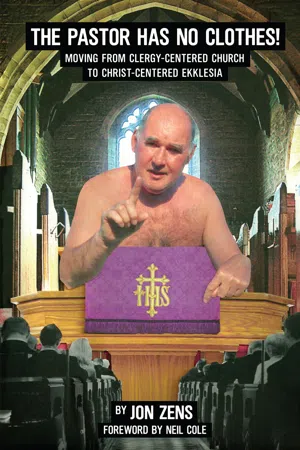
The Pastor Has No Clothes
Moving from Clergy-Centered Church to Christ Centered Ekklesia
- English
- ePUB (mobile friendly)
- Available on iOS & Android
eBook - ePub
Trusted by 375,005 students
Access to over 1.5 million titles for a fair monthly price.
Study more efficiently using our study tools.
Information
Topic
Theology & ReligionSubtopic
Christian ChurchTHE PASTOR HAS NO CLOTHES!
“THE BODY IS NOT ONE PART...” (1 CORINTHIANS 12:14A) WE’VE MADE “CHURCH” REST ON ONE PERSON
In 1 Corinthians 12, Paul discussed the metaphoric reality that there is only one body of Christ, but that this body has many parts with each individual part benefiting the entire Spiritual body (v. 7). In order for any composite or physical body (made up of differing, interrelated components) to be healthy — especially the spiritual body of Christ — all the parts must be functioning.
Is it any wonder that the body of Christ is so sick? The too-common daily dysfunctional picture that we portray to a watching world comes down to this: the inception, growth, health and future of the church rests entirely on the shoulders of one person — the pastor. We make “church” dependent on one part, and thereby have flatly contradicted Paul’s inspired observation that “the body is not one part.”
Is that an exaggeration? I don’t think so. Listen to what those who advocate and defend a one-pastor system say about the centrality of “the pastor” and his pulpit:
>> The pastor has the “master role” in “an occupation distinguished from the occupational role of other persons” (Samuel W. Blizzard, Princeton Theological Seminary, quoted in Neurotics in the Church, Robert James St. Clair, Revell, 1963, p. 24).
>> “Eight ways to view pastoral leadership as the primary ministry in the church” (Description of lead article, “Pastor For Life,” Ministry, July/August, 2010, p. 3).
>> “The local church pastor is key — absolutely central — to everything we are and do as a church. It’s a truth that’s been expressed so many times that perhaps it’s acquired the air of a cliché. But, nevertheless, it expresses reality” (Jan Paulsen, “A Message of Appreciation,” Ministry, July/August, 2010, p. 4).
>> “The pastor is the leading officer of a congregation” (Reformed Presbyterian Book of Church Government, Chapter 4, paragraph 3, cited in the Covenanter Witness, August 30, 1972).
>> “The Pastor is a Gift to the Church…. he is a Pastor by divine ordination, altogether superior to any human planning…. The Pastor is the one who divides the truth to the flock, or assembly, over whom God hath appointed him” (I.M. Haldeman, How to Study the Bible, Revell, 1904, p. 396).
>> “I do not care for the term Chief Pastor. Possibly the direct article, ‘the’ pastor, ‘the’ bishop, ‘the’ elder, is sufficient designation for the pastor of any particular church, while other elders, pastors, bishops are simply referred to without the direct article (p. 12)…. I hold that a church, if it is large enough to afford and needs more than one pastor, must look upon one of these pastors as the pastor, the spokesman for the other pastors and for the church (p. 13)” (E.W. Johnson, Sovereign Grace Message, March, 1974).
>> “Such preaching plays a central part in pastoral work, for it is the main means by which the people of God are built up in faith (p. 72)…. It is through the preaching of the Word that the people of God will grow in their knowledge of God (p. 27)” (Herbert Carson, Hallelujah! Christian Worship, Evangelical Press, 1980).
>> “Much of what happens in our worship services is standardized” by the “ordained eldership.” “The worshipping congregation is to be actively involved in whatever happens in worship.” This can happen, the author suggests, by (1) taking notes during the sermon and (2) having an open Bible (Leonard J. Coppes, Are Five Points Enough? The Ten Points of Calvinism, Reformation Educational Foundation, 1980, p. 179).
>> “In its regular [church] life, the official ministry is central” to Puritan John Owen (p. 21). “Puritan attention when discussing gifts was dominated by their interest in the ordained ministry, and hence in those particular gifts, which qualify a man for ministerial office, and questions about other gifts to other persons were rarely raised (p. 15)” (J.I. Packer, “The Puritans & Spiritual Gifts,” “Profitable for Doctrine & Reproof” — The 1967 Westminster Papers).
>> “The core issue…is a need for the development of, and commitment to, a culture of viewing pastoral leadership as the primary ministry in the denomination’s structure” (Ivan C. Blake, “Pastor for Life,” Ministry, July/August, 2010, p. 8).
>> “Preaching is presented [in Rom. 10:14] as essential to evangelism and salvation…. The answer is found in v. 15, ‘How beautiful are the feet of those who preach the Gospel’ — the answer is a preacher” (Charles E. McLain, “The Centrality of Preaching,” Calvary Baptist Theological Journal, Fall, 1987, p. 22).
>> “The interest and value of worship, as conducted in most churches, depend chiefly on the pastor. The service is almost wholly led by him” (Hezekiah Harvey, The Pastor [1879], Backus Books, 1982, pp. 27-28).
>> Concerning tax breaks for the clergy: “In plain language, ‘If you are ordained, commissioned, or licensed and meet the following three tests, the IRS will generally consider you a minister. You: must administer the sacraments, conduct worship services, and perform services in the control, conduct, or maintenance of a church.’ David Epstein, a tax attorney and author on ‘clergy’ tax, while appearing as a guest a on ‘Money Matters’ radio broadcast stated that one would only have to meet the ordination or licensing requirement and any two of four other requirements: 1. That you lead religious worship. 2. That you administer the sacraments. 3. You have administrative or management functions. 4. Are considered a spiritual leader within your church.’ Other interpretations of the relative tax codes cause even greater concern: ‘To sustain self-employment status, a minister would need to convince the IRS that no one has right to control either the method or the means by which his ministry is conducted. This might also include the authority to unilaterally discontinue the regular service of a local church.’ In light of the word ‘unilateral’ and ‘his ministry’ certainly suggest that in order to qualify for this status, the ‘minister’ must be in total control of everything that goes on in the church. Whether that is the intended interpretation is not the point…. The IRS’s method for determining who qualifies as a ‘minister,’ therefore, is rooted less in legislative caprice than in the distorted church patterns from which the government has derived its rules and regulations” (Alan Allison, “Render Not Unto Caesar The Things That Are God’s,” Searching Together, 26:3-4, Fall-Winter, 1998).
>> “If you have a strong pulpit, you’re going to have a strong church, no matter if everything else is lacking…. Preaching has got to be there or people are not going to come” (Harold Ockenga, “Chairman of the Board,” Christianity Today, Nov. 6, 1981, p. 27).
>> “The government of the Church is Presbyterian: Ministers or teaching Elders are the highest officers, and among these there is perfect parity of power” (The Reformed Presbyterian Testimony, XXIII:3 cited in Blue Banner of Faith & Life, April-June, 1959, p. 98).
>> Regarding pastor John Smalley’s (1734-1820) entrance into the church building: “It was doubtless with assurance born of the reverence with which he was customarily regarded, that by stamping upon the meeting-house doorway floor Smalley made known to his congregation the moment of his arrival, so that members of importance might rise and make him their obeisance as he passed down the center aisle on Sabbath [Sunday] mornings” (Mary Latimer Gambrell, Ministerial Training in 18th Century New England, pp. 113-114).
>> “HOW TO ADDRESS A PASTOR…. The pastor should not be called by his first name…. At times first names can be fitting and appropriate, but not for your parents, nor for judges, not for law officers, nor for preachers. It is a matter of respect for the position and office. A pastor may be called Bishop, Elder, Pastor, or Brother…. How very true the statement, ‘Familiarity breeds contempt.’ Refraining from calling a Pastor by his first name does not mean he is more spiritual than his flock, but it does mean he holds the highest office in the church, namely that of God’s undershepherd, which demands respect, as seen in Hebrews 13:24” (Dan Cozart, Church Bulletin, Sovereign Grace Baptist Church, Tyler, Texas, January 8, 1989).
>> “If I sense a biblical pattern, you would find that the leadership is given to spiritual people who are to decide, to have the oversight of the church, and they lead from the front” (Haddon Robinson, “Power, Preaching & Priorities,” Leadership, 1:1, Winter, 1980, p. 16).
>> “What part of the body is the pastor? Is he not like the cerebellum, the center for communicating messages, coordinating functions, and conducting responses between the head and the body? …The pastor is not only the authoritative communicator of the truth from the Head to the Body, but he is also the accurate communicator of the needs from the Body to the Head” (David L. McKenna, “The Ministry’s Gordian Knot,” Leadership, 1:1, Winter, 1980, pp. 50-51).
>> “The final responsibility for decisions is that of the company commander [the pastor], and he must answer to the Commander-in-Chief…The Pastor has the power in a growing church…. The pastor of a growing church may appear to outsiders as a dictator, but to the people of the church, his decisions are their decisions” (C. Peter Wagner, Your Church Can Grow, Regal, 1987, pp. 66-67).
>> “I think the church today is very clergy-dominated. The ...
Table of contents
- FOREWORD
- INTRODUCTION
- PRELUDE
- THE PASTOR HAS NO CLOTHES!
- ROMANCING THE PASTORATE
- BUILDING UP THE BODY
- APPENDIX TO “BUILDING UP THE BODY”
- THE PASTOR
- THE “CLERGY/LAITY” DISTINCTION
- APPENDIX ONE
- APPENDIX TWO
- SOURCES
- AFTERWORD
- ACKNOWLEDGEMENTS
Frequently asked questions
Yes, you can cancel anytime from the Subscription tab in your account settings on the Perlego website. Your subscription will stay active until the end of your current billing period. Learn how to cancel your subscription
No, books cannot be downloaded as external files, such as PDFs, for use outside of Perlego. However, you can download books within the Perlego app for offline reading on mobile or tablet. Learn how to download books offline
Perlego offers two plans: Essential and Complete
- Essential is ideal for learners and professionals who enjoy exploring a wide range of subjects. Access the Essential Library with 800,000+ trusted titles and best-sellers across business, personal growth, and the humanities. Includes unlimited reading time and Standard Read Aloud voice.
- Complete: Perfect for advanced learners and researchers needing full, unrestricted access. Unlock 1.5M+ books across hundreds of subjects, including academic and specialized titles. The Complete Plan also includes advanced features like Premium Read Aloud and Research Assistant.
We are an online textbook subscription service, where you can get access to an entire online library for less than the price of a single book per month. With over 1.5 million books across 990+ topics, we’ve got you covered! Learn about our mission
Look out for the read-aloud symbol on your next book to see if you can listen to it. The read-aloud tool reads text aloud for you, highlighting the text as it is being read. You can pause it, speed it up and slow it down. Learn more about Read Aloud
Yes! You can use the Perlego app on both iOS and Android devices to read anytime, anywhere — even offline. Perfect for commutes or when you’re on the go.
Please note we cannot support devices running on iOS 13 and Android 7 or earlier. Learn more about using the app
Please note we cannot support devices running on iOS 13 and Android 7 or earlier. Learn more about using the app
Yes, you can access The Pastor Has No Clothes by Jon H. Zens in PDF and/or ePUB format, as well as other popular books in Theology & Religion & Christian Church. We have over 1.5 million books available in our catalogue for you to explore.