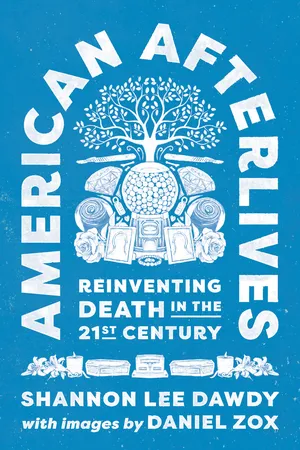
A mesmerizing trip across America to investigate the changing face of death in contemporary life
Death in the United States is undergoing a quiet revolution. You can have your body frozen, dissected, composted, dissolved, or tanned. Your family can incorporate your remains into jewelry, shotgun shells, paperweights, and artwork. Cremations have more than doubled, and DIY home funerals and green burials are on the rise. American Afterlives is Shannon Lee Dawdy's lyrical and compassionate account of changing death practices in America as people face their own mortality and search for a different kind of afterlife.
As an anthropologist and archaeologist, Dawdy knows that how a society treats its dead yields powerful clues about its beliefs and values. As someone who has experienced loss herself, she knows there is no way to tell this story without also reexamining her own views about death and dying. In this meditative and gently humorous book, Dawdy embarks on a transformative journey across the United States, talking to funeral directors, death-care entrepreneurs, designers, cemetery owners, death doulas, and ordinary people from all walks of life. What she discovers is that, by reinventing death, Americans are reworking their ideas about personhood, ritual, and connection across generations. She also confronts the seeming contradiction that American death is becoming at the same time more materialistic and more spiritual.
Written in conjunction with a documentary film project, American Afterlives features images by cinematographer Daniel Zox that provide their own testament to our rapidly changing attitudes toward death and the afterlife.
- 272 pages
- English
- ePUB (mobile friendly)
- Available on iOS & Android
eBook - ePub
About this book
Information
Publisher
Princeton University PressYear
2021Print ISBN
9780691254708
9780691210643
eBook ISBN
9780691228457
CHAPTER 1
The Hole
It was Halloween night in the French Quarter of New Orleans. Daniel, my collaborator and codirector, set up his camera on the sidewalk in front of a costume-wig shop, and the sound guy tested the boom mic. The wig shop was open late that night, busy with last-minute customers. As the sun began to set, couples and small groups of adult revelers, not yet drunk, started to stream past us. We were in the early, experimental stages of making a documentary film. We probably looked like a low-budget TV news crew. We were out to do “man in the street” interviews—or maybe witches, fairies, and unicorns in the street. Whomever we could find. I felt like a nervous streetwalker, propositioning strangers. I was dressed as some sort of vaguely gothic lady in a black corset—hardly the strangest person on the street—but some people crossed over and avoided us anyway. I assume the camera and lights were the scary bit. Others were game to talk.
Early in the evening, one young(?) man walking by on his own paused to humor us. He was dressed completely in black—a suit, tie, and matching trench coat. He had a piece of black hosiery pulled over his head, topped by a fedora. The Invisible Man. I have been told I have a habit of looking too intensely into people’s eyes when I talk to them. I passed my eyes like searchlights back and forth over his face, assessing its bumps and dents so I could make a reasonable guess about where his eyes were. Still, as we talked, I couldn’t tell if he was looking back at me just as intently or staring off toward a vanishing point just beyond my shoulder.
I warmed up by asking him to tell me his name and where he was from. Trevor talked fast and seemed uncannily prepared for my big question of the evening: “What do you want done with your body when you die?” Without a second’s hesitation, he replied, “I would like to figure out a way for me to legally just be put into a bayou. I don’t want a grave, I don’t want to be cremated. Just put my body in a bayou. Let it go back into the swamp.”1
When it comes to a ceremony, he said he wants to go straight to the wake, and to be present for it. He said that’s what they basically did for a friend of his who had recently died of cancer. They all came over to her house on her last weekend and cooked, talked, and played music before she said she was tired and went up to bed. Forever.
His voice cracked as he finished telling me about his friend. I could see wet spots spreading over his form-fitting mask, even darker than the obscuring cloth. Those eyes I couldn’t see started to weep. The invisible man was crying visible tears. I was moved to silence. All I could do was respect his sadness. He gathered himself. “But,” he said, “that’s how it should be.” I thanked him and let him go on his way, hoping he was headed for a party with lighter spirits. I didn’t get to my second question—“What do you think happens to us after we die?”
This exchange has stayed with me. It represents the task I have set for myself—to ask nearly impossible questions. And the risk. The risk that I will set off a chain of the most delicate reactions. A trauma, an anxiety, an unhealed grief—or that most universal of existential crises: Why are we here and what are we going to do about it? In that moment, I felt his grief. It echoed my own. We briefly connected in a way that violates the academic conceit that separates researcher and subject.

Ω Ω Ω
Between 2008 and 2013, I lost four people I loved in the span of five years, as if I had drifted too close to a black hole. That was when I started asking people what they thought happened to us after we died. And what they wanted the living to do with their bodies. A lot of them want to be burned, to go out in a glorious blaze. Fire terrifies me, but many people I talk to say that we are just stardust anyway.
Ω Ω Ω
I am not entirely certain that this book will be considered an anthropological one, much less an archaeological one, except that my profession gave me the arrogance to try to understand human experience by intruding into the private lives of others. But it’s the only book I could write. A conventional academic genre about American afterlives in the twenty-first century would not only blur vivid experiences that I am trying to bring into focus but, in the context of the most devastating pandemic to strike in one hundred years, be tactless. I need to honor those moments of connection that I felt with people like the Invisible Man. It would feel dishonest to disappear myself from the emotional events of fieldwork. I hate being photographed, so I do not appear in the camera frame during our interviews, but I will make myself visible here. I am not invisible.
It was a couple of years before that Halloween night in 2015 that I started to think about doing a research project on contemporary American death practices. It was my way of dealing with the loss of four loved ones in five years. Each of those deaths was different and felt different. Yet in each case, the body was cremated, and there were decisions made, and ceremonies created, to handle the ashes—scattering, burying, making them into jewelry and birdbaths, placing them in a biodegradable box destined for the river that ran through my childhood. Prior to that, I had never thought much about what happens after life, when the body takes an unrecognizable form as an inert shell, a biological and chemical assemblage on its way to morphing into something else. After the intense phases of grief had passed, I became interested in finding out more about what Americans were doing with the remains of their loved ones, and what this might say about their beliefs about who we are and what happens to us after death. Research for me is a form of emotional processing. I slowly began working on this project, first as a historical investigation and then, after I met filmmaker Daniel Zox, as a documentary film that would capture and complement what I was trying to get down on paper.
As I got deeper into the research, I realized that I had stumbled into a cultural field that was simultaneously falling apart and blossoming. Funeral director after funeral director that I talked to offered a version of what Stan, an entrepreneur who distributes novelty funeral paraphernalia, said to me in 2017: “There have been more changes in the funeral business in the last ten years than in the last hundred.”
To this day, the most influential book ever written on the American death scene is British journalist Jessica Mitford’s 1963 exposé The American Way of Death. Through investigative work in Southern California that retraced some of novelist Evelyn Waugh’s steps in The Loved One, Mitford documented the ways in which the American funeral industry had standardized a rite of passage and professionalized what used to be a form of family care. She described, and decried, a distinctly American funeral complex characterized by the popularization of embalming, the open casket, fancy caskets, and expensive vault burials. This “tradition” had developed in the 1880s and spread through diverse urban and rural communities in the United States, becoming fully entrenched by the 1920s. In Mitford’s view, the American death complex that came to dominate the twentieth century amounted to a big con job. Like Waugh, she thought that embalming reflected American optimism gone haywire—that it expressed a denial that death happens at all.2 It’s time for an update.
Jessica Mitford still haunts funeral directors today. Poet-mortician Thomas Lynch, in his 1997 memoir The Undertaking, felt a need to exorcise her ghost, objecting to her claim that “fussing over the dead body” was “barbaric,” when, in fact, an embalmer could undo some of the psychic damage inflicted by a more barbaric murderer, citing a horrific case he was called to work on early in his career. As I read his defense of “the dismal trade,” it occurred to me that people in other countries may not be as familiar with death by homicide. Perhaps the repair work of embalming and restoration offers precisely the kind of death ritual that a violent society needs.3
The United States is also a strongly capitalist society. While Mitford seemed to think that no one should ever make a profit from death, she herself viewed death rituals with a cold, calculating instrumentalist logic. She advocated strongly for low-cost “direct cremation,” in which you pick up your loved one’s ashes at the crematory in a cardboard box—eliminating the funeral director, whom she viewed as an unnecessary middleman between life and death. In her strong opinion, fussing over the dead was unseemly. It was as if American death offended her British sense of propriety. In my interviews, I have found that funeral directors are still trying to respond to Mitford’s critique. Many of the nonprofessionals I spoke to uttered some trickle-down version of it. They don’t want any fuss. They don’t want to take up any space. They don’t want to leave a financial burden. Her ideas have seeped through much of American society and encouraged the transition to cremation. That transition, though, was going slowly until about the year 2000, when it began to explode. Between 2000 and 2015, the US cremation rate doubled, and now nearly 60 percent of all Americans choose this “disposition” of the body (as it is called).4
Not only are bodies being treated differently, more people are sidestepping the traditional funeral and inventing rituals of their own. Religious traditions long governed the disposition of the dead, but they are losing their monopoly. Most faiths have become more open to variation in funeral rites, while many Americans now define their beliefs about the human spirit in a highly individualized way, independent of organized religion. In the twenty-first century, death is being reinvented in the United States on three levels simultaneously—the disposition of human remains, new rituals, and ideas about the afterlife.
There has been a tendency to view Western death culture as ordinary, shallow, secular. Contemporary funeral practices were presumed by many scholars to be boring and profane, sanitized and standardized. Today these generalizations are untenable. Contemporary American death culture might be confusing in its innovations and pluralism, but it could not be said to be boring. Even before the Covid-19 pandemic, death was “having a moment” in the public sphere. You can mix your loved one’s ashes into a vinyl record that plays a recording of their voice. You can live on through a software program timed to send messages to your family from the beyond. You can have your body frozen, incinerated, buried in a redwood grove, plastinated, dissected for science, or dissolved in chemicals. Soon, you can be composted in a steaming pile of wood chips on an urban lot. Your family can take some of your cremated remains and incorporate them into jewelry, artificial reefs, or paperweights. It is increasingly acceptable not only to personally handle the corpse but to continue to live with a piece of it long after the end of biological life. And it’s becoming more acceptable (or once again acceptable) to talk to the dead, to celebrate their birthdays, or to leave a bottle of beer on their grave.5
American Afterlives explores rapidly changing death practices in the twenty-first-century United States. It asks: What does the changing face of death tell us about American beliefs and values at this historical juncture? Between 2015 and 2020, I traveled the United States from Vermont to California, Illinois to Alabama, talking to funeral directors, death-care entrepreneurs, designers, cemetery owners, and death doulas about the changes they are seeing and in many cases promoting. I also spoke to people on the street, like Trevor, who were willing to entertain my almost-taboo questions: What do you think happens to us after we die? And what do you want done with your body?
This book’s premise derives from a long tradition of mortuary archaeology: material evidence of how a society treats its dead can yield powerful clues about that society’s values, beliefs, and day-to-day life.6 This reading of material clues represents a grandiose type of forensics, like Sherlock Holmes reading the psychology of criminals in the cigar ashes they accidentally left behind. Unlike Holmes, an archaeologist can never be entirely certain that they have read the evidence correctly. This book makes no claims that the interpretations offered are the only ones, nor does it offer a complete survey of all that is happening in death care. My focus is on human remains—what is being done with them and what people think and feel about them. Another horizon of big change, both in the United States and internationally, is digital death practices, from video-conferenced funerals to online memorials and several forms of virtual afterlife. These developments have been well studied by others, and fall outside my scope.7 Rather, I’m interested in material afterlives. I take an archaeological approach to contemporary life that uses ethnographic interviews to zero in on the ways in which people relate to objects and landscapes. Traditional archaeologists have to make educated guesses about what artifactual evidence means, but doing a mortuary excavation of the present gives me the advantage of asking people on the ground what they think is going on with the changing face of American death. They aren’t always real sure either. We fumbled through our questions and answers together. This work is the result of a collaborative dialogue between me and dozens of interlocutors about still-emerging phenomena. Its findings are necessarily speculative but not unfounded. Only after sifting through our conversations and putting patterns into historical context, did I start to have those “aha!” moments that give me the courage of explanation. The conclusions I have come to, and will share in the pages that follow, are more profound and moving than I ever anticipated.
The five years of research that inform this book involved tracking down people who are innovators in death care, or who had professional opinions about where things are going and why. I followed hunches and word-of-mouth suggestions. In extended interviews, often with the same person over a period of time, I collected stories about the individual’s life and work and sought to understand the contexts and events that informed their death work. I did not gather opinion surveys or statistical data. That type of information doesn’t get you very far in trying to understand why people do the things they do. While some readers may find some of the new death options I describe here outlandish, my intent is not to entertain or to shock. My anthropological orientation means that I want to get a sense of collective trends and shared concerns while staying alert for disagreements, diversity, and undercurrents. I could have written a different book focused entirely on the most spectacular, tabloid-worthy death rituals involving celebrities, or John Doe getting buried in his Cadillac (thus making him a posthumous celebrity). But that would give the wrong impression that the new death options I am interested in are eccentricities rather than meaningful cultural practices. I also did not look at medical donation or cryonics, because these represent less than 1 percent of dispositions in the United States. The vast majority of Americans are buried or cremated. Even though I met some colorful characters on this journey,...
Table of contents
- Cover
- Frontispiece
- Title Page
- Copyright
- Dedication
- Contents
- List of Images
- Preface
- Acknowledgments
- Chapter 1. The Hole
- Chapter 2. Flesh
- Chapter 3. Bones
- Chapter 4. Dirt
- Chapter 5. Spirit
- Epilogue
- Notes
- References
- Index
Trusted by 375,005 students
Access to over 1.5 million titles for a fair monthly price.
Study more efficiently using our study tools.
Frequently asked questions
Yes, you can cancel anytime from the Subscription tab in your account settings on the Perlego website. Your subscription will stay active until the end of your current billing period. Learn how to cancel your subscription
No, books cannot be downloaded as external files, such as PDFs, for use outside of Perlego. However, you can download books within the Perlego app for offline reading on mobile or tablet. Learn how to download books offline
We are an online textbook subscription service, where you can get access to an entire online library for less than the price of a single book per month. With over 1.5 million books across 990+ topics, we’ve got you covered! Learn about our mission
Look out for the read-aloud symbol on your next book to see if you can listen to it. The read-aloud tool reads text aloud for you, highlighting the text as it is being read. You can pause it, speed it up and slow it down. Learn more about Read Aloud
Yes! You can use the Perlego app on both iOS and Android devices to read anytime, anywhere — even offline. Perfect for commutes or when you’re on the go.
Please note we cannot support devices running on iOS 13 and Android 7 or earlier. Learn more about using the app
Please note we cannot support devices running on iOS 13 and Android 7 or earlier. Learn more about using the app
Yes, you can access American Afterlives by Shannon Lee Dawdy in PDF and/or ePUB format, as well as other popular books in Social Sciences & Cultural & Social Anthropology. We have over 1.5 million books available in our catalogue for you to explore.