How literature of the British imperial world contended with the social and environmental consequences of industrial mining
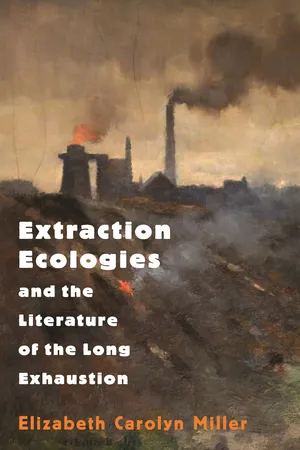
The 1830s to the 1930s saw the rise of large-scale industrial mining in the British imperial world. Elizabeth Carolyn Miller examines how literature of this era reckoned with a new vision of civilization where humans are dependent on finite, nonrenewable stores of earthly resources, and traces how the threatening horizon of resource exhaustion worked its way into narrative form.
Britain was the first nation to transition to industry based on fossil fuels, which put its novelists and other writers in the remarkable position of mediating the emergence of extraction-based life. Miller looks at works like Hard Times, The Mill on the Floss, and Sons and Lovers, showing how the provincial realist novel’s longstanding reliance on marriage and inheritance plots transforms against the backdrop of exhaustion to withhold the promise of reproductive futurity. She explores how adventure stories like Treasure Island and Heart of Darkness reorient fictional space toward the resource frontier. And she shows how utopian and fantasy works like “Sultana’s Dream,” The Time Machine, and The Hobbit offer imaginative ways of envisioning energy beyond extractivism.
This illuminating book reveals how an era marked by violent mineral resource rushes gave rise to literary forms and genres that extend extractivism as a mode of environmental understanding.
- 288 pages
- English
- ePUB (mobile friendly)
- Available on iOS & Android
eBook - ePub
Extraction Ecologies and the Literature of the Long Exhaustion
About this book
Information
Publisher
Princeton University PressYear
2021Print ISBN
9780691205533
9780691205267
eBook ISBN
9780691230559
CHAPTER ONE
Drill, Baby, Drill
EXTRACTION ECOLOGIES, FUTURITY, AND THE PROVINCIAL REALIST NOVEL
“The conditions of production are at the same time the conditions of reproduction.”KARL MARX, CAPITAL, VOLUME 1 (1867), 711“What elegant historian would neglect a striking opportunity for pointing out that his heroes did not foresee the history of the world, or even their own actions? … Here is a mine of truth, which, however vigorously it may be worked, is likely to outlast our coal.”GEORGE ELIOT, MIDDLEMARCH (1871), 61
A NITROGLYCERINE ADVERTISEMENT in the 4 January 1868 issue of the Mining Journal boasts, “The EXPLOSIVE FORCE of this BLASTING OIL is TEN TIMES that of GUNPOWDER, and the ECONOMY and SAVING in TIME, LABOUR, and COST in removing granite and hard rock, in sinking shafts, driving tunnels, and opening forward in close ends is immense” (13) (see figure 1.1). Mining, drilling, and extraction accelerated exponentially under the global force of industrialism, transforming the face of the earth, but also, as this advertisement suggests, the face of the clock. The regime of industrial extraction was variously said to speed up time or to save time, to make the future from the past or the present from the future. Indeed, as this chapter will discuss, extractivism occasioned a complex chronological alchemy, where metals, minerals, and coal proved capable of changing the experience of time and transforming ideas of futurity.1 This new sense of time was born of the perception that future human life could not continue to be sustained by the stock of nonrenewable resources that powered industrial society. In the above epigraph from Middlemarch, Eliot refers to the failures of human foresight as “a mine of truth … likely to outlast our coal” (61); the use of this metaphor in a landmark novel like Middlemarch attests to the role of literature in mediating extractivism’s new horizons of exhausted and uncertain futurity.

FIGURE 1.1. Advertisement from the Mining Journal, 4 January 1868, 13.
This chapter focuses on provincial realist novels set in places of mineral extraction: the sacrifice zones of Britain and its empire, where industrial terraforming pulverized the land, casting up at least as much waste and damage as it did treasure. Understanding provincial realism as the genre that best theorizes “quasi-removal” (Plotz, “Provincial Novel” 369) allows us to see the significance of these texts within imperial, capitalist, and ecological systems, for the regions depicted in these novels provided the mineral material to power British growth.2 As discussed in the introduction, all forms of industrial extraction surged with the steam engine, and extraction begot extraction. Coal-fired engines were required to drain mines of all kinds and were used for boring and for processing ore; steam-powered railways transported mined materials on an industrial scale. But while the project of industrial extraction was a major source of wealth in this era of global mineral rushes, it was also understood to be a temporary bonanza that would not last. Geologists and political economists varied in their estimates of when coal exhaustion and other kinds of mineral exhaustion would occur, but the timescale was short enough to be understood generationally. This was a new view of the issue, as Louis Simonin explains in his 1868 text Mines and Miners: “The duration of the coal-fields, which was formerly estimated by geologists at thousands of years … will, perhaps, not exceed a few hundred years” (263). This widespread conclusion led to a new understanding of industrial life in the present as occurring at the expense of future human generations—a situation familiar enough today, though for different reasons. A question this chapter will begin to frame, one that hangs over the book as a whole, is whether we have been acclimated to the horrors of climate change and the potentially uninhabitable future it portends by two centuries of extraction-based life premised on a model of depletion to which we have become accustomed.3
Britain’s national discourse on mineral exhaustion cannot be said to have begun in the nineteenth century, but it seems to have taken form around the time of the invention of the steam engine and took some years to enter widely into discourse. One of the earliest writers to address the subject was John Williams, in The Natural History of the Mineral Kingdom (first published in 1789), who expressed “not the smallest doubt that the generality of the inhabitants of Great Britain believe that our coal mines are inexhaustible” (159). While Williams felt “a strong reluctance against sounding the alarm” (160), he believed that “silence would be unpardonable” (161), for the question of exhaustion has “never been considered in this light, nor has any person, public or private, to the best of my knowledge, ever taken the trouble to make a fair representation of this matter” (170–71), despite the fact that “the commerce, wealth, importance, glory, and happiness of Great Britain will decay and gradually dwindle away to nothing, in proportion as our coal and other mines fail” (172–73).
The idea that modern existence was now fully reliant on coal, and thus reliant on the depletion of the coal supply available for future generations, made for a profound shift in ideas of time and futurity—a shift that occurred with the rise of industrial extraction. Indeed, a British government cabinet report from 1903 made the case that the problem went beyond coal and was symptomatic of the whole extractive industry: “coal is an exhaustible product of the earth which cannot be replaced by labour.… If it is true of coal, it is true of iron ore, which is believed to be much nearer exhaustion than coal.… It must also be true of … the entire metal industries—lead, copper, brass, tin, also of all bye-products” (Fiscal Problem 24). Seen in this light, the basis of industrial society appeared to be so much sand slipping through the hourglass, and political economists pointed, meanwhile, to sharply increasing rates of coal consumption. Faced with such circumstances, Simonin wrote, “the question naturally arises as to the time when the coal-fields will be exhausted, and as to the nature of the fuel which will replace coal after its total exhaustion—a double problem such as has never been presented until now during the history of the world” (262). This new horizon of exhaustion was difficult to conceptualize, but the provincial realist novel proved to be one genre where mineral exhaustion’s “slow causality,” to use Tina Young Choi and Barbara Leckie’s phrase, could be imaginatively worked out.4 Rather than pointing definitively toward a future end point and collapse, provincial novels set in extraction zones often posit instead an unknown future, an undead future, a future of diminishing returns that recedes as we move toward it. This new future changed the character of the present, for it meant a daily existence bereft of the cyclical comforts of a continuing natural system.
The temporal structures of provincial realist novels set in extraction landscapes convey a growing sense that an extraction-based society is no longer tethered to the seasonal rhythms of the living earth, and they convey a new conception of futurity imbued with the realization that Britain and its empire are now reliant on an industrial system powered by a nonrenewable, diminishing stock of resources. They challenge novelistic forms premised on the human life cycle, like the bildungsroman, or the seasons of the year, like the pastoral, and move instead toward an exhausted future that will not have grown from the past but will have been drained by it. As the steam engine and other industrial technologies were transforming the scale of resource extraction, achieving new dimensions of depth and new heights of production, cultural discourse around exhaustion, supply, futurity, and decline reached a new stage as well and leached into the endings, trajectories, and temporalities of that most characteristic literary form of the industrial era: the realist novel.
REPRODUCTIVE FUTURITY AND EXTRACTION CAPITALISM
After an overview of the major terms of my argument, focusing on reproductive futurity and extractive exhaustion, this chapter will take up five provincial realist novels set in landscapes of extraction: Joseph Conrad’s Nostromo (1904), George Eliot’s The Mill on the Floss (1860), Fanny Mayne’s Jane Rutherford: or, The Miners’ Strike (1854), Charles Dickens’s Hard Times (1854), and D. H. Lawrence’s Sons and Lovers (1913). All five depart from the conventions of the marriage plot—or at least from the assurances of reproductive futurity that typically accompany this plot—and their collective deviation from chrononormativity, to use Elizabeth Freeman’s word, reflects the new understanding, which accompanied the rise of fossil-fueled capitalism, of an extraction-based life claimed at the expense of future generations.5 Echoing extractivism’s scrambling of temporal norms, I have structured my reading of these texts against chrononormativity and have arranged the novels that serve as my case studies not chronologically but according to their primary mineral resource: first the novels of silver and ironstone, then, a more common formation, three novels of the coal-fields.
Let me clarify, first, that my use of the “ ‘no future’ paradigm,” as Macarena Gómez-Barris has called it (144), draws on the work of postcolonial and feminist critics focused on environmental justice rather than the work of Lee Edelman, whose No Future: Queer Theory and the Death Drive (2004) is better known in literary studies. Edelman’s critique of reproductive futurity made a key intervention into US queer theory but does not easily scale out to an analysis of global or transspecies justice, nor translate readily into such domains as Indigenous or environmental justice critique, which are often animated by a sense of ethical obligation to future life—human and nonhuman alike. As Neel Ahuja has argued, the climate crisis asks us to think “more broadly about reproduction than Edelman does, recognizing that bodies and atmospheres reproduce through complex forms of socio-ecological entanglement” (368).6 Viewed in this light, all humans are engaged in reproductive processes, whether they realize it or not, as well as activities that interfere with reproductive processes. Indeed, given ongoing rates of species extinction and climate-related threats to precarious human communities, we are now witnessing what Ahuja describes as a “staggering scale of ‘reproductive failure,’ human and nonhuman” (370). I seek to address reproductive futurity from this broad environmental standpoint, even as I look to marriage and reproduction plots as the provincial novel’s formal conventions for imagining the future of earthly life and its continuance.7
Central to my argument is a cross-historical parallel between the “no future” paradigm of the nineteenth and early twentieth century (resource exhaustion) and the “no future” paradigm of today (climate change). Resource exhaustion did not turn out to be the fatal flaw of fossil-fueled industrialism that many nineteenth- and early-twentieth-century thinkers predicted, but it did occasion early reflection on the unsustainability of this mode of ecological relations. Gómez-Barris locates extraction capitalism at the heart of what she calls the “ ‘no future’ paradigm” (144), and in her recent analysis of South American extraction regimes and the social movements opposed to them, she contrasts the “ ‘no future’ model that is extractive capitalism” (34) with the growing movement toward “transgenerational stewardship” (48), visible, for example, in recent South American legal frameworks that grant “rights to future generations” (27). Gómez-Barris situates her argument squarely within queer feminist thought yet maintains that any “critique of reproductive futures has to be balanced against the historical weight” of eugenics and anti-Indigenous policies, which have sought to fix Indigenous peoples in the past and deny their claims on the future (145). Similarly, Maristella Svampa describes how resistance to extraction regimes in South America has built on a “strengthening of ancestral struggles for land by indigenous and campesino movements,” movements that encompass “the defense of the common, biodiversity, and the environment” (68). The framework of ancestral and multigenerational collectivity has in this instance enabled a powerful critique of extraction capitalism and its inequities across generations. Thea Riofrancos, too, has discussed the success of the anti-extraction movement in Ecuador in achieving a legal basis for an expanded notion of territory “as a space of cultural and ecological reproduction” (“Extractivismo” 287).
Ecofeminist critics focused on North America have similarly emphasized reproductive futurity writ large—a global, transspecies affair—as a key component of environmental justice. Indeed, given that the human communities most threatened by climate change are communities of color, many recognize an urgent need to insist on this point in the interest of racial justice as well as transspecies justice. Naomi Klein, drawing on the work of Indigenous feminists, has posited an environmental “right to regenerate” as “the very antithesis of extractivism, which is based on the premise that life can be drained indefinitely” (This 442). Despite significant differences, recent work by Donna Haraway can also be situated alongside this argument; Haraway’s call to “Make Kin Not Babies” (5–6) asserts the need for a reduction in human reproduction, but Haraway makes this call in the name of humans and other species who face an uncertain future in these “times of burning and extraction called the Anthropocene” (90). Earth’s growing human numbers, she says, “cannot be borne without immense damage to human and nonhuman beings” (208). Her work thus shares a goal of ensuring a future for ongoing generations of earthly creatures, though she insists on the ethical gains of “staying with the trouble” and “learning to be truly present” (1).
In my view, learning to be present will also require attending to the past, for the present is long, extending backward into the historical circumstances that produced it and the narrative and discursive formations with which we confront it. The complex, many-sided environmental crisis we face today, whose scope we are still struggling to grasp, presents pressing hazards such as climate change and air, water, and soil pollution that have material and formal connections to the extraction ecologies that emerged with the Industrial Revolution. The geographies of present-day extraction capitalism are also an extension of the past: today’s large-scale extraction projects are often relegated to Indigenous lands or so-called developing nations, making large profits for international corporations and little for the regions being exploited.8 Attending to our present crisis and its uneven burdens also means attending to the conditions that produced this situation, conditions that are recorded, mediated, and, at times, reproduced within the archive of literature.
The provincial realist novels under discussion here all appeared in an era of accelerating imperial extraction; while most are set in England, one is set in South America, for the provincial backwater and the extraterritorial backwater were both targets for sacrifice and exploitation.9 (My focus turns more squarely to the colonial frontier in chapter 2.) That these novels share features of setting as well as temporality, or, more specifically, that provincial realist novels set in extraction zones defy conventional novelistic temporalities and futurities, suggests that they express what M. M. Bakhtin has called a “chronotope,” the “intrinsic connectedness of temporal and spatial relationships that are artistically expressed in literature” (84). While the concept of the chronotope is key to all the extraction literature I will discuss in this study, my understanding of the particular chronotope of the provincial novel is more finely tuned than Bakhtin’s and more historically situated. Bakhtin reads the provincial novel as a “family-labor, agricultural or craft-work idyll” that conveys “the uninterrupted, age-old link between the life of generations and a str...
Table of contents
- Cover
- Title Page
- Copyright
- Dedication
- Contents
- List of Illustrations
- Acknowledgments
- Introduction
- Chapter 1: Drill, Baby, Drill: Extraction Ecologies, Futurity, and the Provincial Realist Novel
- Chapter 2: Down and Out: Adventure Narrative, Extraction, and the Resource Frontier
- Chapter 3: Worldbuilding Meets Terraforming: Energy, Extraction, and Speculative Fiction
- Conclusion
- Notes
- Works Cited
- Index
Trusted by 375,005 students
Access to over 1.5 million titles for a fair monthly price.
Study more efficiently using our study tools.
Frequently asked questions
Yes, you can cancel anytime from the Subscription tab in your account settings on the Perlego website. Your subscription will stay active until the end of your current billing period. Learn how to cancel your subscription
No, books cannot be downloaded as external files, such as PDFs, for use outside of Perlego. However, you can download books within the Perlego app for offline reading on mobile or tablet. Learn how to download books offline
Perlego offers two plans: Essential and Complete
- Essential is ideal for learners and professionals who enjoy exploring a wide range of subjects. Access the Essential Library with 800,000+ trusted titles and best-sellers across business, personal growth, and the humanities. Includes unlimited reading time and Standard Read Aloud voice.
- Complete: Perfect for advanced learners and researchers needing full, unrestricted access. Unlock 1.5M+ books across hundreds of subjects, including academic and specialized titles. The Complete Plan also includes advanced features like Premium Read Aloud and Research Assistant.
We are an online textbook subscription service, where you can get access to an entire online library for less than the price of a single book per month. With over 1.5 million books across 990+ topics, we’ve got you covered! Learn about our mission
Look out for the read-aloud symbol on your next book to see if you can listen to it. The read-aloud tool reads text aloud for you, highlighting the text as it is being read. You can pause it, speed it up and slow it down. Learn more about Read Aloud
Yes! You can use the Perlego app on both iOS and Android devices to read anytime, anywhere — even offline. Perfect for commutes or when you’re on the go.
Please note we cannot support devices running on iOS 13 and Android 7 or earlier. Learn more about using the app
Please note we cannot support devices running on iOS 13 and Android 7 or earlier. Learn more about using the app
Yes, you can access Extraction Ecologies and the Literature of the Long Exhaustion by Elizabeth Carolyn Miller in PDF and/or ePUB format, as well as other popular books in Literature & Modern British History. We have over 1.5 million books available in our catalogue for you to explore.