eBook - ePub
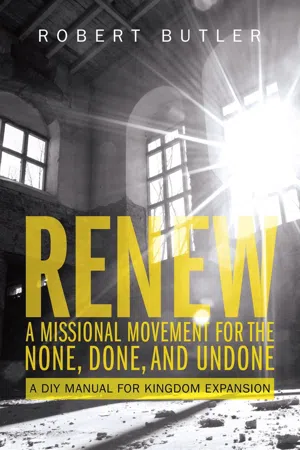
Renew: A Missional Movement for the None, Done, and Undone
A DIY Manual for Kingdom Expansion
- English
- ePUB (mobile friendly)
- Available on iOS & Android
eBook - ePub
Renew: A Missional Movement for the None, Done, and Undone
A DIY Manual for Kingdom Expansion
Information
Topic
Theology & ReligionSubtopic
Mental Health in PsychologyCHAPTER 1
MISSIO DEI
Renewing relationships begins when His mission reshapes our desire and prepares us for a better one alongside Him.
Every year since 1950, people have decided to leave the dominant faith in America. The interesting point is that they are not publicly changing their faith. It’s not a priority or value anymore. I often wonder why some people go to church or temple or the mosque while others don’t or won’t? I’ve heard people say:
- People are busier these days.
- There are more family activities on the weekends.
- There are children’s sports on the weekends.
- We only get two days off, so why would I want to spend it in church?
- I get more out of reading my Bible alone than I do going to a church.
- I commune better with God when I’m in nature.
- The local church seems more concerned with ancillary issues than fostering my relationship with God.
All these comments are real for some and excuses for others. However, my point is that the riddle of why people don’t value coming together never gets solved.
The Jesus I read about was about introducing others to His Dad. He was about relationship. He spent extensive amounts of time with God. He humbled Himself to be a servant. He modeled it for three years with twelve apprentices. He took them everywhere and showed them everything they would need to know before they asked. He demonstrated that love in action equals relationship. It was the type of relationship that stimulated a desire to know more in the hopes of encountering a living God.
Missio Dei means “the mission of God”. Many believe this is the story behind the story. God’s will for us all is that all would come to know Him. The word “know” is not just information. It recognizes our need to grow in our understanding and experience of the relationship, so we can discern when and where to get involved. An involvement that puts into play the two greatest commands (love God and love others) so the people around us will open their hearts to the possibilities that God’s love has for them.
What does it mean to love someone? The Greeks had multiple words for love, but in English we have “love.” As a result, songwriters have struggled with this topic for years. Love is just too hard to define. However, one thing is for certain, love is the cornerstone of every good relationship. It’s as true for the people you meet, as the God you revere.
The larger question is how we can best live “love” as a lifestyle. Discovering this is what RENEW is all about.
We can never give away what we do not have. If you are good relationally today, you are an anomaly. It is the most critical aspect of being successful and yet so many are terrible at being in a relationship with others. We’re not talking about being an extrovert or an introvert. We are referring to the ability to demonstrate love for another in a way they feel valued, known and heard. Social media is a great advancement in the use of technology. It’s useful for keeping connected to those in your social circles, but it doesn’t foster authentic relationships or personal growth, unless you consider emojis a growth area. Rarely does a person share their most intimate thoughts online. They share what they want the world to hear or see. The motives behind a post or picture or video are fascinating, but you will never discover the truth about an individual without first talking with them, belly button to belly button. Trust is hard to develop electronically. We can argue about the power of teleconferencing but ask a person to close a multi-million-dollar deal over SKYPE or ZOOM and my point will be made. Trust is formed when people gather. The most precious aspects of any of our lives require us to be in relationship.
RENEW is founded on the vision that to discover a life worth living, you must first be in relationship with both God and others. Once either relationship begins, the authentic and compassionate nature of human beings fosters a greater understanding of the world around us.
Everything we do at RENEW is about fostering growing relationships. We gather around a table to eat because it lowers the barrier to interaction with others. We provide topic cards for an easy opening. We then move into a time we’ve called the “experience” so people can get themselves centered in the peace, joy and hope of this life. We offer music, art and a story to help everyone begin to think more critically before we break out into smaller affinity discussion groups. The experience is also about diffusing the tension of the world and infusing an everyday topic with a spiritual twist through the intersection of a spiritual and physical consideration. The final component is service. We encourage each person who comes to RENEW to serve somewhere. It could be the neighbor down the block, the local mission or another not-for-profit. We recognize God works in these areas every day. He fosters our relationship with Him in these times and helps us to continue the expansion of our relationships, so others might discover a life through living as well.
It really is the most basic of concepts. It’s easy to say and far more difficult to follow through because, inevitably, if it’s of God there will come a time when it gets hard. This is not a bad omen but a realistic one. It’s the moment the flesh (our will) begins to fight against God’s will. This is not the time to disconnect. These are the moments to walk in faith. As the folks in recovery say, “don’t quit before the miracle happens.” In the same sense, don’t stop the renewing of your heart, mind, soul and strength when the near future looks tough. This is when the real renewal begins because it reshapes your desire or prepares you for a better one.
The group discussion guide for this topic is in Appendix A on page 342.
CHAPTER 2
UNCONDITIONAL LOVE
Loving God and others is an action of perpetual creation
What does it mean to love someone, something or some activity?
It can’t all be the same. I can’t love chocolate the same way I love my son. I can’t love lifting weights the same way I love serving others. I can’t love getting every green light on the way to work the same way I love hearing my wife laugh. I can’t love the smells of a beautiful summer morning the same way I love a clean car. It just doesn’t seem right.
The Greeks had multiple words for love, but in English we just have “love.” Song writers have struggled with this topic for years. I think it’s because when we hear the word “love,” we get so tangled up in emotions, we are not sure what to make of the word. As the saying goes, “Love is many splendored thing” with “many” being the focal point. Love is just too hard to define within our language. However, one thing is for certain, love is the cornerstone of every good relationship. It’s as true for the people you meet, as the God you revere.
I have a confession to make. When I was in my teens and my twenties, I walked away from God. I believed the Billy Joel song, “Only the good die young.” I believed all those people going to a church building were fools. I believed the media when they used Karl Marx’s famous statement, “religion is the opiate of the masses” as a rallying cry that I was smarter than the average bear.1 I knew if I could just plan better, work harder and catch a few breaks, I would succeed in life. I believed by living this way, the “cosmic baker” would bless whatever I did. It wasn’t until I ran so hard that I crashed and burned that I saw the flaws in my philosophy of life.
The soul searching that followed pushed me to answer the question, “If I’m not in control, who is and why are we here?” If you want to talk about a journey, try pondering that question for a while without alcohol or drugs. There are a lot of ideas in the world. However, the one which made the most sense at the time was, “God is love.” It was a simple concept with huge ramifications that grew over time.t
Now, there are many through the ages who have wrestled with the statement, “God is love.” I was even listening to a Christian radio program recently whereby a teacher/preacher was not happy with this proclamation. He was convinced this statement, like Marx’s, was actually a half-truth. A deadly half-truth that God would disagree with and he went on to prove his point using scripture. I wondered as I drove if the person on the radio had ever really loved anyone unconditionally. You see, I believe deep, unconditional love can give us a glimpse of God’s love for each of us.
I’ll never forget when my son was small. I was watching him at our home when I turned my back for a minute. I heard a horn honking in the street. I turned to see my son in the street with his nose a few inches from a car bumper. I ran, grabbed him and put him on the driveway, waved to the neighbor and then swatted his rear. I didn’t hit him hard enough to hurt him. But I surely scared him and me. I will never forget his look. I then got down on my knees and explained how much I loved him and why it scared me so. It was revolutionary to learn love includes discipline, obedience, sacrifice and even consequences when we reject the love being offered. The Christian understanding of God builds this into its teaching from its primary source, the Bible. It’s a love story — but not a sappy love story they make into a movie that your wife or girlfriend makes you go to on date night. It’s a real story of a God so confident, perfect, just and loving, that He creates a world out of love, creates plants, animals and yes, even humans. He then watches us fail, like a loving parent watching his youngest learn to ride a bike without training wheels. And then when we fall, he comes to each of us and provides for us out of love.
I want to share with you a little snippet of scripture which has profound implications for all of our faith journeys. It comes from the Bible and it’s written by a guy named Mark. Mark was an interesting guy who wrote the facts, and just the facts, as he could remember them of his friend Jesus. Listen to this …
28 One of the teachers of the law came and heard them debating. Noticing that Jesus had given them a good answer, he asked him, “Of all the commandments, which is the most important?” 29 “The most important one,” answered Jesus, “is this: ‘Hear, O Israel: The Lord our God, the Lord is one. 30 Love the Lord your God with all your heart and with all your soul and with all your mind and with all your strength.’31 The second is this: ‘Love your neighbor as yourself.’ There is no commandment greater than these.” 32 “Well said, teacher,” the man replied. “You are right in saying that God is one and there is no other but him. 33 To love him with all your heart, with all your understanding and with all your strength, and to love your neighbor as yourself is more important than all burnt offerings and sacrifices.” 34 When Jesus saw that he had answered wisely, he said to him, “You are not far from the Kingdom of God.” And from then on no one dared ask him any more questions. Mark 12:29-34 (NIV)
Now, there is a lot in this passage. I want to add some background, so you see this. The Jewish leaders of this era didn’t like Jesus or want to believe He was the Messiah. Sure, they were praying He would come for a number of years, but Jesus didn’t fit the bill. They believed an all-powerful God would come and free them from oppression and choose them to run the joint. Since Jesus didn’t have the right lineage (or so they thought), they discounted Him and just like the whistleblower at the office or a cancer in the body, they wanted Him gone. They proceeded to try to catch him in lie or stating something foolish, so they could discredit Him. It’s kind of like our political candidates when they are interviewed. The press asks a question so they can make a headline. The only difference between today’s pundits and those of Jesus’ time is the question carried more cultural clout. The questions in this text are coming from the community’s spiritual leaders.
Jesus is asked by the community leaders, “What’s the greatest commandment?” This was always a “talk show” debate back in the day. People would call into radio stations to talk about it. The Roman comedians of the day would joke about it. However, Jesus was not amused. He shared from the core Jewish teaching, the Shema — words no good Jew would ever forget. They repeated them twice a day. They were the words spoken by God to Moses, so as Jesus answers, you can see every Jew nodding, including the cultural leaders.
The scripture then really pinpoints the Pharisee and Scribe’s arrogance, “you are right.” I mean, really think about that for a second. The scribe is telling Jesus he got the answer right. Jesus?! The one that more than a billion people claim was God in the flesh? But when I dig a little deeper, we all do the same thing. When God does what we like, we claim he gets it right. But when God doesn’t do what we want, we begin to think God must be the one who is wrong. The reality is, we all have a God problem.
We all do it. Truth and confession time: I have been angry at God before. He didn’t answer the prayer. He didn’t keep me from temptation. In James 1:13-14, “When tempted, no one should say, ‘God is tempting me.’ For God cannot be tempted by evil, nor does he tempt anyone; but each person is tempted when they are dragged away by their own evil desire and enticed.” He tells us God will not keep us from temptation. He didn’t stop the tragedy. He didn’t hear my cries. I developed resentment and you want to know what he did? He watched as I...
Table of contents
- COVER
- ENDORSEMENTS
- TITLE
- COPYRIGHT
- CONTENTS
- RENEW: A MOVEMENT FOR A BROKEN ECCLESIA
- FOREWORD
- INTRODUCTION
- 1. MISSIO DEI
- 2. UNCONDITIONAL LOVE
- 3. FATHER
- 4. PRAYER
- 5. WILL OF GOD
- 6. SOCIETY
- 7. DEFECTS OF CHARACTER
- 8. TEMPTATION
- 9. POLITICS
- 10. THE CHURCH
- 11. ENEMIES
- 12. RENEWABLE FORGIVENESS
- 13. ERROR
- 14. UNBELIEF
- 15. FRIENDSHIPS
- 16. MARRIAGE
- 17. FAMILY
- 18. WOMEN
- 19. WRATH
- 20. RICHES
- 21. POVERTY
- 22. GIVING TO MAN
- 23. GIVING TO GOD
- 24. WAR
- 25. NON-RESISTANCE/BOUNDARIES
- 26. RIGHTS
- 27. CHARACTER
- 28. DEATH
- 29. LOVE
- 30. WORK
- 31. TEACHING
- 32. DISEASE
- 33. KINGDOM OF HEAVEN
- 34. HELL
- 35. FALSEHOOD
- 36. JUDGEMENT
- 37. FAITH
- 38. SACRIFICE
- 39. HOLY SPIRIT
- 40. PLEASURE
- 41. PURPOSE OF LIFE
- 42. JESUS
- 43. MORAL IDEAS
- 44. GOOD NEWS
- 45. THE SUPERNATURAL
- 46. TECHNOLOGY
- 47. SEX
- 48. IDOLS
- 49. CULTS
- 50. KINDNESS
- 51. VIOLENCE
- 52. COMPLACENCY
- APPENDIX A : DISCUSSION GUIDE QUESTIONS
Trusted by 375,005 students
Access to over 1.5 million titles for a fair monthly price.
Study more efficiently using our study tools.
Frequently asked questions
Yes, you can cancel anytime from the Subscription tab in your account settings on the Perlego website. Your subscription will stay active until the end of your current billing period. Learn how to cancel your subscription
No, books cannot be downloaded as external files, such as PDFs, for use outside of Perlego. However, you can download books within the Perlego app for offline reading on mobile or tablet. Learn how to download books offline
Perlego offers two plans: Essential and Complete
- Essential is ideal for learners and professionals who enjoy exploring a wide range of subjects. Access the Essential Library with 800,000+ trusted titles and best-sellers across business, personal growth, and the humanities. Includes unlimited reading time and Standard Read Aloud voice.
- Complete: Perfect for advanced learners and researchers needing full, unrestricted access. Unlock 1.5M+ books across hundreds of subjects, including academic and specialized titles. The Complete Plan also includes advanced features like Premium Read Aloud and Research Assistant.
We are an online textbook subscription service, where you can get access to an entire online library for less than the price of a single book per month. With over 1.5 million books across 990+ topics, we’ve got you covered! Learn about our mission
Look out for the read-aloud symbol on your next book to see if you can listen to it. The read-aloud tool reads text aloud for you, highlighting the text as it is being read. You can pause it, speed it up and slow it down. Learn more about Read Aloud
Yes! You can use the Perlego app on both iOS and Android devices to read anytime, anywhere — even offline. Perfect for commutes or when you’re on the go.
Please note we cannot support devices running on iOS 13 and Android 7 or earlier. Learn more about using the app
Please note we cannot support devices running on iOS 13 and Android 7 or earlier. Learn more about using the app
Yes, you can access Renew: A Missional Movement for the None, Done, and Undone by Robert Butler in PDF and/or ePUB format, as well as other popular books in Theology & Religion & Mental Health in Psychology. We have over 1.5 million books available in our catalogue for you to explore.