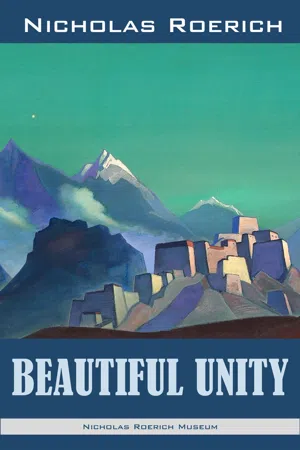
eBook - ePub
Beautiful Unity
Information
Topic
ArtSubtopic
Artist MonographsARMOR OF LIGHT
I REMEMBER how Puvis de Chavannes always found a sincere, benevolent word for the most different creations. But I cannot forget how another famous artist used to go around all exhibitions but with the foam of bitter criticism that he defamed. I noticed that he spent about three-quarters of an hour on abuse and only a quarter of an hour on rejoicing. Taking leave of the artist, I said, “I know how to make you stay longer—with things that are detestable to you!” And the abuse of this artist was most refined, but his praise very poor and dry. Of course, in his creativeness Puvis de Chavannes was far higher. Did not the benevolent criticism of Puvis originate because of his greater creative ability?
Why disparage and act maliciously where a general enthusiasm and a general joy of creativeness have been ordained?
Since time immemorial innumerable are the commandments about the beautiful. Whole kingdoms, whole civilizations were built by this great ordainment. To beautify, to ennoble, to uplift life means to reside in the good. All understanding and all forgiveness and love and self-denial are generated in the attainment of creativeness.
And should not all young hearts strive for creativeness? And so they do; and plenty of ashes of vulgarity are required to choke this sacred flame! How often can one open new gates to the beautiful by the single call, “Create, create”! How much decrepitude is expressed in the fossilized program: First, I shall learn to draw; then, I shall go over to colors; and after this, I shall try to start composition. Innumerable are the cases when the flame of the heart was extinguished before the pupil reached the forbidden gates of creativeness! But how much joy, daring, and vigilance is developed in the consciousness of those who from their childhood dared to create! How enticingly attractive can children’s composition be before their eyes and hearts become hardened by the all-deadening conditions of standard!
Where are the conditions of creativeness? In the genius, in the imperative tremor of the heart, which calls forth constructiveness. The earthly conditions are of no importance for the creator who has been called. Neither time, nor place, nor material can limit this impulse of creativeness. “Even if imprisoned, an artist will become an artist,” was one of the sayings of my teacher, Kuindzhi. But he also used to say, “If you have to be kept under a glass cover, then the sooner you disappear the better! Life has no need for such touch-me-nots.” He understood well the significance of the battle of life, the battle of light and darkness. A small clerk came to the teacher; the latter praised his work, but the clerk complained: “Family and office stand in the way of my work.”
“How many hours do you spend in the office?” asked the artist.
“From ten to five.”
“And what are you doing from four to ten?”
“What do you mean, from four to ten?”
“Yes, from four in the morning?”
“But I sleep.”
“Well, then you will spend your whole life sleeping. When I worked as a retoucher with a photographer, our work was from ten to six; but the whole morning from four to nine, I had at my own disposal. And to become an artist, even four hours per day are sufficient.”
Thus said the venerable master Kuindzhi, who, beginning as a shepherd boy, through labor and unfolding of his talent reached an honorable place in the art of Russia. Not harshness but knowledge of the laws of life suggested to him his replies, full of realization of his responsibility, full of consciousness of labor and creativeness.
The main thing is to avoid everything abstract. It does not exist in the actuality just as emptiness does not exist. Every recollection of Kuindzhi, of his teachership, both in the art of painting and in the art of life, always brings to memory unforgettable details. How necessary are these milestones of experience when they bear witness of tested valor and of actual constructiveness!
I remember, how after my graduation at the Imperial Academy of Arts, the Imperial Society for the Encouragement of the Arts invited me to become assistant editor of their periodical. My colleagues were indignant at such a combination of activities, and prophesied the end of my art. But Kuindzhi firmly advised me to accept the appointment, saying: “A busy person succeeds in everything. An open eye perceives everything. But for a blind man to paint is anyhow impossible.” I remember how Kuindzhi once criticized my painting The March. But half an hour later he returned short of breath, having run up to the studio, and said smilingly, “You must not be grieved. The ways of art are innumerable. The main thing is that the song comes right from the heart.”
Another teacher of mine, Puvis de Chavannes, who was full of well-wishing and inexhaustible creativeness, always called with profound wisdom for the labor, self-expression, and joy of the heart. Love for humanity and the joy of creativeness were not dead in him, but one will remember that his first steps were not encouraged. For eleven years his paintings were not accepted by the Salon. This was a hard testing-stone for the greatness of the heart!
My third teacher, Cormon, always encouraged me to individual, independent work, saying: “We become artists when we remain alone by ourselves.’
Blessed are the teachers when they lead with a benevolent, experienced hand toward wide horizons. It is a great happiness when one can remember one’s teachers with the full tremor of a loving heart.
The teachership of old India, the deep conception of Guru—teacher—is especially touching and inspiring. Yes, it is inspiring to see how a free, conscious veneration for the teacher existed until today. Verily, it forms one of the basic beauties of India. No doubt the same conception existed also among the old masters of Italy, and the Netherlands, and among Russian icon painters. But in these countries it is already a beauty of the past; whereas in India, it is living and will not die out, I hope.
Every spiritual impoverishment is shameful. From the subtler worlds the great masters are watching sorrowfully, grieving over the folly of impeded possibilities. In the articles “Spiritual Values,” “Revaluation,” and “Flame—the Transmuter,” we spoke sufficiently about everything that should not be lost at the crossroads. I cannot forget the deep saying of my deceased friend, the poet Alexander Block, about the ineffable. Block ceased to frequent the Religious Philosophical Society because, as he expressed himself, “They speak there of the unspeakable.” Precisely, there is a limit to words; but there is no limit to feelings, to the capacity of the heart. Everywhere is the beautiful. All pilgrims of the good, all sincere searchers landed at this coast. People may quarrel ever so much and may even become like beasts, but still they will unitedly be silenced at the sound of a mighty symphony and will desist from all quarrels in a museum or under the dome of the Notre-Dame in Paris.
The same love of the heart is evoked when we read in all ordainments the lightnings of beauty.
The Persian apocrypha about Christ is most touching: “When Christ was walking along with his disciples, they came across the carcass of a dead dog, lying near the roadside. The disciples turned away in disgust from the decaying corpse. But the teacher found beauty in this instance and pointed out the beautiful white teeth of the dog.”
At the hour of passing, Buddha the Lord remembered: “How beautiful is Rajagriha and the cliff of the vulture! Beautiful are the valleys and the mountains. Vaishali! What a beauty!”
Every Bodhisattva, besides all his other abilities, has to also be perfect in art.
The Rabbi Gamaliel says: “The study of the law is a noble work if connected with some art. This occupation, which is accompanied by art, leads away from sin. But every occupation that is not accompanied by art leads nowhere.” And the Rabbi Jehuda adds, “He who does not teach his son art, makes of him a highway robber.” Spinoza, who reached considerable perfection in art, answered indeed to this ordainment of harmonization and ennoblement of the spirit.
Of course, the high ordainments of India also affirm the same basic significance of creative art. “In ancient India, art, religion, science were synonymous with Vidya, viz., culture.” “Satyam, Shivam, Sundaram are the eternally triune manifestation of godhood in man—immutable, blissful, and beautiful.”
Let us remember the Museion—the home of the Muses—of Pythagoras, Plato, and all those great ones who understood the cornerstones of the foundations of life, and Plotinus—speaking on the beautiful!
From the depths of hard experiences of life, Dostoevsky exclaims, “Beauty will save the world!” Ruskin, who glorifies the stones of the past, reiterates the same. A well-known head of the church looking at paintings, exclaimed, “A prayer of earth to Heaven!”
The old friend of all creative searchers, Leonardo da Vinci, says:
“He who despises the art of painting, thus despises a philosophic and refined conception of the universe, because the art of painting is the daughter, or rather grandchild of Nature. Everything that exists was born from Nature and has borne, in its turn, the science of painting. This is why I say that painting is the grandchild of Nature and relative of God. He who blasphemes the art of painting, blasphemes Nature.
“The painter must be all-embracing. O artist, may thy multiformity be as infinite as the manifestations of Nature. Continuing what God has commenced, strive to multiply not the deeds of human hands but the eternal creations of God. Never imitate anyone. And every creation of thine, be a new manifestation of Nature!”
The “stubborn sternness” of Leonardo da Vinci—was it not strengthened by the clear joy for the far-off worlds, by the firm prayer of the heart for Infinity?
How many of the best personalities affirmed the prayer of the heart, the prayer for beauty, for the beauty of creativeness, for victories of Light! From all lands in all ages, many affirm the significance of creativeness as the leading principle of life. Ancient monuments retain glorious images of Egypt, India, Assyria, Maya, and China; and are not the treasures of Greece, Italy, France, Belgium, and Germany living witnesses of the significance of highest creativeness?
How wonderful that, even now, amid all spiritual and material crises, we can affirm the kingdom of the beautiful! And we can do this, not as abstract idealists but armed with the experience of life and strengthened by all historical examples and spiritual ordainments.
Remembering the significance of creativeness, humanity must also remember the language of the heart. Are not the parables of Solomon, the Psalms, the Bhagavad Gita, and all fiery commandments of the hermits of Sinai written in this language? How precious it is to realize that all ordainments lead not to division, this limitation, and not to savagery but to the ascent, the strengthening, and purification of the spirit!
Dr. Brinton reminded me that when leaving America in 1930, I told him, ‘‘Beware of the barbarians.” Since then many barbarians have broken into the domain of culture. Under the sign of financial depression many irremediable crimes have been committed within the wall of the spirit. The list of dark oppressors, like tablets of shame, has indelibly been recorded on charts of education and enlightenment. Uncultured retrogrades hastened to destroy and uproot much in the field of education, science, and art! Shame, shame! Chicago has no funds to pay the municipal teachers. A church in New York has been sold in auction. In Kansas City, the capitol has been sold in the same way. And how many museums and schools have been closed! And how many hardworking men of science and art have been thrown overboard! Yet the horse races were visited by fifty thousand people! Shame, shame! The stones of ancient monuments can cry out agai...
Table of contents
- FOREWORD
- BEAUTIFUL UNITY
- RENAISSANCE
- REALIZATION OF THE BEAUTIFUL
- THE BEAUTIFUL
- TREASURE OF THE HOME
- GURU—THE TEACHER
- CULTURAL UNITY
- ADAMANT
- THE ETERNAL GARMENT
- UNITY
- THE BEAUTIFUL VICTORY
- CREDO
- ARMOR OF LIGHT
- CREATORS
Trusted by 375,005 students
Access to over 1.5 million titles for a fair monthly price.
Study more efficiently using our study tools.
Frequently asked questions
Yes, you can cancel anytime from the Subscription tab in your account settings on the Perlego website. Your subscription will stay active until the end of your current billing period. Learn how to cancel your subscription
No, books cannot be downloaded as external files, such as PDFs, for use outside of Perlego. However, you can download books within the Perlego app for offline reading on mobile or tablet. Learn how to download books offline
Perlego offers two plans: Essential and Complete
- Essential is ideal for learners and professionals who enjoy exploring a wide range of subjects. Access the Essential Library with 800,000+ trusted titles and best-sellers across business, personal growth, and the humanities. Includes unlimited reading time and Standard Read Aloud voice.
- Complete: Perfect for advanced learners and researchers needing full, unrestricted access. Unlock 1.5M+ books across hundreds of subjects, including academic and specialized titles. The Complete Plan also includes advanced features like Premium Read Aloud and Research Assistant.
We are an online textbook subscription service, where you can get access to an entire online library for less than the price of a single book per month. With over 1.5 million books across 990+ topics, we’ve got you covered! Learn about our mission
Look out for the read-aloud symbol on your next book to see if you can listen to it. The read-aloud tool reads text aloud for you, highlighting the text as it is being read. You can pause it, speed it up and slow it down. Learn more about Read Aloud
Yes! You can use the Perlego app on both iOS and Android devices to read anytime, anywhere — even offline. Perfect for commutes or when you’re on the go.
Please note we cannot support devices running on iOS 13 and Android 7 or earlier. Learn more about using the app
Please note we cannot support devices running on iOS 13 and Android 7 or earlier. Learn more about using the app
Yes, you can access Beautiful Unity by Nicholas Roerich in PDF and/or ePUB format, as well as other popular books in Art & Artist Monographs. We have over 1.5 million books available in our catalogue for you to explore.