- 389 pages
- English
- ePUB (mobile friendly)
- Available on iOS & Android
eBook - ePub
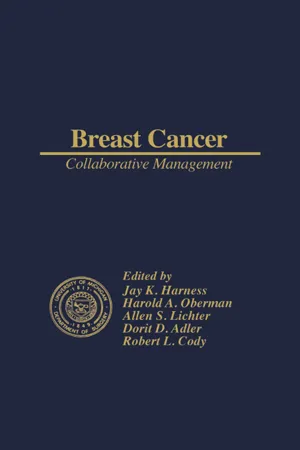
Breast Cancer Collaborative Management
About this book
Prominent specialists champion the view that contemporary management of breast, or any, cancer requires the partnership of physicians, nurses, social workers, and all others whose special training and talents should be integrated for treating the whole patient. Here is the book that sets forth the rationale for this nationwide emerging concept and the means for accomplishing it.
Dealing with total care of the whole patient, this new classic text is written by and for surgeons, radiation oncologists, medical oncologist, pathologists, radiologists, nurses, social workers, and others involved with the care and management of the patient with breast cancer.
Information
SECTION THREE
Issues in the Management of the Patient with Breast Cancer
12. | The Surgeon’s Role in the Management of the Patient with Breast Cancer |
Although many physicians may become involved in the diagnosis and management of the patient with breast cancer, the surgeon usually plays a principal role in this process. As a surgeon who has been involved with the treatment of this disease for more than 35 years, I have been asked to make some comments regarding my personal philosophy and current attitudes regarding diagnosis and therapy; these opinions do not necessarily represent the approach of all of my many colleagues who share in the management of breast cancer at the University of Michigan Medical Center. The more one peruses the thousands of papers published on this topic, the less dogmatic he becomes concerning what represents the optimal approach to diagnosis and treatment. The following comments represent some of my current opinions, which may well change in the future as more definitive data become available.
DIAGNOSIS OF BREAST CANCER
With very few exceptions, the woman who consults her physician because of a palpable lump in the breast is apprehensive and anxious and is seeking a prompt answer to whether the lump could represent a breast cancer. Good patient care, which includes concern for the individual’s psychologic wellbeing, necessitates that the patient be seen and evaluated promptly. If, after examining the lump, there is any concern about a possible cancer, every woman age 30 or over should have bilateral mammograms performed; in younger women, mammography may be considered if the mass is particularly worrisome but with the realization that differentiation of cancer from benign masses is less accurate because of the greater density of breast tissue. Even in the patient with clinically obvious breast cancer, mammography can be helpful in defining whether multicentric or bilateral lesions are present; foreknowledge of these conditions aids greatly in planning operative management.
Needle aspiration cytology of palpable or mammographically demonstrable lesions has been helpful in eliminating the discomfort of open biopsy in the group of patients in whom aspiration biopsy is positive for carcinoma. An aspiration interpreted as benign or acellular has little relevance since the area of concern may have been missed. A negative aspiration cytology should be followed by open biopsy if there is sufficient concern after physical exam or mammography that the lesion might be malignant. In this litigious age, a valid argument can be made that any lesion suspicious enough to require aspiration cytology should be biopsied if negative. However, with the availability of pathologists highly skilled in interpreting aspiration specimens, I am performing this procedure in many patients whom I would have previously followed with frequent examinations. On this basis, if the patient is followed with frequent exams and is informed of the uncertain character of the lesion and is comfortable with a period of follow-up rather than immediate biopsy, this process in selected patients would appear to be more cost-effective and eliminate some of the multiple biopsies some women undergo during their lifetimes.7
Similarly, the cost-effectiveness of sending all fluid aspirated from breast cysts for cytologic examination is debatable. If cyst fluid contains any evidence of blood, pathologic examination is imperative. If the cyst recurs after aspiration, biopsy is indicated. Pneumocystography has been helpful in ruling out an intracystic carcinoma.
Every breast biopsy should be approached with the assumption that the lesion may be malignant. This concept is important in planning the incision so that “lumpectomy” will be complete and the biopsy scar will not interfere with the most cosmetic incision for mastectomy. The incision should be placed directly over the lump and should usually extend transversely, as I feel that transverse mastectomy incisions provide optimal cosmesis and are most satisfactory for subsequent breast reconstruction. Partial circumareolar incisions are only suitable for small subareolar lesions. Each specimen is sent without preservative for determination, if positive for cancer, of estrogen and progesterone receptor activity.
Approximately 99% of our breast biopsies are performed under local anesthesia, including needle localization procedures. The rare exceptions involve deep-lying lesions in women with very large breasts and operations in patients who are uncooperative or who refuse local anesthesia. Concomitant biopsy and mastectomy under general anesthesia is outmoded. The opportunity for the woman to learn the definitive diagnosis after biopsy and then, if cancer is diagnosed, to consider alternative methods of treatment is essential to the current management of this condition. Whether immediate examination by frozen section of gross lesions removed at biopsy should be routine has been debated with our pathologists. Although this represents an additional cost, most women are so anxious concerning the diagnosis that they welcome the assurance that they will be told the result of the frozen section examination before they leave the biopsy suite; it is explained to every patient, however, that a “benign” diagnosis on frozen section is not definitive and that, in several percent of instances, permanent sections will demonstrate a cancer undetected by the limited immediate exam. No needle localization biopsies are submitted to frozen section in order to preserve all tissue for more definitive studies.
The biopsy technique required to define whether the lesion has been completely excised will be discussed by Dr. Margolese. This consideration is of importance for women who are potential candidates for “lumpectomy.” A major problem is women who are referred to us for a second opinion regarding lumpectomy who have had a breast biopsy elsewhere; it is often impossible to determine from the operative note and prepared slides whether the primary lesion has been completely excised. If reexcision of the biopsy site is contemplated because of concern regarding residual neoplasm, the reaction associated with the first operation often makes determination of adequacy of the reexcision extremely difficult and adds to the deformity of the segment of breast. Marriyo et al. have recently reported a 27% incidence of residual disease at the biopsy site in needle-localized mammographically detected cancers.8
DISCUSSION WITH THE PATIENT OF ALTERNATIVE TREATMENTS
While a number of states have now mandated that the several methods for treatment of breast cancer be discussed with each patient, it is important that the surgeon interpret for the patient the advantages and disadvantages of each method and the appropriateness of each therapeutic approach for that particular patient. The problem that every well-read physician encounters in attempting to present an honest and valid assessment of various therapies is that one can find studies to support or denigrate each modality of treatment. In many instances, one can say that at the present time we do not know that one treatment is better than another. The validity of many reports of a specific treatment is confused by selection and time biases and inadequate duration of follow-up.
“Lumpectomy,” Axillary Dissection, and Radiotherapy
Many patients present to our breast care clinic seeking this alternative to mastectomy. Several studies that have indicated that this is a satisfactory therapy have been limited to women with solitary lesions 2 cm in size or smaller; other reports have included lesions up to 4 cm.2 The patient should be told that local recurrence (or evolution of a new multicentric cancer) will occur at an estimated rate of 1% to 2% per year, that more frequent longterm follow-up is required to detect this potential recurrence, and that not all (probably only 1/2) of recurrences will be “curable” by subsequent mastectomy. Perhaps larger lesions in women with large breasts can also be managed by this approach, but the patient should be told that...
Table of contents
- Cover
- Title Page
- Copyright Page
- Preface
- Chapter Authors
- Table of Contents
- Section One-Past and Present Trends in the Management of the Patient with Breast Cancer
- Section Two-Issues in Diagnosis and Decision Making
- Section Three-Issues in the Management of the Patient with Breast Cancer
- Section Four-Psychosocial Issues and Wellness
- Index
Trusted by 375,005 students
Access to over 1.5 million titles for a fair monthly price.
Study more efficiently using our study tools.
Frequently asked questions
Yes, you can cancel anytime from the Subscription tab in your account settings on the Perlego website. Your subscription will stay active until the end of your current billing period. Learn how to cancel your subscription
No, books cannot be downloaded as external files, such as PDFs, for use outside of Perlego. However, you can download books within the Perlego app for offline reading on mobile or tablet. Learn how to download books offline
Perlego offers two plans: Essential and Complete
- Essential is ideal for learners and professionals who enjoy exploring a wide range of subjects. Access the Essential Library with 800,000+ trusted titles and best-sellers across business, personal growth, and the humanities. Includes unlimited reading time and Standard Read Aloud voice.
- Complete: Perfect for advanced learners and researchers needing full, unrestricted access. Unlock 1.5M+ books across hundreds of subjects, including academic and specialized titles. The Complete Plan also includes advanced features like Premium Read Aloud and Research Assistant.
We are an online textbook subscription service, where you can get access to an entire online library for less than the price of a single book per month. With over 1.5 million books across 990+ topics, we’ve got you covered! Learn about our mission
Look out for the read-aloud symbol on your next book to see if you can listen to it. The read-aloud tool reads text aloud for you, highlighting the text as it is being read. You can pause it, speed it up and slow it down. Learn more about Read Aloud
Yes! You can use the Perlego app on both iOS and Android devices to read anytime, anywhere — even offline. Perfect for commutes or when you’re on the go.
Please note we cannot support devices running on iOS 13 and Android 7 or earlier. Learn more about using the app
Please note we cannot support devices running on iOS 13 and Android 7 or earlier. Learn more about using the app
Yes, you can access Breast Cancer Collaborative Management by J.K. Harness,Jay K. Harness in PDF and/or ePUB format, as well as other popular books in Medicine & Gynecology, Obstetrics & Midwifery. We have over 1.5 million books available in our catalogue for you to explore.