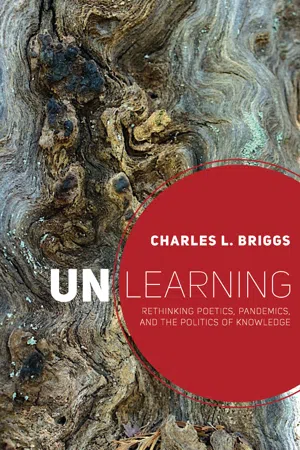
A provocative theoretical synthesis by renowned folklorist and anthropologist Charles L. Briggs, Unlearning questions intellectual foundations and charts new paths forward. Briggs argues, through an expansive look back at his own influential works as well as critical readings of the field, that scholars can disrupt existing social and discourse theories across disciplines when they collaborate with theorists whose insights are not constrained by the bounds of scholarship.
Eschewing narrow Eurocentric modes of explanation and research foci, Briggs brings together colonialism, health, media, and psychoanalysis to rethink classic work on poetics and performance that revolutionized linguistic anthropology, folkloristics, media studies, communication, and other fields. Beginning with a candid memoir that credits the mentors whose disconcerting insights prompted him to upend existing scholarly approaches, Briggs combines his childhood experiences in New Mexico with his work in graduate school, his ethnography in Venezuela working with Indigenous peoples, and his contemporary work—which is heavily weighted in medical folklore.
Unlearning offers students, emerging scholars, and veteran researchers alike a guide for turning ethnographic objects into provocations for transforming time-worn theories and objects of analysis into sources of scholarly creativity, deep personal engagement, and efforts to confront unconscionable racial inequities. It will be of significant interest to folklorists, anthropologists, and social theorists and will stimulate conversations across these disciplines.
eBook - ePub
Unlearning
Rethinking Poetics, Pandemics, and the Politics of Knowledge
- English
- ePUB (mobile friendly)
- Available on iOS & Android
eBook - ePub
About this book
Information
Part I
Unlearning Racialized Disciplinary Genealogies
1
Disciplining Folkloristics
But when one draws a boundary it may be for various kinds of reason. If I surround an area with a fence or a line or otherwise, the purpose may be to prevent someone from getting in or out; but it may also be part of a game and the players be supposed, say, to jump over the boundary.
—Ludwig Wittgenstein, Philosophical Investigations
LEE HARING (2008B) CURATED A SET OF ARTICLES that responded to Alan Dundes’s provocation regarding what he assessed as “the continued lack of innovation in what we might term ‘grand theory’ in folkloristics” (Dundes 2005:387). This essay springs from Haring’s kind invitation to provide my own response. I must admit from the outset that my excitement in contributing to a debate regarding the place of theory in folkloristics was tempered by lingering frustration. Forging more prominent spaces for theoretical work in folkloristics has been one of my central goals for several decades. Nearly three decades ago, Amy Shuman and I curated in Western Folklore a set of papers on theory (1993). But here’s the rub: Shuman and I attempted to turn these articles into a collection for classroom use, but were repeatedly told by publishers that there is no market for books on folkloristic theory. Seeking to disprove this assessment, in 2003 Richard Bauman and I published a book exploring how the study of folklore has informed canonical epistemologies and political projects of the modern world for three centuries. I wish I could say that Voices of Modernity stimulated broad rethinkings of the politics and poetics of the discipline and sparked new attempts to insert folkloristics more centrally in interdisciplinary theoretical debates, but I am not sure that it has. Nevertheless, the text seems to have become part of the discipline’s intellectual infrastructure, particularly for graduate students preparing to take PhD orals.
I thus could not have been more pleased to see my predecessor in the directorship of the University of California, Berkeley, Folklore Graduate Program, Alan Dundes, deliver a spirited call for theoretical debate to a packed ballroom at the 2004 American Folklore Society Annual Meeting, which he published the next year (Dundes 2005). I applaud the contributors to the special issued edited by Lee Haring for responding to Dundes’s challenge (Haring 2008b). Starting with Mills’s (2008) provocative questioning of the category of theory, the authors insightfully queried the theory/folklore relationship, examining how the constitution of these categories overdetermines their interrelations. I would like to further explore this reluctance to embrace theory.
I draw on science studies, especially Thomas Gieryn’s (1983) notion of “boundary-work.” In the mid-twentieth-century United States, Richard Dorson and other folklorists developed a largely atheoretical form of boundary-work that successfully delimited an autonomous folkloristics and expanded its resource base and academic authority. Subsequently, the ethnography-of-speaking and performance-centered approaches in folklore fostered an opposing rhetorical style that used theoretically engaged analysis to promote creative exchanges across disciplinary boundaries. Pointing out why these rhetorics seem less viable in the twenty-first century as discipline-building strategies and returning to the issue that inspired the introduction to this book, I suggest an alternative approach that fosters innovation by collaborating on theoretical issues with nonacademics who reflect deeply on the poetics and politics of vernacular culture—people scholars used to call “the folk.”
Science studies critiques have become markers of academic importance, even for disciplines that also situate themselves in the humanities. But my goal is not just to put folkloristics on the science studies map but to reflect on folklorists’ discipline-building practices and their viability within contemporary academic and sociopolitical contexts—and to imagine alternatives.
Boundary-Work as Disciplinary Strategy
Acknowledging Dorson’s role in consolidating US folkloristics, Simon Bronner (1986) sagely shows that his influence emerged less from new theoretical visions than tireless efforts to promote folkloristics, particularly by creating academic controversies in which he himself featured centrally. Science studies can bring Dorson’s contribution clearly into focus. As Gieryn elucidates in his classic article, boundary-work is a rhetorical style that constructs social boundaries, demarcating intellectual activities accorded the prestige of science from nonscience or pseudo-science. It is most commonly used “to enlarge the material and symbolic resources of scientists or to defend professional autonomy” (1983:782). It builds individual reputations and expands disciplinary boundaries by claiming authority and resources from other professions.
In The British Folklorists, Dorson tells the story of John Aubrey’s discovery of a preexisting object—folklore: “With the sure instinct of the tradition-hunter, he recognized the rupture in society caused by new inventions and new political forms, and the damaging effect of these innovations on the old peasant culture” (1968:5). Discovering folkloristics’ object required a distinct set of methods, collecting “at first hand, from his own immediate world” (8). The precarious, evanescent nature of folklore required boundary-work that distinguished the true object from superficially similar forms. As Bruno Latour (1987) suggests, a key feature of scientific work is the generation of textual-cum-social-cum-material networks. Modes of collecting, classifying, and comparing empirical objects and transforming them into texts thus created networks or communities, first termed antiquarian and later folkloristic. Dorson traces connections from Aubrey’s foundational instincts to their institutionalization in a science of folklore, professional societies, a specialized literature, and increasingly explicit, standardized methods adopted by scholars—a network that seemed to grow continually through space and time. Boundary-work is hardwired into Dorson’s origin story of folkloristics, seemingly required by the nature of folklore and the folk. The dissemination of this genealogy reproduced boundary-work globally. (I take up the colonial aspect of Dorson’s genealogy centrally in chapter 4.)
When he turned to the United States, Dorson similarly fought to consolidate folkloristics as a discipline, to demarcate and defend its boundaries. Such military metaphors provided the language for Dorson’s boundary-work, undertaken in the context of the Cold War. He opened “Folklore, Academe, and the Marketplace” by bemoaning the way that folkloristics has been misunderstood: “my academic life has been largely spent in attempts to combat these misunderstandings” (1976:1). Echoing the militaristic rhetoric of the early Cold War, Dorson coined the term “fakelore” in 1950, which he defined as “a synthetic product claiming to be authentic oral tradition but actually tailored for mass edification” (5). Reflecting that “fakelore” was crafted as “a battle cry,” Dorson argued that “the study of American folklore was being invaded by commercializers and could not as yet be protected by scholars, since specialists in American folklore had not yet been trained” (1971:7). His attacks on amateurs, popularizers, the mass media, and academic interlopers helped to professionalize the discipline, defining folklorists through the ability to recognize a distinctive object, develop distinctive methods, and form professional networks. The production of legitimate knowledge about American folklore thus required departments of folklore and professorial positions. Just as scholarly authority over “folklore” marked the disciplinary boundary from within, Dorson’s explicitly polemical concept of “fakelore” drew it from without, demonizing commercialization, the mass media, “frivolous” folklore investigations, and scholars from other disciplines who “dabbled with folklore” (7) as possessors of mere fakelore. The key marker of the disciplinary boundary was fieldwork, which other scholars did not undertake (at least properly), even as professional training prepared “the academic folklorist [for] zeroing in on a specific target” (1976:13).
The power of boundary-work in mid-twentieth-century folkloristics helps us understand why theory played a limited role in North American folkloristics until recent decades. The fate of folkloristics depended, Dorson claimed, on laying exclusive claim to distinct objects, methods, professional societies, texts, and departments—not theories. The papers in which Dorson claimed theoretical ground, “A Theory for American Folklore” (1959) and “A Theory for American Folklore Reviewed” (1969), are exceptions that prove the rule. Dorson argued that “students of American folklore must find common theoretical ground if they aspire to be more than random collectors or public entertainers” (1959:212). In the 1960s, anthropology, linguistics, sociology, literary studies, and other disciplines were redefining themselves in theoretical terms. Dorson distanced himself from “a modish cult—say of symbolic structuralism, or sociopsychodynamics, or linguistic folklife, or computerized mythology” (1969:227). Echoing American exceptionalism, Dorson rejected foreign theories in favor of a construction of theory that starts with examples of American folklore and proposes definitions as precursors to theory. Professionalizing training in folklorists, he argues, will transform folklore scholarship into “a cooperative inquiry into the behavior of folklore within the American environment” that will “illuminate the American mind” (1959:213). Even this self-proclaimed turn to theory extended Dorson’s boundary-work by adopting a narrowly inductive, not to mention nationalist, understanding of theory that was explicitly defined in opposition to the definitions of theory that were galvanizing and redefining other disciplines. US folklorists could not simply become part of the global expansion of British folkloristics. Building a discipline from made-in-the-USA folklore created a boundary vis-à-vis European folkloristics: high theory was to remain on the other side of the Atlantic.1
I suggest that the question is not just whether folklorists produce or use theory but theory’s marginality to discipline building. Placing boundary-work at the core of discipline-building strategies produced a strong sense of commitment and esprit de corps; nevertheless, as Fine (2008) points out, theory plays a crucial role in providing intellectual cohesion and coherence. Uniting around objects, methods, and a zealous commitment to protect the discipline against usurpers is less successful in fostering broad participation in intellectual debates.
Here I note a contradiction in Dundes’s role in the field. Dundes became the major successor to his teacher in continuing Dorson’s role as folkloristics’ primary boundary worker.2 Most folklorists attribute Dundes’s inability to promote theory to his having bet on the wrong theoretical horse (leaving his earlier explorations of structuralism aside here). Nevertheless, the tremendous importance of psychoanalysis in history, literature, feminist studies, and other fields in recent decades would suggest that the case is not so simple. Indeed, bringing new interpretations of Freud, Jacques Lacan ([1966] 1977), and other psychoanalysts into folkloristics could have created theoretical dialogues across disciplines. I would, rather, argue that Dundes’s difficulties in generating more interest in theory emerges from his persistent efforts to press boundary-work as the sine qua non for discipline-building—or, increasingly, discipline-preservation—strategies for folkloristics. By definition, central reliance on boundary-work produces, in Noyes’s (2016) terms, provincial intellectuals, defined through their (self)exclusion from what they characterize as metropolitan sites of high theory production.
During the Cold War expansion of scientific ideologies and resources in the mid-twentieth century, Dorson and some of his students passionately expanded disciplinary autonomy, scholarly authority, academic departments and programs, grants, and public recognition. The unstable “poetics of disappearance” (Kirshenblatt-Gimblett 1998b:300–302) that defined a continually vanishing object helped create and naturalize new forms of modernity (Bauman and Briggs 2003). In a post–Cold War, postmodern, fragmenting, and rapidly shifting world, the market for modernities collapsed and then became restructured as a critical, reflexive enterprise. The juxtaposition of closely guarded boundaries and claims to scholarly authority with the erosion of resources and prestige sparked a proliferation of declensionist disciplinary narratives—folklorists’ dysfunctional tales of woe. Following up on a point by Bauman (2008), communicative technologies were often used as means of demarcating the boundary of folklore—through their placement on the other side. Accordingly, practitioners could not claim shifting and productive relationships to new technologies as scholarly sites—even as Hermann Bausinger ([1961] 1990) was convincing European folklorists of their productivity.3
Theoretical Boundary Crossing as Disciplinary Strategy
The experience of the 1960s and 1970s suggests, however, that folkloristics can generate substantial academic authority creating analytical models that generate dialogic zones with adjacent disciplines—in short, in theoretically inspired boundary crossing. Dell Hymes (1974) placed folklore and folkloristics at the center of the “ethnography of speaking,” infusing a new analytic perspective that galvanized research in anthropology, communication, linguistics, and folkloristics with such central notions as genre, repertoire, community, and transmission.4 Hymes (1981) and Bauman (1977) then used the notion of performance in redefining and reinterpreting folklorists’ objects of study.
Two features are crucial here. First, whether or not one wants to call these frameworks “theory,” they generated broad textual networks through shared analytic principles. Second, rather than defending boundaries, folklorists drew on concepts and modes of analysis from anthropology, literary studies, linguistics, and history, and they convinced other scholars that folkloristics was valuable for their own fields of inquiry. The cross-disciplinary dialogue that took place in the 1980s in the Journal of American Folklore, the cross-disciplinary popularity of folklore courses, the demand for folklorists in other departments, and the emergence of symposia and special issues on performance in adjacent fields indicate the success of this opposing mode of discipline building. Theoretically oriented folklorists seemed to have been clearly aware during this period that theory is, as Fine (2008) suggests, productive of social-textual networks.
Nonetheless, my goal, to brutalize Shakespeare, is not to praise Bauman and Hymes and bury Dorson. Indeed, more theoretically or analytically based strategies have their drawbacks, too, and these are tied to the epistemological and social underpinnings of the very notion of theory. As Mary Poovey (1998) shows, the theory/fact opposition is a quintessentially modern artifact, reflecting an Enlightenment conviction that facts can exist apart from interests, opinions, and epistemological positions and that general propositions occupy a privileged sphere that is not contingent on history or politics. What gets defined as “theory” is what can best dress itself up as rational, general, disinterested, abstract, and universal—that is, as quintessentially modern and “Western.” As Mills (2008) observes, theory is markedly interdiscursive, explicitly tied to other academic texts; it is also metadiscursive, defining, limiting, and regulating what counts as scholarly discourse within a particular field. What is perhaps most crucial for folkloristics is that the social location of the author helps decide what gets classified as “theoretical”: the words of white, male senior professors from leading US or European universities are much more likely to be dubbed theoretical (I write self-reflexively) than those of women of color, scholars in schools that lack graduate programs, or nonacademics.
Notions of “high,” “middle,” and “low” presuppose this privileging of seemingly decontextualized, abstract discourse, project spatial/social relations in epistemological terms, and reproduce the scale-making claims of theory—the idea that it can enable us to jump from universalities to particularities and back without losing our balance. I would locate the politics of theory less in theories as epistemological objects than in theorizing, in discursive practices that both produce certain types of formulations and frame them as theory. Theoretical discourse is thus potentially exclusionary, expelling merely empirical, classificatory, or methodological work and creating hierarchically ordered textual networks—with the generators of theories on top, their authorized interpreters next, those charged with “applying” them to data just below, and researchers seemingly ignorant of or incapable of citing theory on the bottom. Hierarchies of prestige between universities, within nations and between them, get naturalized in the process. Ever since the seventeenth century, claiming privileged access to spaces constituted by seemingly abstract, general, interest-free knowledge and immunity from forms of situatedness that seemingly constrain the aspirations to universality (Tsing 2005) of projects framed as theoretical has formed a crucial infrastructure for white supremacy and the production of racial hierarchies.
Roberts (2008) indicates how closely theorizing reproduces racial inequalities. The continuing force of three centuries of identifying the speech of white, elite, Euro-American males with rationality, abstraction, and the unmarked subject, and of projecting women, the working classes, and people of color as “local” and marked subjects whose speech is concrete and provincial (Bauman and Briggs 2003; Shapin 1994) is painfully captured by the marginalization of work on African Amer...
Table of contents
- Cover
- Title Page
- Copyright Page
- Dedication
- Contents
- List of Figures
- Introduction
- Part I: Unlearning Racialized Disciplinary Genealogies
- Part II: Rethinking Psychoanalysis, Poetics, and Performance
- Part III: A New Poetics of Health, Multispecies Relations, and Environments
- Epilogue
- Acknowledgments
- References
- Index
Trusted by 375,005 students
Access to over 1.5 million titles for a fair monthly price.
Study more efficiently using our study tools.
Frequently asked questions
Yes, you can cancel anytime from the Subscription tab in your account settings on the Perlego website. Your subscription will stay active until the end of your current billing period. Learn how to cancel your subscription
No, books cannot be downloaded as external files, such as PDFs, for use outside of Perlego. However, you can download books within the Perlego app for offline reading on mobile or tablet. Learn how to download books offline
We are an online textbook subscription service, where you can get access to an entire online library for less than the price of a single book per month. With over 1.5 million books across 990+ topics, we’ve got you covered! Learn about our mission
Look out for the read-aloud symbol on your next book to see if you can listen to it. The read-aloud tool reads text aloud for you, highlighting the text as it is being read. You can pause it, speed it up and slow it down. Learn more about Read Aloud
Yes! You can use the Perlego app on both iOS and Android devices to read anytime, anywhere — even offline. Perfect for commutes or when you’re on the go.
Please note we cannot support devices running on iOS 13 and Android 7 or earlier. Learn more about using the app
Please note we cannot support devices running on iOS 13 and Android 7 or earlier. Learn more about using the app
Yes, you can access Unlearning by Charles L. Briggs in PDF and/or ePUB format, as well as other popular books in Social Sciences & Medical Theory, Practice & Reference. We have over 1.5 million books available in our catalogue for you to explore.