1.2.1 Electromagnetic and Particle Energies
The magnetosphere‐ionosphere‐thermosphere (MIT) coupled system is strongly driven by the solar wind. In order to specify the IT response to magnetospheric energy input, the sources of forcing and the physical processes by which the system responds must be understood. The magnetosphere couples to the ionosphere through the magnetic field of the Earth so that magnetospheric electric field, E, and magnetic field, B, couple to ionospheric E and B fields. FACs provide the communication between the magnetosphere and the solar wind to the ionosphere. Solar UV radiation energy maintains ionization, and solar wind coupling with the magnetosphere provides additional energy via fluctuations in the E and B fields.
The energy that enter the IT system from the magnetosphere takes two forms, electromagnetic (EM) in the form of Poynting flux, and kinetic, in the form of precipitating particles. The majority of magnetospheric energy maps to the high‐latitude region of the Earth. Thus, both types of energy occur at high latitudes in the polar cap, auroral zones, and subauroral regions.
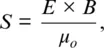
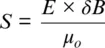
The Poynting flux vector, S, is written
where μ0 is the permeability of free space. The magnetic field, B, includes the Earth’s magnetic field, the steady state contribution from large‐scale currents, and EM wave fields. Only the perturbation wave field, δB, produces energy that dissipates in the ionosphere (Kelley et al., 1991; Richmond, 2010), and only contributions to S from the perturbation magnetic field are considered relevant to energy input to the IT system.
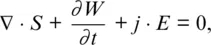
Poynting’s theorem in differential form is written
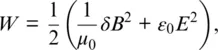
where energy, W, in the EM wave is
ε0 is the permittivity of free space,
j is the current density
, E is the electric field, and
j •
E is the energy dissipation or conversion rate. It is usually assumed that there is little change in the wave energy with time in comparison with the
j.⋅
E term and
is usually ignored. This term is commonly referred to as the Joule heating rate, but it includes the energy transferred into bulk kinetic energy (Thayer & Semeter,
2004; Richmond,
2010). The kinetic energy term is usually regarded as less important (Lu et al.,
1995) though some would disagree (Thayer & Semeter,
2004).
S, as defined above, is the perturbation Poynting flux,
.
Richmond (2010) pointed out that the interpretation of Poynting’s theorem as normally applied for ionospheric energy dissipation requires that the sides of the volume over which the Poynting flux is dissipated be equipotentials. Gary et al. (1994) argued that individual flux tubes can be regarded as the appropriate volume for correct application of Poynting’s theorem.
Figure 1.1, reproduced from Knipp et al. (2004), shows the partition of energy input from 1975 to 2003, based on (1) estimates of power in the solar spectrum from the SOLAR2000 model (Tobiska et al., 2000); (2) estimates of auroral zone particle power based on observations from the Defense Meteorological Satellite Program (DMSP) and NOAA TIROS and Polar‐Orbiting Operational Environmental Satellites (POES); and (3) a com...