Driving Continuous Process Safety Improvement From Investigated Incidents
,
English
ePUB (mobile friendly)
Available on iOS & Android
eBook - ePub
Driving Continuous Process Safety Improvement From Investigated Incidents
,
About this book
New perspectives on how to successfully drive changes in companies' process safety management systems
Simply learning from process safety incidents has proven to be insufficient to drive performance improvements. To truly change, organizations must seek out & embed learnings in their programs & systems. This book picks up from previous CCPS books, Incidents That Define Process Safety and Investigating Process Safety Incidents.
This important book:
Offers guidelines for improving process safety performance by embedding the lessons learned from publicly available investigations
Recommends a continuous improvement learning model focused on organizational learning
Provides examples for using the model's techniques to drive continuous improvements
Contains an index of more than 400 investigated incidents and introduces the concept of Drilldown to help find lessons that might not have been mentioned before.
Written for safety professionals and process safety consultants, Driving Continuous Process Safety Improvement from Investigated Incidents is a hands-on guide for adopting a model for successfully driving the learnings from process safety incident investigations.
“Learning is not compulsory... neither is survival.”
—W. Edwards Deming, Engineer and Management Consultant
Nearly everything we do today, as we manage process safety to prevent losses of primary containment that result in fires, explosions, and toxic releases, we do because of conditions that led to past incidents. Our engineering forebears began building the modern practice of process safety at the beginning of the industrial revolution. Subsequent generations have steadily advanced process safety.
For example, when E.I. DuPont built a black powder works in Delaware, USA, in 1802, he took note of the explosions that had happened in other black powder works. To protect his workers, family, and property, his process buildings were constructed of thick stone, with blow‐out walls aimed away from people and buildings (Klein 2009).
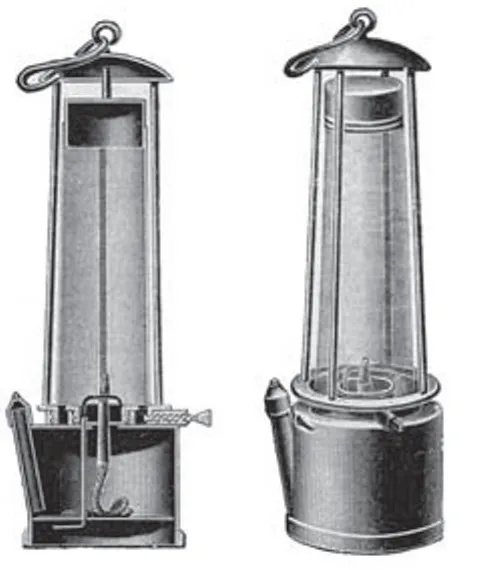
Similarly, Sir Humphrey Davy noted the large number of coal dust explosions in English mines in the early nineteenth century (Gibbs 2020). After talking to miners who survived such explosions, he designed an explosion‐proof lamp based on principles still used today in flame arrestors and explosion‐proof electrical boxes (Figure 1.1).
Figure 1.1 The Davy Lamp
In 1880, H.R. Worthington, A.L. Holley, and J.E. Sweet founded the American Society of Mechanical Engineers (ASME) to create uniform engineering standards that would ensure safety, reliability, and efficiency (ASME 2020).
Working on behalf of the chemical engineering profession, the American Institute of Chemical Engineers (AIChE) began to share findings and recommendations from process safety incidents via the Ammonia Plant Safety (Williams 2005) and Loss Prevention Symposia in the 1950s and 1960s (Freeman 2016). AIChE's Design Institute for Emergency Relief Systems (DIERS) began publishing guidelines for multiphase relief systems in the 1970s (AIChE 2020a).
Until the mid‐1980s, institutional lessons learned came in the form of technology innovations, new or revised standards and codes, or back‐up systems. This began to change with the formation of AIChE's Center for Chemical Process Safety (CCPS) in 1985. CCPS began the process of formally leveraging incident findings and successful practices into “Guidelines” and “Concepts” (Berger 2009). In 1988 CCPS codified the first Process Safety Management System (PSMS). The CCPS 12 Elements (CCPS 1989) provided the first organized common framework to comprehensively manage all the standards, technologies, and practices needed to control a company's process safety hazards. The original framework has evolved into today's 20 elements of Risk Based Process Safety (RBPS), which are organized in four pillars: Commit to Process Safety, Understand Hazards and Risk, Manage Risk, and Learn from Experience (CCPS 2007).
Regulations around the world also began to emerge in the 1980s, most notably the Sevesso Directive in the European Union, the Process Safety Management (PSM) regulation in the USA, and the Control of Major Accident Hazards (COMAH) in the UK. Most national and regional process safety regulations are based on one or a combination of these original regulations.
Unfortunately, incidents continue to happen despite 200 years of continuous development of technology, standards, publications, and management systems. They continue to happen despite the great number of recommendations from incident investigations conducted by every operating company in this industry. And nearly every incident that occurs in an industry, a company, or a plant has root causes that resemble the causes of previous incidents.
1.1 The Focus of this Book
CCPS (CCPS 2019a) and others have written guidelines addressing the general process of incident investigations. These books focus heavily on the process of investigation, the determination of root causes and causal factors, and the process of developing findings and recommendations. CCPS and others also have published books that describe past incidents to extract the lessons that could be learned from them (Gil 2008; CCPS 2019b; Kletz 2019; Hopkins 2008; Hopkins 2012). What's more, CCPS provides several publications addressing how to drive a culture of improvement in process safety (CCPS 2018; 2019c).
Just the same, incidents that look the same as previous incidents continue to occur—whether they happen at a site, or within a company, or replicate well publicized external incidents. Section 3.2 will discuss the numerous reasons companies fail to learn, including but not limited to:
imbalance between production and safety
corporate culture problems
employment turnover
financial or liability concerns
lack of employee involvement
lack of leadership ownership of process safety
lack of sense of vulnerability
knowledge remaining in silos
normalization of deviance.
This book seeks to help companies overcome the reasons they fail to learn. It greatly expands on the process for:
Seeking and obtaining key findings from external incidents.
Translating findings into lessons learned. And especially
Converting these lessons learned into institutional knowledge.
While the examples in this book focus on learning from incidents outside the company, the process described in this book can—and should—be applied to transform findings from internal incidents and near‐misses into institutional knowledge.
Let's define some key terms for this book. Note that most of these terms can be found in the CCPS glossary, while a handful are specific to this book.
Causal factor: A major unplanned, unintended contributor to an incident (a negative event or undesirable condition) that, if eliminated, would have either prevented the incident or reduced its severity or frequency.
Root cause(s): A fundamental, underlying, system‐related reason why an incident occurred that identifies a correctable failure(s) in management systems. There...
Table of contents
Cover
Table of Contents
Series Page
Title Page
Copyright
Disclaimer
ABOUT AIChE AND CCPS
Dedication
ACRONYMS AND ABBREVIATIONS
ACKNOWLEDGEMENTS
GLOSSARY
FOREWORD
EXECUTIVE SUMMARY
APPLICABILITY OF THIS BOOK
1 INTRODUCTION
2 LEARNING OPPORTUNITIES
3 OBSTACLES TO LEARNING
4 Examples of Failure to Learn
5 LEARNING MODELS
6 IMPLEMENTING THE REAL MODEL
7 KEEPING LEARNING FRESH
8 Landmark Incidents that Everyone Should Learn From
9 REAL MODEL SCENARIO: CHEMICAL REACTIVITY HAZARDS
10 REAL MODEL SCENARIO: LEAKING HOSES AND UNEXPECTED IMPACTS OF CHANGE
11 REAL MODEL SCENARIO: CULTURE REGRESSION
12 REAL MODEL SCENARIO: OVERFILLING
13 REAL MODEL SCENARIO: INTERNALIZING A HIGH‐PROFILE INCIDENT
14 REAL MODEL SCENARIO: POPULATION ENCROACHMENT
15 CONCLUSION
Appendix: Index of Publicly Evaluated Incidents
Index
End User License Agreement
Trusted by 375,005 students
Access to over 1.5 million titles for a fair monthly price.
Study more efficiently using our study tools.
Frequently asked questions
Yes, you can cancel anytime from the Subscription tab in your account settings on the Perlego website. Your subscription will stay active until the end of your current billing period. Learn how to cancel your subscription
No, books cannot be downloaded as external files, such as PDFs, for use outside of Perlego. However, you can download books within the Perlego app for offline reading on mobile or tablet. Learn how to download books offline
Perlego offers two plans: Essential and Complete
Essential is ideal for learners and professionals who enjoy exploring a wide range of subjects. Access the Essential Library with 800,000+ trusted titles and best-sellers across business, personal growth, and the humanities. Includes unlimited reading time and Standard Read Aloud voice.
Complete: Perfect for advanced learners and researchers needing full, unrestricted access. Unlock 1.5M+ books across hundreds of subjects, including academic and specialized titles. The Complete Plan also includes advanced features like Premium Read Aloud and Research Assistant.
Both plans are available with monthly, semester, or annual billing cycles.
We are an online textbook subscription service, where you can get access to an entire online library for less than the price of a single book per month. With over 1.5 million books across 990+ topics, we’ve got you covered! Learn about our mission
Look out for the read-aloud symbol on your next book to see if you can listen to it. The read-aloud tool reads text aloud for you, highlighting the text as it is being read. You can pause it, speed it up and slow it down. Learn more about Read Aloud
Yes! You can use the Perlego app on both iOS and Android devices to read anytime, anywhere — even offline. Perfect for commutes or when you’re on the go. Please note we cannot support devices running on iOS 13 and Android 7 or earlier. Learn more about using the app
Yes, you can access Driving Continuous Process Safety Improvement From Investigated Incidents by in PDF and/or ePUB format, as well as other popular books in Technology & Engineering & Chemical & Biochemical Engineering. We have over 1.5 million books available in our catalogue for you to explore.