Winner of the American Book Fest 2021 Best Book Award, Management and Leadership; Silver Medalist, 2021 Living Now Awards; Bronze Medalist, 2022 Axiom Business Book Awards for Success/Motivation/Coaching.
Use mindfulness to unleash your potential - without adopting spiritual beliefs
Mindfulness Without the Bells and Beads: Unlocking Exceptional Performance, Leadership, and Wellbeing for Working Professionals strips away the bells, beads, and hyperbole associated with mindfulness, and explains how you can take your performance and leadership to the next level in just eight weeks, without adopting any spiritual or new age beliefs.
Author Clif Smith, a US Army veteran, former diplomat, and CIA-trained former intelligence officer, serves as EY's Americas Mindfulness Leader and Global Mindfulness Network Leader and is internationally recognized for bringing mindfulness to tens of thousands of corporate and government leaders across the globe. In this book, Clif shares teachings and insights to help achieve the tangible benefits of practicing mindfulness as a fundamental part of our professional and personal lives. You'll discover how to:
Enhance mental focus, resilience, and decision-making under pressure
Increase the impact of your communication and leadership
Transcend limiting beliefs, fear, and other psychological barriers to success
Connect, understand, and interact with others more effectively
Effectively incorporate self-care into a high-performance life
Demystify the practice of mindfulness to make it ideal for a corporate setting
Perfect for corporate leaders, managers, and executives, and any working professional in a high-pressure or high-performance environment, Mindfulness Without the Bells and Beads also belongs on the bookshelves of anyone who works in a stressful environment and wants to achieve a higher level of success and a better quality of life.
Part I My Journey with Mindfulness and an Introduction to the Fundamentals
Chapter 1 The Power of the Trained Mind
On June 13, 1994, I stepped off a bus at Fort Jackson, South Carolina, and was immediately assailed by the shouts from a group of US Army drill sergeants. As you might imagine, my heart was pounding in my chest and I was thinking, “What the hell did I get myself into?” I had barely made the grades needed to graduate from high school just 3 days prior and this was the first step on what has turned out to be an incredible journey through life with its ups, downs, and hard-won lessons learned. I had many family members who served our country and inspired me to do the same, and I wanted to “earn my freedom,” a phrase which, as it turned out, had two meanings.
The first meaning of “earn my freedom” was recognizing I won the world lottery by being born in the United States of America but had done absolutely nothing to earn it. Serving my country was one way to do so. I grew up being inspired by my Uncle Ernie, who served in the US Marines during the Vietnam War and later joined the Army, where he served until retirement. Every Christmas Eve at my grandmother's house in Gettysburg, Pennsylvania, we would gather around the phone for our chance to talk with Ernie for a few minutes when he called in from a far-off place. There was always talk about service, patriotism, and sacrifice after we hung up that phone each year. Those sentiments instilled in me a desire to earn my freedom, and Ernie's stories kindled my interest in leaving my small town to explore the world.
The second meaning of “earn my freedom” came from the fact that we were dirt poor, and earning my financial freedom was high on my list of to-dos. I learned at a very young age what many kids do not learn until later in life, sometimes much later, that the food that arrived on my table each night and the roof over my head were there due to others sacrificing and laboring for me when I could do little in return. Crossing that threshold of understanding about the world fueled my motivation to become self-reliant, claw my way out of poverty, and help others.
Joining the US Army was one of the most important and impactful decisions of my life. The self-discipline, friendships, and experiences I gained in the Army shaped who I am, carried me through challenging times, helped me find the courage to take personal and physical risks, helped me get into and graduate from Harvard, and continue to fuel my motivation to serve others today. But I needed far more than just my experiences in the Army to move from poverty to prosperity.
My journey has not been linear by any stretch of the imagination. I was raised by a single mother of three. We were on and off welfare for much of my childhood, moved nearly a dozen times and across several states, lived in government-subsidized housing, a trailer park, and even had to stay in a shelter for a time when things went sideways with my mom's boyfriend. At Christmas time, we often got free toys from Toys for Tots,1 and during much of my time in school, we were on a free or reduced-cost lunch plan, which required the issuance, carrying, and “spending” of lunch tokens daily in the cafeteria. Noticing my cheeks turn bright red and dealing with intense feelings of embarrassment and shame when a classmate pointed out that I was getting free lunches was an all-too-common occurrence in my school. These circumstances kept me feeling small, feeling like a failure, and wondering why everyone else had it better than I did.
I was not, you might agree, set up for success. That said, I did not lack love and attention from my mother nor good examples of hard work, discipline, and the importance of family from her, as well as my aunts, uncles, and grandparents. I remember my mother working tirelessly to make ends meet while operating her station on the production line in a shoe factory, which was kind of a family profession back then. My grandparents moved from coal mine country in West Virginia to work at Gettysburg Shoe, in Gettysburg, Pennsylvania. Everyone in my extended family worked factory or other laborious jobs. Their collars weren't blue; their entire shirt was. Other than my Uncle Ernie, who was one of the main inspirations for me joining the military, the adult family members who surrounded me worked in shoe factories, cabinet factories, dinnerware factories, and quarries. They drove trucks, welded bars, sawed wood, and laid brick. All jobs that were much better than breathing in coal dust like my great grandfather.
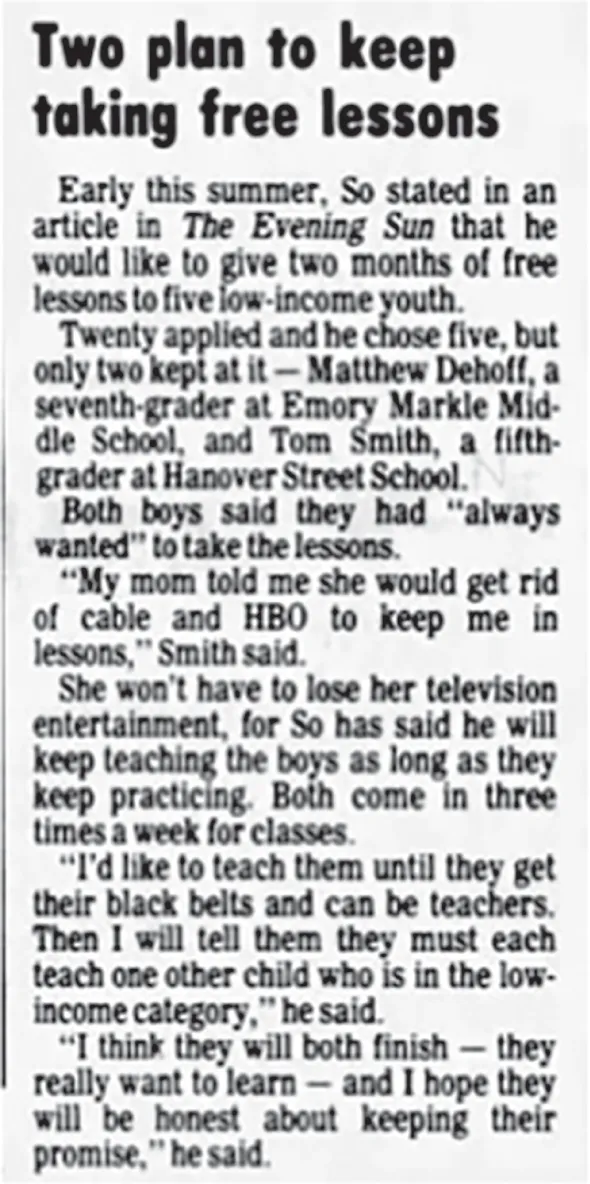
My mother bore the brunt of raising us in difficult times, but there was much I'm sure I didn't see because she shielded it from my siblings and me. After each long day's work, my mom would pick us up from the babysitter's house and give us her full attention, ask about our day, and shower us with love. When I was old enough to go to school the schedule changed a bit, and in third grade, I became a latchkey kid. My mother's affection didn't wane, and she always came up with ways to give us opportunities she knew she couldn't provide on her own. One day she heard about a contest for low-income families to win free martial arts lessons at our local martial arts studio, So's Tae Kwon Do.2 She knew, from the stacks of old kung fu magazines and my penchant for wanting to watch every Chuck Norris and Bruce Lee movie a hundred times, that I would kill (pun intended) for a chance to actually learn martial arts and so she entered me into the contest. She didn't tell me about it before getting the results because she knew how devastated I'd be if we didn't win. Fortunately, I was one of the five lucky kids who won and although the free lessons were to last only two months, the owner and head instructor, Grandmaster Chong C. So, was an amazingly generous man. He was the architect of the contest and when he heard my mother was going to cancel “cable and HBO” to pay for my lessons to continue, he said he would keep teaching me for free as long as I was committed to the training (see Figures 1.1 and 1.2). I spent the next two years or so taking free lessons and, although it wasn't explicitly labeled mindfulness, Master So also taught us focused attention meditation and how to be aware of some often-overlooked aspects of our experience as we trained, competed, and navigated day-to-day life. I picked up three things in that program that I carried forward in my life that have helped me thrive.
Three Skills That Changed My Life
The first skill Master So taught us was to recognize, embrace, and be mindful of the sensations and thoughts associated with fear and then still step forward. “What does fear feel like in the body?” and “How does fear show up in the mind?” were questions Master So posed to us. We learned to exercise this skill each time we approached the sparring mat and faced a stronger or more advanced opponent. Notice the fear, and move forward. Notice the hesitation, and move forward. Notice the heart racing, and move forward. It was by turning toward and embracing fear that we learned we could do anything, whether fear was present or not.
FIGURE 1.1 PICTURE OF ME AT SO'S TAE KWON DO TAKING A TEST FOR MY NEXT BELT LEVEL. I'M THE KID ON THE RIGHT ALTHOUGH THE CAPTION SAYS LEFT.
The second skill Master So taught was to be mindful of unhelpful internal thoughts, beliefs, and stories and still move forward despite their presence. These are the automatic thoughts that tell us we aren't good enough, tall enough, or smart enough. They often claim we don't belong, some achievements are only for others, or other people have it better and that's why they're successful, keeping us in a victim mentality. That unhelpful inner dialogue also includes rumination and worry, far in excess of any helpful contemplation of how to face and overcome a challenge or difficult situation. We learned to exercise this skill each time we had to break wooden boards and eventually cement blocks with specific strikes, such as hammer fist or knife hand strikes. As a young boy about to attempt these types of breaks, my mind would race with thoughts of “I can't do this. There are too many. It's going hurt.” Notice the unhelpful thinking; do the action anyway. Each time we did this, we reinforced our ability to move forward despite a weak and fearful mind, which eventually gave way to a stronger one.
FIGURE 1.2 EXCERPT FROM THE SAME ARTICLE DISCUSSING THE CONTEST FOR LOW-INCOME KIDS AND MY MOM'S OFFER TO CUT CABLE AND HBO SO I COULD KEEP TAKING LESSONS.
This skill of becoming aware of unhelpful thoughts and not letting them affect my actions was reinforced by something my Uncle Howard said when we were fishing one afternoon. He said, “Tommy (that's what everyone called me back then), one thing I love about fishing is that you can cast your line into the water and just let all your worries flow down the stream.” At the time, I did not fully grasp the wisdom of this comment. What's most surprising about it, as I've looked back on that interaction, is that the comment was uttered by a mountain man with a big heart, who had lived his entire life in an area outside Gettysburg, Pennsylvania, called “the Narrows.” He shared an insight with me that he didn't have to travel to an exotic land to discover, didn't have to kiss the feet of a guru to gain access to, and didn't have to take on the demeanor, political views, or values of someone else to be considered worthy of learning it. He shared that nugget with me not knowing if I was ready to hear it and not expecting anything in return. He planted the seed and helped me learn to notice that the world has lessons to teach if we only pay attention. And that wasn't the only nugget of wisdom fishing yielded in support of this skill.
Every time we went fishing, we did something called “catch and release.” No, it wasn't a controversial immigration tactic; it was what we did every time we caught a fish. Catch a bass, release it. Catch trout, release it. You get the picture. I turned this phrase into a way to practice the second skill outside the martial arts studio.
The Catch and Release technique became (and remains) one of my most powerful tools for noticing and letting go of unhelpful internal dialogue and fear-driven thinking. Suddenly, I could do the things I was afraid of and attempt the things my mind told me I couldn't do. I would “catch” myself buying into an unhelpful thoug...
Table of contents
Cover
Table of Contents
Title Page
Copyright
Dedication
Foreword
Introduction
Part I: My Journey with Mindfulness and an Introduction to the Fundamentals
Part II: Diving Deeper: An 8-Week Journey to Exceptional Performance, Leadership, and Well-Being
Acknowledgments
About the Author
Appendix
Index
End User License Agreement
Trusted by 375,005 students
Access to over 1.5 million titles for a fair monthly price.
Study more efficiently using our study tools.
Frequently asked questions
Yes, you can cancel anytime from the Subscription tab in your account settings on the Perlego website. Your subscription will stay active until the end of your current billing period. Learn how to cancel your subscription
No, books cannot be downloaded as external files, such as PDFs, for use outside of Perlego. However, you can download books within the Perlego app for offline reading on mobile or tablet. Learn how to download books offline
Perlego offers two plans: Essential and Complete
Essential is ideal for learners and professionals who enjoy exploring a wide range of subjects. Access the Essential Library with 800,000+ trusted titles and best-sellers across business, personal growth, and the humanities. Includes unlimited reading time and Standard Read Aloud voice.
Complete: Perfect for advanced learners and researchers needing full, unrestricted access. Unlock 1.5M+ books across hundreds of subjects, including academic and specialized titles. The Complete Plan also includes advanced features like Premium Read Aloud and Research Assistant.
Both plans are available with monthly, semester, or annual billing cycles.
We are an online textbook subscription service, where you can get access to an entire online library for less than the price of a single book per month. With over 1.5 million books across 990+ topics, we’ve got you covered! Learn about our mission
Look out for the read-aloud symbol on your next book to see if you can listen to it. The read-aloud tool reads text aloud for you, highlighting the text as it is being read. You can pause it, speed it up and slow it down. Learn more about Read Aloud
Yes! You can use the Perlego app on both iOS and Android devices to read anytime, anywhere — even offline. Perfect for commutes or when you’re on the go. Please note we cannot support devices running on iOS 13 and Android 7 or earlier. Learn more about using the app
Yes, you can access Mindfulness without the Bells and Beads by Clif Smith in PDF and/or ePUB format, as well as other popular books in Business & Management. We have over 1.5 million books available in our catalogue for you to explore.