A comprehensive guide to developing a culture of learning and education within your business.
In any kind of organization, learning has become a vital part of the growth and development process, but it only produces effective results if it is pursued strategically and embedded deeply into the culture of the workplace. In recent years, there has been a growing consensus that, for many organizations, learning is their only sustainable competitive advantage – ensuring a committed and engaged workforce that is positioned to identify and exploit business opportunities in an increasingly volatile and uncertain world. This makes it essential for leaders and senior managers to investigate the full range of learning processes and to understand exactly how individual, group, machine and organization-wide learning can produce long-lasting results for individuals as well as for the company itself.
Backed by new academic theory, yet designed to be completely accessible to a business readership, The Learning-Driven Business highlights the importance of Organizational Learning (OL) for organizations which wish to remain competitive and profitable, before clarifying the various pathways and frameworks that can lead to success.
With the onset of automation and artificial intelligence, as well as the proliferation of redundancies and the economic instability of modern times, organizations and their employees must prioritise effective OL in order to overcome these challenges and remain competitive and relevant in the 21st century. This book is a guide for all business leaders and academics looking to adapt to the changing world through OL, using Garand & Golds' unique and original academic model.
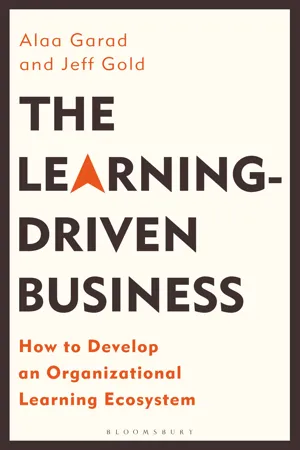
eBook - ePub
The Learning-Driven Business
How to Develop an Organizational Learning Ecosystem
- 336 pages
- English
- ePUB (mobile friendly)
- Available on iOS & Android
eBook - ePub
The Learning-Driven Business
How to Develop an Organizational Learning Ecosystem
About this book
Information
Part One
Leadership Learning and Individual Learning – Introduction
✦ Chapter 1: Leadership and Strategic Learning
✦ Chapter 2: Reflection
✦ Chapter 3: Mentoring and Coaching
✦ Chapter 4: Employees’ Cross-training
In this section, we consider fundamental aspects of the Learning-Driven Business (LDB), all of which are underpinned by the process of learning. We recognize that learning can be perceived in a variety of ways: acquiring knowledge, enhancing understanding, changing behaviour or revising one’s attitude. At a fundamental level, learning is the enhancement or transformation of an individual’s mental models based on newly available information. In simple terms, a mental model is a set of deeply ingrained assumptions or beliefs in one’s mind. What is essential to understand is how individuals throughout a business can become the source of ideas and practices that, through interaction with others, become accepted by everyone in the workplace. It is for leaders to harness such learning, and this is why in Chapter 1 – Leadership and Strategic Learning – we emphasize the role of leaders in forming, executing and reviewing strategy. We also highlight why they have to be critical thinkers in this work. In Chapter 2 – Reflection – we focus on the need for leaders and others to explore the meaning of their experiences and how they interpret them so that they may become autonomous critical thinkers. We show how people can consider the patterns of their thinking so that they become aware of assumptions that can prevent new actions from happening.
We see mentoring and coaching in Chapter 3 as crucial mechanisms to create a culture of continuous learning and change. We show how there are key similarities and differences between the two but how, given the way patterns of working have changed in response to Covid-19, there is a need for leaders to use mentoring and coaching skills to sustain visibility and regular relationships with staff and others, even if this is mediated by technology. We argue that this is a major route to creating a learning culture in a business. In addition, as many businesses are likely to face disturbances to accepted ways of working, staff will need to acquire new skills from different business areas and will require cross-training, which we will cover in Chapter 4. Cross-training can help cover absences but also serve as a way for people to develop employable new skills in a time of turbulence and uncertainty.
1
Leadership and Strategic Learning
On 19 April 2020, the BBC website8 ran with a headline that posed the question: ‘Coronavirus: Will Covid-19 speed up the use of robots to replace human workers?’ At the height of the pandemic, it seemed that the so-called Fourth Industrial Revolution (4IR) was about to intensify. As one commentator quoted on the website: ‘[Covid-19] is going to change consumer preference and really open up new opportunities for automation’, citing the fact that robots would not need to social distance while they completed tasks that humans could not do if they were working at home. Thus Walmart in the US started to use robots to scrub floors. Predictions were in place to suggest that, for as long as social distancing remained present in society, the robots’ time had come.
Such possible disruptions at a time of crisis are part of a continuous challenge to those who are appointed as leaders and who are given responsibility for the achievement of outcomes in a variety of contexts. It highlights how changes in technologies, processes and practices of organization have presented leaders with a VUCA (volatility, uncertainty, complexity and ambiguity) environment; this requires a response in terms of setting a clear direction for the future centred on complex understanding and agile decision-making9. We argue that leaders must engage in learning that is continuous and strategic, that has to include a willingness to embrace critical thinking to avoid what Alvesson and Spicer10 called ‘functional stupidity’ whereby leaders can prevent learning and change for the sake of maintaining and sustaining an order that they avoid justifying. In a similar manner, some leaders can be accused of hubris, show contempt for criticism from others and become capable of inflicting damage on their organizations11.
Leaders, leadership and strategic learning
When we think of leaders and leadership, there is a persistent pattern from research and practice that these terms are synonymous. We are not going to deny the importance of those people appointed to senior positions in any organization as leaders. Nor do we want to deny the many research studies that point to the role of leaders in contrast to managers. For example, leaders establish, communicate and model direction, by empowering and influencing others. They also challenge the status quo and build teams to enact change12. Further, there are many models and frameworks that provide leaders with the necessary skills and abilities for the role. One of the most well-known frameworks is the Multifactor Leadership Questionnaire™ (MLQ)13. This seeks to measure a leader against four dimensions: transformational, transactional, non-transactional and outcomes. A leader is rated against the elements of each dimension by up to 24 others, who provide 360-degree feedback. The MLQ and the idea of transformational or charismatic-transformational leadership have remained very popular in practice and research, so much so that they have been seen as ‘the dominant forms of interest’ that reinforce the view of the importance of leaders14. Others have suggested that there is limited research to support the idea of transformative leaders, its measurement and use, particularly in terms of impact on organization performance, and that the approach ought to be abandoned so the process can start again15, but from where?
We are not going to completely abandon the notion of individual leaders and their role in contributing to the LDB. We want to give them a significant responsibility for strategic learning. Now that we have all experienced a global pandemic, this highlights the importance of flexibility and experimentation when it comes to working practices. This has been emphasized through remote working, when engagement is done via video and telephone, the distributed development of work systems and the development of 4IR technologies. These features of life post-2020 point to our inclusion of machine learning (Chapter 9) and futures and foresight learning (Chapter 8) in the LDB model. Both can play a vital role in the production of knowledge in organizations and the need to leverage such knowledge for developing strategy – these are key components of strategic learning16. In addition, leaders must become critical and challenge core assumptions that underpin their work as decision-makers. It is important to remember that during the global financial crisis of 2007–09 the learning of leaders in many organizations was highlighted as a failing, in that they didn’t take responsibility for what went wrong17. In order to avoid another global financial crisis, responsible leaders need to become critical thinkers. Table 1 provides some of the ways to understand critical thinking.
TABLE 118 Critical Thinking for Leaders
| ✦ Critique of rhetoric – whether arguments and propositions are sound in a logical sense; |
| ✦ Critique of tradition – a scepticism of conventional wisdom and long-standing practices; |
| ✦ Critique of authority – be sceptical of one dominant view and be open to a plurality of views; |
| ✦ Critique of knowledge – recognize that knowledge is never value-free and objective; |
| ✦ Critique of simplification – beyond simple cause-and-effect thinking; |
| ✦ Critique of identity – how subjectivity and identity are bound to influence thought and actions as well as emotions. |
As we will suggest later, there are a number of ways for leaders to utilize this framework of critical thinking.
For most of the twentieth century and into the twenty-first, the primary conception of leaders as the focus of consideration for leadership has held sway. It has become a ‘hot topic’ and something of a panacea19. Applying for a moment the critique of simplification, seeing leaders as leadership makes it easier to attribute success, in terms of linking organization performance to particular individuals, which extends to a justification for significant rewards20. However, if for a moment we focus on leadership rather than individual leaders, we might uncover new possibilities. Kelly21 suggested posing the following question as you enter any organization: ‘Where is leadership?’ Of course, this will depend on which organization you enter. An easy answer in the case of small businesses might be the owner-managers who have the biggest offices. However, in many organizations, there could be different answers, ranging from particular individuals (not necessarily those appointed as leaders) to groups and teams who exert influence in particular parts of the business. A moment’s reflection will reveal that there might be multiple pockets of such influence, all operating in everyday work processes for good or ill throughout an organization and, due to distributed work systems and offsite working, these pockets might not necessarily be within sight of those who seek to make key decisions for the direction of the business. We therefore make a separation between those appointed as leaders and the processes of leadership in everyday work situations. This separation leads to a disconnection and distortion, which we have called the ‘leader’s conundrum’ because leaders still have to make decisions but they are unable to control the everyday processes where leadership occurs. Such leadership happens in units where individuals work with others and create dependencies between processes. Increasingly, technologies mediate the connections and potentially make decisions – a feature that we consider in the chapter on machine learning.
However, the influence of technology does not mean that leaders need to remain disconnected and, as argued by Gronn22, they can act as ‘agents of influence’ if they can engage with the various configurations of leadership. As strategic learners, this is a necessity if leaders are to capture learning from all parts of an organization. For example, this is an example presented by Henry Mintzberg23 in a famous article in Crafting Strategy:
‘A salesman visits a customer. The product isn’t quite right, and together they work out some modifications. The salesman returns to the company and puts the changes through. After two or three more rounds, they finally get it right. A new product emerges, which eventually opens up a new market. The company has changed strategic course.’
A key insight presented by Mintzberg et al24 is how making strategy can be a deliberate and purposeful process that passes through distinct phases – formulation, plan, implementation and review – which he called a ‘design approach’. By contrast, Mintzberg also considered a ‘learning approach’ to strategy, which highlights how new possibilities for action can emerge from everyday situations but also from surprises, accidents and other unplanned situations. Much of this occurs through what people are learning from their work but also what machines are learning in their use. Crucially, strategic learning by leaders involves a both/and consideration of the design approach and the learning approach, which we will now consider.
Aligning planning and emergence in strategy
In the LDB model that we outlined in the Introduction, we made it clear that those appointed to the position of leader have a responsibility to provide clarity of direction for their organizations. Accepting that there are many kinds of organizations of different sizes and configurations with varying purposes, the failure to provide a clear direct...
Table of contents
- Cover
- Series
- Title
- Contents
- Introduction
- Part One: Leadership Learning and Individual Learning – Introduction
- Part Two: Why Team Learning?
- Part Three: Introduction – Differences between OWL and OL
- Part Four: Introduction – Learning Means Excellence
- References
- Acknowledgements
- Index
- Copyright
Trusted by 375,005 students
Access to over 1.5 million titles for a fair monthly price.
Study more efficiently using our study tools.
Frequently asked questions
Yes, you can cancel anytime from the Subscription tab in your account settings on the Perlego website. Your subscription will stay active until the end of your current billing period. Learn how to cancel your subscription
No, books cannot be downloaded as external files, such as PDFs, for use outside of Perlego. However, you can download books within the Perlego app for offline reading on mobile or tablet. Learn how to download books offline
Perlego offers two plans: Essential and Complete
- Essential is ideal for learners and professionals who enjoy exploring a wide range of subjects. Access the Essential Library with 800,000+ trusted titles and best-sellers across business, personal growth, and the humanities. Includes unlimited reading time and Standard Read Aloud voice.
- Complete: Perfect for advanced learners and researchers needing full, unrestricted access. Unlock 1.5M+ books across hundreds of subjects, including academic and specialized titles. The Complete Plan also includes advanced features like Premium Read Aloud and Research Assistant.
We are an online textbook subscription service, where you can get access to an entire online library for less than the price of a single book per month. With over 1.5 million books across 990+ topics, we’ve got you covered! Learn about our mission
Look out for the read-aloud symbol on your next book to see if you can listen to it. The read-aloud tool reads text aloud for you, highlighting the text as it is being read. You can pause it, speed it up and slow it down. Learn more about Read Aloud
Yes! You can use the Perlego app on both iOS and Android devices to read anytime, anywhere — even offline. Perfect for commutes or when you’re on the go.
Please note we cannot support devices running on iOS 13 and Android 7 or earlier. Learn more about using the app
Please note we cannot support devices running on iOS 13 and Android 7 or earlier. Learn more about using the app
Yes, you can access The Learning-Driven Business by Alaa Garad,Jeff Gold in PDF and/or ePUB format, as well as other popular books in Business & Business Development. We have over 1.5 million books available in our catalogue for you to explore.