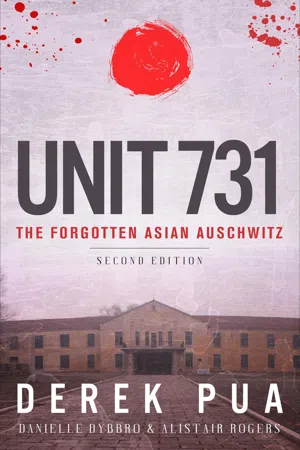
- English
- ePUB (mobile friendly)
- Available on iOS & Android
eBook - ePub
Information
CHAPTER 1

Beginnings
The Early Life of Shiro Ishii
Japan’s involvement with biological warfare begins and ends with one man: Shiro Ishii. Ishii had a long interest in biological warfare and understanding the limits of what the human body could endure under very harsh conditions and treatments. Despite an intellect that was apparent to his superiors, Ishii had rightfully developed the reputation as a heartless, sadistic individual, who cared little for the suffering he imposed on his victims. A closer look into his life before becoming the head of Unit 731 helps present a clearer understanding of his desire to advance Japan’s biological and chemical warfare program in the Far East during the Asia-Pacific War of 1931-1945.
Shiro Ishii was born June 25th, 1892, in the village of Chiyoda, south of the capital of Tokyo. He was the fourth son of a relatively wealthy family that reigned over the local community in a feudal manner despite the abolition of feudalism that came with the Meiji Restoration nearly 30 years before[1]. Specific ideas that did come with Meiji Restoration were rapid advancements in industrialization, nationalism, and expansion as an international power. Loyalty to the Emperor became a central tenet to Japan’s national identity; democratic values were introduced to the country with limited suffrage and a representative body (the Diet); and the military was rebuilt on Western ideas, which contributed to major military victories over China (1895) and Russia (1905). The Japan of the late 19th and early 20th Century was the perfect setting for a man of Shiro’s capabilities to rise professionally and make a career for himself. It also shaped his world perspective, which included belief in the supremacy of Japan over other nations and an undying loyalty to the Emperor.
Not much is known about Ishii’s childhood, although considering he was the fourth son in a relatively wealthy family, it is safe to assume he attended primary and secondary schools[2]. His teachers realized he was a gifted student with much potential. While he was naturally interested in medicine, Shiro also wanted to act on his nationalistic bend and serve in the Japanese Imperial Army. He combined these two passions to set himself on the path to becoming a medical doctor in the Japanese Imperial Army, and was accepted into the Medical Department of Kyoto International University in 1916.
While his talents and ability were well known among his professors and university administration, he was not very popular with his fellow students. Ishii took every advantage to gain proximity to his superiors and the academic administration in order to advance his career. He also made a habit of using lab equipment that was cleaned and organized by his fellow students during the evening without taking the time to clean it himself after conducting his own research.[3] Medical ethics were also not widely discussed at the University, nor was a Hippocratic Oath administered. This paved the way for Shiro to view his subjects as test fodder and not patients whose well-being he was in charge of. Regardless of such shortcomings, Shiro graduated from the Medical Department from Kyoto Imperial University in 1920.[4]
Ishii entered the army one month later and began his military training and after his basic training and a number of transfers, was stationed at the First Army Hospital in 1922 in Tokyo. While at the capital, he engaged in behavior not entirely becoming a respected student from a wealthy family. Shiro partook in womanizing and heavy bouts of drinking throughout Tokyo’s red light district. He was known to seek the services of very young geisha girls, and carry on throughout that neighborhood intoxicated. In spite of such distractions, Ishii was recommended for postgraduate studies, and returned to Kyoto Imperial University, eventually earning his PhD in 1927[5].
That same year, Ishii read an article on the 1925 Geneva Convention outlawing biological and chemical warfare. In the age of internationalism and collective security, the prohibition of biological and chemical weapons was viewed as a step to preventing the indiscriminate harm and destruction of the First World War. While the Japanese delegation to the convention signed the agreement, it was not ratified by the Diet[6]; therefore, Japan was not bound to that agreement, and had the freedom to develop a chemical and biological weapons program. In this global desire to ban such weapons, Ishii saw an opportunity, believing that if the entire world was willing to outlaw such a weapon, it could pose benefits for a Japanese nation desiring expansion throughout the Far East.
With the blessing of both his superiors in both the army and navy, Ishii began research into the theoretical uses of biological and chemical warfare, promoting the argument that producing bacteria would be less expensive than other conventional forms of weaponry. In the spring of 1928, he travelled extensively abroad, visiting numerous European countries and gathered research on biological warfare, some of which came from the US, Germany, Russia, France, and Italy, as well as Switzerland, Turkey, the Soviet Union, Egypt, Singapore, Ceylon, and Canada[7]. While some countries were engaged in the secret development of biological weaponry, his trip did not yield a great amount of information or research.
Ishii returned in 1930 to a more nationalistic Japan that desired expansion and supremacy throughout the Far East. The country’s new slogan – a wealthy country, a strong army – was highly prevalent on the eve of the invasion of Manchuria. According to a secondary source, when Ishii finally returned to Japan from his world tour, he convinced the Japanese State Department of Military Affairs that there was great potential in developing a biological weapons program, despite possible international condemnation.[8]
Although the use of chemical and biological warfare had been banned in the Geneva Convention of 1925, some countries were covertly researching bioweapons, as a Military Attaché in the Japanese Embassy in Washington D.C. “said that he heard that Ishii had studied bacteriological warfare at the Massachusetts Institute of Technology in Boston.”[9]
However, in a primary source testimony from the Khabarovsk War Crime Trials conducted by the Soviets, a former Unit 731 member claimed that in a meeting in 1941, Ishii explained the reason for Japan’s interest in biological warfare. Ishii said this was because “Japan did not possess sufficient natural resources of metals and other raw materials required for the manufacture of weapons,” which meant that Japan “had to develop new types of weapons” and that “all the great powers were carrying on corresponding work in [the sphere of bacteriological warfare] and that Japan must not lag behind in this field.”[10]
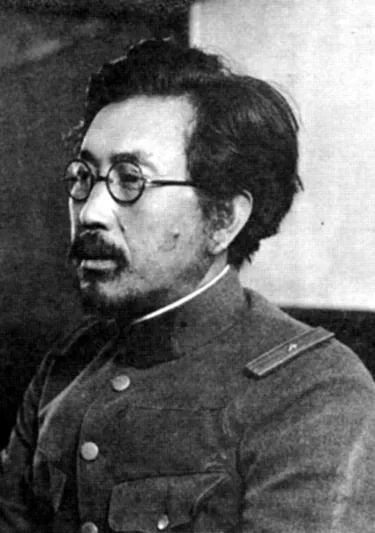
Dr. Shiro Ishii[11]
The beginnings of Unit 731
Ishii’s opportunity to explore the potentials of biological warfare came with the invasion of Manchuria in 1931. The landscape of Manchuria itself, with wide expanses of rural, uninhabited land, was the perfect setting for Ishii to conduct his research away from the cramped, limited space of the island of Japan.
Within the first two years of Japanese imperial control of Manchuria, Ishii established research facilities there, both for defensive and offensive biological warfare. Defensive research was the production of vaccines and offensive research was for mobilizing diseases as weapons, including plague, glanders, and anthrax among others. By the time the Western powers had initiated World War II in 1939, historians estimate there were at least 18 biological warfare facilities established throughout the Japanese empire, located as far north as Manchuria and as far south as Indonesia.[12]
The Japanese Army’s first germ research facility was built in the town of Beiyinhe, outside of Harbin in Manchuria, and was also known as the Zhong Ma Prison Camp.[13] In 1932 the village was evacuated and taken over by Ishii and his colleagues, and the initial research was focused on anthrax, glanders, and plague, and included live dissections of prisoners.[14] Other experiments served as precursors of the Unit 731 experiments, including the testing of poison gas, high voltage tolerance, poison injections, frostbite remedies, and the removal of organs for further research while the prisoner was still alive.[15]
The prisoners that were used in the experiments were mostly Chinese, but Soviets, Mongolians, and Koreans that were arrested by the Japanese army were also used. The prisoners were those that were arrested as spies and resisters to the Japanese in Manchuria, and were scheduled to be executed without a trial, so using them for experiments was deemed a better use of their lives than merely executing them.[16] In fact, some of the medical officials working at the research facilities were fully aware that the subjects brought for research “were [already] doomed to die.”[17] After the prisoners died from experimentation, their bodies were gotten rid of by way of an electric furnace.[18] The Zhong Ma Camp was eventually destroyed and the program was transferred to two newly set up research facilities: one near the city of Changchun and the other one in the Pingfan district, just south of Harbi...
Table of contents
- Table of Contents
- Second Edition Foreword
- Preface
- Introduction
- Chapter 1: Beginnings
- Chapter 2: Duties Of 731
- Chapter 3: Use Of Humans As Test Subjects
- Chapter 4: Other Experiments
- Chapter 5: Deployment Of Biological And Chemical Weapons
- Chapter 6: The Fall
- Chapter 7: Post-War “Legacy”
- Chapter 8: Post-War Denial
- Conclusion
- Notes
- References
Trusted by 375,005 students
Access to over 1.5 million titles for a fair monthly price.
Study more efficiently using our study tools.
Frequently asked questions
Yes, you can cancel anytime from the Subscription tab in your account settings on the Perlego website. Your subscription will stay active until the end of your current billing period. Learn how to cancel your subscription
No, books cannot be downloaded as external files, such as PDFs, for use outside of Perlego. However, you can download books within the Perlego app for offline reading on mobile or tablet. Learn how to download books offline
Perlego offers two plans: Essential and Complete
- Essential is ideal for learners and professionals who enjoy exploring a wide range of subjects. Access the Essential Library with 800,000+ trusted titles and best-sellers across business, personal growth, and the humanities. Includes unlimited reading time and Standard Read Aloud voice.
- Complete: Perfect for advanced learners and researchers needing full, unrestricted access. Unlock 1.5M+ books across hundreds of subjects, including academic and specialized titles. The Complete Plan also includes advanced features like Premium Read Aloud and Research Assistant.
We are an online textbook subscription service, where you can get access to an entire online library for less than the price of a single book per month. With over 1.5 million books across 990+ topics, we’ve got you covered! Learn about our mission
Look out for the read-aloud symbol on your next book to see if you can listen to it. The read-aloud tool reads text aloud for you, highlighting the text as it is being read. You can pause it, speed it up and slow it down. Learn more about Read Aloud
Yes! You can use the Perlego app on both iOS and Android devices to read anytime, anywhere — even offline. Perfect for commutes or when you’re on the go.
Please note we cannot support devices running on iOS 13 and Android 7 or earlier. Learn more about using the app
Please note we cannot support devices running on iOS 13 and Android 7 or earlier. Learn more about using the app
Yes, you can access Unit 731 by Derek Pua,Danielle Dybbro,Alistair Rogers in PDF and/or ePUB format, as well as other popular books in History & Chinese History. We have over 1.5 million books available in our catalogue for you to explore.