eBook - ePub
The PERICEO Tool
Teams and Organizations, Develop Your Capacity for Collective Intelligence
- English
- ePUB (mobile friendly)
- Available on iOS & Android
eBook - ePub
The PERICEO Tool
Teams and Organizations, Develop Your Capacity for Collective Intelligence
Information
Subtopic
PsychotherapyIndex
PsychologyChapter 1
Basic principles of Collective Intelligence
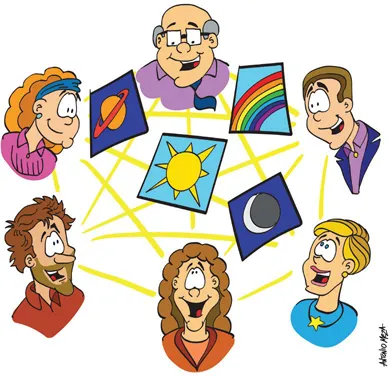
As previously mentioned, there are almost as many definitions of collective intelligence as authors on the subject ... and we know from experience that, for effective communication, it is fundamental to clarify what we intend when we use a particular word, and what it means for the people involved: Do we agree on what this word, this idea covers? Are we talking about the same thing?
It therefore seems to us a priority here—without going into the detailed content that we provide in our courses or interventions on Collective Intelligence—to present as clearly as possible the fundamentals we believe in and that underpin our research. You will find references to these fundamentals later in the text, identifiable by an asterisk (*).
1.1 Resonance – Synergy – Emergence
Resonance refers to what brings us together; where we feel alike and connected; where we meet. If we don't take the time to detect where we have resonance with others, it is difficult to act collectively.
Resonance is the result of a type of mutual influence between systems or objects that are specially attuned to one another.

In groups, resonance refers to the degree to which members feel sense of alignment or connection with other group members’ ideas, values and qualities. It involves discovering:
*What is similar between us?
*Where do we connect?
Synergy refers to our complementarities: the differences between us upon which we can capitalize. Synergy requires a certain degree of initial resonance. It becomes possible to create synergies when we are able to perceive our differences as an enrichment to common goals.
Synergy occurs when two (or more) things function together to produce a result that is not independently obtainable.

It requires an exchange of both information and energy in order to produce a result that includes and extends the individual contributions. Synergy results from exploring:
*Where are our differences?
*How can those differences complement one another?
Emergence results when the resonance and synergy between parts generates something new and unpredictable.
Emergence occurs when complex “patterns” appear as a result of relatively simple group interactions.

Emergent qualities are those that do not come directly from the components of a system but rather from how these components interact, i.e. when the whole is greater than the sum of its parts. Emergence arises from considering:
*What new could appear through our interactions?
*What else becomes possible?
A good analogy is that of a water molecule, which results from the integration of two atoms that originally had nothing to do with this molecule: hydrogen and oxygen.
1.2 Intention
"To the person who does not know where to go there is no favorable wind." – Seneca
In NLP, it is said that our intention focuses our attention. Our intention enables us to direct our energy towards an objective. Without a precise intention, we will not achieve anything specific and our energy will scatter in all directions.
To lead a constructive and fulfilled life requires us to evolve in a conscious way, by setting successive intentions and by focusing on their achievement.
It may be eye opening at this stage to draw a parallel with our smart-phones and tablets. If we use them “off-line” they are disconnected from Bluetooth, wireless networks and from one another. They are unable to send, receive or “download” any new information. The same applies to us: to create the conditions for Collective Intelligence and generative collaboration, we must have our own psychological and physical “circuitry” in the proper state to go “on-line” with each other..
We call this state the COACH State.
1.3 COACH state and CRASH state.
COACH = Generative State - Channel Open – Online

*Center yourself, especially in your belly center.
*Open your field of awareness.
*Attend, to what is going on within you and around you with awareness and mindfulness.
*Connect to yourself and to the larger systems you are part of.
*Holding everything that can happen from a state of resourcefulness and curiosity.

The opposite of this state we call CRASH state.
CRASH = Degenerative State - Channel Closed – Off line
*Contracted
*Reactive
*Analysis Paralysis
*Separated
*Hostile/Hurting/Hating
In a CRASH state, everything is “off line” and it is not possible to develop the connections necessary to produce Collective Intelligence.
1.4 Holons and Holarchies
A fundamental premise of generative collaboration and Collective Intelligence is expressed in the notions of "holons "and "holarchies" proposed by Arthur Koestler in the 1960s2
*Holons: each person is simultaneously a unique and separate whole, composed of other wholes, and part of larger wholes. Holons also have a “holographic” quality, such that the larger whole is in each part, and each part can recreate the whole.
*Holarchy: the dynamics of the relationships/interactions between holons. A holoarchy is an integrated hierarchy of semi-autonomous sub-wholes, consisting of sub-wholes, and so on. Each new larger whole both includes and transcends the parts on the level below it. It is important to emphasize that, in a holarchy, the lower levels are components necessary for all higher levels. If a lower level of the system is not present, the higher levels will not be able to be fully expressed. (As an example, without letters you are unable to make words.)

Each person is whole and part of a greater whole
2 Words and theory created by the novelist Arthur Koestler in his books (The act of creation and Ghost in the machine, 1964 and 1967). Reintroduced in 1997 by the writer and teacher of interpersonal psychology Ken Wilber in his book A Brief History of Everything. Also used in physics in the relativistic formulation of quantum theory of the fields. See Success Factor Modeling Volume I (pp.22-23) and Volume II (p. 8)
1.5 Ego and Soul
Taking into account the fact that each of us is a holon, our lives and motivations are driven by two complementary aspects of our identities: those emerging from our existence as (1) an independent and separate individual, and as (2) part of a larger whole (e.g.: family, profession, community, etc .).
We call “ego” the part of our existence that we experience as a separate whole. The part of our existence that we experience as a holon (part of a larger whole) can be referred to as our “soul.” From our perspective, both of these aspects, ego and soul, are necessary for a healthy and successful existence.
The primary questions relating to our ego are about what we want to achieve for ourselves in terms our ambition and role. The primary questions with respect to the soul are those related to our vision and mission with respect to the larger systems of which we are a part.
1.6. Aligning the Logical Levels (The Dilts Pyramid)

"The concept of logical levels relates to the fact that certain processes and phenomena are created b...
Table of contents
- Cover
- Copyright Page
- Title Page
- Contents
- Acknowledgments
- Preface
- Introduction
- 1 - The Basic Principles of Collective Intelligence
- 2 - Our approach: Synergy of three perspectives (Disney's Imagineering strategy)
- 3 - The Tool: Process and representation Key Factors
- Conclusion
- And now?
- Afterword
- Appendices
- Bibliography
Trusted by 375,005 students
Access to over 1.5 million titles for a fair monthly price.
Study more efficiently using our study tools.
Frequently asked questions
Yes, you can cancel anytime from the Subscription tab in your account settings on the Perlego website. Your subscription will stay active until the end of your current billing period. Learn how to cancel your subscription
No, books cannot be downloaded as external files, such as PDFs, for use outside of Perlego. However, you can download books within the Perlego app for offline reading on mobile or tablet. Learn how to download books offline
Perlego offers two plans: Essential and Complete
- Essential is ideal for learners and professionals who enjoy exploring a wide range of subjects. Access the Essential Library with 800,000+ trusted titles and best-sellers across business, personal growth, and the humanities. Includes unlimited reading time and Standard Read Aloud voice.
- Complete: Perfect for advanced learners and researchers needing full, unrestricted access. Unlock 1.5M+ books across hundreds of subjects, including academic and specialized titles. The Complete Plan also includes advanced features like Premium Read Aloud and Research Assistant.
We are an online textbook subscription service, where you can get access to an entire online library for less than the price of a single book per month. With over 1.5 million books across 990+ topics, we’ve got you covered! Learn about our mission
Look out for the read-aloud symbol on your next book to see if you can listen to it. The read-aloud tool reads text aloud for you, highlighting the text as it is being read. You can pause it, speed it up and slow it down. Learn more about Read Aloud
Yes! You can use the Perlego app on both iOS and Android devices to read anytime, anywhere — even offline. Perfect for commutes or when you’re on the go.
Please note we cannot support devices running on iOS 13 and Android 7 or earlier. Learn more about using the app
Please note we cannot support devices running on iOS 13 and Android 7 or earlier. Learn more about using the app
Yes, you can access The PERICEO Tool by Robert B Dilts,Elisabeth Falcone,Isabelle Meiss in PDF and/or ePUB format, as well as other popular books in Psychology & Psychotherapy. We have over 1.5 million books available in our catalogue for you to explore.