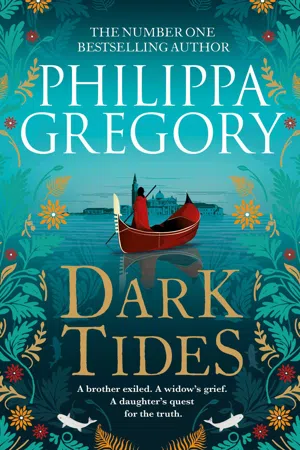
THE SECOND NOVEL IN THE CAPTIVATING FAIRMILE SERIES FROM NUMBER ONE BESTSELLING AUTHOR, PHILIPPA GREGORY, TRACKING THE RISE OF THE TIDELANDS FAMILY IN LONDON, VENICE AND NEW ENGLAND.
Midsummer Eve, 1670. A turbulent time to seek the truth . . .
A wealthy man waits outside a poor London warehouse to meet with Alinor, the woman he failed twenty-one years before. He has everything to offer: money, land, status. He believes she has the only thing he cannot buy: his son and heir.
Meanwhile in New England, Alinor’s brother Ned cannot find justice in the New World, as the King’s revenge stretches across the Atlantic and turns the pioneers against each other and against the American Indians.
Then, a beautiful widow, Livia, arrives from Venice. She claims Alinor as her mother-in-law and has come with the news that Alinor’s son Rob has drowned in the dark tides of the lagoon. But is this true or could this woman be an imposter . . . ?
From London to New England and Venice, the dark tides always rise, and with them come secrets and enemies . . .
‘A gripping read spanning London, Venice and New England, all beautifully observed by Gregory’ Woman & Home
Praise for Tidelands, the first in the Fairmile series:
‘A gripping and intelligent portrait of a woman fighting to survive in a hostile world’ The Times
‘The first in a planned series . . . The author crafts her material with effortless ease. Her grasp of social mores is brilliant, the love story rings true and the research is, as ever, of the highest calibre’ Elizabeth Buchan, Daily Mail
‘Vivid and beguiling – Philippa Gregory at her best’ Woman & Home
‘A compelling novel that shines a light on the struggles of 17th century women’ Daily Mirror
‘The novel's power lies in Gregory's evocative portrayal of the tidelands and the everyday lives of those who are bound to them’ Sunday Express
‘If this novel is the first sign of what's to come then readers are in for a treat’ Emma Lee-Potter, Daily Express
Frequently asked questions
Yes, you can cancel anytime from the Subscription tab in your account settings on the Perlego website. Your subscription will stay active until the end of your current billing period. Learn how to cancel your subscription.
No, books cannot be downloaded as external files, such as PDFs, for use outside of Perlego. However, you can download books within the Perlego app for offline reading on mobile or tablet. Learn more here.
Perlego offers two plans: Essential and Complete
Essential is ideal for learners and professionals who enjoy exploring a wide range of subjects. Access the Essential Library with 800,000+ trusted titles and best-sellers across business, personal growth, and the humanities. Includes unlimited reading time and Standard Read Aloud voice.
Complete: Perfect for advanced learners and researchers needing full, unrestricted access. Unlock 1.4M+ books across hundreds of subjects, including academic and specialized titles. The Complete Plan also includes advanced features like Premium Read Aloud and Research Assistant.
Both plans are available with monthly, semester, or annual billing cycles.
We are an online textbook subscription service, where you can get access to an entire online library for less than the price of a single book per month. With over 1 million books across 1000+ topics, we’ve got you covered! Learn more here.
Look out for the read-aloud symbol on your next book to see if you can listen to it. The read-aloud tool reads text aloud for you, highlighting the text as it is being read. You can pause it, speed it up and slow it down. Learn more here.
Yes! You can use the Perlego app on both iOS or Android devices to read anytime, anywhere — even offline. Perfect for commutes or when you’re on the go. Please note we cannot support devices running on iOS 13 and Android 7 or earlier. Learn more about using the app.
Yes, you can access Dark Tides by Philippa Gregory in PDF and/or ePUB format, as well as other popular books in Literature & Literature General. We have over one million books available in our catalogue for you to explore.
The ramshackle warehouse was the wrong side of the river, the south side, where the buildings jostled for space and the little boats unloaded pocket-size cargos for scant profit. The wealth of London passed them by, sailing upstream to the half-built new Custom House, its cream stone façade set square on the fast-flowing river, as if it would tax every drop of the roiling dirty water. The greatest ships, towed by eager barges, glided past the little wharves, as if the quays were nothing but flotsam, sticks and cobbles, rotting as they stood. Twice a day even the tide deserted them, leaving banks of stinking mud, and piers of weedy ramps rising like old bones from the water.
This warehouse, and all the others leaning against it, like carelessly shelved books, shuddering along the bank towards the dark channel at the side, were hungry for the wealth that had sailed with the new king in the ship that had once been Oliver Cromwell’s, into the country that had once been free. These poor merchants, scraping a living from the river trade, heard all about the new king and his glorious court at Whitehall; but they gained nothing from his return. They saw him only once, as he sailed by, the royal pennants flying fore and aft, once and never again: not down here, on the south side of the river, on the east side of the town. This was never a place that people visited, it was a place that people left; not a place that ever saw a grand carriage or a fine horse. The returning king stayed west of the City, surrounded by aristocratic chancers and titled whores, all of them desperate for promiscuous pleasure, jerked back from despair by gamblers’ luck: not one of them earning their good fortune.
But this little house clung to the old puritan principles of hard work and thrift, just as the buildings clung to the quayside: so thought the man who stood before it, staring up at the windows as if he were hoping to catch a glimpse of someone inside. His brown suit was neat, the white lace at his collar and cuffs modest in these times of fashionable excess. His horse stood patiently behind him as he scanned the blank face of the warehouse – the pulley on the wall, and the wide-open double doors – and then turned to the murky river to watch the lumpers throwing heavy grain sacks, one to another from the grounded flat-bottomed barge, grunting a monotone chant to keep the rhythm.
The gentleman on the quayside felt as alien here as he did on his rare visits to court. It seemed as if there was no place for him at all in this new England. In the glittering, noisy palaces, he was a dowdy reminder of a difficult past, best clapped on the back with a quickly forgotten promise. But here on the quayside at Bermondsey he stood out as a stranger: a rich idler among labouring men, a silent presence amid the constant scream from the pulley of the crane, the rumble of rolling barrels, the shouted orders and the sweating lumpers. At court, he was in the way of a thoughtless round of pleasure, he was too drab for them. Here, he was in the way of the passage of work, where men were not individuals but moved as one, each one a cog; as if even work was not work anymore; but had been atomised into a new painful machine. He thought the world was not whole anymore; but sundered into country and court, winners and the lost, protestants and heretics, royalists and roundheads, the unfairly blessed and the unjustly damned.
He felt very far from his own world of small luxuries taken for granted – hot water in a china jug in the bedroom, clean clothes laid out for the day, servants to do everything – but he must enter this world of work if he were to make right the wrong he had done, bring a good woman to happiness, heal the wounds of his own failure. Like the king, he had come to make a restoration.
He hitched his horse to a ring on a post, stepped to the edge of the wharf and looked down into the flat-bottomed barge which was grounded heavily on the ramp beside the quay. ‘Where have you come from?’ he called down to the man he took to be the master of the ship who was watching the unloading, ticking off the sacks in a ledger.
‘Sealsea Island, Sussex,’ the man replied in the old, familiar drawling accent. ‘Best wheat in England, Sussex wheat.’ He squinted upwards. ‘You’ve come to buy? Or Sussex-brewed ale? And salted fish? We’ve got that too.’
‘I’m not here to buy,’ the stranger replied, his heart thudding in his chest at the name of the island that had been his home: her home.
‘Nay, you’ll be here for a dance in the ladies’ great hall?’ the ship master joked, and one of the lumpers gave a crack of a laugh as the gentleman turned away from their impertinence, to look up at the warehouse again.
It was on the corner of a run of shabby three-storey warehouses built of planks and old ships’ timbers, the most prosperous of a poor row. Further along the quay, where the River Neckinger joined the Thames in a swirl of filthy water, there was a gibbet with a long-ago hanged man, a few tatters of cloth holding the bleached remaining bones. A pirate, whose punishment had been to hang, and be left to hang as a warning to others. The gentleman shuddered. He could not imagine how the woman he had known could bear to live within earshot of the creak of the chain.
He knew that she had no choice, and she had done the best she could with the wharf. Clearly, the warehouse had been improved and rebuilt. Someone had gone to the expense and trouble to build a little turret at the downriver corner of the house, looking out over the Thames and the River Neckinger. She could step out of the glazed door and stand on a little balcony to look east: downriver towards the sea; or west: upriver to the City of London; or inland along St Saviour’s dock. She could open the window to listen to the cry of gulls and watch the tide rise and fall below her window and the goods come into the wharf below. Perhaps it reminded her of home, perhaps some nights she sat there, as the mist came up the river turning the sky as grey as water, and she thought of other nights and the thunder of the tide mill wheel turning. Perhaps she looked across the turbulent river to the north, beyond the narrow street of chandlers and victuallers, past the marshes where the seabirds wheeled and cried; perhaps she imagined the hills of the north and the wide skies of the home of a man she had once loved.
The gentleman stepped up to the front door of the warehouse which was clearly home, business and store combined, lifted the ivory handle of his riding crop and rapped loudly. He waited, hearing footsteps approaching, echoing down a wooden hall, and then the door opened and a maid stood before him, in a stained working apron, staring aghast at the glossy pelt of his French hat and his highly polished boots.
‘I should like to see—’ Now that he had got this far, he realised he did not know what name she used, nor the name of the owner of the warehouse. ‘I should like to see the lady of the house.’
‘Which one?’ she demanded, wiping a dirty hand on her hessian apron. ‘Mrs Reekie or Mrs Stoney?’
He caught his breath at her husband’s name and the mention of her daughter, and thought that if he was so shaken to hear this, what would he feel when he saw her? ‘Mrs Reekie,’ he recovered. ‘It is she that I wish to see. Is Mrs Reekie at home?’
She widened the gap of the front door; she did not open it politely to let him in, it was as if she had never admitted a visitor. ‘If it’s about a load, you should go to the yard door and see Mrs Stoney.’
‘It’s not about a load. I am calling to visit Mrs Reekie.’
‘Why?’
‘Would you tell her that an old friend has called to see her?’ he replied patiently. He did not dare give his name. A silver sixpence passed from his riding glove to the girl’s work-stained hand. ‘Please ask her to receive me,’ he repeated. ‘And send the groom to take my horse into your stables.’
‘We don’t have a groom,’ she answered, pocketing the coin in her apron, looking him up and down. ‘Just the wagon driver, and there’s only the stables for the team horses and a yard where we store the barrels.’
‘Then tell the wagon driver to put my horse in the yard,’ he instructed.
She opened the front door just wide enough to admit him, leaving it open so the men on the quayside could see him, standing awkwardly in the hall, his hat in one hand, his riding crop and gloves in the other. She walked past him without a word, to a door at the rear, and he could hear her shouting from the back door for someone to open the gate to the yard, though there was no delivery, just a man with a horse that wouldn’t stand on the quayside. Miserably embarrassed, he looked around the hall, at the wood-panelled doors with their raised stone thresholds to hold back a flood, at the narrow wooden staircase, at the single chair, wishing with all his heart that he had never come.
He had thought that the woman he was visiting would be poorer even than this. He had imagined her selling physic out of a quayside window, attending births for sailors’ wives and captains’ whores. He had thought of her so many times in hardship, sewing the child’s clothes with patches, stinting herself to put a bowl of gruel before him, turning this way and that to make a living. He had thought of her as he had known her before, a poor woman but a proud woman, who made every penny she could; but never begged. He had imagined this might be some sort of quayside boarding house and hoped she worked here as a housekeeper; he had prayed that she had not been forced to do anything worse. Every year he had sent her a letter wishing her well, telling her that he thought of her still, with a gold coin under the seal; but she had never acknowledged it. He never even knew if she had received it. He had never allowed himself to find the little warehouse on the side of the river, never allowed himself even to take a boat downriver to look for her door. He had been afraid of what he might find. But this year, this particular year, on this month and this day, he had come.
The maid stamped back into the hall and slammed the front door against the noise and glare of the quayside so he felt that he was at last admitted into the house, and not just delivered into the hall like a bale of goods.
‘Will she see me? Mrs Reekie?’ he asked, stumbling on the name.
Before she could answer, a door further down the hall opened, and a woman in her thirties stepped into the hall. She wore the dark respectable gown of a merchant’s wife, and a plain working apron over it, tied tightly at the curve of her waist. Her collar was modestly high, plain and white, unfashionable in these extravagant days. Her golden-brown hair was combed back and almost completely hidden under a white cap. She had lines at the corners of her eyes and a deep groove in her forehead from frowning. She did not lower her eyes like a puritan woman, nor did she coquet like a courtier. Once again, with a sense of dread, James met the direct unfriendly gaze of Alys Stoney.
‘You,’ she said without surprise. ‘After all this time.’
‘I,’ he agreed, and bowed low to her. ‘After twenty-one years.’
‘This isn’t a good time,’ she said bluntly.
‘I could not come before. May I speak with you?’
She barely inclined her head in reply. ‘I suppose you’ll want to come in,’ she said gracelessly, and led the way into the adjoining room, indicating that he should step over the raised threshold. A small window gave the view of the distant bank of the river, obscured by masts and lashed sails, and the noisy quay before the house where the lumpers were still loading the wagon, and rolling barrels into the warehouse. She dropped the window blind so that the men working on the quay could not see her direct him towards a plain wooden chair. He took a seat, as she paused one hand on the mantelpiece gazing down into the empty grate as if she were a judge, standing over him, considering sentence.
‘I sent money, every year,’ he said awkwardly.
‘I know,’ she said. ‘You sent one Louis d’Or. I took it.’
‘She never replied to my letters.’
‘She never saw them.’
He felt himself gasp as if she had winded him. ‘My letters were addressed to her.’
She shrugged as if she cared for nothing.
‘In honour, you should have given them to her. They were private.’
She looked completely indifferent.
‘By law, by the laws of this land, they belong to her, or they should have been returned to me,’ he protested.
Briefly, she glanced at him. ‘I don’t think either of us have much to do with the law.’
‘Actually, I am a justice of the peace in my shire,’ he said stiffly. ‘And a member of the House of Commons. I uphold the law.’
As she bowed her head, he saw the sarcastic gleam in her eyes. ‘Pardon me, your honour! But I can’t return them as I burned them.’
‘You read them?’
She shook her head. ‘No. Once I had the gold from under the seal, I had no interest in them,’ she said. ‘Nor in you.’
He had a choking sensation as if he were drowning under a weight of water. He had to remember that he was a gentleman; and she had been a farm girl and was now passing herself off as the lady of a poor warehouse. He had to remember that he had fathered a child who lived here, in this unprepossessing workplace, and he had rights. He had to remember that she was a thief, and her mother accused of worse, while he was a titled gentleman with lands inherited for generations. He was descending from a great position to visit them, prepared to perform an extraordinary act of charity to help this impoverished family. ‘I could have written anything,’ he said sharply. ‘You had no right…’
‘You could have written anything,’ she conceded. ‘And still, I would have had no interest.’
‘And she…’
She shrugged. ‘I don’t know what she thinks of you,’ she said. ‘I have no interest in that either.’
‘She must have spoken of me!’
The face she turned to him was insolently blank. ‘Oh, must she?’
The thought that Alinor had never spoken of him in all these years struck him like a physical blow in the chest; knocking him back in his hard chair. If she had died in his arms twenty-on...
Table of contents
Cover
Title Page
1. Midsummer Eve, 1670, London
2. June 1670, Hadley, New England
3. June 1670, London
4. June 1670, London
5. June 1670, Hadley, New England
6. June 1670, London
7. June 1670, Hadley, New England
8. June 1670, London
9. June 1670, Hadley, New England
10. June 1670, London
11. June 1670, London
12. June 1670, Hadley, New England
13. June 1670, London
14. June 1670, Hadley, New England
15. June 1670, London
16. June 1670, London
17. June 1670, Hadley, New England
18. June 1670, London
19. June 1670, Hadley, New England
20. June 1670, London
21. June 1670, Hadley, New England
22. June 1670, London
23. June 1670, Hadley, New England
24. June 1670, London
25. July 1670, London
26. August 1670, Hadley, New England
27. August 1670, London
28. August 1670, London
29. August 1670, London
30. September 1670, London
31. September 1670, Hadley, New England
32. September 1670, London
33. September 1670, Hadley, New England
34. September 1670, London
35. September 1670, Hadley, New England
36. September 1670, London
37. October 1670, Hadley, New England
38. October 1670, London
39. October 1670, London
40. October 1670, Hadley, New England
41. October 1670, London
42. October 1670, Hadley, New England
43. October 1670, London
44. October 1670, London
45. November 1670, London
46. November 1670, Hadley, New England
47. November 1670, London
48. November 1670, London
49. November 1670, Hadley, New England
50. November 1670, London
51. November 1670, London
52. November 1670, London
53. November 1670, Hadley, New England
54. November 1670, AT Sea
55. December 1670, London
56. December 1670, Venice
57. December 1670, London
58. December 1670, Venice
59. December 1670, Hadley, New England
60. December 1670, London
61. December 1670, Venice
62. December 1670, Hadley, New England
63. December 1670, Venice
64. December 1670, London
65. December 1670, Venice
66. December 1670, London
67. December 1670, Venice
68. December 1670, London
69. December 1670, Hadley, New England
70. December 1670, Venice
71. December 1670, London
72. December 1670, Venice
73. December 1670, London
74. December 1670, Venice
75. December 1670, London
76. December 1670, Venice
77. December 1670, London
78. December 1670, Venice
79. December 1670, London
80. December 1670, Venice
81. December 1670, Hadley, New England
82. December 1670, London
83. December 1670, Venice
84. December 1670, London
85. December 1670, Venice
86. December 1670, London
87. December 1670, Venice
88. December 1670, Hadley, New England
89. December 1670, London
90. December 1670, Venice
91. January 1671, Hadley, New England
92. January 1671, London
93. January 1671, at Sea
94. February 1671, Hadley, New England
95. February 1671, at Sea
96. February 1671, London
97. February 1671, St Clement Danes Church, London