The Guns of John Moses Browning
eBook - ePub

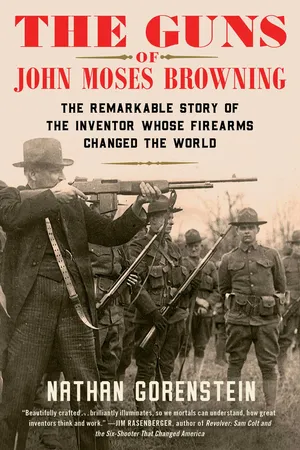
The Guns of John Moses Browning

The Remarkable Story of the Inventor Whose Firearms Changed the World

  1. 336 pages
  2. English
  3. ePUB (mobile friendly)
  4. Available on iOS & Android
eBook - ePub

The Guns of John Moses Browning

The Remarkable Story of the Inventor Whose Firearms Changed the World

About this book

A “well-researched and very readable new biography” (The Wall Street Journal) of “the Thomas Edison of guns,” a visionary inventor who designed the modern handgun and whose awe-inspiring array of firearms helped ensure victory in numerous American wars and holds a crucial place in world history.

Few people are aware that John Moses Browning—a tall, humble, cerebral man born in 1855 and raised as a Mormon in the American West—was the mind behind many of the world-changing firearms that dominated more than a century of conflict. He invented the design used in virtually all modern pistols, created the most popular hunting rifles and shotguns, and conceived the machine guns that proved decisive not just in World Wars I and II but nearly every major military action since. Yet few in America knew his name until he was into his sixties.

Now, author Nathan Gorenstein brings firearms inventor John Moses Browning to vivid life in this riveting and revealing biography. Embodying the tradition of self-made, self-educated geniuses (like Lincoln and Edison), Browning was able to think in three dimensions (he never used blueprints) and his gifted mind produced everything from the famous Winchester “30-30” hunting rifle to the awesomely effective machine guns used by every American aircraft and infantry unit in World War II. The British credited Browning’s guns with helping to win the Battle of Britain.

His inventions illustrate both the good and bad of weapons.

Sweeping, lively, and brilliantly told, this fascinating book that “gun collectors and historians of armaments will cherish” (Kirkus Reviews) introduces a little-known legend whose impact on history ranks with that of the Wright Brothers, Thomas Edison, and Henry Ford.
Frequently asked questions

Yes, you can cancel anytime from the Subscription tab in your account settings on the Perlego website. Your subscription will stay active until the end of your current billing period. Learn how to cancel your subscription.
At the moment all of our mobile-responsive ePub books are available to download via the app. Most of our PDFs are also available to download and we're working on making the final remaining ones downloadable now. Learn more here.
Perlego offers two plans: Essential and Complete
  • Essential is ideal for learners and professionals who enjoy exploring a wide range of subjects. Access the Essential Library with 800,000+ trusted titles and best-sellers across business, personal growth, and the humanities. Includes unlimited reading time and Standard Read Aloud voice.
  • Complete: Perfect for advanced learners and researchers needing full, unrestricted access. Unlock 1.4M+ books across hundreds of subjects, including academic and specialized titles. The Complete Plan also includes advanced features like Premium Read Aloud and Research Assistant.
Both plans are available with monthly, semester, or annual billing cycles.
We are an online textbook subscription service, where you can get access to an entire online library for less than the price of a single book per month. With over 1 million books across 1000+ topics, we’ve got you covered! Learn more here.
Look out for the read-aloud symbol on your next book to see if you can listen to it. The read-aloud tool reads text aloud for you, highlighting the text as it is being read. You can pause it, speed it up and slow it down. Learn more here.
Yes! You can use the Perlego app on both iOS or Android devices to read anytime, anywhere — even offline. Perfect for commutes or when you’re on the go.
Please note we cannot support devices running on iOS 13 and Android 7 or earlier. Learn more about using the app.
Yes, you can access The Guns of John Moses Browning by Nathan Gorenstein in PDF and/or ePUB format, as well as other popular books in Storia & Biografie in ambito storico. We have over one million books available in our catalogue for you to explore.

Information

CHAPTER ONE FRONTIER LESSONS

John Browning’s first firearm was a crude shotgun, fashioned from a discarded musket barrel as long as he was tall. He built it in his father’s workshop in less than a day and afterward went hunting in the grass of the high plains with Matt, his five-year-old brother and future business partner.1
The 1865 Browning home in Ogden, Utah, was adobe brick, situated a few steps away from untrammeled land filled with grouse, a small wildfowl that made tolerable eating once it was plucked, butchered, and cooked, preferably with bacon fat to moisten the dry flesh. Utah’s five varieties of grouse could fly, but mostly the birds shuffled about on the earth. The male “greater” grouse reached seven pounds, making a decent meal and an easy target, as yellow feathers surrounded each eye and a burst of white marked the breast. A skilled hunter could sneak up on a covey picking at leaves and grasses and with one blast of birdshot get two or three for the frying pan.
Such frugality was necessary. The closest railroad stop was nearly one thousand miles east, and the largest nearby town was Salt Lake City, thirty-five miles to the south and home to only ten thousand people. Ogden’s settlers ate what they grew, raised, or hunted. Water for drinking and crops depended on the streams and rivers that flowed west out of the mountains into the Great Salt Lake, and irrigated wheat, corn, turnips, cabbage, and potatoes. Each settler was obliged to contribute labor or money to construct the hand-dug ditches and canals. They made their own bricks, cured hides for leather, and made molasses out of a thin, yellowish juice squeezed from sugar beets with heavy iron rollers and then boiled down to a thick, dark bittersweet liquid.
The rollers were made by John’s father, Jonathan, himself a talented gunsmith who also doubled as a blacksmith while pursuing a variety of entrepreneurial adventures that never yielded more than mixed success. Jonathan’s shop was his son’s playground, and John’s toys were broken gun parts thrown into the corner. At age six, John was taught by his “pappy” to pick out metal bits for forging and hammering into new gun parts. Soon the boy was wielding tools under his father’s direction.
To build that first crude gun John chose a day when his father was away on an errand. From the pile of discards John retrieved the old musket barrel and dug out a few feet of wire and a length of scrap wood. He clamped the barrel into a vise and with a fine-toothed saw cut off the damaged muzzle. He set Matt to work with a file and orders to scrape a strip along the barrel’s top down to clean metal. With a hatchet John hacked out a crude stock. The boys worked intently. On the frontier a task didn’t have to be polished, but it had to be right. Basic materials were in short supply, and to make his gun parts and agricultural tools Pappy Browning scavenged iron and steel abandoned by exhausted and overloaded immigrants passing through on their way west. Once, he purchased a load of metal fittings collected from the burned-out remains of an army wagon train, and as payment he signed over a parcel of land that, years later, became the site of Ogden’s first hotel.
John used a length of wire to fasten the gun barrel to the stock, then bonded them with drops of molten solder. There was no trigger. Near the barrel’s flash hole John screwed on a tin cone. When it came time to fire, gunpowder and lead birdshot would be loaded down the muzzle and finely ground primer powder would be sprinkled into the cone. The brothers would work together as a team: John would aim, Matt would lean in and ignite the primer with the tip of a smoldering stick, and the cobbled-together shotgun would, presumably, fire.
This wasn’t without risk. There was no telling if the soldered wire was strong enough to contain the recoil, or if the barrel itself would burst. Then there was the matter of ammunition. Gunpowder and shot were expensive imports delivered by ox-drawn wagon train, and early settlers, surrounded by game, suffered pangs of hunger when foodstuffs were eaten up, powder was exhausted, and their firearms hung useless on the wall. Even as a shotgun—which fires lead pellets—the Browning brothers’ makeshift weapon might prove ineffective. John could miss, and anger their father by using up valuable gunpowder with no result. Despite the risks, John pilfered enough powder and lead shot (from Jonathan’s poorly hidden supply) for one shot.
In ten minutes the brothers were in open country. Ogden’s eastern side nestled against the sheer ramparts of the Wasatch Mountains, and to the west lay the waters of the Great Salt Lake. To the north the Bear and Weber rivers flowed out of the Wasatch to sustain the largest waterfowl breeding ground west of the Mississippi River. Early white explorers were staggered by seemingly endless flocks of geese and ducks. In the 1840s pioneers described the “astonishing spectacle of waterfowl multitudes” taking to the air with a sound like “distant thunder.” Mountains rose up in all four directions, with one range or another flashing reflected sunlight. It was a striking geographic combination, magnified by the bright, clear sunlight of Ogden’s near-mile-high elevation. A settler’s life was lived on a stage of uncommon spectacle.2
John carried the shotgun while Matt toted a stick and a small metal can holding a few clumps of glowing coal. The idea was to take two or three birds with a single shot, thereby allaying parental anger with a show of skilled marksmanship. Barefoot, the brothers crept from place to place until they spotted a cluster of birds pecking at the ground. Two were almost touching wings and a third was inches away. John knelt and aimed. Matt pulled the glowing stick out of the embers, almost jabbed John in the ear, and then touched the stick to the tin cone to fire the shot. The recoil knocked John backward—but in front of him lay a dead bird. Two other wounded fowl flapped nearby. Matt scampered ahead and “stood, a bird in each hand, whooping and trying to wring both necks at once.”
The next morning, as Jonathan breakfasted on grouse breast and biscuits, John listened to sympathetic advice from his mother and chose that moment to tell Pappy the story of his gun, his hunt—and the pilfered powder. Jonathan sat quietly and when John was finished made no mention of the theft. He did ask to see the weapon and was unimpressed. “John Moses, you’re going on eleven; can’t you make a better gun than that?”
Matt snickered. John choked down his remaining breakfast. “Pappy has drawn first blood, no doubt about that. He hadn’t scolded about the powder and shot, and the sin of stealing. But he’d hit my pride right on the funny bone,” John told his family decades later. A moment later he followed his father into the shop. He unrolled the wire from the barrel, “whistling soft and low to show how unconcerned I was,” and then stamped on the stock, snapped it in two, and tossed the pieces into a pile of kindling. “I remember thinking, rebelliously, that for all Pappy might say, the gun had gotten three fine birds for breakfast. Then I set to work. Neither of us mentioned it again.”

The father, Jonathan, who was tutor and goad to his son John, was born in 1805 to a family that emigrated from Virginia to rich farmland outside Nashville, Tennessee. Jonathan Browning was the sixth of seven children raised on a homestead at Brushy Farm along Bledsoe Creek, a four-mile-long tributary feeding the Cumberland River. Early on, Jonathan decided he’d rather hammer on an anvil than walk behind a plow and at nineteen years of age apprenticed himself to a Nashville rifle maker. He returned to Bledsoe Creek to open his own shop in 1826, and in November of that year, at age twenty-one, married a local woman, Elizabeth Stalcup. She was twenty-three, the only child of a widowed mother. When Jonathan’s parents and several brothers moved west to Quincy, Illinois, a newly settled town on the Mississippi River, Jonathan and Elizabeth followed. In 1834 they moved to the village of La Prairie. It was the start of a decade-long trek westward as they added children at the rate of one infant per year.3
The extended Browning family in Illinois included a cousin, Orville, a politically ambitious attorney who boasted that frontier rarity, a college education. Orville practiced real estate law, and so, along with gunsmithing, Jonathan began purchasing land in the surrounding counties, often at sheriff sales, and holding the parcels for eventual resale. While Orville persuaded Jonathan to run for justice of the peace, it was gunsmithing that produced a lucrative income for his growing family. In addition to a steady flow of repairs, Jonathan designed a repeating rifle that used the same mechanism found in Samuel Colt’s new six-shooter pistol: a metal cylinder with six cylindrical chambers, each loaded with a lead ball and gunpowder, which would be ignited by a percussion cap. Colt’s gun was the first practical repeating firearm. Jonathan produced a rifle-sized version and crafted a trigger, stock, and barrel. A surviving example shows an exquisite level of craftsmanship, but it required time and effort that Jonathan found unsustainable.4
While Jonathan was inventing, cousin Orville was elected to the state legislature, where he befriended another young lawyer, a tall, thin man with a distinctive jaw named Abraham Lincoln.5 The men were of similar age and background. Both grew up in Kentucky, served in the state militia, and had similar politics—they were opposed to the expansion of slavery—which eventually led them to join the new Republican Party. The two legislators became friends, and Browning family oral history says that at Orville’s behest Jonathan and Elizabeth, who enjoyed a relatively spacious home on account of their ever-expanding family, played host to Orville’s friends or clients in need of lodging. On two occasions young lawyer Lincoln was the guest. So the story goes, anyway. Research by a Browning descendant comparing the dates and locations in family lore with the available records of Lincoln’s travels wasn’t definitive but suggests the family lore is “likely” grounded in fact. One story does have a strong whiff of verisimilitude. At an evening meal with Lincoln, probably around 1840, Jonathan remarked how earlier that day he’d set a neighbor’s broken arm, a skill learned after trading a gun for a “doctor book.”
“Fact is, that’s the way I got my first Bible, traded a gun for it.”
Lincoln said that reminded him of “the saying about turning swords into plowshares—or was it pruning hooks?”
“Plowshares,” Jonathan replied.
“Well, that’s what you did, in a way turned a gun into a Bible. But the other fellow—he canceled you out by turning a Bible into a gun. Looks like the trade left the world about where it was.”
The men chuckled; then Jonathan admitted “there was something else funny” about the transaction. “To tell the truth, the mainspring in that old gun was pretty weak, and some other things…”
“You mean to admit that you cheated in a trade for a Bible—a Bible!” Lincoln exclaimed.
Jonathan said that the artful deal making went both ways. “When I got to looking through the Bible at home, I found that about half the New Testament was missing.”
Mending, be it bones or guns, was the evening’s favored metaphor. “The United States are to become the greatest country on earth. But what if the hotheads break it in two, right down the middle? That would be a welding job!” Lincoln declared. “It would need the fires of the infernal for the forge. And where was the anvil? Where is the hammer? Where was the blacksmith?” That blacksmith turned out to be Lincoln, and the fires four years of bloody civil war. Cousin Orville became an advisor to President Lincoln, though the better-educated man believed himself worthier and was privately envious of the rougher, self-educated Lincoln.6
Of greater significance for the Browning family was Jonathan and Elizabeth’s introduction to another man, the charismatic Joseph Smith, who in 1823 declared that he’d found a new holy gospel written on golden tablets discovered buried in a New York hillside, and so was inspired to found a new religion. Most of his neighbors considered it a blasphemous cult. Smith called it the Church of Jesus Christ of Latter-day Saints, or the Mormons. Forced to flee Missouri in 1839, Smith and his followers trekked to Illinois and founded the town of Nauvoo, a name drawn from Hebrew for “they are beautiful.” An earlier stop in Missouri led to that state issuing an extradition warrant for “overt acts of treason,” but Jonathan’s cousin Orville got the warrant thrown out by an Illinois court. That didn’t end Smith’s problems, as rumors circulated about his “plural marriages,” an affront to the law and social mores. Yet the new faith expanded. Unlike most other sects born during the spiritual revival of the mid-1800s, Smith’s religion provided a cohesive community and economic security, a “theocratic-democracy” that offered structure “for lives beset by unpredictability, disorder and change” amid the uncertainties, isolation, and insecurity of the frontier.
In 1840 a proselytizing Mormon in need of a gun repair introduced Jonathan to the faith and, after a lengthy conversation in the shop, the customer called at his home and presented Jonathan with the Book of Mormon. Jonathan wasn’t economically insecure—his business dealings were thriving. Though uneducated in any traditional sense, he was an ambitious, curious man who may have seen the church as an alternative to the many warring Protestant sects. It offered the promise of salvation and a comprehensive social network that was rooted in a patriarchal family structure. “He seemed to perceive a clearly marked road to salvation, a map in effect, to guide man through the wilderness of life to the gates of heaven,” his grandson Jack wrote a century later.
Jonathan was baptized into the church, moved to Nauvoo with his family, and briefly became owner of a two-story home and gun shop. In 1844 the first and only edition of a Nauvoo newspaper, the Expositor, published an editorial that bitterly criticized Smith for serving in the dual role of mayor and church leader. Smith declared the newspaper a public nuisance and ordered the town marshal to destroy the printing press, an ill-considered decision that led to criminal charges of riot and “treason against the state.” Smith was jailed and on June 27, 1844, a mob stormed his cell. A gun battle broke out and Smith was killed.
It was around this time that Jonathan designed a second firearm, soon much sought after by his Mormon brethren. It was an ingenious device called the slide bar repeating rifle, colloquially named a harmonica rifle, since a vital part indeed bore a resemblance to the musical instrument. A brief description of how a firearm works is helpful to understand not only that rifle but John Browning’s later work.

As Browning reached manhood in the 1870s the basic architecture of the modern firearm was cemented into place. Any pistol, rifle, shotgun, or machine gun, no matter how complex or powerful, has the same essential components: a hollow steel barrel, with an opening at one end called the muzzle, where the bullet emerges, and a hole at the other end, called the breech, where the barrel is bored out to create the loading chamber. When a gun is loaded, the “cartridge”—a brass case with a pinch of explosive primer at its base followed by gunpowder and topped by a lead projectile—is inserted into the chamber. Then the chamber is sealed by a “breechblock” so that the hot gas produced by fast-burning7 propellant is directed forward, out of the muzzle, and not backward (into the shooter’s face).
The breechblock is also sometimes simply called the block or the bolt. Thanks to the English language’s many borrowed words, and a history of firearm development dating to the 1200s, a single component can have a variety of names. “Bullet” is from the French word for “small ball” and technically only refers to a lead projectile, but it’s also used to describe what is otherwise called the cartridge, a word with roots in medieval Latin. A cartridge is also called a round, from the original round musket balls. “Ammunition” refers to one or more cartridges.
Whatever the name, ammunition in a modern firearm is loaded through the breech, rather than down the muzzle. That advance came when inventors in the nineteenth century figured out how to design breechblock mechanisms that could quickly open and close while withstanding the force of exploding gunpowder. Reduced to its most basic element, a modern firearm design begins with selecting—or inventing—the breechblock. As John Browning later wrote, “With me, the breech closure is the initial point, everything else is designed to conform to it.”8

In Jonathan’s harmonica gun the sliding bar was drilled to hold five charges that could be fired in quick succession. The loaded bar slid sideways into the rifle and was locked in place by a lever. With a pull of the trigger the hammer snapped forward, struck a percussion cap, and ignited the powder.
To reload, the lever was released, the bar was slid over, and the next chamber was aligned with the barrel. About four hundred of the rifles were built over the next decade as the family traveled west, pausing in Iowa before setting out for Utah with a family of eleven children and seven wagons of supplies and equipment, and carrying a respectable $600 in savings. They arrived in Salt Lake Valley on October 2, 1852, midway through the great Mormon migration west.

By then Jonathan was forty-seven years old and had lived more than half his life. Nevertheless, he marked his arrival in Mormo...

Table of contents

  1. Cover
  2. Title Page
  3. Author’s Note
  4. Prologue
  5. Chapter One: Frontier Lessons
  6. Chapter Two: Land of Invention
  7. Chapter Three: Conquering the East
  8. Chapter Four: Trekking Through Georgia
  9. Chapter Five: Thinking in Three Dimensions
  10. Chapter Six: America’s Deer Rifle
  11. Chapter Seven: The Mustachioed Man
  12. Chapter Eight: Georg’s Luger and John’s Shotgun
  13. Chapter Nine: A Mechanism for the Ages
  14. Chapter Ten: Arming the Army
  15. Chapter Eleven: The Sixty-Fourth or Sixty-Fifth Voyage
  16. Chapter Twelve: Twenty Thousand Feet High
  17. Chapter Thirteen: Soldiers at War
  18. Epilogue
  19. Photographs
  20. Acknowledgments
  21. About the Author
  22. Glossary
  23. Notes
  24. Bibliography
  25. Index
  26. Copyright