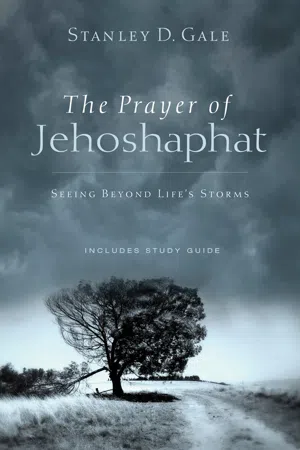
As overwhelming circumstances take over our lives, Prayer of Jehoshaphat directs us to hold on to God's hand who leads us from the crisis to gather up his blessings.
- English
- ePUB (mobile friendly)
- Available on iOS & Android
eBook - ePub
About this book
Information
Topic
Theology & ReligionSubtopic
Religion10
Aftermath of Grace
That place has been called the Valley of Beracah.
O n a note of praise, even in an atmosphere of worship, Jehoshaphat led his grossly overmatched, vastly outnumbered army out to take on the enemy. Instead of a battle cry, his soldiers sang and gave thanks to the Lord for his steadfast love. The battle was engaged, but it was the Lord who fought on their behalf. He caused the vast horde to implode, fighting with one another. “They all helped to destroy one another” (v. 23). Before the Lord, the enemy was routed.
It’s almost as if the battle were a side note to the account. The lion’s share of the detail is devoted to variegated prayer to God (i.e., praise, confession, thanksgiving, petition), and the giving of glory to God who fights on behalf of his people. A mere two verses are given to the description of the battle. Perhaps that’s reflective of the power of the “vast horde” in comparison to the power of the Lord God Almighty. Perhaps the paucity of battle details is indicative of what God actually wants us to see in the account. Perhaps the presenting crisis is tangential to what is the real battle.
Field of Battle
When we face crisis in our lives and try to find voice in our times of distress, the main issue is not the crisis, although it’s hard to convince ourselves of that at the time. When a mountain of debt or a devastating diagnosis or a ruptured relationship besieges us, it certainly seems the main issue. But is it?
Numerous times I have stood alongside men, women, couples, and families in the trenches of a battle they face. By prayer and God’s revealed Word, we have traveled from the feebleness of fear to the fortress of faith in God their refuge and strength, an ever-present help in trouble. Yet, when the storm is past I find the same fears and “what ifs” and frustrations have crept back in. They have not been washed away by the tide of trouble. Many times those involved have even been inoculated by the episode, inviting a stronger strain of the disease of doubt, more resistant to change. They may have overcome the financial, physical, or whatever sort of tyranny confronted them, but they remain in the grip of a foe occupying their heart. The inner oppressor, silhouetted and exposed by the flashing of the bombs of the assault, continues to hold ground.
The primary front on which God works in our lives is the battleground of our hearts. The main issue, the heart of the matter, is the matter of the heart. Where are our hearts in respect to God? Who is greater in our eyes, God or the crisis? Whose will do we really want? How will we handle ourselves in the face of fear? These are the questions that occupy center stage in the wartime drama with Jehoshaphat.
The Spoils of Struggle
Growing up at the beach I witnessed many severe storms. Often during a hurricane or nor’easter I would walk down to the shore and take in the fury of the gray, white-capped, swelling, surging ocean. Sometimes the water would come all the way up, completely engulfing the beach, washing even over the boardwalk. It was an impressive sight.
When the storm passed and the waters receded, the beach would be littered with debris—a treasure trove of shells, driftwood, and sea life left behind by the retreating tide. Remarkably, the only way those treasures could be found on the beach was through the storm. The wind and the waves served as the vehicle through which the debris was deposited.
Storms come into our lives with the purpose of God, carrying the treasures of his providence, leaving an aftermath of his grace. We listen again to the wisdom of God as Moses ministers God’s Word to the people in their wilderness wanderings:
And you shall remember the whole way that the Lord your God has led you these forty years in the wilderness, that he might humble you, testing you to know what was in your heart, whether you would keep his commandments or not. And he humbled you and let you hunger and fed you with manna, which you did not know, nor did your fathers know, that he might make you know that man does not live by bread alone, but man lives by every word that comes from the mouth of the Lord. Your clothing did not wear out on you and your foot did not swell these forty years. Know then in your heart that, as a man disciplines his son, the Lord your God disciplines you. (Deut. 8:2–5)
Moses describes God’s hand in the deprivation for enrichment of his people. God is at work as a good and wise father in the lives of his children. Many times the storm is the only mode of transportation by which those blessings of his grace and fruit of his loving discipline could come.
James in the New Testament reminds us that the trials of our lives carry with them the purpose of God.
Count it all joy, my brothers, when you meet trials of various kinds, for you know that the testing of your faith produces steadfastness. And let steadfastness have its full effect, that you may be perfect and complete, lacking in nothing. (James 1:2–4)
The joy is not in the trial per se, but in the personal hand of our God and Father who brings the trial to us and in the expectation of what that trial will bring to us in keeping with his perfect purpose.
God’s intention is that the crises we face in our lives that cause us so much distress will work to make us stronger, more fully committed, better acquainted with the sufficiency of his grace, more determined to know and serve him, and more mature in Christlike character by his handiwork of grace. That’s what James means when he speaks of us being “perfect and complete, lacking in nothing.” He’s not referring to our bank accounts but to the vault of heavenly riches that we will carry into eternity as he grows us for glory.
To the Victor
As was typical in battle in ancient times, to the victor belonged the spoils. In this case, Jehoshaphat’s army reaped the spoils of the vicarious victory. Such was the extent of the booty that we are told, “they could carry no more.” “They were three days in taking the spoil, it was so much” (2 Chron. 20:25).
They ventured into the field of battle to survey the aftermath of God’s grace, to take what they had not earned and to gather up an abundance they had not expected. What an amazing picture of God’s grace! That’s what grace is. Grace gives us what we do not deserve. It comes to us as a gift—unmerited, unearned, unexpected. Their faith had not earned a blessing, but it certainly had received a blessing.
We might grimace to think of war and plundering the spoil, but that offers an apt picture for the aftermath of the crisis that has oppressed us. It reminds us that there is a struggle involved and blessing from our God, who is not merely waiting for us as a light at the end of the tunnel. He is with us as the light in the tunnel to guide and provide, brightening our way to the bounty of blessing carried by the trial that awaits our exploration.
Now weighed down with bounty instead of dread, Jehoshaphat and his victorious army assembled in the “Valley of Beracah”(v. 26). Beracah means “blessing.” The concept cuts two ways. On the one hand it speaks to the blessing we receive, for which we are to scour the field of battle, the treasures of grace brought by our God to us through the upheaval. On the other hand, Beracah speaks to the blessings we are...
Table of contents
- Contents
- Seeing beyond the Storm
- Sharpening Our Gaze on Glory
- Privileged Access
- Prevailing Prayer
- Sand Bags of Promise
- Standing Firm
- Stepping Out
- Courage of Faith
- Aftermath of Grace
Trusted by 375,005 students
Access to over 1.5 million titles for a fair monthly price.
Study more efficiently using our study tools.
Frequently asked questions
Yes, you can cancel anytime from the Subscription tab in your account settings on the Perlego website. Your subscription will stay active until the end of your current billing period. Learn how to cancel your subscription
No, books cannot be downloaded as external files, such as PDFs, for use outside of Perlego. However, you can download books within the Perlego app for offline reading on mobile or tablet. Learn how to download books offline
Perlego offers two plans: Essential and Complete
- Essential is ideal for learners and professionals who enjoy exploring a wide range of subjects. Access the Essential Library with 800,000+ trusted titles and best-sellers across business, personal growth, and the humanities. Includes unlimited reading time and Standard Read Aloud voice.
- Complete: Perfect for advanced learners and researchers needing full, unrestricted access. Unlock 1.5M+ books across hundreds of subjects, including academic and specialized titles. The Complete Plan also includes advanced features like Premium Read Aloud and Research Assistant.
We are an online textbook subscription service, where you can get access to an entire online library for less than the price of a single book per month. With over 1.5 million books across 990+ topics, we’ve got you covered! Learn about our mission
Look out for the read-aloud symbol on your next book to see if you can listen to it. The read-aloud tool reads text aloud for you, highlighting the text as it is being read. You can pause it, speed it up and slow it down. Learn more about Read Aloud
Yes! You can use the Perlego app on both iOS and Android devices to read anytime, anywhere — even offline. Perfect for commutes or when you’re on the go.
Please note we cannot support devices running on iOS 13 and Android 7 or earlier. Learn more about using the app
Please note we cannot support devices running on iOS 13 and Android 7 or earlier. Learn more about using the app
Yes, you can access The Prayer of Jehoshaphat by Stanley D. Gale in PDF and/or ePUB format, as well as other popular books in Theology & Religion & Religion. We have over 1.5 million books available in our catalogue for you to explore.