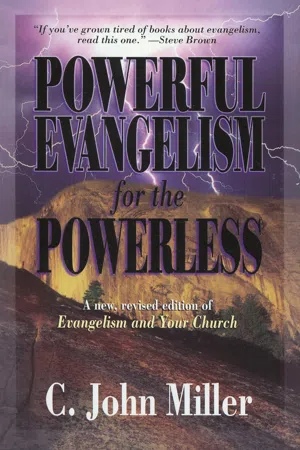
Miller both challenges and inspires as he shows us how to overcome powerlessness in bearing witness for Christ.
- English
- ePUB (mobile friendly)
- Available on iOS & Android
eBook - ePub
Powerful Evangelism for the Powerless
About this book
Information
Topic
Theology & ReligionSubtopic
Christian Ministry1
The Unspent Treasure: Our Missionary Legacy
Do you remember Roots? Few things captured the imagination of the American public so completely as that first television miniseries, a chronicle of a black family’s life. All of a sudden, people were scouring archives and attics for traces of their own family history. Overnight, the past became the “latest thing.” It was seen by thousands of Americans as the key to a deeper sense of personal identity
I don’t believe that the American public had ever experienced a phenomenon quite like Roots, but it wasn’t the first time that I had seen large groups of people delve into the past with great curiosity and enthusiasm. As a pastor, seminary teacher, and church planter during the past thirty years, I have seen that an interest in theological roots runs deep among Christians of almost every tradition. My own origins lie within the circle of Reformed and Presbyterian churches. There I have observed many times that retelling the story of our Reformation heritage will light up countenances as little else can! Our historical roots are very important to us.
And really, isn’t that as it should be? The events that spread the gospel through Western Europe should inspire doxologies in the person who loves God’s Word. Our forefather John Calvin, in particular, is justly honored as a scholar, pastor, and teacher who embodied the Reformation commitment to a faith governed by the Word of God.
In my opinion, the Reformed community would be hard to surpass in the way it has respected and preserved its historical and spiritual heritage. And yet one thing about our secular, Roots-seeking counterparts has challenged me regarding the manner in which we study our past. Above all other considerations, the secular seekers’ interest in their pasts is supremely practical. They study their family histories because they believe that such knowledge will provide them with a perspective that will enable them to function better today. They are convinced that the past will open the door to the present, that it will help them to find perspective and purpose now.
Most of us would agree that these individuals are expecting too much from an assemblage of historical data. It is unrealistic to believe that one’s past history will infuse meaning and purpose into a life that otherwise lacks them. As Christians, however, our position is different. Our individual and corporate lives do have meaning and purpose: to glorify God through the faithful ministry of the gospel of His Son, as it is contained in the Scriptures. We know why we are here; we do not need to look to the past to find that answer. However, I am convinced that a study of our religious heritage could be of immense instrumental value if we sought from it practical insights on the ministries of men like Calvin, Knox, Whitefield, and Edwards. What was their understanding of their ministries? How did their perspectives shape the form their works took? What elements of their perspectives and priorities may we adapt to our twenty-first-century ministry?
We as believers need to ask questions like that today, because most of us would agree that the Reformed community, along with the broader evangelical church, has lost much of the impact it had on the world in other periods since the Reformation. It seems as if we are heirs to a vast spiritual inheritance, but we don’t know what to do with it. We know it is valuable, so we guard it to keep it intact. But we lack the practical wisdom to take our fortune and reinvest it, so that the treasures of the past may yield new bounty in our generation.
A number of facts about present-day evangelical and Reformed Christianity suggest that we have not fully “invested” our spiritual inheritance. Consider what we see within some of our churches. Something has gone wrong when a friendly visitor attends one of our urban churches and comes out saying, as one did, “I agreed with the theology of the sermon, but the whole service carried the odor of death.” Some notable exceptions in our tradition have occurred recently in the U.S. and throughout the world. For example, the Presbyterian Church in America has engaged in vigorous church planting in North America and throughout the world. But even in this denomination, what Louie M. Barnes Jr., wrote in the seventies still has relevance for many congregations. He said that “the average local church in the U.S.” has “barely one nostril out of the water,” with Reformed churches in most cases “experiencing the same nosedive in ‘growth’ rates.”[1] With even more burning passion, Sam Moffet, veteran missionary strategist, says that contemporary Christian religious communities (including all denominations) have a “ghetto complex” that segregates them from non-Christians and makes effective evangelism extremely difficult.
What is the fundamental cause of this self-containment and consequent evangelistic barrenness?
As I have studied our forefathers—mine as well as those in the Anglican, Baptist, Methodist, Plymouth Brethren, and Moravian traditions—I cannot escape a disturbing conclusion: we have lost their deep conviction that the gospel, the Word of God, is alive and active, a message so powerful and so thoroughly irresistible when applied by the Holy Spirit, that it could not help but bear fruit in the salvation of souls. Their reverence for the Word and for the doctrines of grace was great, just as ours is today, but the difference between us is this: While our emphasis is on preserving true doctrine and defending the faith, theirs was on taking the gospel and going on the offensive, bringing God’s message to men and conquering them in Christ. They wanted not only to preserve the gospel, but to put it to work, to see it change lives and expand God’s kingdom.
Baptist Charles Haddon Spurgeon’s ministry illustrates the perspective I am describing. The source of power for his preaching can be seen in this sermon excerpt:
Oh, the power, the melting, conquering, transforming power of that dear cross of Christ! My brethren, we have but to abide by the preaching of it, we have but constantly to tell abroad the matchless story, and we may expect to see the most remarkable spiritual results. We need despair of no man now that Jesus has died for sinners. With such a hammer as the doctrine of the cross, the most flinty heart will be broken; and with such a fire as the sweet love of Christ, the most mighty iceberg will be melted. We need never despair for the heathenish or superstitious races of men; if we can but find occasion to bring the doctrine of Christ crucified into contact with their natures, it will yet change them, and Christ will be their king.[2]
It was said of Anglican George Whitefield (by no less a preacher than John Newton) that “he never preached in vain.”[3] J. C. Ryle describes him as “the first to see that Christ’s ministers must do the work of fishermen. They must not wait for souls to come to them, but must go after souls, and ‘compel them to come in.’ “[4]
What was his motivation? “Cry out who will against this my frowardness,” wrote Whitefield, “I cannot see my dear countrymen, and fellow Christians everywhere ready to perish through ignorance and unbelief, and not endeavor to convince them of both.”[5] And to what did Whitefield attribute the amazing fruit of his preaching? “I intend to exalt and contend for more and more,” he once wrote of his future ministry; “not with carnal weapons—that be far from me—but with the sword of the Spirit, the Word of God! No sword like that!”[6]
Calvin also felt the divine imperative not merely to defend the gospel, but to preach it actively to men. In his commentary on John 4:34, he notes,
The nature of Christ’s office is well known—to advance the Kingdom of God, to restore lost souls to life, to spread the light of the Gospel and in short to bring salvation to the world. The importance of these things made Him forget meat and drink when He was tired and hungry. From this we receive no common comfort. It tells us that Christ was so anxious for men’s salvation that the height of pleasure for Him was to attend to it; for we cannot doubt that He has the same attitude towards us today.[7]
What is common to these quotations, and to the men of faith who wrote them, is the deep awareness of God’s foremost intention for His Word and for the church to whom it is entrusted: It is intended to glorify His great name in its orientation toward the salvation of the lost!
God had a missionary purpose when He gave mankind His Word. His desire to reveal Himself to men pervades Scripture from Genesis to Revelation (Gen. 3:15; Rev. 22:17). The fervor of men like Calvin, Whitefield, Spurgeon, Knox, Edwards, and Newton to reach out to the world with the gospel came because by faith they embraced that purpose as their own. This is what we need to learn from our forebears; indeed, this is what we need to learn from God Himself.
We need to come to grips with God’s missionary purpose for His Word. John Newton once commented that “Calvinism was one of the worst of systems preached theoretically, but one of the best preached practically.”[8] I fear that many pastors today have fallen into the error of preaching the doctrines of grace theoretically instead of preaching them practically and using the truths of Scripture to draw men to Christ. Instead of using the Bible as our instrument to draw men into fellowship with God, biblical doctrine has become our grounds to exclude those—even other believers—who disagree with us. Instead of using the Scripture as the sword of the Spirit to conquer men for Christ, we spend our energies defending it, as if it were fragile and easily broken.
I do not wish to dismiss the church’s responsibility to guard her sheep from wolves teaching false doctrine. My problem lies solely with the assumption that such concerns must have first place in the normal ministry of the church. This protectiveness overturns God’s standard order for the church and its ministry. God’s first priority for His church is to proclaim the gospel to the lost, bringing them to salvation. This is followed by the cultivation of the life and unity which that gospel produces among Christ’s people. And finally, in that context, as a living testimony to the power of the Word, the church defends herself against error.
It is noteworthy that Calvin did not suffer from the reversal of priorities from which we suffer. Calvin knew the Bible as a great missionary book in a way that few moderns do. For him it was largely a book of promises centering on Christ’s conquest of the nations through gospel preaching. This can be seen in his commentary on Isaiah 2:3, where he says that men out of “all nations” will be conquered by “the doctrines of the gospel” and stream to Christ. Commenting on the verse that follows, he adds,
By these words he first declares that the godly will be filled with such an ardent desire to spread the doctrines of religion, that every one not satisfied with his own calling and his personal knowledge will desire to draw others along with him. And nothing could be more inconsistent with the nature of faith than that deadness which would lead a man to disregard his brethren, and to keep the light of knowledge choked up within his own breast.[9]
Calvin was not slow to translate his own missionary vision into action. During the years 1555 to 1562, eighty-eight men were trained and commissioned by Calvin as pastors to France. Additional works established in Holland and Scotland by men trained by Calvin were greatly blessed. In Scotland, the response to Christ was so overwhelming that one contemporary observed that “the sky rained men.”
In Germany, England, Wales, Poland, and Hungary, flourishing evangelical Presbyterian and Reformed churches were planted and strengthened by men trained in Geneva. Even such ardently Catholic lands as Italy and Spain were touched by their influence. An amazing zeal for Christ’s cause and God’s glory were instilled in the men Calvin taught.
Yet somewhere in the years between Calvin’s century and ours, our working theology has become abbreviated in a way that would have dismayed such a pioneer in missions. Our emphasis on the wonderful doctrines of grace has somehow come to mask and perhaps (in our own minds) even justify a deep-seated indifference to the lost. Evangelism, God’s first priority for His Word and His church, has become a peripheral activity in the lives of many local congregations. Often it even raises eyebrows as a theologically questionable undertaking because it is so far afield of our usual defensive posture! Louie Barnes noted this attitude in his aforementioned report. Unlike other denominational leaders whose church rolls were shrinking, Barnes observed that Reformed churchmen “sense very little urgency in this matter.” In fact, he says, “many of my colleagues believe that a rapidly expanding, active ‘church’ is proof positive that doctrinal or ethical compromise has certainly taken place.”[10]
I also have observed this attitude among my Reformed contacts. I recall an incident in which one man in a Reformed setting accused another of Arminianism. Asked to justify his charge, he replied simply, “He does aggressive evangelism; that means he’s Arminian.” In another instance, a Reformed pastor was alarmed that Campus Crusade for Christ had come through his community and motivated many of his people to witness in shopping malls. His response was to teach a class in which he “proved” that church officers alone were intended to do evangelism.
Of course, these are extreme examples. But what concerns me is their roots in a widely held conviction that evangelistic zeal is suspect. The inadequacies of some evangelistic groups may fuel those feelings, but I firmly believe that the greatest reason for our antipathy to zeal is that we have overlooked God’s oft-affirmed intention to draw the lost to Himself through the proclamation of His Word.
If God’s primary commitment to reveal Himself to the world is as clear as I have maintained, why have so many well-trained, godly, and dedicated pastors missed it? I attribute this myopia to a “remnant theology” that makes the idea of aggressive evangelism seem pointless. One pastor defended the position this way: “We must not be impatient with history. This is the day of small things; apostasy has reduced us to a remnant. We should really rejoice that ours is the privilege of purifying and strengthening these few.”
But a theology of fewness has no meaning for God’s people since the event of Pentecost. Such a small vision simply does not square with the finality of Peter’s bold announcement that the “last days” have come and that an age of fullness has dawned, with the Spirit being poured out abundantly “upon all flesh” (Acts 2:17). Today we have the banquet of abundant grace! We must open the eyes of faith to the wonder of God’s saving purpose, reaching out since Pentecost to embrace the nations...
Table of contents
- Contents
- Introduction
- 1: The Unspent Treasure: Our Missionary Legacy
- 2: How Big Is God’s Mission Field?
- 3: How Deep Is God’s Love?
- 4: The Marks of Biblical Boldness
- 5: Prayer and the Promises: Power Source for Bold Ministry
- 6: The Community of Joy: The Special Power of a Corporate Witness
- 7: The Pastor Models Personal Witness
- 8: How to Involve Your Church in Evangelistic Outreach
- 9: An Outline for Evangelism Training
- 10: Five Steps to a Gracious Evangelistic Encounter
- 11: Should We Evangelize the Church?
- 12: Revitalization through Spiritual Inquiry
- 13: How to Witness with the “New life” Booklet
- 14: Mobilizing through Faith: God’s Way to Do God’s Work
- Appendix: A New Life
- Notes
Trusted by 375,005 students
Access to over 1.5 million titles for a fair monthly price.
Study more efficiently using our study tools.
Frequently asked questions
Yes, you can cancel anytime from the Subscription tab in your account settings on the Perlego website. Your subscription will stay active until the end of your current billing period. Learn how to cancel your subscription
No, books cannot be downloaded as external files, such as PDFs, for use outside of Perlego. However, you can download books within the Perlego app for offline reading on mobile or tablet. Learn how to download books offline
Perlego offers two plans: Essential and Complete
- Essential is ideal for learners and professionals who enjoy exploring a wide range of subjects. Access the Essential Library with 800,000+ trusted titles and best-sellers across business, personal growth, and the humanities. Includes unlimited reading time and Standard Read Aloud voice.
- Complete: Perfect for advanced learners and researchers needing full, unrestricted access. Unlock 1.5M+ books across hundreds of subjects, including academic and specialized titles. The Complete Plan also includes advanced features like Premium Read Aloud and Research Assistant.
We are an online textbook subscription service, where you can get access to an entire online library for less than the price of a single book per month. With over 1.5 million books across 990+ topics, we’ve got you covered! Learn about our mission
Look out for the read-aloud symbol on your next book to see if you can listen to it. The read-aloud tool reads text aloud for you, highlighting the text as it is being read. You can pause it, speed it up and slow it down. Learn more about Read Aloud
Yes! You can use the Perlego app on both iOS and Android devices to read anytime, anywhere — even offline. Perfect for commutes or when you’re on the go.
Please note we cannot support devices running on iOS 13 and Android 7 or earlier. Learn more about using the app
Please note we cannot support devices running on iOS 13 and Android 7 or earlier. Learn more about using the app
Yes, you can access Powerful Evangelism for the Powerless by C. John Miller in PDF and/or ePUB format, as well as other popular books in Theology & Religion & Christian Ministry. We have over 1.5 million books available in our catalogue for you to explore.