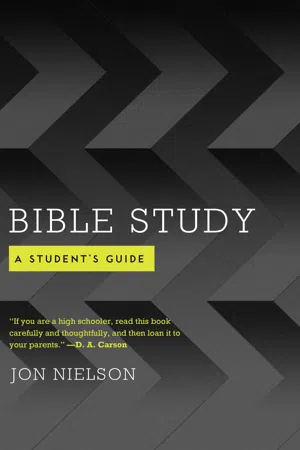
Jon Nielson takes teenagers seriously, confirming that real, meaningful Bible study is possible and important for them. He demonstrates how the Bible should be studied and how teenagers themselves can lead that study.
- English
- ePUB (mobile friendly)
- Available on iOS & Android
eBook - ePub
About this book
Information
Topic
Theology & ReligionSubtopic
Biblical Studies1
The Bible Is
God Speaking
God Speaking
“If it is true that the Bible tells us about God, not least what kind of God he is, it is no less true that unless God really is that sort of God, it is impossible to appreciate the Bible for what it is. To approach the Bible correctly it is important to know something of the God who stands behind it.”
—D. A. Carson1
Have You Been There?
Ryan had heard it since he was a little kid. “The Bible is the inspired Word of God.” It had never meant very much to him—an answer to a theological trivia question in Sunday school, nothing more. After all, we refer to lots of things as “inspired,” right? We talk about artists who have a moment of inspiration, and then go on to create beautiful works of art. Athletes, after a great game, have been known to say things like this: “I was just really inspired by what Coach said to the team at halftime in the locker room.” Ryan had always had a vague impression that the inspiration of the Bible must be slightly different from what happens to an artist or an athlete, but he wasn’t quite sure how to work it out. Did it mean that the Bible is special in some way? Did it mean that God made the Bible magically appear? Could it really mean that God still speaks to people today through a several-thousand-year-old book?
Inspiration
The Bible. Sixty-six books. Forty different authors. Around 1,500 years in production. And this is all together in one volume. Kind of amazing, isn’t it? Some of these facts have served as bases for many attacks on the Bible and its reliability. How can we really believe that all those different authors—over more than a thousand years—could put together something that has any relevance for us today? The simple answer is this: God is the author of the Bible. Yes, there are human authors who composed the books of the Bible, but there is ultimately one main author: God.
We can say that God is the author of the Bible because of the Christian doctrine of inspiration. This doctrine teaches that the human authors of the Bible were inspired by God the Holy Spirit to write exactly the words that God intended them to write. In Scripture, the word “inspiration” communicates the sense that these human authors were “carried along” by the Holy Spirit as they wrote (2 Peter 1:21), and that the Holy Spirit “breathed” into them in a way that ensured that their words would be God’s words. Because of inspiration, we can say that God is the author of the Bible. The Bible is God speaking.
Listen to the way the apostle Paul summarizes the biblical truth of inspiration: “All Scripture is breathed out by God and profitable for teaching, for reproof, for correction, and for training in righteousness” (2 Tim. 3:16). He makes a really incredible statement, doesn’t he? All Scripture—all the books written by various human authors over hundreds of years—is “breathed out” by God. That is what the Bible teaches. Now, let’s not get inspiration mixed up with dictation. Some of you may have a picture in your minds of God somehow taking control of Moses’ arm and guiding every stroke of his pen by force while Moses took a nap. That is not what we’re talking about here! The human authors wrote from their own experience, personalities, and situations—as we’ll see later in this book when we talk about literary genres. But God in his power and wisdom guided their writing perfectly and carefully so as to lead them to include exactly what he wanted in the book that would guide his people for the rest of human history. His leading was sure, intentional, and perfect, even while they wrote out of their unique personalities and situations. That is an amazing work of an incredibly wise and powerful God, and it makes Scripture absolutely unique; there is no book like it in the world, and there never will be!
An Illustration of Inspiration
I have a wonderful assistant who helps me in many ways with the youth and student ministry at our church. Sometimes I ask her to do things. (OK, I ask her to do things a lot!) Let’s say that I ask her to make a reservation for our youth group at a camp. I might call her on the phone to ask her to do that. I might walk over to her desk and ask her in person. I might send her an e-mail. Now, let’s say I choose the last option: I send her an e-mail, asking her to make a reservation at a camp. Then, a couple of days later, I ask her whether she’s made the reservation, and she says, “No, of course not. All I got was an e-mail from you.” Would that be right? No, of course not. Why? Because, for my assistant, an e-mail instruction is as good as a face-to-face instruction. This sounds weird, but where my e-mail speaks, I speak! That is what we are saying about the Bible. Where the Bible speaks, God speaks. Period. So, what does that mean for how we view the Bible?
Implications for How We See the Bible
If this fundamental truth of inspiration is indeed a truth, then we need to affirm that everything in the Bible is true. God doesn’t mess up. In other words, we can read any passage in the Bible and know that it is accurate and correct in what it portrays. The Bible is reliable. This belief does call for a certain amount of faith. We are called to believe in a God who is powerful enough to carefully oversee the writing of thousands and thousands of words—using human authors to accomplish his great purpose of communication with the people he created.
There is another fundamental truth that comes from the doctrine of inspiration, or the idea that the Bible is God speaking. This is the truth of “authorial intent.” In other words, if God is the author of the Bible, then the Bible means something. And its ultimate meaning is what God—the author—intended it to mean. This concept is going to fly in the face of a lot of what you are probably being taught in your literature classes today. Some of you have heard of “reader response theory,” the idea that the reader of a text is the one who really determines what the text means. That concept has worked its way into a lot of Bible studies. You’ll know that this idea is at play when you hear someone ask the question, “What does this Bible passage mean to you?” Now, that’s not always a bad question, but it should never be the first question that we ask in Bible study. Because the Bible is God speaking—because God is the ultimate author of the Bible—the first question we should always ask is, “What does this Bible passage mean—and what does God intend it to mean?” Because God is the author of the Bible, and because he does intend the words to mean something specific, that question is answerable for us in the context of Bible study, although it may require hard work!
Another way to communicate this idea is through this important statement about Scripture: “The Bible can’t mean something that it never meant.” The Bible’s meaning doesn’t change based on time, audience, or situation. It meant something to its original audience, and that original meaning still guides how we interpret the Bible today. The Bible teaches “timeless theological truths”—realities about God that will never change, even while they are grounded in the historical events and situations of the human biblical authors. The God we hear from today, through Scripture, is the same God who spoke to and led his people so many years ago.
That leads us to a third implication of the doctrine of inspiration. If the Bible is God speaking, then everything in the Bible is there on purpose. I’m sure some of you have at some point in your lives (maybe in the midst of getting bogged down in the book of Leviticus in your personal devotions) wondered whether parts of the Bible just “slipped through the cracks.” Did God really mean for this passage to be in the Bible? Is this really important? What we are saying, when we affirm that the Bible is God speaking, is that the entire Bible is God speaking. It’s all there on purpose, for our benefit, and according to the will of God. It is all, therefore, worth reading, studying, and understanding. God, the ultimate author of Scripture, put the Bible together in a purposeful way.
Finally, if the Bible is God speaking, then we need to realize that the Bible is still speaking today. The doctrine of inspiration leads us to see the Bible as completely different from any other book in the entire world. It is alive! We can actually hear God’s voice in the words of the Bible. Scripture has the ability to touch us and affect us in powerful ways—in ways that no other book can. Listen to how the author of Hebrews describes the living nature of Scripture: “For the word of God is living and active, sharper than any two-edged sword, piercing to the division of soul and of spirit, of joints and of marrow, and discerning the thoughts and intentions of the heart” (Heb. 4:12). This is no ordinary book. The Bible is God speaking. And God—the living God of the universe—still speaks powerfully through his written Word today.
So, before we get into some implications of inspiration for Bible study, let’s summarize what we’ve been saying here. God is the author of the Bible; the Bible is therefore God speaking. We can even say this in a slightly stronger way: where the Bible speaks, God speaks. This means that the Bible is true. It has a discernible meaning (based on its author’s intent). It is intentionally put together by God. And it is still alive and powerful, since God is still speaking through it to his people today.
Implications for How We Study the Bible
The Nature of Bible Study: It Is Personal
A lot of you have been to a lot of Bible studies. Some of you have not enjoyed them. You can be honest if that’s you! That’s been me at many points. Bible studies can be dry, formal, even boring. Sometimes, I think, that’s what drives students away from real Bible study toward meetings that are a little more focused on fellowship, sharing, and accountability. But could it be that we are reacting against—not Bible study itse...
Table of contents
- Contents
- Foreword
- Acknowledgments
- Introduction
- 1. The Bible Is God Speaking
- 2. The Bible Is Powerful
- 3. The Bible Is Understandable
- 4. The Bible Is a Literary Work
- 5. Exploring Biblical Genres
- 6. The Bible Is One Story
- 7. Studying the Bible As One Story
- 8. So . . . What Is Bible Study?
- 9. Barriers to Bible Study for Young People
- 10. Aids and Approaches to Bible Study
- 11. Leading Together
- 12. A Call to Young People
- Conclusion
- Epilogue
- Notes
- Bibliography
- More Resources from P&R
Trusted by 375,005 students
Access to over 1.5 million titles for a fair monthly price.
Study more efficiently using our study tools.
Frequently asked questions
Yes, you can cancel anytime from the Subscription tab in your account settings on the Perlego website. Your subscription will stay active until the end of your current billing period. Learn how to cancel your subscription
No, books cannot be downloaded as external files, such as PDFs, for use outside of Perlego. However, you can download books within the Perlego app for offline reading on mobile or tablet. Learn how to download books offline
Perlego offers two plans: Essential and Complete
- Essential is ideal for learners and professionals who enjoy exploring a wide range of subjects. Access the Essential Library with 800,000+ trusted titles and best-sellers across business, personal growth, and the humanities. Includes unlimited reading time and Standard Read Aloud voice.
- Complete: Perfect for advanced learners and researchers needing full, unrestricted access. Unlock 1.5M+ books across hundreds of subjects, including academic and specialized titles. The Complete Plan also includes advanced features like Premium Read Aloud and Research Assistant.
We are an online textbook subscription service, where you can get access to an entire online library for less than the price of a single book per month. With over 1.5 million books across 990+ topics, we’ve got you covered! Learn about our mission
Look out for the read-aloud symbol on your next book to see if you can listen to it. The read-aloud tool reads text aloud for you, highlighting the text as it is being read. You can pause it, speed it up and slow it down. Learn more about Read Aloud
Yes! You can use the Perlego app on both iOS and Android devices to read anytime, anywhere — even offline. Perfect for commutes or when you’re on the go.
Please note we cannot support devices running on iOS 13 and Android 7 or earlier. Learn more about using the app
Please note we cannot support devices running on iOS 13 and Android 7 or earlier. Learn more about using the app
Yes, you can access Bible Study by Jon Nielson in PDF and/or ePUB format, as well as other popular books in Theology & Religion & Biblical Studies. We have over 1.5 million books available in our catalogue for you to explore.