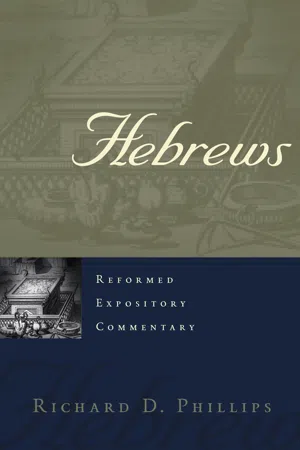
Philips sees in Hebrews a matchless presentation of Jesus as an exhortation to persevere in the faith, even during trials. This commentary is biblical, redemptive historical, and expositional.
eBook - ePub
Hebrews
About this book
Information
Subtopic
Commentaire bibliquePART 1

The Supremacy of Christ
1
GOD’S FINAL WORD
Hebrews 1:1–2
Long ago, at many times and in many ways, God spoke to our
fathers by the prophets, but in these last days he has spoken to us
by his Son. (Heb. 1:1–2)
fathers by the prophets, but in these last days he has spoken to us
by his Son. (Heb. 1:1–2)
Ascene from Jesus’ life and ministry wonderfully depicts what the Book of Hebrews is all about. Matthew 17 tells us that Jesus took his three closest disciples up onto the mount, where they saw him transfigured in glory, speaking with Moses and Elijah. Peter proposed building a tabernacle for the veneration of these three spiritual giants. But just then the Shekinah glory cloud enveloped them in brightness and the voice of God said, “This is my beloved Son, with whom I am well pleased; listen to him” (Matt. 17:5). When the disciples rose from their terror, they did not see either Moses or Elijah, but they saw Jesus alone. A. W. Pink comments: “The glory associated with Moses and Elijah was so eclipsed by the infinitely greater glory connected with Christ, that they faded from view.”1
This is what the Book of Hebrews is about—the supremacy of Christ, along with the sufficiency of his work and the necessity of faith in him for salvation.
BACKGROUND TO THE BOOK OF HEBREWS
We should begin studying a book with a consideration of its background. Who wrote the Book of Hebrews? To whom was it written and when? What prompted the writing of the letter, what is its literary genre, and on what basis is it included in the biblical canon?
When we consider the authorship of Hebrews, we must first observe that the answer is not stated in the letter itself. There is no opening greeting, nor do the closing remarks identify the writer. There is, however, no shortage of candidates for the honor of authorship.
Throughout church history there has been a strong impulse to name the apostle Paul as the author of Hebrews. There seem to be two main reasons for this, the first of which is that much of the letter’s content sounds Pauline. Hebrews 13:23 refers to Timothy, one of Paul’s protégés, and chapter 10’s theme of joy amidst suffering strongly reminds us of Paul. Therefore, it is argued, the author of Hebrews must at least have been a member of the Pauline circle. The second reason to support Paul has to do with the canonicity of the book. The inclusion of Hebrews in the Bible was not without controversy, and arguments for Paul’s authorship naturally strengthened its case dramatically.
Nonetheless, there are many indications that Paul almost certainly did not write Hebrews. First, in all of Paul’s other letters he identifies himself, blatantly asserting his apostolic authority. The writer of Hebrews does not identify himself, although some speculate that because of Jewish hostility Paul may have wanted to remain anonymous. More telling is the nature of the Greek in Hebrews, which is of a high literary style in striking contrast to Paul’s more common Greek. The structure of Hebrews, with its interspersed exhortations, contrasts with Paul’s tendency to save practical applications for the letter’s end. Most conclusive is the statement of Hebrews 2:3, which says the author’s message “was attested to us by those who heard.” In other words, the writer received his message from those who heard it firsthand from Jesus. This is the very thing Paul always denies in his letters, insisting that he received his revelation directly from the Lord and not from the other apostles (see Gal. 1:12).
With Paul ruled out, other candidates are drawn from his circle and include Luke, Silas, and Priscilla. Most persuasive are the arguments in favor of Barnabas and Apollos. Hebrews 13:22 describes the letter as a “word of exhortation,” and Barnabas’s name means “son of exhortation.” Not only was Barnabas a close associate of Paul, but as a Levite he would likely have had the kind of interest in the Jewish priesthood that shows up in Hebrews. An even more intriguing suggestion was made by Martin Luther in favor of Paul’s sometime associate Apollos. Acts 18:24 identifies him as “an eloquent man, competent in the Scriptures,” which qualifies him to write such an extraordinary epistle. Furthermore, Apollos hailed from Alexandria, and Hebrews shows an interest in theological themes known to have been popular there.
So who wrote Hebrews? In the end, we must agree with the ancient scholar Origen, who concluded, “Who wrote the epistle is known to God alone.”2 All we can say with confidence is that it came from an apostolic figure who was likely a colleague of the apostle Paul. It did not please the Holy Spirit to have us know the human author’s identity, so we must content ourselves with knowing that the letter is the Word of God.
Also important is the identity of the recipients. The title “To the Hebrews” is not in the text, although it is found in all the earliest manuscripts. This, along with the letter’s content, argues persuasively that these were Jewish Christians who were under pressure to renounce the faith and return to Judaism.
As to their location, the two main options are Palestine and Rome. Those who argue for a Palestinian audience point out that Christians are known to have suffered at the hands of their fellow Jews, and also point to the detailed references to the Jewish temple ritual. Since the discovery of the Dead Sea Scrolls, some have tried to show similarities to the writings of the Essene community in the Judean desert. Opposing this theory is the fact that all of the Old Testament citations in Hebrews are from the Septuagint, the Greek version common in that time, which was not used in Palestine as much as elsewhere. Also opposing a Palestinian background is the statement that the recipients of the letter had only heard of Jesus secondhand (see Heb. 2:3). Furthermore, Hebrews 12:4 states that earlier persecutions did not involve the shedding of blood, whereas those in Palestine certainly did from the very beginning.
Scholarly consensus has recently shifted in the direction of Rome. Clement of Rome, writing around A.D. 95, shows close familiarity with Hebrews, and the books of Acts and Romans speak of a large Jewish church in Rome from early on. The Jewish Christians there were persecuted in A.D. 49 under the emperor Claudius, and then again in the 60s under Nero. What we know of the former of these persecutions seems to fit the description of 10:32–34 and 12:4 (in that Claudius’s persecution involved loss of property and imprisonment, but not bloodshed), and the anticipation of violence fits the latter, with Nero’s notorious violence against Christians. Finally, there is the statement of Hebrews 13:24, “Those who come from Italy send you greetings.” It could be that a pastor now in Rome was writing to Jewish believers in Palestine. But the more natural reason for Italian Christians to send their greetings is that the readers were themselves from Italy.
If Rome was the location of the audience, then the letter would have been written shortly before A.D. 64, when Nero’s persecution broke out. Under almost all theories, Hebrews was written prior to A.D. 70, when Jerusalem and its temple were destroyed by the Romans. Not only does Hebrews speak of the temple rituals as a present reality, but it is hard to imagine its writer passing up such an opportunity as the fall of Jerusalem to prove the passing away of the old covenant religion.
The purpose of Hebrews is made clear by its content. The writer warns Christians not to fall back from faith in Christ in the midst of trials and exhorts them instead to press on to full maturity. The letter should not be thought of as a theological treatise, but as a sermon written by a pastor to a congregation from which he is separated. The writer describes it as “my word of exhortation” (13:22). His method is to point out the supremacy of Christ over everything to which the readers might be tempted to turn; he is superior to angels, to Moses and the prophets, to Aaron and the Levitical priests, to the blood sacrifices of the old covenant, and to the tabernacle and temple themselves. Since Jesus is the true messenger, the true prophet, the true priest, and the true sacrifice, to renounce him is to lose salvation altogether. Therefore, the readers must hold fast to Jesus Christ. The author’s plea is summed up in Hebrews 10:23: “Let us hold fast the confession of our hope without wavering, for he who promised is faithful.”
The final matter of background to consider is the place of Hebrews in the New Testament canon. The early church’s basic test of canonicity was proof of apostolicity. This did not mean that a book had to be written by an apostle, as is shown by the ready inclusion of Mark, Luke, Acts, and other books. It was sufficient for the author to be an associate of an apostle, so long as the teaching was apostolic in character. We should not think, however, that it was the church that created the canon, since really it was exactly the opposite. The canon—that is, the apostolic teaching of the New Testament writings—created the church. Hywel Jones aptly summarizes, “The canon was drawn up . . . by way of response to the effect which sacred literature had on those who heard it. The church’s formal acknowledgement of a piece of literature was an ‘Amen’ to the Holy Spirit’s testimony in it, and not a bestowing of its own imprimatur.”3
Any introduction to Hebrews ought to conclude with an appreciation of its outstanding excellence. Here the last word is best given to John Calvin, who wrote in the dedication of his commentary: “Since the Epistle addressed to the Hebrews contains a full discussion of the eternal divinity of Christ, His supreme government, and only priesthood (which are the main points of heavenly wisdom), and as these things are so explained in it, that the whole power and work of Christ are set forth in the most graphic way, it rightly deserves to have the place and honor of an invaluable treasure in the Church.”4
GOD HAS SPOKEN
As soon as we begin the Book of Hebrews, we encounter what is perhaps the single most important statement that could be made in our time: “God spoke” (Heb. 1:1). This is one of the most vital things people today need to know. Ours is a relativistic age; as many as 70 percent of Americans insist that there are no absolutes, whether in matters of truth or morality. Secular society having removed God, there no longer is a heavenly voice to speak with clarity and authority. The price we have paid is the loss of truth, and with truth, hope. Even when it comes to those things we think we know, we now consider them mere constructs of thought amidst the constant flux of uncertain knowledge and belief. Really, we are told, we don’t know anything for sure, nor can we.
All this is especially the case when it comes to our knowledge of God himself. Can we know our Creator, if there is one? Is there a Savior to help us? Unless God has spoken, we cannot even be sure he is there; unless God is there, there is no ultimate hope for us as individuals, and no answer for the ultimate problem of death. Job asks, “Can you find out the deep things of God?” (11:7) and answers No. By definition, God is beyond the realm of our senses, from which all our self-gained knowledge has to come. Therefore, if God is there and wants us to know him—if he has an answer, a plan, or a salvation—he is going to have to speak to us. And he must speak in a way we can understand. Therefore, there is nothing more important, nothing more essential, than what Hebrews says in its very first verse: “God has spoken.”
This is the uniform testimony of the Bible about itself, that it is God’s very Word. The Bible’s books were written by human authors, who spoke and wrote in human language. But the Bible insists that through them God himself spoke and speaks to us still. Peter explained, “Men spoke from God as they were carried along by the Holy Spirit” (2 Peter 1:21). This is what we refer to as the Bible’s inspiration. God has communicated to us through the Holy Spirit’s leading of its human authors. The point is not that these books contain the inspired insights of men; the point is exactly the opposite. Indeed, we might better speak of the Bible not as being inspired but as being expired. It is God’s Word as from his very mouth, given through the Holy Spirit’s work in the lives of human servants. This is what Paul emphasizes in 2 Timothy 3:16, where he says, “All Scripture is breathed out by God.”
The divine authorship of Holy Scripture needs to be emphasized today, especially since contemporary scholarship tends to focus on the human authors. It is right, of course, to realize the human contours God used to give different shape to different Bible books. Moses had his own experience and calling and personality and gifts, and God used them to craft a particular message in the books that Moses wrote. The same is true of Paul and John and all the other biblical writers. But while the Bible itself affirms this, its own emphasis is on divine authorship. Hebrews 1:1 says that God spoke “at many times and in many ways,” and that God employed “the prophets” to do this. But in all of this it was still God who spoke. It is not Moses who spoke in Genesis, nor David who spoke in the Psalms, nor Paul who spoke in Romans. God spoke in the Bible, and we must regard all Scripture as his holy Word.
The Book of Hebrews gives the Bible’s own slant on the process of revelation. Whenever the writer cites Scripture, it is never the human author whom he credits but the divine Author. In Hebrews 2:12 he cites Psalm 22:22 and ascribes it to Jesus Christ speaking in the Old Testament. Hebrews 3:7–11 cites Psalm 95, but prefaces it not by saying “as David said,” but “as the Holy Spirit says.” So it goes all through Hebrews. The point is not to deny the significance of the Bible’s human authors, but to show that our emphasis, following the Bible’s own emphasis, must always be on God speaking in his Word.
This has several important implications. First, if God speaks in the Bible, then the Bible carries divine authority. Today, many want to set aside the Bible’s teachings when they collide with cu...
Table of contents
- Cover Page
- Title Page
- Copyright Page
- Contents
- Series Introduction
- Preface
- Part 1: The Supremacy of Christ
- Part 2: Warnings against Falling Away
- Part 3: Our Great High Priest
- Part 4: Exhortations to and Examples of Faith
- Part 5: Concluding Exhortations
- Index of Scripture
- Index of Subjects and Names
Trusted by 375,005 students
Access to over 1.5 million titles for a fair monthly price.
Study more efficiently using our study tools.
Frequently asked questions
Yes, you can cancel anytime from the Subscription tab in your account settings on the Perlego website. Your subscription will stay active until the end of your current billing period. Learn how to cancel your subscription
No, books cannot be downloaded as external files, such as PDFs, for use outside of Perlego. However, you can download books within the Perlego app for offline reading on mobile or tablet. Learn how to download books offline
Perlego offers two plans: Essential and Complete
- Essential is ideal for learners and professionals who enjoy exploring a wide range of subjects. Access the Essential Library with 800,000+ trusted titles and best-sellers across business, personal growth, and the humanities. Includes unlimited reading time and Standard Read Aloud voice.
- Complete: Perfect for advanced learners and researchers needing full, unrestricted access. Unlock 1.5M+ books across hundreds of subjects, including academic and specialized titles. The Complete Plan also includes advanced features like Premium Read Aloud and Research Assistant.
We are an online textbook subscription service, where you can get access to an entire online library for less than the price of a single book per month. With over 1.5 million books across 990+ topics, we’ve got you covered! Learn about our mission
Look out for the read-aloud symbol on your next book to see if you can listen to it. The read-aloud tool reads text aloud for you, highlighting the text as it is being read. You can pause it, speed it up and slow it down. Learn more about Read Aloud
Yes! You can use the Perlego app on both iOS and Android devices to read anytime, anywhere — even offline. Perfect for commutes or when you’re on the go.
Please note we cannot support devices running on iOS 13 and Android 7 or earlier. Learn more about using the app
Please note we cannot support devices running on iOS 13 and Android 7 or earlier. Learn more about using the app
Yes, you can access Hebrews by Richard D. Phillips in PDF and/or ePUB format, as well as other popular books in Théologie et religion & Commentaire biblique. We have over 1.5 million books available in our catalogue for you to explore.