In Exodus, Numbers, and Deuteronomy, Moses is not just God's chosen leader of the Jews but also a precursor of the future Messiah, Jesus. Anthony Selvaggio focuses upon the redemptive-historical aspects of Moses' life.
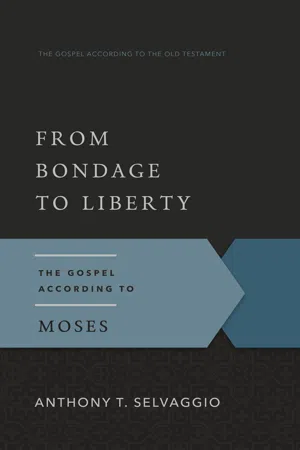
- English
- ePUB (mobile friendly)
- Available on iOS & Android
eBook - ePub
About this book
Information
Topic
Theology & ReligionSubtopic
Biblical StudiesChapter one
The Power of Providence
Exodus 1:1–2:10
My wife and I once attended a play entitled All in the Timing, by David Ives. The play is made up of six short comedic sketches, one of which is called “The Philadelphia.” In this sketch, one character enters the scene complaining about his day. He declares that everything is going wrong for him. When he explains his predicament to a friend, the friend tells him that he is experiencing these problems because he is in a “Philadelphia.” The friend used the phrase “in a Philadelphia” to describe a day in which everything you try to accomplish is thwarted. That phrase stuck with us, and, while we have nothing against the city of Philadelphia (it is a wonderful place!), my wife and I sometimes employ this phrase to describe one of those days in our lives when it seems like nothing is going our way. We just look at each other and say, “I am in a Philadelphia.”
Have you ever been “in a Philadelphia,” experiencing one of those days in which everything goes wrong?” Have you ever wondered where God is on days like that? I know that when I am in a “Philadelphia” I am often tempted to ask, “Where are you, God?” Perhaps you do too.
As we commence our journey into the life of Moses, we learn that at the time of his birth the Israelites were in a “Philadelphia” of sorts (or perhaps it would be better to say they were in an “Egypt”!). Everything had gone wrong for them. The glorious promises made to Abraham seemed to have fallen to the ground. It must have seemed to them that all hope was lost. But God never forgets his promises, his people, or his plan. In his marvelous providence, we know that “in all things God works for the good of those who love him” (Rom. 8:28)—even when we are in a “Philadelphia.” Israel would eventually realize this, but in the opening chapters of Exodus they must have been doubtful about this reality. Just as we often do during difficult times, Israel was likely questioning the power of God’s providence to work all things together for their good. But it was at the moment when all must have seemed lost to Israel that God sent forth his redeemer and thus revealed the glorious power of his providence.
From Promise to Peril
For us to understand properly the mindset of the Israelites prior to Moses’ birth, we must first consider who they were before everything went wrong. It is important to remember that when Israel entered Egypt four hundred years earlier, the people were filled with promise and hope regarding the future. There were two reasons why the Israelites had such great hope when they first entered Egypt.
First, the Israelites were God’s chosen people. They were the descendants of Abraham and thus heirs to the covenant promises made to him in Genesis 12, 15, and 17. As children of Abraham, the Israelites were promised that they would be prosperous (Gen. 17:6), that they would produce a lineage of kings (Gen. 17:6), and that they would inherit the entire land of Canaan. In addition, God promised that his covenant would be “everlasting”; it would extend for generations (Gen. 17:7).
The second reason they were filled with hope upon entering Egypt was the fact that it was God himself who had told them to go there. God visited Jacob in a night vision and told him to take his family to Egypt (Gen. 46:1–4). At that time, the children of Israel were experiencing a great famine and there was food in Egypt. Further, not only was there food, but God had also placed his servant Joseph there and had raised him to a position of power in Pharaoh’s court. Even more than that, God promised to be with his people while they were in Egypt and he promised to prosper them:
“I am God, the God of your father,” he said. “Do not be afraid to go down to Egypt, for I will make you into a great nation there. I will go down to Egypt with you, and I will surely bring you back again. And Joseph’s own hand will close your eyes. (Gen. 46:3–4)
God promised Israel (as Jacob and his descendants would henceforth be known) that he had nothing to fear about going to Egypt. God promised to be with his people, to prosper them, and to bring them back.
When Israel first arrived in Egypt, they witnessed the fulfillment of God’s promises and became a great nation there (Ex. 1:7). At this point, the Israelites had everything going for them. They had survived the famine and had prospered in Egypt just as God had promised. The Egyptians did not like Israel’s prosperity and made efforts to suppress them, but the Israelites continually rose to the top. Everything was going their way, but that was about to change. Israel was about to enter a “Philadelphia,” and it began with these words: “Then a new king, to whom Joseph meant nothing, came to power in Egypt” (Ex. 1:8).
From Bad to Worse
When the new Pharaoh came to power everything changed; everything began to go wrong for Israel. The once prosperous and powerful Israelites soon found themselves as lowly slaves. The Egyptians came to dread them (Ex. 1:12) and worked the Israelites ruthlessly (Ex. 1:13); they “made their lives bitter with harsh labor” (Ex. 1:14). The Israelites were now in bondage to a foreign nation.
In addition to facing ruthless treatment and slavery, the Israelites faced another, even more horrifying, threat—the slaughter of their sons. Although the Egyptians had made their lives bitter, the Israelites were still multiplying in number, much to the alarm of Pharaoh, who feared that they would become a military rival. So Pharaoh hatched an evil plan to control the population growth:
The king of Egypt said to the Hebrew midwives, whose names were Shiphrah and Puah, “When you are helping the Hebrew women during childbirth on the delivery stool, if you see that the baby is a boy, kill him; but if it is a girl, let her live.” (Ex. 1:15–16)
Pharaoh ordered the Hebrew midwives to kill every Israelite baby boy. The Hebrew midwives, however, courageously obstructed Pharaoh’s plan. They remained faithful to God and refused to implement the plan. This frustrated Pharaoh and led him to employ a more direct strategy for the elimination of Hebrew boys. “Then Pharaoh gave this order to all his people: ‘Every Hebrew boy that is born you must throw into the Nile, but let every girl live’ ” (Ex. 1:22).
As you can see, everything was going wrong for Israel. They had come to Egypt filled with confidence and assurance of God’s promises, but soon found themselves in harsh slavery and under the ruthless oversight of their Egyptian taskmasters. Even worse than that, a Pharaoh who was unfamiliar with Joseph had mustered his entire nation against them. The Nile was about to become the graveyard of Israel’s future. Just pause and consider what Israel’s mindset must have been at this moment. The people must have felt like they were in a “Philadelphia.” The children of promise were now slaves to a foreign king. They must have been asking questions like, “Where are you, God?” and “Why is this happening to us?”
Where Are You, God?
Although few of us have faced the type of persecution that the Israelites faced in Egypt, we do sometimes find ourselves in difficult and challenging circumstances which lead us to ask the questions, “Where are you, God?” and “Why is this happening to me?” As Christians, we all give verbal assent to the truth of Romans 8:28, that God “in all things works for the good of those who love him,” but it is much easier to assent to this truth when things are going our way. When hard providences crash upon the shores of our lives in seemingly relentless waves, the truth of Romans 8:28 is easy to question and doubt. I confess that in the midst of my own personal trials I have had my doubts. How about you? In the midst of your own personal trials have you ever wondered, “What good could possibly come out of this?”
While it can be difficult to trust God in challenging circumstances, it is often when things seem most perilous that he works most powerfully. God often sows the seeds of redemption in the seemingly barren soil of despair. God enjoys confounding the conventional wisdom of our world, and he often does this by snatching victory out of the jaws of defeat. We can see an example of this in how God delivered Israel from their predicament in Egypt.
The Power of God’s Providence
If there had been a twenty-four-hour news network like CNN in the days before Moses’ birth, the headlines that would have been flashing across the screen might have been something like this: “Hebrews Continue in Slavery; No End in Sight,” “Hebrew Sons to Be Tossed in the Nile,” and “God’s Promises: Fact or Fiction?” In other words, things were very bleak for the Hebrews and they knew it. But even at this bleak moment, the hand of God’s providence was at work planting the seeds of a plan that would eventually blossom into the redemption of his people and the fulfillment of his promises to them.
God’s plan required a leader and mediator through whom God would bring about his deliverance. God’s purpose required a human vessel and that vessel was Moses. But Moses was about to enter the world at what seemed like the worst possible time; he was born as a Hebrew son at a time when Hebrew sons were doomed to die in the Nile. The plan of God seemed surely destined to fail, but then God intervened in his providence and extracted a glorious victory. From the river of death, God brought life and deliverance.
The power of God’s providence can be witnessed in Moses’ early life through the amazing way in which he was preserved in the face of Pharaoh’s evil edict. Pharaoh had decreed that every Hebrew son must die, but God decreed that he would send a son of the Hebrews to redeem his people. God won. The kings of earth often shake their fists at heaven and declare themselves to be gods, but their decrees and plans have consistently been relegated to the dust heap of history by the power of God’s providence. We see this proven once again in Moses’ victorious birth.
But the glory of God’s providence in the birth of Moses is not seen primarily in the reality that God won, but in how he orchestrated the events that preserved Moses’ life in the face of Pharaoh’s decree. God plucked the strings of history like a masterful musician. He saved Israel by his providential control over the actions of three women.
Three Women and a Baby
The first woman whom God employed in his providential preservation of Moses’ life was Moses’ mother. God gave Moses a faithful and courageous mother. The most powerful man in Egypt had decreed that all Hebrew sons must die, but when Moses was born his mother subverted Pharaoh’s decree, putting herself at personal risk. After his birth, Moses’ mother realized there was something special about this child and she hid him from the authorities for three months (Ex. 2:2).
But, eventually, Moses grew too big to be hidden, and so his mother came up with the following plan:
But when she could hide him no longer, she got a papyrus basket for him and coated it with tar and pitch. Then she placed the child in it and put it among the reeds along the bank of the Nile. (Ex. 2:3)
At first glance, this plan did not seem like a very effective one. After all, the most likely outcome of such a plan was that Moses would die from dehydration, malnutrition, or drowning. Moses’ mother was seemingly leaving his survival to chance. It may have been the case that Moses’ mother was uncertain of his destiny when she placed him in the water, but it also possible that she knew the location where Pharaoh’s daughter came to bathe and strategically placed him in the water so that he would be found by her. Either way, the hand of God’s providence was at work in preserving the life of Moses. God was watching over the redeemer of his people.
Exodus 2:4 tells us about the second woman involved in preserving Moses’ life: “His sister stood at a distance to see what would happen to him.” As his sister was standing there, she noticed that other people were approaching, among them Pharaoh’s daughter who was coming to the Nile to bathe. Pharaoh’s daughter was to become the third woman God used to preserve Moses’ life.
When Pharaoh’s daughter arrived, she saw Moses and sent her servant to recover him from the water (Ex. 2:5). As soon as Pharaoh’s daughter looked at Moses, she felt “sorry for him,” recognizing that Moses was one of the Hebrew babies (Ex. 2:6). She decided to adopt him. This is when Moses’ sister jumped into the situation and made the following suggestion to Pharaoh’s daughter: “Shall I go and get one o...
Table of contents
- Contents
- Foreword
- Acknowledgments
- Introduction
- 1. The Power of Providence
- 2. One of Life’s Detours
- 3. A Life-Changing Encounter
- 4. What’s in a Name?
- 5. The God Who Is Sufficient
- 6. The Prophet, the Pharaoh, and the Plagues
- 7. Belief, Blood, and Bread
- 8. Taking the Hard Road
- 9. The Law Came through Moses
- 10. From Idolatry to Glory
- Epilogue
- Notes
- Index of Scripture
Trusted by 375,005 students
Access to over 1.5 million titles for a fair monthly price.
Study more efficiently using our study tools.
Frequently asked questions
Yes, you can cancel anytime from the Subscription tab in your account settings on the Perlego website. Your subscription will stay active until the end of your current billing period. Learn how to cancel your subscription
No, books cannot be downloaded as external files, such as PDFs, for use outside of Perlego. However, you can download books within the Perlego app for offline reading on mobile or tablet. Learn how to download books offline
Perlego offers two plans: Essential and Complete
- Essential is ideal for learners and professionals who enjoy exploring a wide range of subjects. Access the Essential Library with 800,000+ trusted titles and best-sellers across business, personal growth, and the humanities. Includes unlimited reading time and Standard Read Aloud voice.
- Complete: Perfect for advanced learners and researchers needing full, unrestricted access. Unlock 1.5M+ books across hundreds of subjects, including academic and specialized titles. The Complete Plan also includes advanced features like Premium Read Aloud and Research Assistant.
We are an online textbook subscription service, where you can get access to an entire online library for less than the price of a single book per month. With over 1.5 million books across 990+ topics, we’ve got you covered! Learn about our mission
Look out for the read-aloud symbol on your next book to see if you can listen to it. The read-aloud tool reads text aloud for you, highlighting the text as it is being read. You can pause it, speed it up and slow it down. Learn more about Read Aloud
Yes! You can use the Perlego app on both iOS and Android devices to read anytime, anywhere — even offline. Perfect for commutes or when you’re on the go.
Please note we cannot support devices running on iOS 13 and Android 7 or earlier. Learn more about using the app
Please note we cannot support devices running on iOS 13 and Android 7 or earlier. Learn more about using the app
Yes, you can access From Bondage to Liberty by Anthony T. Selvaggio in PDF and/or ePUB format, as well as other popular books in Theology & Religion & Biblical Studies. We have over 1.5 million books available in our catalogue for you to explore.