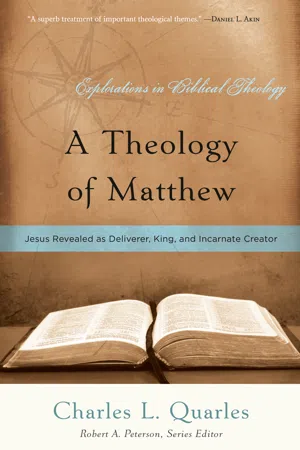
An explanation of the primary theological themes of Matthew's gospel—and how they connect to the rest of the Bible.
eBook - ePub
A Theology of Matthew
Jesus Revealed as Deliverer, King, and Incarnate Creator
- English
- ePUB (mobile friendly)
- Available on iOS & Android
eBook - ePub
About this book
Information
Topic
Theology & ReligionSubtopic
Biblical StudiesPart 1
Foundations for a
Theology of Matthew
Theology of Matthew
1
Introduction to the
Gospel of Matthew
Gospel of Matthew
This book is titled A Theology of Matthew rather than A Theology of the Gospel of Matthew. This implies that the book intends to summarize and describe the theology of an individual by a particular name who served as the author of this gospel. This is possible, of course, only if a man named Matthew actually wrote this gospel. Yet many scholars today contest the claim that this gospel was written by the apostle Matthew. Some theologians seek to evade potential problems in describing the theology reflected in this gospel by placing the name Matthew in quotation marks, indicating that Matthew refers not to the apostle by that name but to the assumed author, whoever he may have been. This book does not place the name Matthew in quotation marks. This book seeks to explore the theology of the apostle Matthew himself. This naturally leads to an exploration of introductory issues related to the Gospel of Matthew. Did the apostle really write this gospel? If so, when, where, and why?
Who Wrote This Gospel?
The Gospels in the New Testament are formally anonymous. Unlike Paul’s letters, in which the introduction to each letter identifies Paul as the author, one never finds a statement such as “Matthew, apostle of Jesus Christ, to the churches” in the body of the Gospels. Yet this is not as significant as it might seem at first. R. T. France has pointed out that most books even today would have to be considered formally anonymous by this standard.1 Authors rarely identify themselves in the body of the work, unless the work is an autobiography. Instead, they identify themselves on the cover of the book and the title page.
Authors of ancient books sometimes identified themselves by name in the body of their work.2 In many other instances, however, authors identified themselves only by titles, headings, a preface (called a proem), or an inscription at the end of the book called a colophon.3 For the gospel writers, the most important collection of books was the Old Testament. Many of the Old Testament books identified the author and the circumstances of writing only in headings. The gospel writers followed this model. The author’s name is disclosed only by the title or heading of the work.
The title According to Matthew appears as the heading to this gospel in the earliest manuscripts available today.4 Later manuscripts elaborate the title to The Gospel according to Matthew, to The Holy Gospel according to Matthew, or to a similar title. No manuscript evidence suggests that the gospel ever circulated without a title. The titles are definitely very early. From the moment that multiple Gospels began to circulate among the churches, believers would have needed a way to distinguish them, and titles such as According to Matthew and According to Mark would have been useful, even necessary. If another gospel was in existence when Matthew wrote his gospel, he might have personally assigned the gospel a title to prevent confusion with the other gospel. Consequently, a growing number of scholars suspect that the titles of the Gospels are original.
The earliest preserved testimony regarding the authorship of Matthew’s gospel is that of Papias, bishop of Hierapolis, in his Expositions of the Lord’s Sayings. Although some scholars date Papias’s work to the mid-second century, strong evidence suggests that it should be dated to the early second century.5 Papias received his information about the Gospel’s authorship directly from older Christians who had been personally taught by Jesus’ disciples. Papias wrote, “Therefore, on the one hand Matthew arranged in order the sayings in the Hebrew dialect; on the other hand, each translated these as he was able.”6
This statement describes Matthew as one who collected and arranged Jesus’ sayings in Hebrew or Aramaic. Some scholars believe that these sayings are the major discourses of Matthew’s gospel that are absent from Mark.7 Others believe that the word sayings is used in a broader sense and refers to the gospel as a whole.
Many scholars deny that Matthew or any significant portion of his gospel was first written in Hebrew or Aramaic. They further reason that if Papias was wrong in his comment about the original language of the gospel, we can have no confidence in his statement about Matthew’s authorship. This, of course, is not a necessary conclusion. One can be wrong about something, perhaps even many things, without being wrong about everything. Papias could be incorrect about a Hebrew Gospel of Matthew but still correct that Matthew wrote the gospel.
It is also possible that Papias was correct about both the original language and authorship of Matthew’s gospel. Rejection of a Hebrew original of Matthew is based on the assumption that the excellent Greek of Matthew’s gospel could not have been produced by a translator. But a skilled translator would have been capable of translating an original Hebrew document into Greek of the quality that appears in Matthew’s gospel. Numerous early church fathers insisted that this gospel was first written in Hebrew, and as native Greek speakers they were in a better position than modern scholars to judge whether the Greek could have been produced by a skilled translator. Furthermore, features such as the allusion to David in the number fourteen in Matthew 1:17, the comment on the significance of Jesus’ name in 1:21, and the significance of Jesus’ identity as a Nazarene in 2:23 are meaningful only in Hebrew. This seems to suggest that at least portions of Matthew’s gospel, such as the account of Jesus’ birth, were first written in Hebrew.8 Modern scholars are wise to acknowledge that sufficient evidence is lacking to determine with absolute confidence the original language of the gospel. Thus, arguments regarding authorship based on presumptions about the gospel’s original language are necessarily weak.
A few clues from the gospel itself support the claim of the title and of early church fathers that Matthew was its author. First, abundant evidence in the gospel shows that the author was a Jewish Christian. Second, only Matthew’s gospel indicates that the tax collector named Levi who became one of the twelve apostles was also called Matthew (Matt. 9:9; cf. Mark 2:14; Luke 5:27). The mention of this alternative name could be a personal touch from Levi/Matthew himself. Third, although Mark and Luke use the term denarius to describe the payment of the imperial tax, Matthew uses the more precise expression “coin for the tax” (Matt. 22:15–22). The more precise nomenclature might express the expertise of a former tax collector.
By itself, this internal evidence would not be very persuasive. When added to the very early evidence of the title and the testimony of Papias, however, it amounts to rather impressive evidence in support of the traditional view that Matthew is the author of the gospel that bears his name. The evidence in support of Matthew’s authorship is sufficiently persuasive that some scholars who previously denied Matthew’s authorship of this gospel have now changed their minds and affirm that Matthew had some role in the composition of the gospel.9
When Was the Gospel Written?
Many scholars date the composition of the Gospel of Matthew to the mid- to late 80s a.d. This late date is generally based on the assumption that Jesus was not capable of...
Table of contents
- Contents
- Series Introduction
- Foreword
- Acknowledgments
- Introduction
- Part 1: Foundations for a Theology of Matthew
- Part 2: The New Moses: Jesus, Our Savior
- Part 3: The New David: Jesus, Our King
- Part 4: The New Abraham: Jesus, Our Founder
- Part 5: The New Creator: Jesus, Our God
- Conclusion
- Questions for Study and Reflection
- Select Resources on Matthew’s Theology
- Index of Scripture
- Index of Subjects and Names
- Notes
Trusted by 375,005 students
Access to over 1.5 million titles for a fair monthly price.
Study more efficiently using our study tools.
Frequently asked questions
Yes, you can cancel anytime from the Subscription tab in your account settings on the Perlego website. Your subscription will stay active until the end of your current billing period. Learn how to cancel your subscription
No, books cannot be downloaded as external files, such as PDFs, for use outside of Perlego. However, you can download books within the Perlego app for offline reading on mobile or tablet. Learn how to download books offline
Perlego offers two plans: Essential and Complete
- Essential is ideal for learners and professionals who enjoy exploring a wide range of subjects. Access the Essential Library with 800,000+ trusted titles and best-sellers across business, personal growth, and the humanities. Includes unlimited reading time and Standard Read Aloud voice.
- Complete: Perfect for advanced learners and researchers needing full, unrestricted access. Unlock 1.5M+ books across hundreds of subjects, including academic and specialized titles. The Complete Plan also includes advanced features like Premium Read Aloud and Research Assistant.
We are an online textbook subscription service, where you can get access to an entire online library for less than the price of a single book per month. With over 1.5 million books across 990+ topics, we’ve got you covered! Learn about our mission
Look out for the read-aloud symbol on your next book to see if you can listen to it. The read-aloud tool reads text aloud for you, highlighting the text as it is being read. You can pause it, speed it up and slow it down. Learn more about Read Aloud
Yes! You can use the Perlego app on both iOS and Android devices to read anytime, anywhere — even offline. Perfect for commutes or when you’re on the go.
Please note we cannot support devices running on iOS 13 and Android 7 or earlier. Learn more about using the app
Please note we cannot support devices running on iOS 13 and Android 7 or earlier. Learn more about using the app
Yes, you can access A Theology of Matthew by Charles L. Quarles in PDF and/or ePUB format, as well as other popular books in Theology & Religion & Biblical Studies. We have over 1.5 million books available in our catalogue for you to explore.