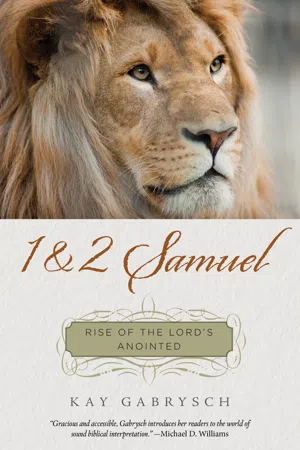
1&2 Samuel, where the word "messiah" first appears, was originally one volume. Through weekly tailored and "big picture" questions, Kay Gabrysch trains us to become confident readers of scriptural narrative.
- English
- ePUB (mobile friendly)
- Available on iOS & Android
eBook - ePub
About this book
Information
Topic
Theology & ReligionSubtopic
Biblical CommentaryLesson 1
1 Samuel 1:1–2:10
Meditation and Discovery
1. Read the entire passage and, as you read, observe the details of the settings, situations, and crises of peoples’ lives. Circle or write down repeated words that highlight the narrator’s emphasis. The writers of Hebrew narratives use repetition to emphasize character traits, action, theological points, etc. Next, look for contrasting words like darkness/light, strength/weakness, etc. The words but and yet will often signal a contrast as well. Next, look for words that signal time and scene changes, such as then and now.
2. Write down questions that come to mind that you expect or hope will be answered as you study. These might include but are certainly not limited to:
• What does this particular thing mean?
• Where is this happening?
• Why are they doing this particular thing?
• What surprises you in the story?
Good interpretation involves asking many questions of the text!
3. Next we will look at the context of the passage. What precedes and follows this passage, and what light do these “next-door neighbors” shed on the passage? Determine how this particular passage fits into the central idea of all 1 and 2 Samuel. Expand the context to the whole Bible. Where does the passage/book fit into the whole story of Scripture? What was going on historically at the time this was written? Who made up the original audience? Two very important keys to interpretation are (1) what was the author’s intent in writing to his audience? and (2) what would that original audience have understood?
Rule #1: Relax! Understanding a passage in its context is not something that can be done up front if you are not familiar with the Old Testament, but it is so important to understanding the text. It will become easier for you as you go along in this study and understand more and more the “one-story-ness” of the Bible.
Each book of the Bible is a link in the chain of the progressive, unfolding, larger story of redemption. God progressively and coherently tells his story over thousands of years. The Bible is not just a collection of truth statements. It is held together by a storyline. It is best understood as a narrative. It is the story of God, who has created a world in which the apex of his creation, humankind, has rebelled against him, thus creating the conflict for which God provides the resolution, his Son, Jesus Christ. It is a story of creation, rebellion, redemption, and re-creation. The beginnings of the monarchy have an important and specific part in that unfolding story.
4. After reading and rereading the passage, what do you think is the main idea or theme of this particular passage?
Characterization and Scenes
Because the story of redemption begins with the Old Testament and is told from Genesis to Revelation, God makes himself known in the Old Testament stories in his covenant relationships to his people and in his relationships to all his creation. The God who redeemed Hannah, Samuel, and David is the same God of all grace who has redeemed those in the New Testament. The means by which God has worked in history has always been human beings living in time and space.
When we read the stories of God’s ancient people, we are reading the stories of our own spiritual ancestors who have gone before us and played their parts on the stage of God’s drama. How humbling to see how tiny our lives are in the enormous scheme of things, yet how dignifying to have a role to play in that scheme. When we belong to God through faith in Christ, we can know that we are enabled by his Spirit to walk like those who have gone before us and to take our place as a participant in the story as each of them did. As Dr. Michael Williams likes to say, “We are not the trees in the school play.” We have a role to faithfully inhabit and a contribution to make to the establishing of Christ’s kingdom as we live in these times between Christ’s first and second comings.
When we study the characters of the historical narratives, we see that our relational God cares deeply about his people and is constantly involved in their lives for his glory and their good. Every character in the story is defined by his or her relationship to God. Notice that they are real people with conflicts, choices, sins, consequences, joys, and sorrows. They are people just like us who face each day not knowing what it will bring. Some will be grappling with suffering, some will be acting on the sin in their hearts, some will be living in accordance with the purposes of God. Be on the lookout for how God confirms the identity of those who are his—comforting, disciplining, and providentially working in and through them, always for their good and his glory. Conversely, identify how he confronts the many ways in which people turn away from the character and ways of God in complete rebellion.
The Bible is a story about what God has done to redeem his sin-sick world. He is not just the sum of attributes and names to be memorized and studied. He is always acting in relationship with his people. Consequently the fundamental question will always be: what is God doing in these people’s lives and in his world in this part of the story to drive the story forward toward its ultimate goal—the coming of the Lord Jesus Christ in his life, death, resurrection, and reign both in this age and the age to come?
1. Make a list of characters and identify habits, desires, emotions, overt actions, and speech of each that give clues to their relationship to God and the condition of their hearts. According to the narrator, what is God’s evaluation of their conduct and character?
2. As they dialogue and interact with each other, how are the characters in this passage contributing to each other’s lives? Contrast the positive traits of some characters with the negative traits of others. Notice the ways the darkness of some characters accentuates the brilliance of others.
3. In no other genre does our attention so easily drift from God to human beings than in Old Testament narratives. Therefore it is crucial that we constantly ask ourselves, “What does God reveal about himself here?” No matter who the human characters are in the story, we must always see that God is the hero of every passage. We are always looking for how the telling of the story is depicting God, his character, his values, and his mission for those in the story and those to whom the story was told. The intensity of God’s presence will vary from passage to passage. In some passages he will interact extensively with his creatures, speaking and directing events in the heart of the action. In some he will be less explicit, and it will appear as if human actions dominate, even as he is providentially controlling all events.
Thoughts to guide you as you consider what you are learning about God in this passage:
• Where do you see him confronting people in truth, power, compassion, grace, mercy, judgment, etc.?
• Where do you see him acting in mercy for the guilty, strength for the weak, love for the unlovely and undeserving, provision for the needy, warning for those who are in error, punishment for enemies, and rescue of his people from enemies from whom they cannot rescue themselves?
• Where do you see discipline that turns people back into God’s arms and away from unsafe paths?
• Keeping these examples in mind, what evidences of his grace and attributes of his character are predominately on display in this particular passage?
4. What inconsistency or error in your thinking about God is corrected by seeing his involvement with the characters in this story?
5. What are the prominent concerns and issues in these characters’ lives with which you most identify? Why?
6. Make two lists: one list of the issues involved in this ancient situation, and another list of what might be the contemporary equivalents of those issues.
| Ancient Issue | Contemporary Equivalent |
Questions on 1 Samuel 1:1–2:10
We must see this story in the context of Israel’s unfolding history and God’s plan to send the true and perfect King before we can understand the significance of the answered prayer of this humble, obscure woman. Hannah arrived on the scene when the nation was spiritually crumbling. The priesthood was corrupt, the people were indifferent to God and, as Judges reminds us over and over, “In those days there was no king in Israel. Everyone did what was right in his own eyes” (Judg. 17:6; 21:25). All of a sudden, the biblical narrative zeroes in on the painful marriage and barren womb of one woman.
Look carefully at Hannah’s story and how God uses this insignificant, barren woman to bring about his redemptive plans. While we struggle to understand this God who seems to be withholding the very blessings we crave, he is using the struggle to reveal to us his greater purposes in our own life’s story and in his kingdom.
Chapter 1
1. Like so many women before her, Hannah finds herself in the heartbreaking condition of barrenness.
Read Genesis 25:20–21, 26; 29:31; 30:22–23. In light of the extraordinary promise the Lord made to the woman in Genesis 3:15 regarding her role in the redemptive plan, every Israelite woman knew that it was important and necessary to have children. One of the blessings of the Mosaic covenant was that “the fruit of your womb” would be blessed (Deut. 28:4). How would Hannah have been perceived within the Israelite community, as seen in Peninnah’s treatment of her?
In light of the covenant promise of blessing, what is Hannah really yearning for?
2. As he often does, God chooses to begin the story of the next phase of redemptive history with what appears to be a hopeless situation. What other ...
Table of contents
- Contents
- Acknowledgments
- Introduction
- Overview
- Lesson 1
- Lesson 2
- Lesson 3
- Lesson 4
- Lesson 5
- Lesson 6
- Lesson 7
- Lesson 8
- Lesson 9
- Lesson 10
- Lesson 11
- Lesson 12
- Lesson 13
- Lesson 14
- Lesson 15
- Lesson 16
- Lesson 17
- Lesson 18
- Lesson 19
- Lesson 20
- Lesson 21
- Lesson 22
- Bibliography
- Notes
Trusted by 375,005 students
Access to over 1.5 million titles for a fair monthly price.
Study more efficiently using our study tools.
Frequently asked questions
Yes, you can cancel anytime from the Subscription tab in your account settings on the Perlego website. Your subscription will stay active until the end of your current billing period. Learn how to cancel your subscription
No, books cannot be downloaded as external files, such as PDFs, for use outside of Perlego. However, you can download books within the Perlego app for offline reading on mobile or tablet. Learn how to download books offline
Perlego offers two plans: Essential and Complete
- Essential is ideal for learners and professionals who enjoy exploring a wide range of subjects. Access the Essential Library with 800,000+ trusted titles and best-sellers across business, personal growth, and the humanities. Includes unlimited reading time and Standard Read Aloud voice.
- Complete: Perfect for advanced learners and researchers needing full, unrestricted access. Unlock 1.5M+ books across hundreds of subjects, including academic and specialized titles. The Complete Plan also includes advanced features like Premium Read Aloud and Research Assistant.
We are an online textbook subscription service, where you can get access to an entire online library for less than the price of a single book per month. With over 1.5 million books across 990+ topics, we’ve got you covered! Learn about our mission
Look out for the read-aloud symbol on your next book to see if you can listen to it. The read-aloud tool reads text aloud for you, highlighting the text as it is being read. You can pause it, speed it up and slow it down. Learn more about Read Aloud
Yes! You can use the Perlego app on both iOS and Android devices to read anytime, anywhere — even offline. Perfect for commutes or when you’re on the go.
Please note we cannot support devices running on iOS 13 and Android 7 or earlier. Learn more about using the app
Please note we cannot support devices running on iOS 13 and Android 7 or earlier. Learn more about using the app
Yes, you can access 1 & 2 Samuel by Kay Gabrysch in PDF and/or ePUB format, as well as other popular books in Theology & Religion & Biblical Commentary. We have over 1.5 million books available in our catalogue for you to explore.