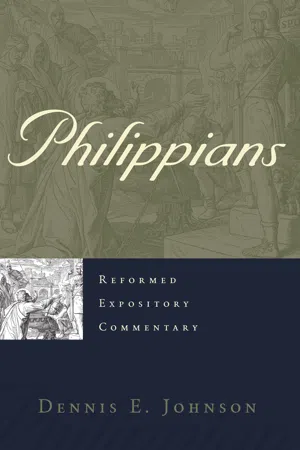
The truth revealed behind the phrase "for me to live is Christ" transforms our responses to present imperfections and future hope. Johnson's commentary—grounded in pastoral application—is ideal for sermon preparation and devotional reading.
eBook - ePub
Philippians
About this book
Information
Topic
Theology & ReligionSubtopic
Biblical Commentary1
CAPTIVATED BY CHRIST JESUS
Philippians 1:1–2
Paul and Timothy, servants of Christ Jesus, To all the saints in Christ Jesus who are at Philippi, with the overseers and deacons:
Grace to you and peace from God our Father and the Lord Jesus Christ. (Phil. 1:1–2)
Grace to you and peace from God our Father and the Lord Jesus Christ. (Phil. 1:1–2)
What do you hear in the opening lines of the apostle Paul’s letter to the church at Philippi? Are these words just stock boilerplate “preliminaries,” to be skimmed over quickly to get to the meat of the matter? Should we process them the way we do a form letter’s impersonal “To Whom It May Concern,” or the fake familiarity of “Dear Valued Customer” in computer-generated mass mailings, sent by marketers who consider us “dear” and “valued” only because they want our dollars?
The openings of Paul’s letters do sound alike. Their basic components can be found in almost any piece of first-century Greek correspondence: author, recipients, and a greeting (good wishes or a blessing). It would be a mistake, however, to dismiss Paul’s handling of this standard template as though it were the thoughtless product of a mechanical “mail-merge” function. As similar as they seem, each of Paul’s letter openings actually introduces key themes to be developed in the rest of the epistle, just as the opening lines of John Milton’s Paradise Lost foreshadow the tragic story that follows:
Of man’s first disobedience, and the fruit
Of that forbidden tree, whose mortal taste
Brought death into the world, and all our woe,
With loss of Eden, till one greater Man
Restore us, and regain the blissful seat,
Sing Heav’nly Muse.1
As these words give a premonition of Adam’s fall and its dire effects, while promising rescue through a second Adam, so Paul begins his “conversation” in correspondence with the Philippian congregation with a preview of his agenda for writing. The apostle “tweaks” the Hellenistic epistle template to lay the groundwork on which he will build his pastoral counsel to his friends in Philippi.
THE BACKSTORY OF THE CHURCH AT PHILIPPI
Chains and armed guards prevented Paul from carrying on a face-to-face conversation with the Christians of Philippi, so his epistle had to serve as his side of a dialogue between himself, this congregation’s founding father, and his beloved children in the faith. Paul and the Philippians shared a history that had forged a strong bond between them. These believers would have heard every word from Paul’s pen against the backdrop of that relationship. To pick up the subtle previews embedded in Paul’s opening greeting, we need to do some detective work to place ourselves, as much as possible, into the context that the Philippian believers inhabited day by day. We need to comb through the epistle, the book of Acts, and other ancient records reflecting life in Philippi, picking up clues to the situation that prompted Paul to send this missive of warm love and surprising joy.
By the time that Paul, Silas, and their team reached Philippi, this city in eastern Macedonia already had a colorful history. Four centuries earlier, the city had been taken over by King Philip II of Macedonia, father of Alexander the Great—hence the name Philippi. In the century before Paul arrived, Julius Caesar’s nephew Octavian and the general Marc Antony defeated Caesar’s assassins in a decisive battle fought just outside Philippi, and the victors celebrated their triumph by constituting Philippi a Roman colony. That meant that citizens of Philippi had the same legal rights and privileges as citizens of Rome, the capital of the empire. Many retired army veterans settled in Philippi, adding to the city’s “Roman flavor,” which was reflected in its architecture and its language. Although surrounded by Greek-speaking communities in the eastern Mediterranean, Philippi had Latin as its official language. Not surprisingly, Philippi prided itself on its religious devotion to the Roman emperors, in addition to worshiping indigenous pagan deities. Yet one choice was missing from the smorgasbord of religious options offered in Philippi: there was no synagogue, apparently because the Jewish community was so small that it lacked the minimum quorum of ten males required by rabbinical tradition.2
These influences molded the Philippian mind-set that Paul and Silas met as they traveled west along a major Roman road (Via Egnatia) to this significant Macedonian city, located north of the Aegean Sea on the eastern side of what is now Greece. Outside the city gate they found a riverbank where women whose hearts hungered to know the God of Israel had gathered for prayer. One of these was Lydia, a textile importer from Thyatira in Asia, across the Aegean Sea. She believed the gospel as the Lord opened her heart, and offered her spacious home as the missionaries’ ministry base (Acts 16:11–15). Later, Paul’s exorcism of an evil spirit from a slave girl enraged her owners, who had profited from her “gift” for fortune-telling (16:16–18). The owners gathered a mob and played on Philippi’s pride in its privileged link to Rome by accusing Paul and Silas of advocating “customs that are not lawful for us as Romans to accept or practice” (16:21). To quell the disturbance, Philippi’s magistrates ordered beating and incarceration. By the next morning, however, an earthquake and an urgent midnight conversation had brought the jailer and his family from spiritual death into everlasting life (16:25–34).
When Paul wrote his letter a dozen years later, some who heard it read aloud had probably lived through those (literally) earth-shaking events. Was Lydia still hosting the church in her home, as she did at first? Was the jailer sitting in the congregation with his family, recalling Paul’s bleeding back as the words “the same conflict that you saw I had” (Phil. 1:30) were spoken? Was he replaying in his mind the missionaries’ surprising songs in the night as he heard Paul’s new report of his current chains and contagious joy (1:18–26)? Was the slave girl there, too, in her right mind, set free by the name of Jesus, to whom every knee will bow, in heaven and on earth and under the earth, as every tongue confesses that Jesus Christ is Lord (2:10–11)? Were there Roman citizens who had once praised the emperor as lord and savior but who now rejoiced in a higher citizenship and awaited a greater Savior and Lord: for “our citizenship is in heaven, and from it we await a Savior, the Lord Jesus Christ” (3:20)?
Paul had a deep affection for this church. The letter is laced with terms of endearment and expressions of longing for reunion with his friends, to whom Paul says, “I hold you in my heart . . . . I yearn for you with all the affection of Christ Jesus” (Phil. 1:7–8), and whom he calls “my brothers, whom I love and long for, my joy and crown” (4:1).
On the other hand, the members of the Philippian church would also be aware that their congregation had problems. One flaw, which Paul will address later in the letter, was a subtle self-centeredness that showed itself in competing priorities and interpersonal frictions. He keeps returning to this concern:
Do nothing from rivalry or conceit, but in humility count others more significant than yourselves. Let each of you look not only to his own interests, but also to the interests of others. (Phil. 2:3–4)
Do all things without grumbling or questioning, that you may be blameless and innocent, children of God without blemish in the midst of a crooked and twisted generation . . . . (2:14–15)
I entreat Euodia and I entreat Syntyche to agree in the Lord. Yes, I ask you also, true companion, help these women, who have labored side by side with me in the gospel . . . . (4:2–3)
Such rivalries and misunderstandings jeopardized the Philippians’ unity at the very time when external pressure from persecution made it all the more imperative that they be “in full accord and of one mind” (Phil. 2:2). Although the physical threat of suffering (1:27–30) and the spiritual threats of Judaizing legalism (3:2–11) and lawless sensuality (3:18–19) lurked in the background, the frictions and fissures that divided these believers weighed most heavily on Paul’s heart. Putting it bluntly, the members of this otherwise wonderful church were not jumping for joy at the prospect of being slaves, which is precisely the way that Paul unapologetically characterized himself and Timothy. Slaves, after all, had to do what other people wanted. Greeks spoke of them as “talking tools” or “thinking tools,” like a plow or a hammer, only more versatile and able to perform a variety of tasks. Slaves had to submit their personal preferences, opinions, convenience, schedules—even their physical health and safety—to the agendas and whims of their masters. Who would volunteer for such a powerless position, unless compelled by armed force or economic necessity?
Later in this letter Paul will explicitly correct the Philippians’ self-centeredness. In these opening sentences, he takes a very gentle approach to the sensitive subject of their resistance to the calling of slaves. He presents himself and Timothy as men who have found freedom in being slaves, captivated by Christ. Then he gives reasons to believe that becoming Christ’s slave is the road to lasting joy.
Paul makes these points by mentioning one name three times in these two verses: Christ Jesus . . . Christ Jesus . . . the Lord Jesus Christ. This threefold repetition foreshadows how thoroughly Paul will extol Christ as the only theme worth preaching (Phil. 1:15, 17, 18), the only master worth honoring (1:20), the only cause to make life worth living and death worth dying (1:21). To each mention of Jesus’ name Paul attaches a distinctive phrase:
Servants of Christ Jesus
Saints in Christ Jesus
Grace . . . and peace from . . . the Lord Jesus Christ
These three phrases are keys that unlock the mystery of how Paul and Timothy could find joy in being captivated as Christ’s slaves, and how we can experience that same joy.
SERVANTS OF CHRIST JESUS
The epistle’s opening verse expresses Paul’s first point: The heart of joy is selflessly serving King Jesus and others for his sake.
Slave-Authors
Paul’s emphasis on servanthood can be seen in two small but significant variations to the standard opening of a first-century letter. First, with respect to authorship, Paul groups Timothy’s name with his own, and then shares with Timothy the title servants or, more precisely, slaves.3 In other letters Paul included the names of his colleagues with himself as virtual coauthors (2 Corinthians, Colossians, Philemon, and 1 and 2 Thessalonians). But when he attached titles to names, he affixed one title to himself and another to his colleagues. We read, for example, of Paul the apostle and Timothy the brother (2 Corinthians; Colossians), or of Paul the prisoner and Timothy the brother (Philemon). Only in Philippians does Paul open an epistle by associating a colleague with himself and then link their names with a shared title, “slaves of Christ Jesus.” Why would he do this here and not elsewhere—and, specifically, why choose the title slaves to describe himself and Timothy?
The Philippians need to see dramatized in Paul and in Timothy the counterintuitive truth that these men bear God’s authority because Christ has captivated them as his slaves. Paul and Timothy are living proof that those whom Jesus saves he enslaves. In their self-centered preoccupations and competing agendas, Paul’s Philippian friends need to see what joyful slavery looks like, up close and personal.
The claim that Jesus enslaves those he saves may sound harsh and uninviting: what kind of “salvation” is it that deprives us of our cherished autonomy and subjects us to the will of Another? But consider the link between being saved and being enslaved by Jesus from this perspective: everybody is somebody’s slave. Despite the inflated claim of William Ernest Henley’s Victorian poem “Invictus,” none of us can honestly say, “I am the master of my fate: I am the captain of my soul.” No matter how much you would like to think otherwise, your every plan and action is driven by a desire to avoid pain or achieve gain by pleasing or placating some “lord” or other. The master you serve may be success or money, or what money can buy. Your lord may be affection or romance, or reputation and respect. You may be enslaved by other people’s opinions, terrified at the prospect of rejection or ridicule, or perhaps you are haunted by the specter of life alone.
You also have to face the fact that every master other than Jesus will exploit and disappoint you in the end. Not all are as obvious as the evil spirit that had seized the Philippian slave girl and forc...
Table of contents
- Cover Page
- Title Page
- Copyright Page
- Contents
- Acknowledgments
- Series Introduction
- Preface
- Abbreviations
- 1. Captivated by Christ Jesus (Philippians 1:1-2)
- 2. He Finishes What He Starts (Philippians 1:3–8)
- 3. A Pastor’s Passionate Prayer (Philippians 1:9–11)
- 4. Prison Is Great—Wish You Were Here! (Philippians 1:12–18a)
- 5. A Tough Choice, but One Supreme Goal (Philippians 1:18b–26)
- 6. Solidarity in Suffering (Philippians 1:27–30)
- 7. Hearts Turned Inside Out (Philippians 2:1–4)
- 8. The King Who Stooped to Conquer (Philippians 2:5–8)
- 9. The Son Exalted for the Father’s Glory (Philippians 2:9–11)
- 10. Bright Stars in a Dark Sky (Philippians 2:12–18)
- 11. Living Replicas of the Servant of the Lord (Philippians 2:19–30)
- 12. Trading My Rags for His Robe (Philippians 3:1–11)
- 13. The Restless Race of Those Who Rest in Grace (Philippians 3:12–16)
- 14. A Tale of Two Citizenships (Philippians 3:17–21)
- 15. Stand Together (Philippians 4:1–3)
- 16. Antidotes to Anxiety (Philippians 4:4–9)
- 17. Cracking the Contentment Code (Philippians 4:10–13)
- 18. The Puzzling Partnership of Getting by Giving (Philippians 4:14–23)
- Select Bibliography of Commentaries Cited or Consulted
- Index of Scripture
- Index of Subjects and Names
Trusted by 375,005 students
Access to over 1.5 million titles for a fair monthly price.
Study more efficiently using our study tools.
Frequently asked questions
Yes, you can cancel anytime from the Subscription tab in your account settings on the Perlego website. Your subscription will stay active until the end of your current billing period. Learn how to cancel your subscription
No, books cannot be downloaded as external files, such as PDFs, for use outside of Perlego. However, you can download books within the Perlego app for offline reading on mobile or tablet. Learn how to download books offline
Perlego offers two plans: Essential and Complete
- Essential is ideal for learners and professionals who enjoy exploring a wide range of subjects. Access the Essential Library with 800,000+ trusted titles and best-sellers across business, personal growth, and the humanities. Includes unlimited reading time and Standard Read Aloud voice.
- Complete: Perfect for advanced learners and researchers needing full, unrestricted access. Unlock 1.5M+ books across hundreds of subjects, including academic and specialized titles. The Complete Plan also includes advanced features like Premium Read Aloud and Research Assistant.
We are an online textbook subscription service, where you can get access to an entire online library for less than the price of a single book per month. With over 1.5 million books across 990+ topics, we’ve got you covered! Learn about our mission
Look out for the read-aloud symbol on your next book to see if you can listen to it. The read-aloud tool reads text aloud for you, highlighting the text as it is being read. You can pause it, speed it up and slow it down. Learn more about Read Aloud
Yes! You can use the Perlego app on both iOS and Android devices to read anytime, anywhere — even offline. Perfect for commutes or when you’re on the go.
Please note we cannot support devices running on iOS 13 and Android 7 or earlier. Learn more about using the app
Please note we cannot support devices running on iOS 13 and Android 7 or earlier. Learn more about using the app
Yes, you can access Philippians by Dennis E. Johnson in PDF and/or ePUB format, as well as other popular books in Theology & Religion & Biblical Commentary. We have over 1.5 million books available in our catalogue for you to explore.