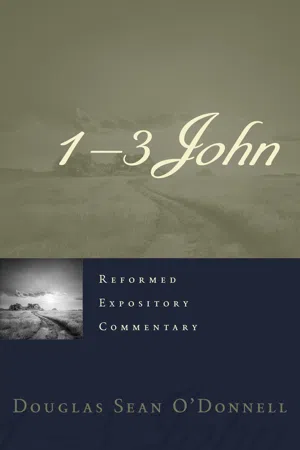
Live a gospel-transformed life! An illuminating, engaging commentary on John's letters that illustrates and applies John's answers to the question, "How can we know that we possess eternal life?"
- English
- ePUB (mobile friendly)
- Available on iOS & Android
eBook - ePub
About this book
Information
Topic
Theology & ReligionSubtopic
Biblical Commentary1
APOSTOLIC FELLOWSHIP
1 John 1:1–4
That which we have seen and heard we proclaim also to you, so that you too may have fellowship with us; and indeed our fellowship is with the Father and with his Son Jesus Christ. (1 John 1:3)
Tongue twisters are my archenemy. I cannot say, and I no longer attempt to say, phrases such as “Peter Piper picked a peck of pickled peppers,” “How can a clam cram in a clean cream can?,” “Send toast to ten tense stouts’ ten tall tents,” and “Unique New York, unique New York, you know you need unique New York.”
While the opening verses in 1 John are not tongue twisters, they do present us with an “abrupt,” “exceedingly complex,” “syntactically convoluted,” “frequently ambiguous,” “complicated interweaving” of “stammer[ing],” “infuriatingly obscure” “ ‘insider’ language,” as a compilation of commentators puts it,1 or, more plainly, “a grammatical tangle,” as C. H. Dodd bemoaned.2 We wonder: What is “which,” and who is “we,” and what does “we” have to say about “which” to “you”? We wonder whether we have jumped into a Dr. Seuss book.
Admittedly, the pronouns can be perplexing in this opening sentence that runs rhythmically for nearly three verses and includes a parenthesis.3 Yet the message itself is plain enough: divine fellowship demands apostolic fellowship. Put metaphorically, if we want to hold the hand of God (stay in fellowship with him), we must hold the apostles’ hands (stay in fellowship with their God-appointed and God-approved testimony concerning Jesus Christ).
With that message in mind, I want to untangle this strange but straightforward text by implementing the odd but accurate questions I presented above, the first of which is “What is ‘which’?”
WHAT IS “WHICH”?
First John is a letter. Or is it a short sermon, an encyclical, a tractate, or some sort of theological manifesto? Whatever its precise genre, it is a short writing that begins without a beginning (i.e., there is no “from John to Gaius in Ephesus, grace and peace in Christ”) by beginning, “That which was from the beginning” (1 John 1:1). Some Bible translations hide this initial ambiguity by starting verse 1 with the verb found in verses 2 and 3, “we proclaim.” Thus, it is rendered “We proclaim to you” (NLT) or “We declare to you” (NRSV). The English Standard Version (ESV) wisely left the original alone, since the ambiguity is likely intentional. Like the reader of a good mystery novel, we have to wait until the end, or nearly the end (the very end of verse 3!), to solve the riddle. Who or what, then, is the “that which”? Five times in verses 1–3 we find the Greek word ho, rendered “which” in the ESV.4 “That which was from the beginning, which we have heard, which we have seen . . . , which we looked upon . . . [,] which we have seen and heard” (vv. 1, 3).
The word which is a neuter singular relative pronoun, thus pointing us to the Father’s Son, Jesus Christ (1 John 1:3), as the answer to the question “what is ‘what’?” or “who is ‘ho’?” That deduction was reached not directly from the grammar but by common sense and a basic grasp of John’s style and vocabulary. Grammatically, the neuter word which (ho) cannot connect with the masculine word word (logos) or the feminine word life (zōē). It can, however, connect with the neuter word message (angelia) in verse 5 (cf. 3:11). But in verses 1–2, it is surely not the gospel message that was “seen” and “touched.” It might be, as some have suggested,5 that John uses the neuter for Jesus to encompass both the divine man (Jesus) and the divine message (about Jesus). Whatever the case may be, it is certainly true that in John’s Gospel the words word and life are used to represent Jesus. Moreover, it is not uncommon for John to use the neuter for the masculine gender (e.g., John 3:5a with 5b; 1 John 5:4 with 5).6 Thus, the “which” is God incarnate. Or perhaps it is better to say: he who “was from the beginning” and is “the word of life” is God’s Son, the man Jesus.
With this mystery solved, let us delve into it deeper. Why call Jesus “that which was from the beginning” and “the word of life” (1 John 1:1)? Both phrases are brimming with theological significance. The phrase “from the beginning” is used eight times in 1 John (cf. 2 John 5–6), and it has a few different connotations based on its context. For example, in 3:8 we read that “the devil has been sinning from the beginning.” This means something like “he has always sinned and continues to do so.”7 Or “from the beginning” refers back to Genesis 3. In 1 John 2:7, 24, and 3:11, we read of Jesus’ love command as being “from the beginning,” namely, from the time that Jesus gave it or the time that John’s recipients first received it. The way “from the beginning” is used in 1:1 could speak of the event of the incarnation, Jesus’ ministry after his baptism, the apostolic proclamation of his teachings, the absolute beginning of the universe (as in 2:13–14), or the time before creation when Jesus was the preincarnate logos. I take the last reference to be correct, namely, that John’s “from the beginning” is essentially the same as his declaration: “In the beginning was the Word, and the Word was with God, and the Word was God. He was in the beginning with God” (John 1:1–2).8 In terms of Habakkuk’s question to Yahweh in Habakkuk 1:12 (NIV), “O LORD, are you not from everlasting?” (LXX,9 ap’ archēs), Jesus replies, “Yes, I am!” Jesus existed before creation and enjoyed (as he now continues to enjoy; see 1 John 1:3) an eternally intimate fellowship with the Father.
The phrase “word of life” is in tune with this high Christological note, teaching that the eternal, preexistent, fully divine Son came into the world as the “definitive revelation of God.”10 He is the voice, image, and embodiment of God. Through him, God is made audible (cf. Heb. 1:2–3), visible (cf. Col. 1:15), and touchable (cf. Mark 3:10). Also through him, we are given “life” (1 John 1:1), even “eternal life” (v. 2; cf. John 17:3). Rudolf Schnackenburg says it beautifully: the incarnation is “the descent of the life eternal into the world of humankind alienated from God, the invasion of the absolute, indestructible power of life into this transitory cosmos, destined as it was to perdition (1 John 2:17).”11 Are you concerned about death and damnation? You should be. We are all doomed to die and then face the judgment. So, then, how can anyone escape? Is there deliverance? Where? How? Who? Come hear, see, and touch Jesus.
WHO IS “WE”?
But how are we to hear, see, and touch Jesus when he no longer lives on earth? How can we behold the eternal and ascended Lord? John answers through the “we” of verses 1–3. Here our attention turns to our second question, “Who is ‘we’?”
The English pronoun “we” is used six times in the first three verses (“we,” “our,” and “us” are used eleven times!): “That . . . which we have heard, which we have seen with our eyes, which we looked upon and have touched with our hands” (1 John 1:1); “And we have seen it” (v. 2); “that which we have seen and [we] heard we proclaim also to you” (v. 3). This “we” can be inclusive: it means the writer along with his readers. John uses “we” like that in verses 6–10, such as in verse 9, “If we confess our sins.”12 But in verses 1–3, as well as verse 5, John uses “we” exclusively, as in “we” and not “you” the readers. The emphasis and shift are obvious. There is something or someone (namely, “that which was from the beginning,” v. 1) that a certain group of people (the “we”) have heard, seen, and touched that is now being proclaimed to others (the “you” of verse 3). Think of it this way. Our text covers three periods: first, the timeless preexistence of Christ; second, the era of eyewitness testimony; third, the occasion when John wrote the letter and its intended audience received it.13 The “we” is the key to the second and third eras.
While we can identify the “we” as generically “the authorized teachers of the Church”14 or “the authoritative bearers of tradition,”15 it is simplest to call them “the apostles.” Here is where the matter of authorship comes to bear. If the apostle John, the son of Zebedee, was not the author, we have a small problem,16 for the person writing verses 1–4 claims apostolic authority. In some ways, this prologue announces the same authority with which Paul opened his letter to the Galatians: “Paul, an apostle—not from men nor through man, but through Jesus Christ and God the Father” (Gal. 1:1). The author of 1 John presents himself not only as one of the few people who saw Jesus (there were more than five hundred people who witnessed the resurrected Jesus, 1 Cor. 15:6), but as someone especially commissioned to proclaim the message about Jesus: “that which we have seen and heard [and “touched”! 1 John 1:1] we proclaim also to you” (1 John 1:3). He aligns himself with those few men who qualify to be apostles because they witnessed “all that he [Jesus] did” (Acts 10:39; cf. 1:21–22; Luke 1:2) and were “chosen by God as witnesses” (Acts 10:41). So, then, in sum, the “we” representing the “apostolic we,” as it is sometimes called, best explains the language of ear, eye, and hand testimony, as well as the whole authoritative tone of the letter.
WHAT DOES “WE” SAY ABOUT “WHICH” TO “YOU”?
This introductory study to John’s first epistle has centered on small words with big ideas behind them. Having looked at “which” and “we,” we come now to “you.” Our final question is: “What does ‘we’ have to say about ‘which’ to ‘you’?” The answers are found by finding another small word—hina in Greek, “so that” in English. Each “so that” of 1 John 1:3 and 4 is joined to a subjective verb (highlighted in bold below), that is, a verb that expresses purpose or intent:
that which we have seen and heard we proclaim also to you, so that you too may have fellowship with us; and indeed our fellowship is with the Father and with his Son Jesus Christ. And we are writing these things so that our joy may be complete. (1 John 1:3–4)
The medieval historian and exegete Venerable Bede wrote of 1 John 1:3: “John shows quite clearly that those who want to have fellowship with God must first of all be joined to the church.”17 That is part of the first answer to our third question. The point, however, is even more specific. John teaches that whoever wants to have fellowship with God must first be joined to the apostolic testimony about God incarnate. Thus, verse 3 can be amplified to read as follows: “That which we apostles have seen and heard we apostles proclaim also to you—those who have not seen and heard—so that you too may have fellowship with us; and indeed our fellowship is with the Father and with his Son Jesus Christ.” The Jewish philosopher Martin Buber wrote of the “I” and “Thou” relationship between man and God. Man is the “I,” God the “Thou.” The text before us shows that the “we” and “you” relationship—“we” being the apostles and “you” being all who believe in Christ on account of their message—must come before the “I” and “Thou.” I will put it this way: “You” are in Christ because of the apostolic “we.” Without this apostolic “we,” there is no you and me. Without the “holy, catholic, and apostolic church” (Nicene Creed),18 there is no “communion of the saints” (Apostles’ Creed). The good news of 1 John is that we have koinōnia (“fellowship”) with God through our koinōnia with one another (4:7–8, 11–12; 4:20–21; 5:1–3), a relationship that starts by aligning ourselves with the apostolic testimony. We align ourselves by holding to the New Testament as God’s authorized witness and faithfully participating in a local church that sits under the apostles’ teachings. Are we trusting God’s Word?...
Table of contents
- Cover Page
- Title Page
- Copyright Page
- Contents
- Series Introduction
- Preface
- 1. Apostolic Fellowship (1 John 1:1–4)
- 2. Live in the Light (1 John 1:5–10)
- 3. Advocacy and Example (1 John 2:1–6)
- 4. Why Love Matters (1 John 2:7–11)
- 5. Knowing Christ and Overcoming the Devil (1 John 2:12–14)
- 6. What Not to Love (1 John 2:15–17)
- 7. Antichrist Is Coming! (1 John 2:18–27)
- 8. The Appearance Is Everything (1 John 2:28–3:10)
- 9. What We Know (1 John 3:11–24)
- 10. Who’s Got Your Ear? (1 John 4:1–6)
- 11. The Two Loves (1 John 4:7–21)
- 12. The Nature and Knowledge of Faith (1 John 5:1–12)
- 13. Festival of Faith (1 John 5:13–21)
- 14. In Truth and Love (2 John)
- 15. Seven Important Lessons from 219 Inspired Words (3 John)
- Select Bibliography of Commentaries Cited and Consulted
- Index of Scripture
- Index of Subjects and Names
Trusted by 375,005 students
Access to over 1.5 million titles for a fair monthly price.
Study more efficiently using our study tools.
Frequently asked questions
Yes, you can cancel anytime from the Subscription tab in your account settings on the Perlego website. Your subscription will stay active until the end of your current billing period. Learn how to cancel your subscription
No, books cannot be downloaded as external files, such as PDFs, for use outside of Perlego. However, you can download books within the Perlego app for offline reading on mobile or tablet. Learn how to download books offline
Perlego offers two plans: Essential and Complete
- Essential is ideal for learners and professionals who enjoy exploring a wide range of subjects. Access the Essential Library with 800,000+ trusted titles and best-sellers across business, personal growth, and the humanities. Includes unlimited reading time and Standard Read Aloud voice.
- Complete: Perfect for advanced learners and researchers needing full, unrestricted access. Unlock 1.5M+ books across hundreds of subjects, including academic and specialized titles. The Complete Plan also includes advanced features like Premium Read Aloud and Research Assistant.
We are an online textbook subscription service, where you can get access to an entire online library for less than the price of a single book per month. With over 1.5 million books across 990+ topics, we’ve got you covered! Learn about our mission
Look out for the read-aloud symbol on your next book to see if you can listen to it. The read-aloud tool reads text aloud for you, highlighting the text as it is being read. You can pause it, speed it up and slow it down. Learn more about Read Aloud
Yes! You can use the Perlego app on both iOS and Android devices to read anytime, anywhere — even offline. Perfect for commutes or when you’re on the go.
Please note we cannot support devices running on iOS 13 and Android 7 or earlier. Learn more about using the app
Please note we cannot support devices running on iOS 13 and Android 7 or earlier. Learn more about using the app
Yes, you can access 1–3 John by Douglas Sean O’Donnell,Douglas Sean O'Donnell in PDF and/or ePUB format, as well as other popular books in Theology & Religion & Biblical Commentary. We have over 1.5 million books available in our catalogue for you to explore.