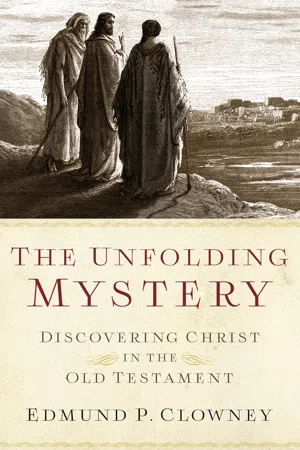
Beginning with Adam and Eve and closing with the last of the prophets, Dr. Clowney takes a fascinating walk through the Old Testament, revealing Christ in places where he is usually overlooked.
eBook - ePub
The Unfolding Mystery (2d. ed.)
Discovering Christ in the Old Testament
- English
- ePUB (mobile friendly)
- Available on iOS & Android
eBook - ePub
About this book
Information
Topic
Theology & ReligionSubtopic
Biblical StudiesChapter ONE
The New Man

The very first written Scripture came from the hand of God Himself: God inscribed His law on two tablets of stone (Ex. 31:18). That inscription begins: “I am the Lord your God” (Ex. 20:2).
God identified Himself there on Mount Sinai as the God of Israel. Israel’s God was not a tribal deity, however. He was also the King of the nations and the God of creation. Included in God’s revelation to Israel was not only the law by which their life and worship was to be regulated, but much more. To know the Lord their God, Israel had to know Him as the Creator. To know their calling, the people needed to know the story of their father Abraham, and his calling. It was also essential for them to know God’s rule over the nations: the nations that were to be blessed through the new nation begun from the son of Abraham.
The first book of Moses begins at the beginning to tell the story that leads to the calling of Israel and their exodus from Egypt. It is the book of “generations,” tracing not only the stories of the fathers of Israel, but putting their calling in the context of God’s dealings with the whole human race from the time of creation. Although all the earth was His, Israel was God’s chosen people, His precious possession. Yet Israel’s calling was not for their sake alone. They were chosen from the nations, that they might bear witness to the nations. To do that, Israel needed to confess the God who called Abraham, spared Noah, and put Adam in the garden.
Made as the Image of God
“God created man in his own image, in the image of God he created him; male and female he created them” (Gen. 1:27). In a beautifully crafted literary form, the first chapter of Genesis leads up to the climax of creation: God made man and woman in His image. All the mythology of the nations is swept aside. Mankind does not originate in a process of divine copulation or from the blood of a slaughtered god. A man is not a piece of a god, nor a piecing together of god and beast. Rather, Adam and Eve are God’s creatures, but creatures who bear His likeness. That they are God’s creatures is perfectly clear. Their creation is not assigned to a separate day in the divine work: animals and men are alike made on the sixth day of creation.
If the first pair are blessed and told to be fruitful and multiply, so are the fish of the sea (Gen. 1:22, 28). Both are multiplying creatures. Human creatureliness is further stressed when the second chapter goes on to describe the “generations” of the heavens and of the earth: that is, what God’s hand brings forth from His created world. The earth brings forth living creatures at God’s command, but man, too, comes from the earth. God forms Adam from the dust of the ground, and Eve is formed from the body of Adam.
On the other hand, both chapters emphasize the distinctiveness of this human creature. In chapter one, the creation of man follows a divine determination: “Let us make man in our image, in our likeness” (Gen. 1:26). The mention of the Spirit of God at the beginning of the chapter suggests that here God takes counsel with Himself, not merely as a man might address his own soul, but in the mysterious richness of the divine being. In the second chapter, the remarkable distinctiveness of the creation of man is shown first in the special care God uses to form man from the dust. Beyond the touch of God’s hands is the breath of His lips. In a picture of intimate fellowship, God breathes into man’s nostrils the breath of life.
Man is a creature, because he is made by God. But he is a unique creature, because he is made like God. The term “image” is used later in the Old Testament to describe idols. God forbids men to make images for worship, even images of men made in God’s image. Man is made, not simply in the image of God, as though the divine image were reproduced in man, but rather, man is made as the image of God. He is like God.
Again the Genesis account is set against the convictions of the nations. Racial mythologies separate one tribe or people as descended from the gods. Royal myths teach that the king alone is made in the image of the god. A cuneiform text declares, “The father of the king, my lord, was the image of Bel, and the king, my lord, is the image of Bel.”1 In Genesis, however, mankind is created in the image of God, “in the image of God he created him; male and female he created them” (Gen. 1:27).
Made in God’s image, man’s nature and role are unique in creation. The fact that man shares organic, bodily life with all the animate creation qualifies him to represent that creation before God. Through man the praises of the physical creation can be addressed to God. Humanity, the climax of creation, has a role to fulfill. Man mediates between the Creator and the created world of which he is part. In man God may deal with His creation personally. God speaks to man, and with human lips man replies for the creation of which he is head.
Because man represents the very glory of God in created form, he also rules over creation. Man’s image bearing is joined to his dominion over creation (Gen. 1:26–27). The charming story of Adam’s naming of the animals is not given just for the delight of children. It indicates Adam’s calling by God to understand the forms of creation and to order them. It therefore also dramatically shows that no animal, however loyal in his service of man, can be his partner and equal.
We all know a relationship in which one differs from another, yet shows a remarkable likeness. We often say that a little boy is the very image of his father. Scripture states that when Seth was born to Adam and Eve, Adam “begat a son in his own likeness, after his image” (Gen. 5:3, kjv). Since this is recorded after the fall into sin, and since the chapter reaffirms Adam’s creation in the image of God, some have concluded that the image was lost in the Fall, and that what remains is no longer the image of God but only the weak reflection of that image in Adam. In the same book of Genesis, however, the value of human life is established by appeal to the creation of man in the image of God (Gen. 9:6; cf. James 3:9).
Since the image of God in some sense continues to distinguish man from the animals, we may assume that Seth in Adam’s image is also in God’s image. For this reason Luke traces the genealogy of Christ to Seth, the son of Adam, the son of God. The emphasis in Genesis is on the continuity of the image, in spite of the Fall. Seth, the son, is in the image of his father, and Adam is in the image of God. The implication that Luke draws attention to is clear: Adam, as the image-bearer in the likeness of God, may be called the son of God. At the same time, in Genesis it is Seth, not Cain, who is said to bear the image of his father, Adam. It is to the line of Seth, not of Cain, that God’s promise is given; in that line true Sonship will be realized.
What a splendid figure is Adam in the Genesis account! Formed by God and made like God, he is placed in the garden that God planted, teeming with the richness of created life: scurrying animals, trees burdened with fruit, skies bright with sunshine or heavy with mist. This first man is the lord of all; through him creation lifts its eyes to the Creator and speaks God’s praise. Adam is the cultivator of the garden, free to explore its riches and develop the world beyond. There is gold in Havilah. Great rivers water the garden and flow forth beyond it.
Adam’s freedom would seem to have only one restraint. God pointed out to him one tree in the garden of which he must not eat. A smaller limitation would be hard to imagine. All the fruits of Eden were his to enjoy. All the trees were his to cultivate, all the animals his to call and command. Yet Adam, the son of God, was being tested in his obedience to his Father and Creator. He, the first man, held the destiny of all his descendants, for his was the pivotal role. He was the father of those to be born in his image; he represented the race of those who would come from him. By obedience under testing, his righteousness would pass beyond its original innocence. He would know the difference between good and evil by choosing the good. He would be confirmed as the righteous son of God, free to eat of the tree of life forever.
But Adam was alone in paradise. God formed from his very side a woman to be with him, his companion and helper. To Adam’s role as head of creation was added a new role of headship in relation to the woman who was bone of his bone and flesh of his flesh (Gen. 2:23). Together they could be fruitful and fill the earth that was theirs to possess.
Even before we are told the story of the Fall, the Genesis account prepares us for the role Jesus Christ would play in God’s plan of salvation. The figure of Adam at the dawn of human history reminds us that God deals with mankind personally. Adam served as the representative man. Christ came as the second Adam (Rom. 5:12–21; 1 Cor. 15:22)—not as a divine afterthought, but as the One chosen from the foundation of the world to manifest all that the divine image in man may mean.
Before the story of redemption begins, the sole figure of Adam, God’s image-bearer, stands before us. He receives God’s command and promise even before Eve has been given to him. All this has meaning, not only for the beginning of human history, but for its culmination. Adam, the representative man, prepares us for Christ. Christ is more than a substitute for Adam, a stand-in, as it were, to succeed where Adam failed. Christ, who is the Omega, the goal of human history and of created humanity, is also the Alpha, the true Adam, Head of the new and true humanity. He is “the image of the invisible God, the firstborn over all creation” (Col. 1:15), for He is not only the Prince of creation; He is also the Creator. His image bearing infinitely exceeds that of Adam, for as the eternal Son, He is one with the Father. At the last, Adam’s created sonship can only reflect the greater Sonship of the divine model. The apostle Paul rejoices that the son-ship we gain in Christ far exceeds what we lost in Adam (Rom. 8:14–17).
For that reason, too, God forbade the people of Israel to make images of God to focus their worship (Deut. 4:15–24). They were warned not only against the worship of idols representing other gods. They were also reminded that they saw no form when God spoke from Sinai, and that they were not to attempt to make a representation of the true God.
This does not mean that there can be no representation of God; after all, God made man in His image. But it means that man is not free to invent an image for worship, not even a replica of the image God made: man himself. In the plan of the tabernacle given to Israel in the wilderness, the ark of the covenant represented the very throne of God. The golden lid of this ark was the mercy seat, the place where God was enthroned in the midst of Israel. Representations of the cherubim with outstretched wings attended the throne. But on th...
Table of contents
- Contents
- About the Author
- Foreword
- Introduction
- 1. The New Man
- 2. The Son of the Woman
- 3. The Son of Abraham
- 4. The Heir of the Promise
- 5. The Lord and His Servant
- 6. The Rock of Moses: Is the Lord among Us?
- 7. The Lord’s Anointed
- 8. The Prince of Peace
- 9. The Lord to Come
- Notes
- Index of Scripture
Trusted by 375,005 students
Access to over 1.5 million titles for a fair monthly price.
Study more efficiently using our study tools.
Frequently asked questions
Yes, you can cancel anytime from the Subscription tab in your account settings on the Perlego website. Your subscription will stay active until the end of your current billing period. Learn how to cancel your subscription
No, books cannot be downloaded as external files, such as PDFs, for use outside of Perlego. However, you can download books within the Perlego app for offline reading on mobile or tablet. Learn how to download books offline
Perlego offers two plans: Essential and Complete
- Essential is ideal for learners and professionals who enjoy exploring a wide range of subjects. Access the Essential Library with 800,000+ trusted titles and best-sellers across business, personal growth, and the humanities. Includes unlimited reading time and Standard Read Aloud voice.
- Complete: Perfect for advanced learners and researchers needing full, unrestricted access. Unlock 1.5M+ books across hundreds of subjects, including academic and specialized titles. The Complete Plan also includes advanced features like Premium Read Aloud and Research Assistant.
We are an online textbook subscription service, where you can get access to an entire online library for less than the price of a single book per month. With over 1.5 million books across 990+ topics, we’ve got you covered! Learn about our mission
Look out for the read-aloud symbol on your next book to see if you can listen to it. The read-aloud tool reads text aloud for you, highlighting the text as it is being read. You can pause it, speed it up and slow it down. Learn more about Read Aloud
Yes! You can use the Perlego app on both iOS and Android devices to read anytime, anywhere — even offline. Perfect for commutes or when you’re on the go.
Please note we cannot support devices running on iOS 13 and Android 7 or earlier. Learn more about using the app
Please note we cannot support devices running on iOS 13 and Android 7 or earlier. Learn more about using the app
Yes, you can access The Unfolding Mystery (2d. ed.) by Edmund P. Clowney in PDF and/or ePUB format, as well as other popular books in Theology & Religion & Biblical Studies. We have over 1.5 million books available in our catalogue for you to explore.