Traces eschatological themes through the Bible, emphasizing how each book develops these themes, and their culmination in the coming of Christ, showing how all those texts fit into redemptive history.
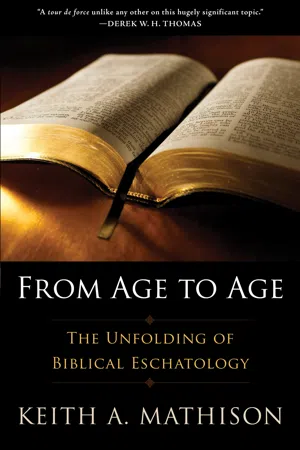
- English
- ePUB (mobile friendly)
- Available on iOS & Android
eBook - ePub
About this book
Information
Topic
Theology & ReligionSubtopic
Christian TheologyPART 1
THE OLD
TESTAMENT
1
The Pentateuch (1)
Genesis
Most people, when reading a book, do not begin with the final chapter. In fact, the contents of a book’s final chapter will usually make little sense if the reader does not know what has preceded it. Many Christians, however, in their desire to understand what the Bible teaches about the last days, begin by turning to the book of Revelation. The book of Revelation is certainly important for an understanding of the outworking of God’s redemptive work in history, but the book of Revelation is, so to speak, the final chapter. In order to understand biblical eschatology, we must understand the entire Bible. It is true that biblical eschatology focuses on the end of redemptive history, but the end of that history can only be understood within the context of the whole of that history. The redemptive events described in the New Testament are the fulfillment of the promises found in the Old Testament. These ancient promises go back to the very beginning, to the five books of Moses.
The Pentateuch in Context
Christians and others have used the term “Pentateuch” since at least the third century to refer to the first five books of the Bible. In Jewish tradition, however, these books are usually referred to as the Torah and are the first section of the Tanakh, the Hebrew Bible.1 The overarching genre of the Pentateuch is historical narrative, but it also contains other genres such as law and poetry. The historical narrative of the Pentateuch, like that of the other historical books of the Old Testament, may best be described as theological history. In other words, the Pentateuch is a historical account written for a specific purpose, namely to reveal the nature of Israel’s God.2
The books of the Pentateuch themselves nowhere indicate the name of their author, but the New Testament and Jewish tradition both attribute authorship to Moses (Matt. 19:7; 22:24; Mark 7:10; 12:26; John 1:17; 5:46; 7:23).3 In the nineteenth century, this traditional understanding of the authorship of the Pentateuch was challenged with the rise of the documentary hypothesis. According to this hypothesis, the Pentateuch is composed of four distinct sources: the Yahwistic source (J), the Elohistic source (E), Deuteronomy (D), and the Priestly source (P). These sources were gradually combined and edited, eventually resulting in the final form of the Pentateuch in approximately the fifth century B.C. It is well beyond the scope of this work to provide a critique of the documentary hypothesis.4 Suffice it to say, however, that while more conservative scholars have always rejected the hypothesis, critical scholars are now reevaluating it as well. The literary unity of the Pentateuch is now much more widely acknowledged.5
Among those who accept not only literary unity but also Mosaic authorship for the Pentateuch, there is a general consensus regarding its original audience and the historical occasion for its writing. These five books were written and originally addressed to the people of Israel during that time in their history following the exodus from Egypt when they were on the plains of Moab, east of the Jordan River preparing to enter the Promised Land.6 Moses, their leader since the exodus from Egypt, would not be entering the land with them (Num. 20:12). But because he knew what his people needed, he composed the Pentateuch. Within these five books, Moses explains to the people of Israel who they are, why God brought them out of Egypt, and what God expected of them in terms of his covenant with them. The Pentateuch, then, was originally addressed to a specific people (Israel) within a specific historical context (the eve of their conquest of Canaan).
For the sake of convenience, it is helpful to deal with each of the five books of Moses as separate documents. It should be noted, however, that the five books of the Pentateuch are in actuality a unified literary entity. As T. D. Alexander observes, the later books of the Pentateuch presuppose knowledge of the earlier books, while the earlier books are incomplete without the later ones.7 In addition, the Pentateuch as a whole has a distinct thematic connection with the books of Joshua to 2 Kings. As we look at the individual books and the smaller sections within each of these books, this larger literary context must always be kept in mind.
Genesis
The book of Genesis may be divided into two major sections: the primeval history (1:1–11:26) and the patriarchal history (11:27–50:26). Within this broad outline there exists a distinctive literary structure. Following a brief prologue (1:1–2:3), the book is divided into ten sections of varying length that are indicated and introduced by variations of the phrase “These are the generations [toledot] of . . .” (2:4; 5:1; 6:9; 10:1; 11:10; 11:27; 25:12; 25:19; 36:1; 37:2). Some of the toledot headings introduce extended historical narratives, while others introduce genealogies.
The Primeval History (Gen. 1:1–11:26)
Of the fifty chapters of Genesis, the first eleven narrate what is often referred to as the primeval history. These chapters recount history from creation to the time of Abram’s call. The amount of space the author devotes to the primeval history (eleven chapters) compared to the amount of space he devotes to the patriarchal history (thirty-nine chapters) indicates that the primeval history is essentially introductory and preparatory. The patriarchal narratives are the author’s primary interest. The first eleven chapters of Genesis place the patriarchs into a broader creational context. They reveal, as Gordon Wenham observes, that the “God who called Abraham was no local divinity but the creator of the whole universe.”8 Genesis 1–11, then, provides the historical and theological background to Abram’s call and ultimately to the birth of Israel. These chapters reveal the hopeless situation of fallen man without the gracious intervention of God, and they set the stage for the revelation of God’s covenantal promises to Abraham, Isaac, and Jacob. These promises are the means by which God will begin to fulfill his original purposes for all of creation.9
When read in its ancient Near Eastern context, it also becomes evident that the primeval history of Genesis 1–11 presents its readers with a worldview that is dramatically different from that of the surrounding cultures.10 It directly challenges the contemporary pagan views of deity, the universe, and the nature and purpose of mankind. Israel had only recently been redeemed from the idolatrous environment of Egypt and was soon to come into contact with the equally idolatrous environment of Canaan. The primeval history reveals to Israel the truth about God, creation, and sin that the people would have to understand in order to counter and resist the false pagan worldviews surrounding them on every side.
The Creator and His Creation
An examination of the structure of Genesis indicates that the creation account in Genesis 1:1–2:3 functions as a prologue or introduction to the book as a whole. In this prologue, the people of Israel learn that their God, the God who brought them out of Egypt, is not merely some local tribal deity. He is not like the false gods of the surrounding nations. Instead, he is the Creator of the universe and the only true God. He is the sovereign King over all. This passage beautifully describes God’s creation of all things followed by his rest from his labors.
In Genesis 1:1 we read: “In the beginning, God created the heavens and the earth.” The temporal clause “In the beginning” points to the fact that the space/time universe in which we live had an absolute beginning.11 It is not eternal. The subject of this first sentence of Genesis is “God,” the one who created the universe. The word translated “God” here is ’elohim, and it is used some thirty-five times in the prologue alone. This chapter is predominantly about him. God is said to have created “the heavens and the earth.” In other words, God created the universe and all that is in it. The universe did not come into being by spontaneous generation. Everything that is owes its existence to God (Neh. 9:6; Rev. 10:6; Col. 1:16).12 As the Creator, God is also the sovereign King over all that he has made, and all that he has made exists to glorify him (Col. 1:16; Rev. 4:11).13 He is the Great King, and the creation is intended to be his kingdom.
Genesis 1:2 describes the universe as “without form and void.”14 With the universe in this condition, the Spirit of God hovers over the formless deep. On the first three days of creation God creates light (1:3–5), the sky and seas (1:6–8), and dry land and plants (1:9–13). On the last three days of creation, these separate spheres are filled as God creates the heavenly lights (1:14–19), the birds and fish (1:20–23), and finally the land animals and man (1:26–31).15 There is a parallel, then, between the creative work of the first three days and the creative work of the last three days. In contrast to those pagan religions and philosophies that believe the physical world to be inherently evil, God repeatedly describes the created material world as “good” (1:4, 10, 12, 18, 21, 25, 31).16
On the fourth day, God creates the sun, the moon, and the stars. Aside from the creation of man on the sixth day, more attention is given to this aspect of creation than to any other. The probable reason for such detailed attention is that the sun and the moon were considered to be important gods in ancient Near Eastern thought while the stars were believed to impact human lives. In its account of the fourth day of creation, Genesis makes it clear that the sun, moon, and stars are a part of God’s creation called into being by his mighty word.17 They are not gods to be worshiped or consulted.
On the fifth and sixth day, God creates birds, fish, and land animals, each according to its own kind. The climax of the creative work of God, however, is reached with the creation and blessing of man.18 In Genesis 1:26, God says, “Let us make man in our image, after our likeness.”19 The words tselem and demut, translated “image” and “likeness” respectively, are generally synonymous in this context.20 Their use in this verse indicates that man is like God in certain respects, but their use also indicates that there is a distinction between the Creator and the creature. Likeness is not identity. Man is like God in that he is a rational and moral being who is personal and relational. Man is unlike God in that he is, among other things, a finite creature.
Verse 27 reveals that the creation of man in God’s image entailed the creation of man and woman. The man and woman are created for union and communion with their Creator as well as with each other. As a consequence of being made in the image of God, man is given dominion over the rest of creation (Gen. 1:28; Ps. 8:6–8). This “dominion mandate” is the first clear hint in Scripture of God’s creational purpose. The first man, created in the...
Table of contents
- Cover Page
- Title Page
- Copyright Page
- Contents
- Preface
- Abbreviations
- Introduction
- Part 1: The Old Testament
- Part 2: The New Testament
- Conclusion
- References
- Index of Scripture and Extrabiblical References
- Index of Subjects and Names
Trusted by 375,005 students
Access to over 1.5 million titles for a fair monthly price.
Study more efficiently using our study tools.
Frequently asked questions
Yes, you can cancel anytime from the Subscription tab in your account settings on the Perlego website. Your subscription will stay active until the end of your current billing period. Learn how to cancel your subscription
No, books cannot be downloaded as external files, such as PDFs, for use outside of Perlego. However, you can download books within the Perlego app for offline reading on mobile or tablet. Learn how to download books offline
Perlego offers two plans: Essential and Complete
- Essential is ideal for learners and professionals who enjoy exploring a wide range of subjects. Access the Essential Library with 800,000+ trusted titles and best-sellers across business, personal growth, and the humanities. Includes unlimited reading time and Standard Read Aloud voice.
- Complete: Perfect for advanced learners and researchers needing full, unrestricted access. Unlock 1.5M+ books across hundreds of subjects, including academic and specialized titles. The Complete Plan also includes advanced features like Premium Read Aloud and Research Assistant.
We are an online textbook subscription service, where you can get access to an entire online library for less than the price of a single book per month. With over 1.5 million books across 990+ topics, we’ve got you covered! Learn about our mission
Look out for the read-aloud symbol on your next book to see if you can listen to it. The read-aloud tool reads text aloud for you, highlighting the text as it is being read. You can pause it, speed it up and slow it down. Learn more about Read Aloud
Yes! You can use the Perlego app on both iOS and Android devices to read anytime, anywhere — even offline. Perfect for commutes or when you’re on the go.
Please note we cannot support devices running on iOS 13 and Android 7 or earlier. Learn more about using the app
Please note we cannot support devices running on iOS 13 and Android 7 or earlier. Learn more about using the app
Yes, you can access From Age to Age by Keith A. Mathison in PDF and/or ePUB format, as well as other popular books in Theology & Religion & Christian Theology. We have over 1.5 million books available in our catalogue for you to explore.