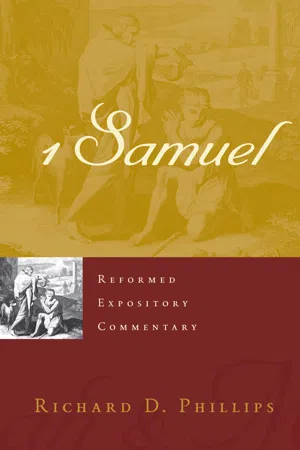
When people think of 1 Samuel, they think of David, the man after God's own heart. Yet 1 Samuel introduces us to two great alter egos—Samuel and Saul. And let's not forget Eli, Hannah, and Jonathan!
eBook - ePub
1 Samuel
About this book
Information
Topic
Theology & ReligionSubtopic
Biblical Commentary PART 1

Last of the Judges
1
THE BARREN WIFE
1 Samuel 1:1–8
Elkanah, her husband, said to her, “Hannah, why do you weep? And why do you not eat? And why is your heart sad? Am I not more to you than ten sons?” (1 Sam. 1:8)
Among the treasures of our world are the great stories that shape the identity of whole peoples. Homer’s Iliad provided the ancient Greeks with a literary foundation on which centuries of great culture were erected. Out of the chaos of the Dark Ages, the Britons found a noble ideal in the story of King Arthur and Camelot. More ancient than either of these is the Old Testament book of Samuel, with its story of the rise of King David and the establishment of Israel’s kingdom.
As literature, Samuel is unsurpassed in the richness of its plot, the complexity and depth of its characters, the intensity of its action, and the profundity of its lessons. This is all the more the case when we realize that Samuel is not a fictional tale, but a true historical narrative. These people lived on our earth, and these events happened in our world. Homer and King Arthur inspire us through their fantasy world of heroes, maidens, and monsters. Samuel refuses to yield the palm when it comes to these. But Samuel’s importance lies not only in that its story is true, but also in that it forms a part of the unfolding story of God’s salvation that is the greatest truth of all.
LAST OF THE JUDGES, FIRST OF THE PROPHETS
Samuel was born sometime around the year 1050 B.C. “In those days there was no king in Israel,” says the book of Judges. “Everyone did what was right in his own eyes” (Judg. 21:25). This summarizes the condition of the nation at the time of Samuel’s birth. Israel faced a leadership crisis that was accompanied by a spiritual crisis. Having entered the Promised Land in victory and strength, the people of God had lost their way spiritually, politically, and militarily. Judges 2:10 explains why: after Joshua and his generation, “there arose another generation after them who did not know the LORD.”
Forgetting the Lord is the greatest evil that can befall any generation. Absent God’s help, Israel failed to drive out the remnants of the Canaanites, but instead began to follow in their pagan ways and to worship their unholy idols. In punishment, God gave the Israelites over into the hands of their enemies, periodically showing mercy by raising up judges to deliver them (see Judg. 2:10–23). The book of Judges concludes with a series of stories that depict the decadent setting in which Samuel was born and raised, including the spiritual corruption of the Levites, the idolatry of the people, and the moral squalor of Israelite society.
The birth of Samuel portended a new age. Just as God would later prepare Israel for her Messiah by sending John the Baptist, God prepared the way for a king after God’s own heart (1 Sam. 13:14) by sending Samuel, who was at once the last of Israel’s judges and the first of the great line of the prophets who served during Israel’s kingdom. David Tsumura observes: “Samuel takes the decisive role in the period of transition from the days of the judges to the monarchical era, leading to the establishment of the House of David and the beginning of the worship of Yahweh in Jerusalem.”1
The historical significance of Samuel is evidenced by the birth narrative that begins the two books of the Bible that bear his name. The Scriptures always take care to inform us of the birth and upbringing of its most important figures, and so it is here. Just as Moses, Samson, John the Baptist, and Jesus Christ were all born in times of distress to humble, godly parents, Samuel enters history as the child of Elkanah and Hannah. The book begins: “There was a certain man of Ramathaim-zophim of the hill country of Ephraim whose name was Elkanah the son of Jeroham, son of Elihu, son of Tohu, son of Zuph, an Ephrathite” (1 Sam. 1:1).
Samuel’s father was a “certain man,” hardly a description for someone of prominence. We are told two things about Elkanah, starting with the place where he lived. Ramathaim-zophim was a small town in the very heart of Israel, belonging to the territory allotted to Ephraim, not far from its border with Judah, about five miles north of what would later be the city of Jerusalem. Samuel would put Ramah, as it was later called, “on the map,” making it Israel’s virtual capital during his judgeship (1 Sam. 8:4) and founding there the school of the prophets (1 Sam. 19:18–20). Neither Elkanah nor Samuel was an Ephraimite, however. They traced their lineage through Tohu to Zuph, who was an Ephrathite, a denizen of the region of Bethlehem in the land of Judah. Moreover, theirs was a priestly family, of the tribe of Levi and the clan of Kohath, as we learn in 1 Chronicles 6:33–38; the Kohathites were originally charged with guarding the ark of the covenant and serving as the tabernacle’s gatekeepers (Num. 3:31). Under David, the “sons of Kohath” were dedicated to the ministry of song in the tabernacle. Samuel’s grandson Heman is denoted as “the singer” and seems to have enjoyed the enormous privilege of serving as music director for Israel’s worship under David (1 Chron. 6:31–33). Samuel’s descendants were probably among “the sons of Korah,” to whom authorship of eleven psalms is ascribed.
GOD’S BARREN WIFE
The primary focus in Samuel’s birth is not on his father, however, but on his mother, Hannah. We can often trace the faith of remarkable children to their remarkable mothers. So it is with this woman, who presents one of the most striking feminine characters in the Bible. Robert Bergen observes that “the spiritual powerhouse in this narrative was a socially impotent woman . . . [who] alone understood the true power of undivided faith in the Lord.”2 There is much to say about this extraordinary woman, but at the time there was one fact that dominated her existence. Hannah’s womb was closed, so she was unable to bear Elkanah any children. After telling us that Hannah is Elkanah’s wife, the Bible simply reports, “Hannah had no children” (1 Sam. 1:2).
Hannah’s barrenness seems to correspond to Israel’s spiritual state. Women who suffer this condition often wonder how God is involved, but in Hannah’s case we know, since the text informs us that “the LORD had closed her womb” (1 Sam. 1:5). There are many reasons why God brings trials into the lives of his people, often to stimulate our faith, but in the case of the mother of so important a figure as Samuel, the point has to do not with Hannah but with Israel. The Lord closed Hannah’s womb to remind Israel that he had also caused the people to be spiritually barren because of their idolatry and unbelief. Israel was God’s barren wife, having failed to give him the children of faith he desired. As a nation, Israel particularly manifested her barrenness in the resultant lack of the strong leadership of a true king. Bruce Birch explains: “The situation in Elkanah’s family is intended as a parable of Israel’s situation at this moment in history. Hannah’s anxiety over having no children, even though Elkanah loves her, parallels Israel’s anxiety over having no king in spite of the care and love of God.”3
What God shows us through Hannah is relevant for every Christian whose faith seems barren. It is true for barren churches, as the church in the West, including America, can largely be considered today, bearing very little of the harvest of holiness and zeal for truth that God desires. As we continue in Hannah’s story, she will model for us the grace-seeking prayer that we need to offer to God. But in these opening verses we see another essential point. For in a time when Israel as a whole had forgotten the Lord, “this man used to go up year by year from his city to worship and to sacrifice to the LORD of hosts at Shiloh, where the two sons of Eli, Hophni and Phinehas, were priests of the LORD” (1 Sam. 1:3).
Shiloh was the location of the tabernacle and the ark of the covenant in Elkanah’s time. Eli was hardly an impressive spiritual leader, and his wicked sons, Hophni and Phinehas, made a mockery of ministry, as we will see (1 Sam. 2:22–25). Elkanah did not go up to Shiloh to see Eli or his sons, but to come before the Lord and renew his covenant fidelity. Elkanah did what we must also do: he prioritized the place of God in his life and gave his attention to the Lord. However little Elkanah knew of true religion at a time like this, he knew enough to come as a sinner, seeking grace from God by means of the shed blood of a sacrifice.
This is how salvation begins for any barren soul. It begins with realizing that we must get right with God. Sinners come to the cross of Jesus Christ, the Lamb of God to whom the old sacrifices pointed, seeking forgiveness through his atoning blood and renewal through his redeeming grace. Spiritually barren Christians come back to the cross, confessing to God their sin and spiritual neglect and finding cleansing and acceptance through Christ’s once-for-all sacrifice. This is what God desired from Israel: a sincere and repentant seeking after him and his grace, for which purpose he had afflicted them with the barrenness of the time of the judges, and which he reflected in the childless condition of godly Hannah. When we see Hannah’s tears, shed not for her own but for Israel’s failings, we should grieve for our own sins and the barren lives they cause. Her deliverance will likewise remind us of God’s redeeming love and transforming power that is available to us.
TEARS IN THE TABERNACLE
The theology of Hannah’s barren condition would have been little on her heart, however, as she returned to the tabernacle with her family. It was a dysfunctional family, primarily because Hannah was not Elkanah’s only wife: “He had two wives. The name of the one was Hannah, and the name of the other, Peninnah. And Peninnah had children, but Hannah had no children” (1 Sam. 1:2).
The practice of polygamy is frequently seen in the Old Testament, though it was probably not the norm. The book of Genesis makes it clear that God designed marriage to be between one man and one woman (Gen. 2:24), a definition that is confirmed by Jesus Christ (Matt. 19:5). Elkanah’s polygamy was probably provoked by Hannah’s inability to bear children, which threatened both economic hardship and the cutting off of his name and lineage. Therefore, like the patriarchs Abraham and Jacob, Elkanah took a second wife to bear him children while his affections remained fixed on Hannah.
The emotional divide in this marriage that necessarily followed corresponds to the names of the two wives: Hannah, whose name means “gracious,” and Peninnah, whose name means “prolific.” Polygamy always causes family conflict, but much more certainly when one wife receives affection and the other receives children. The discord in Elkanah’s house mirrors the intertribal dissension within Israel and reminds us all of the importance of family and church unity.
Hannah’s emotional distress over her barren womb would have been grief enough without Peninnah to goad her. Her trial is familiar to women today who suffer an inability to bear children. She had never had the thrill of bringing the news of a pregnancy to her husband, but had instead known the monthly frustration of infertility. Whenever she went to the marketplace or socialized with other families, the sound of infant voices—the very sound she most desired—plunged into her heart like a knife. William Blaikie adds that “the trial which Hannah had to bear was particularly heavy . . . to a Hebrew woman. To have no child was not only a disappointment, but seemed to make one out as dishonoured by God, as unworthy of any part or lot in the means that were to bring about the fulfillment of the promise, ‘In thee and in thy seed shall all the families of the earth be blessed’ ”4 (Gen. 12:3). It is always cruel, and almost always unwarranted, to assume another’s affliction as a sign of God’s disfavor, especially a trial so painful to a woman’s heart. But since children were considered a sign of God’s favor (Deut. 7:14; 28:4), and since the Mosaic law listed barren wombs as one sign of God’s curse for covenant-breaking (28:18), childless women were often scorned in female society, depriving them of the emotional support they needed. All this was Hannah’s bitter portion, month by month and year by year.
Then there was Peninnah. While Hannah had Elkanah’s heart, Peninnah had his children, and she missed no opportunity to inflict misery on this account: “[Hannah’s] rival used to provoke her grievously to irritate her, because the LORD had closed her womb. So it went on year by year” (1 Sam. 1:6–7).
A typical example is what took place during this visit to Shiloh: “On the day when Elkanah sacrificed, he would give portions to Peninnah his wife and to all her sons and daughters. But to Hannah he gave a double portion, because he loved her, though the LORD had closed her womb” (1 Sam. 1:4–5). We can imagine Elkanah’s quandary: should he distribute all the portions for Peninnah and her many children, but only one to Hannah? In order to express his sympathy and love, he gave Hannah a double portion. This sign of special favor enraged Peninnah, inciting her to savage mockery. Perhaps this was delivered backhandedly, as imagined by Dale Ralph Davis:
“Now do all you children have your food? Dear me, there are so many of you, it’s hard to keep track.”
“Mommy, Miss Hannah doesn’t have any children.”
“What did you say, dear?”
“I said, Miss Hannah doesn’t have any children.”
“Miss Hannah? Oh, yes, that’s right—she doesn’t have any children.”
“Doesn’t she want children?”
“Oh, yes, she wants children very, very much! Wouldn’t you say so, Hannah?
[In a low aside] Don’t you wish you had children too?”
“Doesn’t Daddy want Miss Hannah to have kids?”
“Oh, certainly he does—but Miss Hannah keeps disappointing him; she just can’t have kids.”
“Why not?”
“Why, because God won’t let her.”
“Does God not lik...
Table of contents
- Cover Page
- Title Page
- Copyright Page
- Contents
- Series Introduction
- Preface
- Part 1: Last of the Judges
- Part 2: A King like All the Nations
- Part 3: A Man after God’s Own Heart
- Index of Scripture
- Index of Subjects and Names
Trusted by 375,005 students
Access to over 1.5 million titles for a fair monthly price.
Study more efficiently using our study tools.
Frequently asked questions
Yes, you can cancel anytime from the Subscription tab in your account settings on the Perlego website. Your subscription will stay active until the end of your current billing period. Learn how to cancel your subscription
No, books cannot be downloaded as external files, such as PDFs, for use outside of Perlego. However, you can download books within the Perlego app for offline reading on mobile or tablet. Learn how to download books offline
Perlego offers two plans: Essential and Complete
- Essential is ideal for learners and professionals who enjoy exploring a wide range of subjects. Access the Essential Library with 800,000+ trusted titles and best-sellers across business, personal growth, and the humanities. Includes unlimited reading time and Standard Read Aloud voice.
- Complete: Perfect for advanced learners and researchers needing full, unrestricted access. Unlock 1.5M+ books across hundreds of subjects, including academic and specialized titles. The Complete Plan also includes advanced features like Premium Read Aloud and Research Assistant.
We are an online textbook subscription service, where you can get access to an entire online library for less than the price of a single book per month. With over 1.5 million books across 990+ topics, we’ve got you covered! Learn about our mission
Look out for the read-aloud symbol on your next book to see if you can listen to it. The read-aloud tool reads text aloud for you, highlighting the text as it is being read. You can pause it, speed it up and slow it down. Learn more about Read Aloud
Yes! You can use the Perlego app on both iOS and Android devices to read anytime, anywhere — even offline. Perfect for commutes or when you’re on the go.
Please note we cannot support devices running on iOS 13 and Android 7 or earlier. Learn more about using the app
Please note we cannot support devices running on iOS 13 and Android 7 or earlier. Learn more about using the app
Yes, you can access 1 Samuel by Richard D. Phillips in PDF and/or ePUB format, as well as other popular books in Theology & Religion & Biblical Commentary. We have over 1.5 million books available in our catalogue for you to explore.