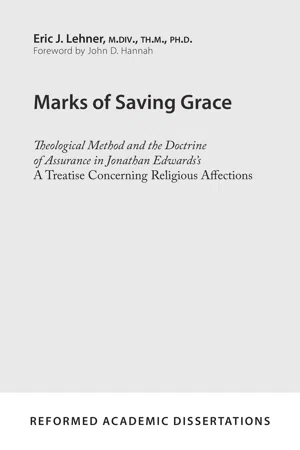
Eric Lehner explores Jonathan Edwards's theology of Christian assurance in terms of his theological method—examining Edwards's use of philosophical, historical, and biblical sources for A Treatise Concerning Religious Affections.
eBook - ePub
Marks of Saving Grace
Theological Method and the Doctrine of Assurance in Jonathan Edwards's A Treatise Concerning Religious Affections
- English
- ePUB (mobile friendly)
- Available on iOS & Android
eBook - ePub
Marks of Saving Grace
Theological Method and the Doctrine of Assurance in Jonathan Edwards's A Treatise Concerning Religious Affections
About this book
Information
Topic
Theology & ReligionSubtopic
Christian Theology 1
The Puritan Model of Assurance
A Treatise Concerning Religious Affections speaks directly to the individual and experiential aspect of the Christian faith, so not surprisingly, the degree of attention the church has given to the work spans over two centuries. Furthermore, Religious Affections is especially valued because it addresses that one question which is more significant than any other: how can a person avoid self-deception regarding one’s own profession of faith and know that one’s own faith is genuine and saving? Religious Affections seeks to answer the question of Christian assurance in terms that are definitive and theological. Marks of Saving Grace, in turn, seeks to understand Edwards’s answer to that question as well as the method he used to justify his answer.
Several layers of context, moving from the general to the specific, overlap one another to bring a clear picture of Edwards’s background and his motivation for writing. First, the doctrine of assurance was a substantial component of the overall Puritan idea, and as such the essential idea of Puritanism itself is critical for understanding Religious Affections. Second, it is important to account for the early Puritan motivations for the development of the doctrine of assurance. Building on these two principles, necessity then demands the examination of the substance of the Puritan doctrine of assurance; this third step will establish the theological context of Religious Affections. Fourth, the doctrinal components of syllogism and preparation, which the Puritans employed to enhance their theology of assurance, are key to understanding Edwards’s approach to assurance.
The Essential Idea of Puritanism
Efforts to define Puritanism have typically assessed the concepts, agendas, values, or ideas which were essential to the movement. A number of single governing motifs have been suggested, as have certain combinations of motifs, in order to explain what Puritanism really consisted of.
Interpretations of the Essence of Puritanism
Interpretations of Puritanism have varied considerably over the last hundred years or so. A concise analysis by Joel Beeke and Randall Pederson1 documents competing definitions of Puritanism which center upon single governing ideas such as predestination,2 covenant,3 conversion,4 politicized socio-economics,5 and anti-Anglicanism.6 Additionally, Edmund Morgan proposes that separatism was the central idea that propelled Puritanism.7 Andrew Delbanco’s work is typical of the socio-political interpretation in which New England Puritanism is viewed as the key to comprehending the moral and religious fabric that is unique to the American mind set.8
An alternative approach, however, has emerged: one which suggests that Puritanism should be understood in terms of a multifaceted rubric. Beeke and Pederson see Puritanism as a movement comprised of a combination of theological, practical, political, and experiential components.9 J. I. Packer defines Puritanism as “that movement in sixteenth- and seventeenth-century England which sought further reformation in the Church of England than the Elizabethan settlement allowed.” This movement enveloped clergy, laity, and powerful public figures who found common cause in resisting Anglican formalism, embracing Presbyterian causes, promoting Calvinist forms of theology and practice, and employing the legal system for the purpose of establishing societal norms compatible with their values.10 Francis Bremer likewise takes a synthetic view but with a pronounced emphasis on the theological element.11 Alan Simpson seems agreeable to such an approach when he suggests that the various groups in the movement were united by the conversion experience, the establishment of a holy community, an apocalyptic view of their destiny, and the shared community experience.12
Conversion as the Essence of Puritanism
When considering the essence of Puritanism from the Puritan perspective, it appears that the idea of conversion rises to the place of prominence. The idea of conversion accounts not only for particular claims of certain Puritans,13 but, more importantly, it explains the logical relationship the Puritans maintained between the community and the individual. The importance of this relationship is seen in the Synod of 1662 and its consequent “Half-Way Covenant.” These two events illustrate how Puritans perceived conversion to be the key to uniting the individual to the holy community, so conversion became the priority that defined the existence and purpose of Puritanism.
The Vision for Establishing the Holy Community
The vision of the New England Puritans was to succeed where the Puritans of Old England had failed. The attempt to establish a holy state under the Cromwell regime rapidly degenerated into a failed cause, but the Puritans did not abandon all hope. The colonial enterprise on the other side of the Atlantic promised another opportunity. America, it seemed, promised the Puritans a blank slate for the establishment of a pure community.
Perry Miller’s definitive Errand into the Wilderness unfolds this visionary element of the Puritan enterprise. The book’s title, and its governing thesis, is drawn from the sermon delivered by Samuel Danforth on May 11, 1670 entitled A Brief Recognition of New England’s Errand into the Wilderness.14 Miller is convinced that Danforth intentionally used the term errand with a double meaning: that of having a purpose of business to accomplish and that of performing a duty in obedience to a higher power. Miller convincingly argues that the “Puritans did not flee to America; they went in order to work out that complete reformation which was not yet accomplished in England and Europe, but which would quickly be accomplished if only the saints back there would have a working model to guide them.”15 In the words of John Winthrop, “Wee must Consider that wee shall be as a Citty upon a Hill, the eies of all people are uppon us.”16 New England, then, would have a divine purpose:
A society despatched upon an errand that is its own reward would want no other rewards: it could go forth to possess a land without ever being possessed by it. . . . For once in the history of humanity (with all its sins), there would be a society so dedicated to a holy cause that success would prove innocent and triumph not raise up sinful pride or arrogant dissention.17
Of course, the success of this enterprise was not guaranteed; it “would come about if the people did not deal falsely with God.”18 But the errand failed; the Puritans failed to set up the kingdom, and their kingdom theology could not adequately explain their failure. For this reason, says Miller, the theology of Puritanism was abandoned, and the “errand” was redefined by man to serve his own interests.
The Logic for Attaining the Holy Community
As important as the realization of the holy society was, the spiritual condition of the individual was the prerequisite for such a society. Without the conversion of the individual, the purpose and the logic of the Puritan agenda was lost. So essential was the conversion of the individual that, by 1660, the issue of conversion had plunged New England Puritanism into crisis. While the Restoration had sealed the demise of the Puritan community in Old England, New England Puritans were discovering that the holy community was rapidly suffering a disintegration of its own. The second and third generation offspring of the original colonists were not giving sufficient evidence of conversion and its attending holiness, precipitating a dilemma which threatened the very existence of the Puritan vision of a holy church-state.
In keeping with the recently established Westminster Confession (1646), the sacrament of baptism carried the significance of circumcision, requisite to acceptance in the covenant community. The first generation of American Puritans professed conversion and received baptism. They baptized their children, making the second generation external participants in the covenant community; the children were committed to God with the anticipation that God would bring them to conversion. These were not to participate in communion until such a time that they could profess godliness (conversion). Therefore, until they evidenced conversion, they were, in effect, half-members.
Some of these children, those of the second generation, grew to adulthood without evidencing or professing conversion. Should their children be permitted to be baptized? If the answer was “no,” then the vision of an undivided church-state community was compromised. If the answer was “yes,” then the vision of a pure church was compromised. The Puritans, then, were forced to choose between (a) an undivided Christian community and (b) a pure church comprised of regenerate membership.
The Synod of 1662 addressed the conundrum. The signatories implemented a compromise designed to buttress the fragile church/state union while maintaining a semblance of church purity. The compromise became known as “the Half-Way Covenant,”19 because it permitted baptism (the first half of the covenant) for the children of the unconverted, but not communion (the second half). Thus the covenant of grace was taken to be one that extended through generations even if only as a gateway to salvation.
Although numerous interpretations have been proposed concerning the essence of Puritanism, the collective action of the New England community in 1662 gives compelling evidence that, in their view, the conversion of the individual was the decisive component of Puritanism. Both Simpson and Packer, who prefer a synthetic definition of Puritanism, are nevertheless willing to concede that the matter of individual conversion is the pre-eminent element.20
Puritanism, then, was variegated in agenda, but its essential and foundational principle was the conversion of the individual. The regeneration of the person was the single element from which the variety of Puritan expression found its motive to collective action, whether toward a united national church or toward a separated one.21
The Impetus for the Puritan Doctrine of Assurance
With conversion in the foreground of the Puritan mind, it comes as no surprise that three important factors converged to motivate the Puritans to aggressively focus on the doctrine of assurance. The first is the very close proximity, both in time and in topic, of Puritan soteriology to the Reformer’s work on justification. The secon...
Table of contents
- Cover Page
- Title Page
- Copyright Page
- Contents
- Analytical Outline
- Series Introduction
- Foreword by John D. Hannah
- Preface
- Acknowledgments
- 1. The Puritan Model of Assurance
- 2. Edwards's Quest for True Religion
- 3. The Question of Edwards's Theological Method
- 4. The Illustrative Power of Metaphysics and Epistemology in Religious Affections
- 5. The Confirmation of History in Religious Affections
- 6. The Supremacy of Scripture in Religious Affections
- 7. Edwards's Theology of Assurance in Religious Affections: A Synthesis
- 8. Theological Method and the Doctrine of Assurance in Religious Affections: An Appraisal and Appropriation
- Conclusion
- Appendix 1: Distribution of Historical Sources in Religious Affections
- Appendix 2: Reference to Thomas Shepard in Religious Affections
- Appendix 3: Reference to Solomon Stoddard in Religious Affections
- Appendix 4: Reference to John Flavel in Religious Affections
- Appendix 5: Reference to Minor Historical Sources in Religious Affections
- Appendix 6: Citations of Biblical References in Religious Affections
- Bibliography
- Index of Scripture
- Index of Subjects and Names
Trusted by 375,005 students
Access to over 1.5 million titles for a fair monthly price.
Study more efficiently using our study tools.
Frequently asked questions
Yes, you can cancel anytime from the Subscription tab in your account settings on the Perlego website. Your subscription will stay active until the end of your current billing period. Learn how to cancel your subscription
No, books cannot be downloaded as external files, such as PDFs, for use outside of Perlego. However, you can download books within the Perlego app for offline reading on mobile or tablet. Learn how to download books offline
Perlego offers two plans: Essential and Complete
- Essential is ideal for learners and professionals who enjoy exploring a wide range of subjects. Access the Essential Library with 800,000+ trusted titles and best-sellers across business, personal growth, and the humanities. Includes unlimited reading time and Standard Read Aloud voice.
- Complete: Perfect for advanced learners and researchers needing full, unrestricted access. Unlock 1.5M+ books across hundreds of subjects, including academic and specialized titles. The Complete Plan also includes advanced features like Premium Read Aloud and Research Assistant.
We are an online textbook subscription service, where you can get access to an entire online library for less than the price of a single book per month. With over 1.5 million books across 990+ topics, we’ve got you covered! Learn about our mission
Look out for the read-aloud symbol on your next book to see if you can listen to it. The read-aloud tool reads text aloud for you, highlighting the text as it is being read. You can pause it, speed it up and slow it down. Learn more about Read Aloud
Yes! You can use the Perlego app on both iOS and Android devices to read anytime, anywhere — even offline. Perfect for commutes or when you’re on the go.
Please note we cannot support devices running on iOS 13 and Android 7 or earlier. Learn more about using the app
Please note we cannot support devices running on iOS 13 and Android 7 or earlier. Learn more about using the app
Yes, you can access Marks of Saving Grace by Eric J. Lehner in PDF and/or ePUB format, as well as other popular books in Theology & Religion & Christian Theology. We have over 1.5 million books available in our catalogue for you to explore.