This collection of essays by Venema summarizes and defends a consensus view of the doctrine of the covenants in the history of Reformed theology and clarifies disputed covenant theological issues.
eBook - ePub
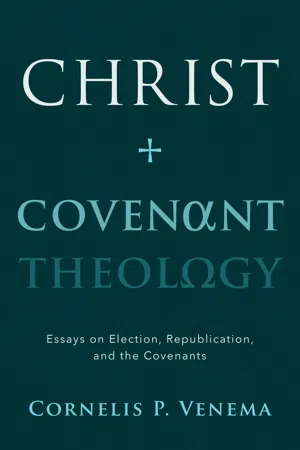
Christ and Covenant Theology
Essays on Election, Republication, and the Covenants
- English
- ePUB (mobile friendly)
- Available on iOS & Android
eBook - ePub
About this book
Information
Topic
Theology & ReligionSubtopic
Christian TheologyPART I
THE COVENANT OF WORKS AND THE COVENANT OF GRACE
1
THE COVENANT OF WORKS IN THE WESTMINSTER CONFESSION OF FAITH
“1. The distance between God and the creature is so great, that although reasonable creatures do owe obedience unto him as their Creator, yet they could never have any fruition of him as their blessedness and reward, but by some voluntary condescension on God’s part, which he hath been pleased to express by way of covenant. 2. The first covenant made with man was a covenant of works, wherein life was promised to Adam; and in him to his posterity, upon condition of perfect and personal obedience.” WCF 7.1–2.
In his extensive study of the WCF, The Westminster Assembly and Its Work, Benjamin Breckinridge Warfield remarked that “[t]he architectonic principle of the Westminster Confession is supplied by the schematization of the Federal theology, which had obtained by this time in Britain, as on the Continent, a dominant position as the most commodious mode of presenting the corpus of Reformed doctrine.”1 Certainly, when the WCF is compared and contrasted with earlier Reformed confessions of the sixteenth century, it distinguishes itself by its full expression of federal or covenant theology, including this theology’s characteristic distinction between the covenant of works and the covenant of grace. No one reading the WCF can fail to detect the fruit of developments in the doctrine of the covenant that occurred within the earliest period of Reformed theology in the first half of the sixteenth century. For example, the WCF’s distinction between a prefall covenant of works and a postfall covenant of grace—a distinction which plays such a foundational role in covenant theology—is not found in the writings of John Calvin, and was only first expressed among the Reformed in the writings of Zacharias Ursinus, an author of the HC.
The development of covenant theology in the period between the early Reformation and the writing of the WCF has been much discussed in recent literature.2 One of the disputed issues that has surfaced is the degree to which the later covenant theology is consistent with the earlier views of John Calvin. Those who maintain a divergence of viewpoints between Calvin and the later covenant theologians frequently note that Calvin nowhere mentions or develops a specific doctrine of a covenant of works. Calvin, these writers repeatedly point out, only knew a covenant of grace. It has also been argued that a significant divergence emerged within Reformed theology between, on the one hand, a “testamentary” or monopleuric view of the covenant shaped by the doctrine of election, and on the other hand, a full or dipleuric covenant doctrine.3 Reams of paper have been printed in evaluating these developments on the doctrine of the covenant in early and post-Reformation Reformed theology.
Rather than reviewing the history of the development of covenant theology or answering the questions that have arisen in the literature on this subject, I want to consider some criticisms that have more recently been registered against the formulation of the doctrine of the covenant of works in the WCF. Since this formulation expresses the dominant position of the covenant theology of the period in which the Confession was written (and indeed of subsequent Reformed covenant theology), these criticisms raise important questions regarding this doctrine’s warrant or biblical propriety. My aim is to evaluate the validity of these criticisms and answer some of the objections that have been pressed against the WCF’s understanding of the covenant of works.
It will become evident in what follows that there are two broad sources for such criticisms of the WCF. The first arises primarily within the framework of neoorthodoxy, that revision of classical Reformed theology associated with the theology of Karl Barth. The second arises within the quite different framework of Reformed orthodoxy, though it represents something of an adjustment and refinement of the classical Reformed doctrine of the covenant of works. After briefly summarizing the main lines of these criticisms of the WCF, I will conclude with a brief defense of the Westminster doctrine of the covenant of works.
Criticisms of the Westminster Confession of Faith
Before considering two writers who have expressed the gist of the Barthian criticism of the WCF’s view of the covenant of works, it will be helpful to consider a few important themes in the theology of Karl Barth which find their echo in this criticism.
Karl Barth
To understand Karl Barth’s antipathy to the distinction between a prefall covenant of works and a postfall covenant of grace, it is essential to grasp what he means by speaking of the creation as the “external basis of the covenant” and the covenant as the “internal basis of creation.” Speaking of the former, Barth argues that
[t]he existence and being of the creature willed and constituted by God are the object and to that extent the presupposition of His love. Thus the covenant is the goal of creation and creation the way to the covenant. Nor is creation the inner basis of the covenant. . . . The inner basis of the covenant is simply the free love of God, or more precisely the eternal covenant which God has decreed in Himself as the covenant of the Father with His Son as the Lord and Bearer of human nature, and to that extent the Representative of all creation. Creation is the external—and only the external—basis of the covenant.4
In Barth’s theology of the covenant, God’s free act of calling the creation into existence provides a context for him to enter into covenant with the creature. The creation constitutes the sphere within which God’s gracious care for the creature in Jesus Christ can be expressed and realized. It is in this sense, then, that the creation constitutes the external basis of the covenant, the arena within which God’s saving purpose toward humanity in Christ can be realized and effected.
However, Barth also insists that the creation has no independent existence or meaning apart from the covenant of grace. The covenant of grace, eternally purposed in Christ and realized in all of God’s dealings with the creation, is the “internal basis of creation.”
The covenant whose history had still to commence was the covenant which, as the goal appointed for creation and the creature, made creation necessary and possible, and determined and limited the creature. If creation was the external basis of the covenant, the latter was the internal basis of the former. If creation was the formal presupposition of the covenant, the latter was the material presupposition of the former. If creation takes precedence historically, the covenant does so in substance. If the proclamation and foundation of the covenant is the beginning of the history which commences after creation, the history of creation already contains, as the history of the being of all creatures, all the elements which will subsequently meet and be unified in this event and the whole series of events which follow; in the history of Israel, and finally and supremely in the history of the incarnation of the Son of God.5
For Barth the whole purpose of God’s work of creation is the realization of communion and fellowship between God and his people in Christ. In the free bestowal of his favor and mercy upon the creature in Christ, God shows his glory and realizes his purposes of self-revelation and self-communication to the creature. In the covenant of grace, the triumphant “yes” of God to the creature of his favor resounds, and the essential purpose of creation is realized.
It is evident that Barth can find no place for a covenant of works in distinction from the covenant of grace, which precedes in history the fall into sin and that does not express the saving grace exhibited in the gospel. Not only does Barth regard the biblical account of creation and fall to be nonhistorical saga, but he also resists any suggestion of a transition in history from wrath to grace subsequent to the fall into sin. From the beginning, God’s dealings with the creature are preeminently and exclusively gracious. There is no change that occurs in history in the relationship between God and the creature because of the fall into sin. Furthermore, consistent with his view of the covenant of grace as the internal basis of creation, Barth rejects any ordering of law and gospel in which the gospel does not have the first (as well as the last) word. At no point in God’s dealings with the creature does the law precede the gospel. Not only in eternity, but also in history, the triumphant “yes” of God’s grace is the first and definitive word. To suggest that, prior to God’s gracious dealings with his covenant people in the history of redemption, there existed another covenant relationship, a covenant of works, is to introduce a concept that betrays the most fundamental feature of all of God’s dealings with humanity—the free turning of God toward humanity in Christ.
From Barth’s perspective, a doctrine of the covenant of works like that enunciated in the WCF threatens the gospel of God’s grace in Christ. It rests upon a precritical view of biblical history, viewing the biblical account of the creation and fall of man as though it were a straightforward historical account and transition from favor to disfavor with God.6 But more important, it permits the suggestion that humanity’s covenant relationship with God, prior to the fall, might be construed as one contingent upon obedience to a probationary command of God. The latter idea would entail placing law before grace in God’s prefall dealings with humanity. It would suggest that man’s relationship to God, at least in the primal circumstances before the fall into sin, was founded upon and sustained by meritorious works done in obedience to the law.
Many of the objections to the WCF’s understanding of the covenant of works stem from the influence of these themes in Barth’s theology. Though there are other sources for similar criticisms, it is the theology of Barth that informs many of the arguments against the legalism of the WCF’s doctrine of the covenant, especially its formulation of the covenant of works. To illustrate the influence of Barth and the nature of this criticism, it will be useful to turn to the arguments of two critics of the WCF who follow this approach.
Holmes Rolston III
One of the most vigorous advocates that the WCF’s doctrine of the covenant of works leads to legalism, is Holmes Rolston III.7 Rolston believes that the Westminster’s formulation represents a substantial betrayal of the original Reformation insight that man’s standing before God is always founded upon grace alone. When the WCF describes the covenant of works as a covenant in which “life was promised to Adam; and in him to his posterity, upon condition of perfect and personal obedience,” Rolston thinks it introduces into Reformed theology a concept of merit that militates against the genius of the Reformation rediscovery of the gospel of grace.
In Rolston’s summary of the classic view of the covenant of works, he maintains that it begins with and always insists upon the “merit and ability of man.”8 In this first covenant, the Mosaic law’s teaching that the promise of life is conditional upon man’s obedience to the law (cf. Lev. 18:5) is read back into the original state described in Genesis 1 and 2. The condition of this covenant is not faith, but works, and the reward of life is earned by law-keeping. Thus, man’s standing before God, his covenant fellowship with God, is founded upon and maintained by meritorious good works. Furthermore, there is a tendency in this older covenant theology, Rolston insists, to identify the obligation of obedience with the natural law which binds man’s conscience perpetually as a creature and which is sharply distinguished from the sphere of God’s grace toward his people in Christ. The extent to which this doctrine of the covenant is ruled by the idea of merit is evident also in its insistence that the saving work of Christ, the Mediator, involves a work of obedience, as the second Adam, in which the law is fulfilled on our behalf. This is a doctrine, accordingly, that is wholly colored by the themes of obedience and merit and that mutes the gospel testimony of God’s prevenient grace in all of his dealings with his people.
Rolston finds all this in marked contrast with the order of grace that predominates and pervades the theology of John Calvin, and from which the WCF and its covenant theology is an obvious declension. Calvin knew nothing, Rolston argues, of the two-covenant doctrine of the WCF; in fact, he was not a covenant theologian at all, at least not in the normal use of these terms. For Calvin, “[a]ll things are ordered according to the movement of God’s grace in creation and purpose in redemption.”9 All of God’s dealings with the creature, whether before or after the fall, express this order of grace.
Although Calvin does not use just that term, he speaks often of both the order and of the divine grace first instituted. The part given to man is reflexive of grace. From the start Calvin transcends the concept of order as primarily moral and legal and places this under the higher order of grace. What is paramount is that God is gracious and requires acknowledgement of his grace.10
Rolston believes that Calvin does not speak, therefore, of two covenants, a covenant of works and a covenant of grace, but of one order of grace, an order that may be either “inverted” through the fall into sin or “reestablished” through redemption. There are not two distinct covenants but one, the covenant of grace being a “reflection of and . . . restoration of . . . the original order.”11
For Rolston there is no indication in Calvin’s theology that man’s relationship before God is sustained or maintained on the basis of meritorious good works. For Calvin, grace always precedes the law, even in paradise, and man’s obedience never merits God’s acceptance but only expresses man’s grateful and responsible answer to God’s gracious dealings with him. Life is always God’s gift, never the achievement of the obedient creature. What man ought to do is always reflexive of grace, unlike in later covenant theology wherein what man ought to do is fundamentally reflexive of law. This also accounts for the superficial doctrine of sin in covenant theology. Whereas covenant theology identifies sin primarily with disobedience to the law, Calvin identified sin with “man’s faithless rejection of the goodness of God in favour of his own self-willed efforts to seek his own happiness elsewhere.”12 Rolston finds the WCF, therefore, to depart seriously in its covenant doctrine from the theology of John Calvin and the Reformers. In this doctrine the grace of God in Christ is no longer the first or primary word. In its place has come an emphasis upon man’s legal obligation to his Creator by virtue of the covenant of works.
James B. Torrance
A second critic of the WCF who follows a similar line to Barth is James B. Torrance.13 Torrance also regards the federal theology of the seventeenth century, especially as this is set forth in the WCF, to be a “rationalistic” departure from the early Scottish tradition of Knox, the Scots Confession, the pre-Westminster confessions, and the theology of John Calvin. It is evident that Torrance believes the source for a growing legalism in Scottish theology and practice, confirmed in the so-called “Marrow Controversy,”14 lay in an increasing emphasis upon the federal scheme and the conditional character of the covenant between God and his people. According to Torrance, the idea of “conditional g...
Table of contents
- Cover Page
- Title Page
- Copyright Page
- Contents
- Foreword by Sinclair B. Ferguson
- Acknowledgments
- Introduction
- Abbreviations
- Part 1: The Covenant of Works and the Covenant of Grace
- Part 2: Covenant and Election
- Part 3: Covenant Theology in Recent Discussion
Trusted by 375,005 students
Access to over 1.5 million titles for a fair monthly price.
Study more efficiently using our study tools.
Frequently asked questions
Yes, you can cancel anytime from the Subscription tab in your account settings on the Perlego website. Your subscription will stay active until the end of your current billing period. Learn how to cancel your subscription
No, books cannot be downloaded as external files, such as PDFs, for use outside of Perlego. However, you can download books within the Perlego app for offline reading on mobile or tablet. Learn how to download books offline
Perlego offers two plans: Essential and Complete
- Essential is ideal for learners and professionals who enjoy exploring a wide range of subjects. Access the Essential Library with 800,000+ trusted titles and best-sellers across business, personal growth, and the humanities. Includes unlimited reading time and Standard Read Aloud voice.
- Complete: Perfect for advanced learners and researchers needing full, unrestricted access. Unlock 1.5M+ books across hundreds of subjects, including academic and specialized titles. The Complete Plan also includes advanced features like Premium Read Aloud and Research Assistant.
We are an online textbook subscription service, where you can get access to an entire online library for less than the price of a single book per month. With over 1.5 million books across 990+ topics, we’ve got you covered! Learn about our mission
Look out for the read-aloud symbol on your next book to see if you can listen to it. The read-aloud tool reads text aloud for you, highlighting the text as it is being read. You can pause it, speed it up and slow it down. Learn more about Read Aloud
Yes! You can use the Perlego app on both iOS and Android devices to read anytime, anywhere — even offline. Perfect for commutes or when you’re on the go.
Please note we cannot support devices running on iOS 13 and Android 7 or earlier. Learn more about using the app
Please note we cannot support devices running on iOS 13 and Android 7 or earlier. Learn more about using the app
Yes, you can access Christ and Covenant Theology by Cornelis P. Venema in PDF and/or ePUB format, as well as other popular books in Theology & Religion & Christian Theology. We have over 1.5 million books available in our catalogue for you to explore.