Ray Heiple traces motivational theories and practices in academia—also looking at various educational and preaching models—and shows from Scripture how to motivate others and be motivated biblically yourself.
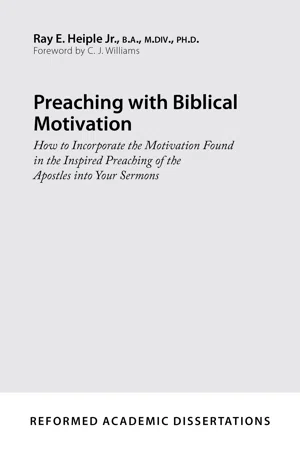
eBook - ePub
Preaching with Biblical Motivation
How to Incorporate the Motivation Found in the Inspired Preaching of the Apostles into Your Sermons
- English
- ePUB (mobile friendly)
- Available on iOS & Android
eBook - ePub
Preaching with Biblical Motivation
How to Incorporate the Motivation Found in the Inspired Preaching of the Apostles into Your Sermons
About this book
Information
Topic
Teologia e religioneSubtopic
Ministro del culto cristiano1
Promoting Motivational Theory to the Church
Forty years ago, when psychological motivational theory was still somewhat new, Gary Collins sought to promote some of its alleged benefits to church leaders. In his influential work, Collins opines that difficult theological concepts could be more effectively taught by making the teaching activity as meaningful as possible.1 He argues that since boredom, meaninglessness, and hopelessness are the common plagues of modern life, the main challenge of the church is “to get people interested, enthusiastic, and involved in spiritual issues.”2 Yet Collins recognizes that people perceive things differently based on their knowledge, past experiences, current interests, emotions, hopes, and expectations. He gives, as an example, the way in which people of different backgrounds might view the same piece of land. The architect considers the home he could build, the farmer thinks about the crops he could plant, the geologist imagines the rocks he could find, and the artist envisions the painting he could create.3
Collins goes so far as to classify emotion as motivation.4 He claims, “Emotions are so influential in motivating our behavior that some psychologists have even suggested dropping the term ‘emotion’ from psychology textbooks altogether and using the term ‘motivation’ instead.”5 Yet, he notes that emotional overload can have the opposite effect, resulting in de-motivation. For example, whereas the mildly anxious student is motivated to study harder,6 “high stress and anxiety can hinder our motivation.”7 Collins says the desire for need reduction (I’m hungry so I eat), stimulation (going on a roller coaster or eating an expensive steak), unconscious habits, goals, and incentives all play a part in the complex way in which people are motivated.8 Moreover, he notes that beliefs, attitudes, opinions, and values, which all interact with emotion to influence the way people think or act, could themselves be affected or changed by persuasion. In fact, even God uses motivation to persuade: “The Holy Spirit can and does motivate.”9 Thus, the right use of persuasion looms large in Collins’ theory for the future benefit of the church.10 Collins exhorts, “In the church we must be aware of how people are motivated and attempt to use this knowledge in motivating Christians to be more diligent in their service for Christ.”11 Collins’ triad of persuasion, emotion, and personal factors will be taken up again and again by others.
1 Gary Collins, Man in Motion: The Psychology of Human Motivation (Carol Stream, IL: Creation House, 1973), 24.
2 Ibid., 9.
3 Ibid., 44–45.
4 Ibid., 49.
5 Ibid., 52. Here he cites M. D. Vernon, Human Motivation (Cambridge: Cambridge University Press, 1969), and R. S. Lazarus, J. R. Averill, and E. M. Opton, Jr., “Towards a Cognitive Theory of Emotions,” in Feelings and Emotions: The Loyola Symposium, ed. M. B. Arnold (New York: Academic Press, 1970).
6 Collins, Man in Motion, 51.
7 Ibid., 64.
8 Ibid., 56–64.
9 Ibid., 64.
10 Ibid., 108–9. He cites Acts 26:28, where Paul “almost persuaded” Agrippa to become a Christian.
11 Ibid., 65.
2
Motivational Theory in Academia
Edward J. Murray on Motivation and Emotion
One of the early pioneers in the field of motivation, Edward J. Murray, set forth some of the difficulties experts were wrestling with right from the beginning: “The field of motivation and emotion is so disorganized,”1 he writes in his seminal 1964 work, Motivation and Emotion. Psychologists were disagreed over such basic issues as whether motivation and emotion should be one area or two, he notes, and some wanted to eliminate them both entirely from the field of psychology.2 In his work, Murray seeks consensus by defining motivation as the answer to the question of why a man does what he does. He claims that part of the confusion was because “science” was for the first time entering an area previously dominated by philosophy and religion, in order to discover how motives were affected by one’s biology and experience.
Like others, Murray matter-of-factly distinguishes between internal and external motivation. He refers to the internal component as “drive” and the external as “goal” or “reward.” He did not agree with some who were advocating a third categorization of “conscious desire,” or “want.”3 Instead, he emphasizes that there was a “general agreement that a motive is an internal factor that arouses, directs, and integrates a person’s behavior.”4 Thus, while motivation was both external and internal, motives were understood to be internal. Like Collins a little later, Murray sees the importance of motivation as a means of influencing behavior. He notes that success in all kinds of business depends upon giving the customers the product they want. (Today we would probably say success is better achieved by giving customers the “want” for your product.) His point is that by understanding a person’s motivation (what he wants), we are able to influence him toward good action or hold him responsible for bad. Here Murray cites as an example the American justice system where the punishment for murder depends upon the killer’s motivation—was it premeditated or was it provoked?5
Murray’s work is important to my research for several reasons. He marks the point in time when motivational theory made a final break with the system of “instincts” of the Freudian model, which by the 1920s had officially categorized over six thousand different instincts, including the “instinct to avoid eating apples in one’s own orchard!”6 In the transition period between instinct and motivation, some flirted with various “drive theories” where the energy that impels to action was categorized under such headings as hunger drive, thirst drive, sex drive, and so on, but Murray’s approach of understanding these drives as psychological needs seemed to already be the majority position in 1964.7 Additionally, Murray gives a good overview of the various strands of motivational theory competing for ascendency right at the time when the field was coming into its own. In particular his view of the relationship of emotion to motivation anticipates certain views of preaching that we will consider in the church context. Finally, Murray represents a strong break with the peculiar strand of motivational theory that was stilted in the mechanical determinism of influential American psychologist John B. Watson. According to Murray, that classical behavioral-based motivation theory, which held that an organism has a drive that continues until the stimulation that produced the drive is reduced (what we know today as “drive-reduction” theory), had as its ultimate goal of action a state of nirvana, or no stimulation. Yet Murray keenly points out that the universally-acknowledged undesirable state of boredom flies in the face of this theory. He concludes rather that people seek neither too much, nor too little, stimulation.
For at least the last thirty years, high schools and colleges have regularly taught Maslow’s hierarchy of needs, but Murray goes further than Maslow in allowing, even at a basic level, acquired needs born out of love. He cites as support the functional autonomous motivation of Gordon W. Allport demonstrated in Allport’s famous example of the wealthy ex-sailor who began his career simply needing work to buy food, but then fell in love with the sea and longed to return from an entirely different motive, the first one being no longer operative at all. Neither is there any animalistic instinct or hormonal drive needed to explain his behavior.8 Murray cites examples where new stimulations are sought out and desired (seeing new sights), whereas old ones can grow tiresome (an overplayed song). Likewise, he notes that children are motivated to activity merely for the pleasure of doing it: running, jumping, climbing, and so on.9 Murray tries to incorporate the emotions, desires, growth, and change that all people go through into his presentation of motivational theory, resulting in a view of man that differs from other pioneers in the field and is closer to man’s actual nature as set forth in Scripture.
Murray’s Error: Emotions Are Motivation
Ironically, the theme of Murray’s book—how motivation interacts with emotion—is the weak point in his presentation. In chapter 5, “Emotional Motives,” he notes that science identifies emotions as feelings and reactions aroused by external stimuli, which can...
Table of contents
- Cover Page
- Title Page
- Copyright Page
- Contents
- Series Introduction
- Foreword
- Preface
- Acknowledgments
- Introduction
- 1. Promoting Motivational Theory to the Church
- 2. Motivational Theory in Academia
- 3. Motivational Theory in the Church
- 4. Motivational Theory for Pastors
- 5. Motivational Theory in Preaching
- 6. Motivational Techniques of Popular Preachers
- 7. Motivation and Preaching in the Reformed Tradition
- 8. Motivation in New Testament Sermons: Selecting the Texts
- 9. Theological Position Statement
- 10. Defining Terms and Describing Methodology
- 11. Possible Grammatical Indicators of Motivation as Defined by Study
- 12. Defense of Methodology
- 13. Exegetical Approach: Identifying Motivation in Scripture
- 14. Applying the Approach: Identifying Motivation in Our Texts
- 15. Exegesis of Sermon Texts with Preaching Application Summary
- 16. A Defense of Application
- 17. Biblical Motivation, Part One: The Substance
- 18. Biblical Motivation, Part Two: The Approach
- 19. Conclusion
- Appendix A: Doctrinal Similarities Chart
- Appendix B: Structural Similarities Chart
- Appendix C: A Sunday-School Teaching Outline on the Fear of God
- Bibliography
- Index of Scripture
- Index of Subjects and Names
Trusted by 375,005 students
Access to over 1.5 million titles for a fair monthly price.
Study more efficiently using our study tools.
Frequently asked questions
Yes, you can cancel anytime from the Subscription tab in your account settings on the Perlego website. Your subscription will stay active until the end of your current billing period. Learn how to cancel your subscription
No, books cannot be downloaded as external files, such as PDFs, for use outside of Perlego. However, you can download books within the Perlego app for offline reading on mobile or tablet. Learn how to download books offline
Perlego offers two plans: Essential and Complete
- Essential is ideal for learners and professionals who enjoy exploring a wide range of subjects. Access the Essential Library with 800,000+ trusted titles and best-sellers across business, personal growth, and the humanities. Includes unlimited reading time and Standard Read Aloud voice.
- Complete: Perfect for advanced learners and researchers needing full, unrestricted access. Unlock 1.5M+ books across hundreds of subjects, including academic and specialized titles. The Complete Plan also includes advanced features like Premium Read Aloud and Research Assistant.
We are an online textbook subscription service, where you can get access to an entire online library for less than the price of a single book per month. With over 1.5 million books across 990+ topics, we’ve got you covered! Learn about our mission
Look out for the read-aloud symbol on your next book to see if you can listen to it. The read-aloud tool reads text aloud for you, highlighting the text as it is being read. You can pause it, speed it up and slow it down. Learn more about Read Aloud
Yes! You can use the Perlego app on both iOS and Android devices to read anytime, anywhere — even offline. Perfect for commutes or when you’re on the go.
Please note we cannot support devices running on iOS 13 and Android 7 or earlier. Learn more about using the app
Please note we cannot support devices running on iOS 13 and Android 7 or earlier. Learn more about using the app
Yes, you can access Preaching with Biblical Motivation by Ray E. Heiple Jr. in PDF and/or ePUB format, as well as other popular books in Teologia e religione & Ministro del culto cristiano. We have over 1.5 million books available in our catalogue for you to explore.