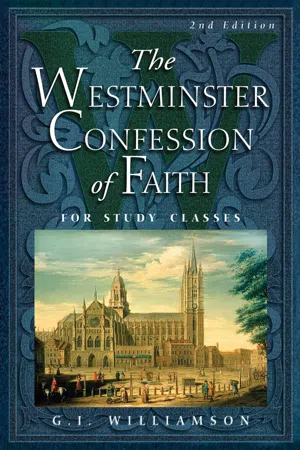
The Westminster Confession of Faith is an unsurpassed summary of biblical truth and is familiar ground to people of Reformed and Presbyterian conviction. Ideal for churches and colleges everywhere.
- English
- ePUB (mobile friendly)
- Available on iOS & Android
eBook - ePub
About this book
Information
Topic
Theology & ReligionSubtopic
Christian Theology C h a p t e r
1

I. Of the Holy Scriptures
1. Although the light of nature, and the works of creation and providence, do so far manifest the goodness, wisdom, and power of God, as to leave men inexcusable; yet they are not sufficient to give that knowledge of God, and of his will, which is necessary unto salvation: therefore it pleased the Lord, at sundry times, and in divers manners, to reveal himself, and to declare that his will unto his Church; and afterwards, for the better preserving and propagating of the truth, and for the more sure establishment and comfort of the Church against the corruption of the flesh, and the malice of Satan and of the world, to commit the same wholly unto writing; which maketh the holy Scripture to be most necessary; those former ways of God’s revealing his will unto his people being now ceased.
This section of the Confession teaches us (1) that God reveals himself in two distinct ways to man: in nature and in Scripture, (2) that no man can evade constant confrontation by that which reveals the living and true God (even without Scripture), (3) that all men are without excuse for their ignorant and sinful condition, and (4) that Scripture is necessary for true and saving knowledge of God because therein alone is revealed God’s redemptive provision.
It has long been the habit among Christians (even of Reformed persuasion) to speak of the insufficiency of natural revelation, as if there were something defective in the revelation it makes of God. This may be seen in the traditional use of the theistic proofs.
(l) From the world as a great effect we may argue the possibility of a great cause.
(2) From the apparent order and design in the world we may argue the possibility of a designing intelligence.
(3) From the apparent rule of the world by moral law we may argue the possibility of a moral law-giver.
After these, and similar arguments, were developed and brought together, it was hoped that unbelievers might be convinced that (a) “a god” probably exists; and that (b) if he does exist, he might possibly be the God of the Bible. Only when the possibility of the existence of “God” was thus “proved” was it expected that the unbeliever would admit further evidence that might confirm that God really does exist. Observe that in this scheme the creature fixes the terms under which God must present his credentials. Facts are not allowed to say, “The true God is,” but only, “A god may possibly exist.”
What is wrong with such an approach? Simply this: every fact (and the sum total of all facts) proves the existence of the God of the Bible. And there is good reason. This God is. He always was. He existed before anything was made. And the whole universe exists only because he planned it. Every detail of the related aspects of existence has the precise character and purpose that God intended. It therefore has meaning that is God-given. “The heavens declare the glory of God; and the firmament shows His handiwork. . . . There is no speech nor language where their voice is not heard” (Ps. 19:1, 3). Everything in heaven and earth says that the true God is, that he is glorious, that he is Creator and ruler of all, and that we are his creatures.
Man was once God’s true image. He alone among the creatures could think thoughts of his Creator. Before sinless man the whole creation (including man’s own being) was an unclouded mirror in which God could be seen with clear vision. In the mind of man God’s revelation came to self-conscious reinterpretation. It was the task of man to become conscious of all the meaning deposited by God in the universe. Man began this task (Gen. 2:19–20). He used God-given powers of investigation to discover the true (that is, God-imprinted) meaning of nature. When Adam named something in the world of nature, he was simply reading the name (meaning) put there by God.
We must observe, however, that even before the fall of man God revealed himself in word as well as in nature. Nature revealed all that Adam needed for a right knowledge of the nature of God and the world. But how could Adam know the will or purpose of God? And how could he know what his own will and purpose ought to be? The answer is: only by special (word) revelation.
In order for man to be the image and likeness of God two things were essential. His being must be like God’s, and his will or purpose must also be like God’s. The being of God is not a matter of choice. Neither is the being of man a matter of choice. He is God’s image. To be other than this would be to be other than human. As long as men are men they exist in God’s image. It therefore follows that human existence is such as to compel the sense of deity within man. All men know God, the true God, the only God. They do not merely have the capacity for knowing him; they actually do know him, and cannot possibly evade knowing him.
However, the purpose of man is a matter of choice. As God is free to do as he will, so man (being created in the divine image) is free to do as he will. But even in his freedom of will man cannot escape the absolute control of God because the being of man (he is only an image) is wholly dependent upon God. In setting his will against the will of God revealed by the Word of God, man can only violate, but can never destroy, his dependent relationship to God. He is metaphysically God’s image, although he is ethically God’s likeness no longer. Man’s determination to be independent of God is doomed to frustration, and he is clearly and constantly reminded of this through natural revelation. Natural revelation never ceases to declare to sinful man the fact that the true God is, and that man’s very existence is wholly dependent upon God. In order to continue in rebellion against God, therefore, a man must lie to himself about the situation. He must suppress the truth in unrighteousness (Rom. 1:18). This suppression of the truth (whereby sinful men refuse to know either themselves or the true God aright) is wholly due to sin, and not in any way due to an insufficiency or defect in natural revelation.
However, the revelation of God before the fall differed from that which God has given since the fall, and this is true of both natural and special (or word) revelation. The two forms of revelation are always coordinate. Natural and special revelation before the fall were related to, and designed to operate through, Adam’s obedience. The fall rendered this revelation inoperative. Revelation now speaks in relation to man’s fallen condition. Natural revelation not only declares the attributes of God (as it did from the beginning), but also reveals the wrath of God against all unrighteousness and ungodliness of men (about which it did not previously need to testify, for the simple reason that there was then no unrighteousness or ungodliness of men). That natural revelation so testifies now is taught in the Bible (Rom. 1:18; 2:14–15). Certain changes were introduced in the natural order (Gen. 3:17–19) so that nature would testify to man’s folly and ruin. As the regularity and peacefulness of man’s original environment had testified in every way to God’s goodness, so now the turmoil and violence of the environment testify that God is angry with sinners every day. This is why it is no easier for sinners to accept God’s revelation in nature than for them to accept his revelation in Scripture. Natural revelation is hard for the sinner to read, not because it does not say enough, nor because it does not speak clearly enough, but because it says too much only too clearly.
Just as the test of man’s obedience came by way of word revelation, so the remedy for man’s present need comes by way of word revelation. Only the gospel can supplement natural revelation in such a way as to (a) disclose the means of removing God’s enmity (Rom. 1:17; 2 Cor. 5:18–21) and (b) make man once more a willing subject of the will of God (Rom. 12:1–2). Therefore, it has pleased God to make such a revelation by a gradual process which is now completed, with the result that his saving Word is now deposited in the Bible. As Scripture says, (a) “God . . . at various times and in various ways spoke in time past to the fathers by the prophets” and then, (b) “in these last days [has] spoken to us by His Son” (Heb. 1:1–2). The culmination came when (1) the final revelation of God “began to be spoken by the Lord,” and then (2) “was confirmed to us by those who heard Him” (that is, the apostles and other eyewitnesses; Heb. 2:3). God gave this confirmation by granting the apostles power (a) to perform great signs and wonders and (b) to distribute special charismatic gifts according to his will.
It will be noted that the Confession sharply contradicts the view popularized today by the neo-Pentecostal movement. In essence this view would have us believe that we can have the same charismatic gifts today—such as prophecy, speaking in tongues, and healing—that we read occurred in the age of the apostles. This is a very serious error. In essence it is a result of a failure to grasp the biblical teaching concerning the history of salvation. The Bible itself makes it clear that there are many things in the history of redemption that cannot, and will not, be repeated. There will never again be a universal flood, or a crossing of the Red Sea, or a virgin birth. Never again will there be an outpouring of the Holy Spirit such as took place on the day of Pentecost. The sending of the Holy Spirit is just as much an unrepeatable event as the birth of Christ was. It is for this reason that the miracles—the signs and wonders—that we read of in the Bible were not constantly occurring but, rather, centered on the major events in the process of revelation. Note, for instance, how few the miracles are in the Bible until we come to the time of Moses (the author of the first part of the Bible). Note also how the signs and wonders that we read of in the book of Acts are always associated with the presence of the apostles. For these, and similar facts, there is a reason. The reason is that these signs and wonders were given by God to attest and confirm that these men were his spokesmen. And since this process came to completion in the finished work of Christ, and the testimony of these men is now deposited in the Scriptures, the Bible alone is God’s present revelation. Of this we shall see more in the sections that follow.
QUESTIONS
- How many kinds of revelation are there? Name them.
- It has been imagined by some that natural revelation spoke clearly to Adam (some even imagine that he needed no word revelation before the fall), but that it does not speak clearly to us. Disprove.
- Is there proof for the existence of God? Where?
- What is wrong with the traditional proofs for the existence of God?
- What are the two aspects of man’s nature as the image of God?
- Which of these could man lose?
- Which of these was produced wholly by God?
- Which of these was partly produced by man?
- Was natural revelation alone sufficient before the fall? Why?
- What does natural revelation declare now that it did not declare before the fall of man?
- Does man still exist in the image of God?
- What prevents men from having consciousness of the true and living God who hates sin?
- Why must the remedy for man’s condition come by special (word) revelation?
- What is the fundamental error of the “charismatics”?
- What was the purpose of the signs and wonders that we read of in the Bible?
- Do we limit God when we say that these do not occur today?

I, 2–5
2. Under the name of holy Scripture, or the Word of God written, are now contained all the books of the Old and New Testaments, which are these:
| Of the Old Testament | |||
| Genesis | I Kings | Ecclesiastes | Obadiah |
| Exodus | II Kings | The Song of Songs | Jonah |
| Leviticus | I Chronicles | Isaiah | Micah |
| Numbers | II Chronicles | Jeremiah | Nahum |
| Deuteronomy | Ezra | Lamentations | Habakkuk |
| Joshua | Nehemiah | Ezekiel | Zephaniah |
| Judges | Esther | Daniel | Haggai |
| Ruth | Job | Hosea | Zechariah |
| I Samuel | Psalms | Joel | Malachi |
| II Samuel | Proverbs | Amos | |
| Of the New Testament | |||
| The Gospels according to Matthew Mark Luke John The Acts of the Apostles Paul’s Epistles to the Romans | Corinthians I Corinthians II Galatians Ephesians Philippians Colossians Thessalonians I Thessalonians II Timothy I Timothy II | Titus Philemon The Epistle to the Hebrews The Epistle of James The First and Second Epistles of Peter | The First, Second, and Third Epistles of John The Epistle of Jude The Revelation |
All which are given by inspiration of God to be the rule of faith and life.
3. The books commonly called Apocrypha, not being of divine inspiration, are no part of the canon of the Scripture, and therefore are of no authority in the Church of God, nor to be any otherwise approved, or made use of, than other human writings.
4. The authority of the holy Scripture, for which it ought to be believed, and obeyed, dependeth not upon the testimony of any man, or church; but wholly upon God (who is truth itself) the author thereof: and therefore it is to be received, because it is the Word of God.
5. We may be moved and induced by the testimony of the ...
Table of contents
- Cover Page
- Title Page
- Copyright Page
- Contents
- Preface to the Second Edition
- Preface to the First Edition
- 1. Of the Holy Scriptures (I)
- 2. Of God, and of the Holy Trinity (II)
- 3. Of God’s Eternal Decree (III)
- 4. Of Creation (IV)
- 5. Of Providence (V)
- 6. Of the Fall of Man, of Sin, and of the Punishment Thereof (VI)
- 7. Of God’s Covenant with Man (VII)
- 8. Of Christ the Mediator (VIII)
- 9. Of Free Will (IX)
- 10. Of Effectual Calling (X)
- 11. Of Saving Faith (XIV) and Of Repentance unto Life (XV)
- 12. Of Justification (XI)
- 13. Of Adoption (XII)
- 14. Of Sanctification (XIII)
- 15. Of Good Works (XVI)
- 16. Of the Perseverance of the Saints (XVII)
- 17. Of Assurance of Grace and Salvation (XVIII)
- 18. Of the Law of God (XIX)
- 19. Of Christian Liberty, and Liberty of Conscience (XX)
- 20. Of Religious Worship, and the Sabbath Day (XXI)
- 21. Of Lawful Oaths and Vows (XXII)
- 22. Of Marriage and Divorce (XXIV)
- 23. Of the Church (XXV)
- 24. Of Communion of Saints (XXVI)
- 25. Of the Sacraments (XXVII)
- 26. Of Baptism (XXVIII)
- 27. Of the Lord’s Supper (XXIX)
- 28. Of Church Censures (XXX)
- 29. Of the Civil Magistrate (XXIII)
- 30. Of the Civil Magistrate (continued) and Of Synods and Councils (XXXI)
- 31. Of the State of Men after Death, and of the Resurrection of the Dead (XXXII)
- 32. Of the Last Judgment (XXXIII)
- Answers to the Questions
- Index of Scripture
Trusted by 375,005 students
Access to over 1.5 million titles for a fair monthly price.
Study more efficiently using our study tools.
Frequently asked questions
Yes, you can cancel anytime from the Subscription tab in your account settings on the Perlego website. Your subscription will stay active until the end of your current billing period. Learn how to cancel your subscription
No, books cannot be downloaded as external files, such as PDFs, for use outside of Perlego. However, you can download books within the Perlego app for offline reading on mobile or tablet. Learn how to download books offline
Perlego offers two plans: Essential and Complete
- Essential is ideal for learners and professionals who enjoy exploring a wide range of subjects. Access the Essential Library with 800,000+ trusted titles and best-sellers across business, personal growth, and the humanities. Includes unlimited reading time and Standard Read Aloud voice.
- Complete: Perfect for advanced learners and researchers needing full, unrestricted access. Unlock 1.5M+ books across hundreds of subjects, including academic and specialized titles. The Complete Plan also includes advanced features like Premium Read Aloud and Research Assistant.
We are an online textbook subscription service, where you can get access to an entire online library for less than the price of a single book per month. With over 1.5 million books across 990+ topics, we’ve got you covered! Learn about our mission
Look out for the read-aloud symbol on your next book to see if you can listen to it. The read-aloud tool reads text aloud for you, highlighting the text as it is being read. You can pause it, speed it up and slow it down. Learn more about Read Aloud
Yes! You can use the Perlego app on both iOS and Android devices to read anytime, anywhere — even offline. Perfect for commutes or when you’re on the go.
Please note we cannot support devices running on iOS 13 and Android 7 or earlier. Learn more about using the app
Please note we cannot support devices running on iOS 13 and Android 7 or earlier. Learn more about using the app
Yes, you can access The Westminster Confession of Faith by G.I. in PDF and/or ePUB format, as well as other popular books in Theology & Religion & Christian Theology. We have over 1.5 million books available in our catalogue for you to explore.