The imago Dei doctrine has been criticized for technically excluding persons with severe cognitive disabilities. George Hammond recasts previous theological insights to establish a more accurate and inclusive imago theology.
eBook - ePub
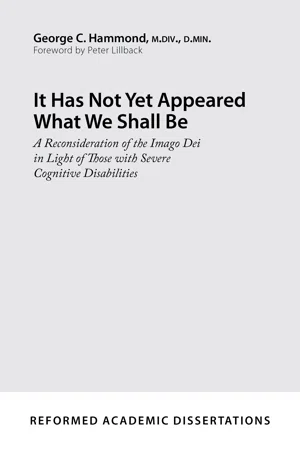
It Has Not Yet Appeared What We Shall Be
A Reconsideration of the Imago Dei in Light of Those with Severe Cognitive Disabilities
- English
- ePUB (mobile friendly)
- Available on iOS & Android
eBook - ePub
It Has Not Yet Appeared What We Shall Be
A Reconsideration of the Imago Dei in Light of Those with Severe Cognitive Disabilities
About this book
Information
Topic
Theology & ReligionSubtopic
Religion1
The Problem and Its Setting
Introduction
This study was born out of a crisis of my own faith. When I was a divinity student at Westminster Theological Seminary in Philadelphia in the early 1990s I was required to take a biblical anthropology course titled The Doctrine of Man taught by D. Clair Davis. It was in this class that I was introduced to some of the complexities associated with the consideration of the doctrine of the Image of God. That mankind was created in the image of God lays on the surface of the text. What exactly it means for mankind to be made in the image of God has been the occasion for on-going reflection from the patristic period to the present day.
The course introduced me to the various historical approaches to and perspectives on in what exactly the imago Dei consists. Generally, these approaches can be summarized under three headings: 1) The imago Dei may be seen as something substantive in man, a God-like component or aspect of man (analogia entis) often presented as being manifested in those qualities which separate man from the animals (e.g., faculties of rationality, spirituality, self-conscious volition, morality, etc.). 2) The imago Dei may be seen in terms of man’s function in the world. In this view Genesis 1:26b often is seen to be the epexegetical commentary on Genesis 1:26a. “And let them rule over the fish of the sea and the birds of the air, over the livestock, over all the earth, and over all the creatures that move along the ground” is the explanation of what it means for mankind to be made “in our image, and after our likeness.” 3) The imago Dei may be seen in terms of relationship. Following Barth, many modern theologians have seen the imago Dei as consisting in the ability of human beings to create and maintain complex interpersonal relationships (analogia relationis).
Having been favorably influenced by Poythress’ multi-perspectival approach to theology,1 I saw value in all of these approaches to the doctrine and no reason to choose among them. These perspectives were complementary, not mutually exclusive.
I was ordained to the ministry in 1993. In 2001 my fourth child, Rebecca, was born. It would not be until she was about a year old that we would be told that she had severe developmental delays. When she was about five years old these were reclassified as disabilities. Over the next few years it became apparent that short of miraculous intervention on the part of God, Rebecca would never speak, never calculate a math problem, never attend college, never live on her own or exercise authority over any sphere of her life, would never marry, and would never be a friend to anyone (if being a friend is defined as consciously and sacrificially giving of one’s self for the good of another).
One day while I was watching Rebecca play by herself (the only way she plays) a thought occurred to me that filled me with horror: My daughter does not bear the image of God. The thought was abhorrent to me; every fiber of my being told me that my conclusion must be false. But there was no denying my theological grid. If the imago Dei is to be found substantively in those things which separate us from the animals such as language and intellect; if it is to be found functionally in the ability to exert dominion over the environment and other creatures; or if it is to be found relationally in creating and maintaining intricate human relationships, then it was evident that Rebecca’s life did not fit these criteria.
As I began to pay closer attention to what I heard and read about the image of God, I discovered that my theological grid of exclusion was not unique. In his book Receiving the Gift of Friendship Hans Reinders reaches much the same conclusion: by traditional definitions those with severe cognitive disabilities are disqualified from the image of God.2 Yet Reinders also notes that Christians who care for or come in contact with those with such disabilities are not willing to bar them from humanity, and will in fact include them either inexplicably (i.e., “Such people may not fit my definition of the image of God, nor my definition of what it means to be human, but they still are in the image of God and human”) or by exception.3
While it is encouraging that Christians intuitively will not exclude these people from humanity, it is problematic that they include them either by making an exception for them in their theology or with no theological basis at all. One would think that the doctrine of the image of God should surely provide the basis for the inclusion of some of humanity’s neediest members. In fact, however, in dealing with this doctrine theologians throughout history have frequently (though perhaps inadvertently) presented the doctrine in such a way as to exclude those with severe intellectual disabilities from participation in the imago Dei. Reinders notes,
When I first began thinking about this problem [i.e., the humanity of those with cognitive disabilities], my intuitive response—as a Christian theologian—was that the Christian tradition could handle it easily because of the doctrine of the imago Dei. . . . When I started to explore this question, however, it soon became clear to me that the Christian tradition might have been one of the major sources of the commonsense view [that humanity is to be found in certain intellectual, stewardship, and relational abilities].4
The sacrosanct nature of human life as it is presented in the Scriptures rests upon mankind being made in the image of God. The first instance of a lex talionis in the Scripture prescribes the death penalty for the one who (unjustly) takes a human life. The reason given for the severity of the penalty is that mankind is made ad imago Dei: “Whoever sheds the blood of man, by man shall his blood be shed; for in the image of God has he made man” (Gen. 9:6).
The secularized modern world began to speak of the universality of human dignity and rights after World War II, but it did so (and continues to do so) using the unacknowledged borrowed capital of the imago Dei doctrine. John Behr notes that before the wide-spread acceptance of the imago doctrine, Greco-Roman culture had no notion of the universal rights, dignity, or worth of all human beings.5 He questions whether a modern philosophical anthropology uncoupled from the biblical imago doctrine can long bear the weight of the affirmation of universal human personhood, dignity, worth, and rights. His concerns are well-founded.
Dismissing the creation account as a “Hebrew myth,”6 Peter Singer feels free to question whether severely cognitively disabled human beings really qualify as “persons.”7 With the myth of the imago Dei disposed of, Singer maintains that the right to life does not extend to all innocent human beings.8 Indeed, it could be argued that if mankind is not made in the image of God, the right to life does not extend to any human being. Similarly, Steven Pinker has argued that the notion of universal human dignity is “stupid,” the invocation of “obstructionist bioethics,” and “hardly up to the heavyweight moral demands assigned to it.”9
Few Christians would question whether all human beings are “persons” and universally are possessed of dignity, rights, and worth. But are all human beings created in the image of God? The reflexive answer to this question by Christians is “of course.” Yet the way in which the doctrine of the imago Dei has been conceived and set forth throughout history may leave doubt that this is the case.
The Imago Dei : A Brief Historical Overview
Theology may be defined as the human echo of the divine voice. The Scriptures themselves were not given in abstraction, but rather were given in and to particular and specific historical contexts. Good hermeneutics requires the consideration of the context of a given book or passage of Scripture for sound exegesis.10
Theology likewise has a context. Theologians engage in the task of understanding and applying the Scriptures to their particular situation and setting. In this regard there is no “pure theology” if that phrase means theological formulation uninfluenced by the theologian’s own setting. There is always a “hermeneutical spiral” between the text and the reader’s context which affects, limits, and gives insights into what one concludes from a given text of Scripture.11
As the imago Dei is considered in the light of those with severe cognitive disabilities, it is important to note that until the twentieth century such people were not as visible, and perhaps not as prevalent, as they are today.12 This is so not only because factors in the modern world may actually increase the risk of cognitive disability,13 but also because before the advent of modern medicine many of the underlying or concomitant physical conditions of severe cognitive disability made it less likely for such people to survive childhood.
Even apart from underlying physical conditions, severe cognitive disability carries its own risk of mortality. In the wake of the Second World War, First World nations have seen a marked increase in both the number of labor saving devices and the amount of living space. Practically speaking, this means that parents of ambulatory severely cognitively disabled children are able to keep them in safer and more spacious confines, and are freed from many of the labor-intensive tasks that consumed their ancestors’ time and attention. This has allowed them to be more attentive to the safety of their children than was possible in the past. The risk that cognitively disabled people can pose to themselves is seen anecdotally in the first encounter Jesus had when he came down from the mount of transfiguration: “‘Lord, have mercy on my son,’ he said. ‘He has seizures14 and is suffering greatly. He often falls into the fire or into the water’” (Matt. 17:15 NIV).
The Christian doctrine of the imago Dei traces its history back to the earliest Christian centuries. For much of the history of the church, theologians did not regularly encounter and thus did not much consider those with severe cognitive disabilities in their formulations of the doctrine. Not until the 1960s and the advent of the l’Arche communities did such people come to the attention of theologians in any notable way. It has only been in the last two or three decades that any thought has been given to a theology of severe cognitive disability.
What follows is a brief historical sketch of the contours of the development of the imago Dei doctrine. The purpose of the sketch ...
Table of contents
- Cover Page
- Title Page
- Copyright Page
- Contents
- Series Introduction
- Foreword by Peter A. Lillback
- Preface
- Acknowledgments
- Introduction
- Abbreviations
- Prologue
- 1. The Problem and Its Setting
- 2. Literature Review
- 3. Exegesis of Pertinent Passages
- 4. A Reconsideration of the Imago Dei
- 5. Implications and Practical Applications
- Epilogue
- Appendix 1: Survey
- Appendix 2: Raw Data
- Appendix 3: Survey Analysis
- Appendix 4: Herman Bavinck's Reformed Dogmatics
- Bibliography
- Index of Scripture
- Index of Subjects and Names
Trusted by 375,005 students
Access to over 1.5 million titles for a fair monthly price.
Study more efficiently using our study tools.
Frequently asked questions
Yes, you can cancel anytime from the Subscription tab in your account settings on the Perlego website. Your subscription will stay active until the end of your current billing period. Learn how to cancel your subscription
No, books cannot be downloaded as external files, such as PDFs, for use outside of Perlego. However, you can download books within the Perlego app for offline reading on mobile or tablet. Learn how to download books offline
Perlego offers two plans: Essential and Complete
- Essential is ideal for learners and professionals who enjoy exploring a wide range of subjects. Access the Essential Library with 800,000+ trusted titles and best-sellers across business, personal growth, and the humanities. Includes unlimited reading time and Standard Read Aloud voice.
- Complete: Perfect for advanced learners and researchers needing full, unrestricted access. Unlock 1.5M+ books across hundreds of subjects, including academic and specialized titles. The Complete Plan also includes advanced features like Premium Read Aloud and Research Assistant.
We are an online textbook subscription service, where you can get access to an entire online library for less than the price of a single book per month. With over 1.5 million books across 990+ topics, we’ve got you covered! Learn about our mission
Look out for the read-aloud symbol on your next book to see if you can listen to it. The read-aloud tool reads text aloud for you, highlighting the text as it is being read. You can pause it, speed it up and slow it down. Learn more about Read Aloud
Yes! You can use the Perlego app on both iOS and Android devices to read anytime, anywhere — even offline. Perfect for commutes or when you’re on the go.
Please note we cannot support devices running on iOS 13 and Android 7 or earlier. Learn more about using the app
Please note we cannot support devices running on iOS 13 and Android 7 or earlier. Learn more about using the app
Yes, you can access It Has Not Yet Appeared What We Shall Be by George C. Hammond in PDF and/or ePUB format, as well as other popular books in Theology & Religion & Religion. We have over 1.5 million books available in our catalogue for you to explore.