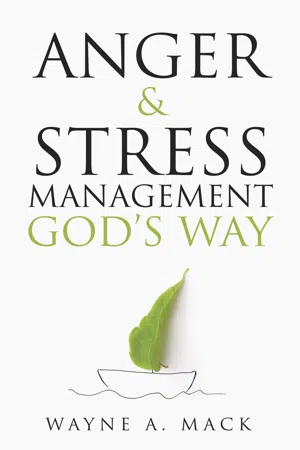
Anger and stress may be commonplace, but they are still destroyers that must be controlled. Wayne Mack applies biblical teaching that shows how to change and overcome these destructive forces.
- English
- ePUB (mobile friendly)
- Available on iOS & Android
eBook - ePub
Anger and Stress Management God's Way
About this book
Information
Topic
Theologie & ReligionSubtopic
Religion1
SOMETIMES IT’S RIGHT
AND SOMETIMES IT’S
WRONG TO BE ANGRY
Is it always a sin to be angry? Some people sincerely believe that it’s always a sin to be angry. From childhood, they were taught that it was wrong to express anger in any form.
There are other people who seem to believe that anger is never sinful—unless it’s directed at them. For example, some parents will not tolerate their children expressing anger at them or at each other, but will quickly excuse their own anger toward their children. There are husbands and wives who have one standard for themselves and another standard for their spouses. A man once told me that his anger against his wife was always justified. These people think that anger is wrong mostly when it’s someone else’s anger, not their own.
The truth of the matter is that anger is sometimes sinful and sometimes righteous. Ephesians 4:31 says, “Let all bitterness and wrath and anger and clamor and slander be put away from you, along with all malice” (ESV). In other words, let every kind—all forms—of anger and wrath be put away. Colossians 3:8 teaches the same. “But now you also, put them all aside: anger, wrath, malice, slander, and abusive speech from your mouth.”
According to these verses, there is a kind of anger that is sinful and must be excluded from the life of a believer. This is the kind of anger that we find in Genesis 4, when Cain became angry with his brother Abel and murdered him. We see it in the life of King Saul, too: in 1 Samuel 18, Saul was angry with David when David did well in battle and was praised by the people. Later, Saul became angry with his son, Jonathan, for being friends with David (see 1 Sam. 20:30). These were all expressions of sinful anger.
In Mark 6:19, we are told that Herodias “had it in” (this is the literal translation from the Greek) for John the Baptist. Because of her sinful anger, John the Baptist was beheaded. In Acts 7:54, the Jewish leaders were enraged against Stephen. As a result of their sinful anger, they took up stones and killed him. In Acts 23:3, the apostle Paul went before the high priest of the Sanhedrin and said, “God is going to strike you, you whitewashed wall! Do you sit to try me according to the Law, and in violation of the Law order me to be struck?” The context and Paul’s later confession indicate that this was sinful anger on Paul’s part. As the Bible indicates in these and many other verses, there are times when our anger is sinful.
The Bible also teaches that there are times when our anger is not sinful. There are times when it’s proper, righteous, and necessary to be angry. In the same passage in Ephesians 4 where we are instructed to put aside bitterness, wrath, and anger, we are told that there is a way to be properly angry. Ephesians 4:26 commands us, “Be angry, and yet do not sin.” It’s clear from this verse that there is a kind of anger that is not sinful. These verses do not contradict each other; they are simply teaching us how to handle two different kinds of anger—anger that is sinful and anger that is not sinful.
There are many times in Scripture when God—who cannot sin—is said to be angry. Psalm 7:11 says, “God . . . has indignation every day.” Exodus 4:14 tells us that the anger of God burned against Moses. Deuteronomy 29:27–28 declares,
Therefore, the anger of the LORD burned against that land, to bring upon it every curse which is written in this book; and the Lord uprooted them from their land in anger and in fury and in great wrath, and cast them into another land, as it is this day.
God was extremely angry at the Israelites on this occasion and on others.
The gospels of Mark and John describe two situations in which the Lord Jesus, the meek and lowly one, became righteously angry. Mark 3:5 says that He was deeply grieved and became angry because of the Pharisees’ hard hearts. We know that Christ’s anger was sinless—holy and righteous—because “in Him there is no sin” (1 John 3:5). In John 2:13–17, Jesus angrily drove out the sellers and money changers from the temple courts because zeal for His Father’s house had consumed Him.
Acts 17:16 relates an example of righteous anger on the part of the apostle Paul. While ministering in Philippi, Paul had been beaten, falsely accused, and thrown in prison. His life had been in danger from an earthquake, and he had eventually been thrown out of town (see Acts 16:16–40). From Philippi, Paul went on to minister in two cities and was threatened and chased out of both (see Acts 17:1–15). Paul arrived in Athens alone and had to wait there for his companions, Timothy and Silas, to join him.
We can only assume that Paul arrived in Athens physically and emotionally exhausted. Very likely, he anticipated a time of rest and recovery while waiting for Timothy and Silas. Though this may have been his intention, the Scripture says that “his spirit was being provoked within him as he was observing the city full of idols” (Acts 17:16). The Expository Dictionary of New Testament Words indicates that this phrase means that Paul’s spirit was roused to anger.1 The Christian Counselor’s New Testament translates the sentence this way: “He was enraged within as he looked at the city filled with images.”2 In other words, Paul was righteously angry.
Another example of righteous anger is found in 2 Corinthians 7:9–11. In his previous letter to the Corinthians, Paul rebuked the people for various sins. In this passage of his second letter to them, Paul describes their response to his first message:
I now rejoice, not that you were made sorrowful, but that you were made sorrowful to the point of repentance; . . . for the sorrow that is according to the will of God produces a repentance without regret, leading to salvation. . . . For behold what earnestness this very thing, this godly sorrow, has produced in you: what vindication of yourselves, what indignation, what fear, what longing, what zeal, what avenging of wrong!
The believers in Corinth had responded to Paul’s teaching both in action and in mind. They took steps to avenge their wrongs (to pursue justice within their midst), and they also became sorrowful over their sin to the point of zealous indignation, or anger. Paul commended them for their anger because it was for the right reason and was expressed rightly. In essence, he said to them, “Good job! I’m glad you became angry over your sin.”
The passages that we just looked at clearly indicate that there are two kinds of anger. There is a sinful kind of anger that is destructive and ungodly, and there is a righteous kind of anger that is constructive and godly. What, then, distinguishes godly anger from ungodly anger? When is our anger sinful and when is it righteous? How can we be sure that our anger is used constructively rather than destructively?
To answer these questions, we first need to carefully study the characteristics of sinful anger—anger that is displeasing to God and destructive to us, other people, and other things. We will study these characteristics throughout the rest of this chapter and all of chapter 2. In chapters 3 and 4, we will consider how to respond to our anger in a way that is godly and constructive.
— APPLICATION QUESTIONS —
- What do you think about the idea that anger is sometimes righteous and sometimes sinful?
- What biblical statements support the concept of righteous anger?
- Which of the two types of anger do you think occurs more frequently?
- Which of the two types of anger do you think you experience more frequently?
- What biblical examples of righteous anger were given in the previous section?
WHEN IS OUR ANGER SINFUL? WHAT ARE THE CHARACTERISTICS OF SINFUL ANGER?
Our anger is sinful when we become angry for the wrong reasons. In many cases, our anger is aroused because of our selfishness. Selfish anger is always a sin. Cain’s anger toward his brother Abel was a sinfully selfish anger (see Gen. 4). Cain had not brought a proper sacrifice to the Lord, and when God rejected his offering, Cain became angry with God and jealous of his brother. His anger stemmed from both selfishness—at God’s rejecting his offering—and jealousy—at his brother’s offering being accepted. When we become angry because someone else is receiving attention or appreciation that we are not, our anger is sinful. If we are honest, we will recognize how frequently we get angry for this reason!
In 1 Kings 21, Ahab became sinfully angry because of his selfishness. Ahab, the king of Israel, wanted to buy the vineyard of a man named Naboth. Naboth refused to sell it, angering King Ahab. The Bible says, “So Ahab came into his house sullen and vexed” (v. 4). In other words, he was depressed (sullen) and angry (vexed). In my experience with counseling, I have found that depression and anger often go together, as one frequently leads to the other. Ahab was angry because he was denied the vineyard that his heart coveted, and which he thought he had a right to. How often do we become angry because our “rights” have been denied?
Some time ago, I made an effort to be friendly to another person who was riding with me on an elevator. I gave the man standing beside me a cheerful hello and asked him, “How are you doing today?” The man ignored me; he never blinked an eye or acknowledged my greeting. He never answered my question. He just flat-out ignored me. My reaction to his lack of response was a bit of irritation. I thought, “Who does he think he is, treating me like that?” I interpreted his nonresponse as a put-down and a slap in the face. In my sinful pride, I started to become angry.
At the time, I wouldn’t have called it that. If I admitted that I was at all affected by that little episode, I would probably have used some euphemisms such as, “I was hurt, or a little upset, or mildly disturbed, at being snubbed that way.” After all, I was nice to him. I went out of my way to show an interest in him. I thought I deserved a certain amount of politeness. I never considered that he might have had a lot on his mind, a problem with his hearing, or a severe headache, or that he was reticent to interact with strangers. I just assumed that I had a “right” to be acknowledged, and that he was denying that right. When I was denied that perceived right, I experienced a mild form of anger. I thought that I had a right to be recognized. I thought I had a right to be treated as though I was worthwhile, as though I was important enough for this man to at least respond to me. That’s what happened with Ahab, and that’s what frequently happens with us. Though my experience and expression of anger were not as severe as those of Ahab in 1 Kings 21, they were still the same species and had their roots in the same soil of pride and selfishness. That kind of response is sinful, selfish anger.
When children fail to do something exactly as their parents want them to, even if their actions are not definitively sinful, parents sometimes become angry. After all, they think, “Children are supposed to obey and show respect to their parents. And the fact that they didn’t do something exactly as I wanted them to shows disrespect.” Never mind that the Bible says, “Love suffers long and is kind; love . . . is not provoked” (1 Cor. 13:4–5 NKJV). Their children don’t treat them the way they want to be treated. So they become peeved and upset and openly express their annoyance to their children. When that happens, the parents’ anger has nothing to do with what is best for the children. It’s simply due to the fact that the children are not doing what they want them to do. They become upset because the “rights” they have, as the boss of their home, are being denied. That kind of anger is sinful, selfish anger.
The anger of Herodias against John the Baptist was a sinful, selfish anger. She was upset with John the Baptist because he had told her that she was sinning by living with her husband’s brother. Herodias did not want to hear the truth about her sinful lifestyle because she felt that she had a “right” to live as she pleased. Likewise, Saul’s anger against David was sinfully selfish. When Saul heard the women singing, “Saul has slain his thousands, and David his ten thousands” (1 Sam. 18:7), the Bible says that Saul, from that time forward, was angry with David. He was jealous of the praise and recognition that David was getting. His anger was sinfully selfish.
How frequently do we become angry when someone else receives more credit than we do? We may think about how regularly we attend church services, how dedicated we are to serving others, how faithfully we teach Sunday school classes week after week, or how much money we give to the work of the church. Then, when someone else is recognized for something in the church more than we are, we respond with sinful, selfish anger. “It’s not fair! I deserve recognition, too!”
In Luke 15:11–32, Jesus told the parable of the prodigal son. In this parable, a young man treated his father unfairly. He demanded his inheritance and then ran away from home with it. He wasted the money on wicked living, quickly using it up. After hitting rock bottom and realizing he had nowhere else to turn, he returned home. His father welcomed him back with open arms, dresse...
Table of contents
- Cover Page
- Title Page
- Copyright Page
- Contents
- Foreword
- Introduction
- 1 Sometimes It's Right and Sometimes It's Wrong to Be Angry
- 2 When Is Anger Wrong?
- 3 Learning to Be Good and Angry
- 4 Six Questions That Can Make the Difference
- 5 Where Does Stress Come From?
- 6 There Are Consequences
- 7 The Way of Escape: Part 1
- 8 The Way of Escape: Part 2
Trusted by 375,005 students
Access to over 1.5 million titles for a fair monthly price.
Study more efficiently using our study tools.
Frequently asked questions
Yes, you can cancel anytime from the Subscription tab in your account settings on the Perlego website. Your subscription will stay active until the end of your current billing period. Learn how to cancel your subscription
No, books cannot be downloaded as external files, such as PDFs, for use outside of Perlego. However, you can download books within the Perlego app for offline reading on mobile or tablet. Learn how to download books offline
Perlego offers two plans: Essential and Complete
- Essential is ideal for learners and professionals who enjoy exploring a wide range of subjects. Access the Essential Library with 800,000+ trusted titles and best-sellers across business, personal growth, and the humanities. Includes unlimited reading time and Standard Read Aloud voice.
- Complete: Perfect for advanced learners and researchers needing full, unrestricted access. Unlock 1.5M+ books across hundreds of subjects, including academic and specialized titles. The Complete Plan also includes advanced features like Premium Read Aloud and Research Assistant.
We are an online textbook subscription service, where you can get access to an entire online library for less than the price of a single book per month. With over 1.5 million books across 990+ topics, we’ve got you covered! Learn about our mission
Look out for the read-aloud symbol on your next book to see if you can listen to it. The read-aloud tool reads text aloud for you, highlighting the text as it is being read. You can pause it, speed it up and slow it down. Learn more about Read Aloud
Yes! You can use the Perlego app on both iOS and Android devices to read anytime, anywhere — even offline. Perfect for commutes or when you’re on the go.
Please note we cannot support devices running on iOS 13 and Android 7 or earlier. Learn more about using the app
Please note we cannot support devices running on iOS 13 and Android 7 or earlier. Learn more about using the app
Yes, you can access Anger and Stress Management God's Way by Wayne A. Mack in PDF and/or ePUB format, as well as other popular books in Theologie & Religion & Religion. We have over 1.5 million books available in our catalogue for you to explore.