This final volume in the Theology of Lordship series discusses God's Word in modern theology and how God's Word comes to us as his controlling power, authority, and personal presence.
- English
- ePUB (mobile friendly)
- Available on iOS & Android
eBook - ePub
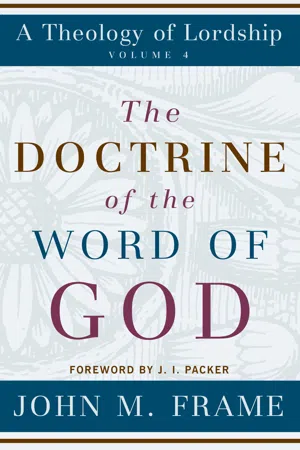
The Doctrine of the Word of God
About this book
Information
Topic
Theology & ReligionSubtopic
Christian TheologyPART ONE
ORIENTATION
CHAPTER 1
The Personal-Word Model
The main contention of this volume is that God’s speech to man is real speech. It is very much like one person speaking to another. God speaks so that we can understand him and respond appropriately. Appropriate responses are of many kinds: belief, obedience, affection, repentance, laughter, pain, sadness, and so on. God’s speech is often propositional: God’s conveying information to us. But it is far more than that. It includes all the features, functions, beauty, and richness of language that we see in human communication, and more. So the concept I wish to defend is broader than the “propositional revelation” that we argued so ardently forty years ago, though propositional revelation is part of it. My thesis is that God’s word, in all its qualities and aspects, is a personal communication from him to us.
Imagine God speaking to you right now, as realistically as you can imagine, perhaps standing at the foot of your bed at night. He speaks to you like your best friend, your parents, or your spouse. There is no question in your mind as to who he is: he is God. In the Bible, God often spoke to people in this way: to Adam and Eve in the garden; to Noah; to Abraham; to Moses. For some reason, these were all fully persuaded that the speaker was God, even when the speaker told them to do things they didn’t understand. Had God asked me to take my son up a mountain to burn him as a sacrifice, as he asked of Abraham in Genesis 22, I would have decided that it wasn’t God and could not be God, because God could never command such a thing. But somehow Abraham didn’t raise that question. He knew, somehow, that God had spoken to him, and he knew what God expected him to do. We question Abraham at this point, as did Søren Kierkegaard in Fear and Trembling.1 But if God is God, if God is who he claims to be, isn’t it likely that he is able to persuade Abraham that the speaker is really he? Isn’t he able to unambiguously identify himself to Abraham’s mind?
Now imagine that when God speaks to you personally, he gives you some information, or commands you to do something. Will you then be inclined to argue with him? Will you criticize what he says? Will you find something inadequate in his knowledge or in the rightness of his commands? I hope not. For that is the path to disaster. When God speaks, our role is to believe, obey, delight, repent, mourn—whatever he wants us to do. Our response should be without reservation, from the heart. Once we understand (and of course we often misunderstand), we must not hesitate. We may at times find occasion to criticize one another’s words, but God’s words are not the subject of criticism.
Sometimes in the Bible we do hear of “arguments” between God and his conversation partners. Abraham pleaded for the life of his nephew Lot in Sodom (Gen. 18:22–33), and Moses pleaded that God would not destroy Israel (Ex. 33:12–23). But no human being, in such a conversation, ought to question the truth of what God says, God’s right to do as he pleases, or the rightness of God’s decisions. The very presupposition of Abraham’s argument, indeed, is “Shall not the Judge of all the earth do what is just?” (Gen. 18:25), a rhetorical question that must be answered yes. Abraham’s argument with God is a prayer, asking God to make exceptions to the coming judgment he has announced. Abraham persists in that prayer, as all believers should do. But he does not question the truth of God’s words to him (Rom. 4:20–21) or the rightness of God’s plans.2 Sometimes, to be sure, believers in Scripture do find fault with God, as did Job (Job 40:2), but that is sin, and such people need to repent (40:3–5; 42:1–6).
God’s personal speech is not an unusual occurrence in Scripture. In fact, it is the main engine propelling the biblical narrative forward. The thing at issue in the biblical story is always the word of God. God speaks to Adam and Eve in the garden to define their fundamental task (Gen. 1:28). All of human history is our response to that word of God. God speaks to Adam again, forbidding him to eat the forbidden fruit (2:17). That word is the issue before the first couple. If they obey, God will continue to bless. If they don’t, he will curse. The narrative permits no question whether the couple knew that it was God who spoke. Nor does it allow the possibility that they did not understand what he was saying. God had given them a personal word, pure and simple. Their responsibility was clear.
This is what we mean when we say that God’s word is authoritative. The authority of God’s word varies broadly according to the many functions I have listed. When God communicates information, we are obligated to believe it. When he tells us to do something, we are obligated to obey. When he tells us a parable, we are obligated to place ourselves in the narrative and meditate on the implications of that. When he expresses affection, we are obligated to appreciate and reciprocate. When he gives us a promise, we are obligated to trust. Let’s define the authority of language as its capacity to create an obligation in the hearer. So the speech of an absolute authority creates absolute obligation. Obligation is not the only content of language, as we have seen. But it is the result of the authority of language.
As we know, Adam and Eve disobeyed. Many questions arise here. How did people whom God had declared “very good,” along with the rest of creation (Gen. 1:31), disobey his word? The narrative doesn’t tell us. Another question is why they would have wanted to disobey God. They knew who God was. They understood the authority of his word and his power to curse or bless. Why would they make a decision that they knew would bring a curse on themselves? The question is complicated a bit by the presence of Satan in the form of a serpent. Satan presumed to interpose a word rivaling God’s, a word contradicting God’s. But why would Adam and Eve have given Satan any credence at all? The most profound answer, I think, is that Adam and Eve wanted to be their own gods. Impulsively, arrogantly, and certainly irrationally, they exchanged God’s truth for a lie (cf. Rom. 1:25). So they brought God’s curse upon themselves (Gen. 3:16–19). Clearly, they should have known better. The word of God was clear and true. They should have obeyed it.
Noah, too, heard God’s personal speech, telling him to build an ark. Unlike Adam, he obeyed God. He might have thought, like his neighbors, and like Adam, that God couldn’t have been right about this. Why build a gigantic boat in a desert? But Noah obeyed God, and God vindicated his faith. Similarly with Abraham, Isaac, Jacob, Moses, Joshua, Gideon, David. All these narratives and others begin with God’s personal speech, often saying something hard to believe or commanding something hard to do. The course of the narrative depends on the character’s response, in faith or unbelief. Hebrews 11 summarizes the faithful ones. Faith, in both Testaments, is hearing the word of God and doing it.
That’s the biblical story: a story of God speaking to people personally, and people responding appropriately or inappropriately.
Scripture is plain that this is the very nature of the Christian life: having God’s word and doing it. Jesus said, “Whoever has my commandments and keeps them, he it is who loves me” (John 14:21). Everything we know about God we know because he has told us, through his personal speech. All our duties to God are from his commands. All the promises of salvation through the grace of Christ are God’s promises, from his own mouth. What other source could there possibly be, for a salvation message that so contradicts our own feelings of self-worth, our own ideas of how to earn God’s favor?
Now, to be sure, there are questions about where we can find God’s personal words today, for he does not normally speak to us now as he did to Abraham. (These are questions of canon.) And there are questions about how we can come to understand God’s words, given our distance from the culture in which they were given. (These are questions of hermeneutics.) I will address these questions in due course. But the answer cannot be that God’s personal words are unavailable to us, or unintelligible to us. If we say either of those things, then we lose all touch with the biblical gospel. The idea that God communicates with human beings in personal words pervades all of Scripture, and it is central to every doctrine of Scripture. If God has, in fact, not spoken to us personally, then we lose any basis for believing in salvation by grace, in judgment, in Christ’s atonement—indeed, for believing in the biblical God at all. Indeed, if God has not spoken to us personally, then everything important in Christianity is human speculation and fantasy.
Yet it should be evident to anyone who has studied the recent history of theology that the mainstream liberal and neoorthodox traditions have in fact denied that such personal words have occurred, even that they can occur. Others have said that although God’s personal words may have occurred in the past, they are no longer available to us as personal words because of the problems of hermeneutics and canon. If those theologies are true, all is lost.
The present book is simply an exposition and defense of the biblical personal-word model of divine communication. As such, it will be different from many books on the theology of revelation and Scripture. Of course, this book will differ from the liberal and neoorthodox positions, but it will not spend a great deal of time analyzing those. Nor will it resemble the many recent books from more conservative authors that have the purpose of showing how much we can learn from Bible critics and how the concept of inerrancy needs to be redefined, circumscribed, or eliminated.3 I don’t doubt that we can learn some things from Bible critics, but that is not my burden here. As for inerrancy, I think it is a perfectly good idea when understood in its dictionary definition and according to the intentions of its original users. But it is only an element of a larger picture. The term inerrancy actually says much less than we need to say in commending the authority of Scripture. I will argue that Scripture, together with all of God’s other communications to us, should be treated as nothing less than God’s personal word.
To make that case, I don’t think it’s necessary to follow the usual theological practice today, setting forth the history of doctrine and the contemporary alternatives and then, in the small amount of space that remains, choosing among the viable options. I have summarized my view of the liberal tradition here in chapters 3–7, and I do hope that in later editions of this book and in other writings I will find time to interact more fully with those writings.4 But although we can learn from the history of doctrine and from contemporary theologians, the final answers to our questions must come from the Word of God itself. And I don’t think you need to look hard to find those answers. You don’t need to engage in abstruse, complicated exegesis. You need only to look at the obvious things and be guided by them, rather than by Enlightenment skepticism. This book will attempt to set forth those obvious teachings and explore some of their implications.
The main difference between this book and other books on the doctrines of revelation and Scripture is that I am trying here, above all else, to be ruthlessly consistent with Scripture’s own view of itself. In that regard, I’m interested in not only defending what Scripture says about Scripture, but defending it by means of the Bible’s own worldview, its own epistemology,5 and its own values.6 That there is a circularity here I do not doubt. I am defending the Bible by the Bible. Circularity of a kind is unavoidable when one seeks to defend an ultimate standard of truth, for one’s defense must itself be accountable to that standard.7 Of course, I will not hesitate to bring extrabiblical considerations to bear on the argument when such considerations are acceptable within a biblical epistemology. But ultimately I trust the Holy Spirit to bring persuasion to the readers of this book. God’s communication with human beings, we will see, is supernatural all the way through.
1. Søren Kierkegaard, Fear and Trembling: The Sickness unto Death (1941; repr., Garden City, NY: Doubleday, 1954).
2. On the question whether God can change his mind, see DG, 559–72. And see ibid., 150, which is also relevant to the question whether God’s decrees are in any sense dependent on events in history, that is, how God’s foreordination is related to his foreknowledge.
3. For examples of how I respond to such arguments, see my reviews of recent books by Peter Enns, N. T. Wright, and Andrew McGowan, Appendices J, K, and L in this volume.
4. For examples of such interaction, see Appendices A, E, F, H, M, and Q in this volume.
5. I have formulated what I think a biblical epistemology looks like in DKG.
6. DCL focuses on biblical values. DKG makes the case that biblical epistemology can be understood as a subdivision of biblical ethics.
7. See DKG, 130–33.
CHAPTER 2
Lordship and the Word
If we are to understand the nature of the word of God, we must certainly understand so...
Table of contents
- Cover Page
- Title Page
- Copyright Page
- Contents
- Analytical Outline
- Foreword
- Preface
- Abbreviations
- Part One: Orientation
- Part Two: God’s Word in Modern Theology
- Part Three: The Nature of God’s Word
- Part Four: How the Word Comes to us
- Appendix A: Antithesis and the Doctrine of Scripture
- Appendix B: Rationality and Scripture
- Appendix C: Review of Richard Muller, The Study of Theology
- Appendix D: Dooyeweerd and the Word of God
- Appendix E: God and Biblical Language: Transcendence and Immanence
- Appendix F: Scripture Speaks for Itself
- Appendix G: Review of John Wenham, Christ and the Bible
- Appendix H: Review of David Kelsey, The Uses of Scripture in Recent Theology
- Appendix I: Review of The Nature and Extent of Biblical Authority: Christian Reformed Church, Report 44
- Appendix J: Review of Peter Enns, Inspiration and Incarnation
- Appendix K: Review of N. T. Wright, The Last Word
- Appendix L: Review of Andrew McGowan, The Divine Spiration of Scripture
- Appendix M: Review of Norman Geisler, ed., Biblical Errancy
- Appendix N: No Scripture, No Christ
- Appendix O: In Defense of Something Close to Biblicism: Reflections on Sola Scriptura and History in Theological Method
- Appendix P: Traditionalism
- Appendix Q: The Spirit and the Scriptures
- Bibliography
- Index of Names
- Index of Subjects
- Index of Scripture
Trusted by 375,005 students
Access to over 1.5 million titles for a fair monthly price.
Study more efficiently using our study tools.
Frequently asked questions
Yes, you can cancel anytime from the Subscription tab in your account settings on the Perlego website. Your subscription will stay active until the end of your current billing period. Learn how to cancel your subscription
No, books cannot be downloaded as external files, such as PDFs, for use outside of Perlego. However, you can download books within the Perlego app for offline reading on mobile or tablet. Learn how to download books offline
Perlego offers two plans: Essential and Complete
- Essential is ideal for learners and professionals who enjoy exploring a wide range of subjects. Access the Essential Library with 800,000+ trusted titles and best-sellers across business, personal growth, and the humanities. Includes unlimited reading time and Standard Read Aloud voice.
- Complete: Perfect for advanced learners and researchers needing full, unrestricted access. Unlock 1.5M+ books across hundreds of subjects, including academic and specialized titles. The Complete Plan also includes advanced features like Premium Read Aloud and Research Assistant.
We are an online textbook subscription service, where you can get access to an entire online library for less than the price of a single book per month. With over 1.5 million books across 990+ topics, we’ve got you covered! Learn about our mission
Look out for the read-aloud symbol on your next book to see if you can listen to it. The read-aloud tool reads text aloud for you, highlighting the text as it is being read. You can pause it, speed it up and slow it down. Learn more about Read Aloud
Yes! You can use the Perlego app on both iOS and Android devices to read anytime, anywhere — even offline. Perfect for commutes or when you’re on the go.
Please note we cannot support devices running on iOS 13 and Android 7 or earlier. Learn more about using the app
Please note we cannot support devices running on iOS 13 and Android 7 or earlier. Learn more about using the app
Yes, you can access The Doctrine of the Word of God by John M. Frame in PDF and/or ePUB format, as well as other popular books in Theology & Religion & Christian Theology. We have over 1.5 million books available in our catalogue for you to explore.