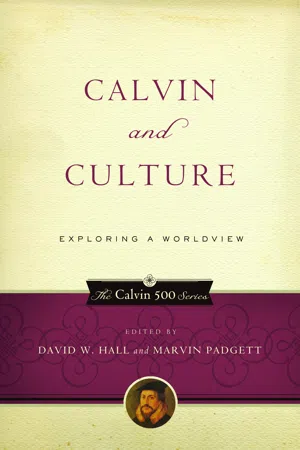
Calvin's worldview extends far beyond theology. Fourteen authors demonstrate how Calvin's ideas have transformed many fields of human study and how his worldview continues its powerful influence to this day.
- English
- ePUB (mobile friendly)
- Available on iOS & Android
eBook - ePub
About this book
Information
Topic
Theology & ReligionSubtopic
Biblical Studies1
1929 and All That, or What Does Calvinism Say to Historians Searching for Meaning?
Darryl G. Hart

The year 1929 was a significant one in the lives of many Americans. That year, as most people know, was the time of the Great Crash on Wall Street that escalated into the Great Depression. Most historians of the United States recognize this as one of the most profound crises in the life of the nation. The most recent economic downturn has generated even greater awareness of the nation’s economic history as policy makers and citizens alike look for lessons from the Depression.
In 1929 another event transpired, one usually omitted from survey textbooks on United States history, but with arguably even more significance than the decline in stock prices that hit Wall Street on October 29, 1929. This was the reorganization of Princeton Seminary and the subsequent start of Westminster Seminary to carry on Princeton’s original mission. The larger events surrounding Princeton’s administrative adjustment are part of the fundamentalist controversy that engaged liberal and conservative Presbyterians for most of the 1920s. Although Princeton did not experience directly a liberal takeover, its new administrative structure after 1929 meant that conservatives were a minority on the board that oversaw academic and theological standards. J. Gresham Machen’s decision, with support from many Presbyterian conservatives, to found a successor seminary to Princeton was arguably one of the major developments in the Presbyterian controversy. Even if the founding of Westminster did not affect as many Americans as did the crash of the stock market, the stakes for the new seminary were higher since they reflected not the price of temporal assets but the value of eternal realities—ones pertaining to the redemption purchased by Christ. From the perspective of eternity, the downfall of old Princeton and the creation of Westminster were more important than the fall of stock prices at the New York Stock Exchange.1
If this comparison is not adequate to start mental gears turning on the subject of doing history from a Calvinistic outlook, then perhaps what will do so is Machen’s perspective on the meaning of 1929 for conservative Presbyterians. At his convocation address for Westminster, delivered before faculty, students, and well-wishers in center city Philadelphia, Machen admitted that he was at a loss in trying to make sense of Princeton Seminary’s demise. He said:
At first it might seem to be a great calamity, and sad are the hearts of those Christian men and women throughout the world who love the gospel that the old Princeton proclaimed. We cannot fully understand the ways of God in permitting so great a wrong. Yet good may come even out of a thing so evil as that.2
As a student of Scripture, Machen knew that many times throughout redemptive history God had accomplished his purposes through events that looked as if God’s people were experiencing defeat. The story of Joseph and his brothers, the selection of the diminutive David as king of Israel, and above all Christ’s death on the cross all made plausible Machen’s sense that good might spring from evil in the course of redemptive history. Even so, he was unsure about Princeton. And if uncertain how to interpret developments in the church, how much more reluctant would Machen have been to try to interpret the significance of the Great Depression?
As disquieting as historical uncertainty may be, Machen’s Calvinistic instincts were exactly on target. Although many historians and theologians have claimed that the Reformed faith specifically and Christianity more generally equip historians with insights about the meaning of historical developments, a deeper reality exists: that the Reformed faith may hinder attempts to derive the ultimate meaning of historical events. As Machen’s own example suggests, the Reformed faith encourages epistemological humility when trying to tell what God is doing in history. Instead of adding up to a complete narrative, with beginning, middle, transitions between chapters, and an upbeat ending, history from a Calvinist outlook is actually filled with mystery. No one knew this better than John Calvin, whose doctrine of providence and instruction on how to view the world represents one of the best starting points for Reformed Protestants who study the past and want to make sense of it.
Providence According to Calvin
Reformed Protestants generally have raised few objections to the doctrine of providence. Because many come to the Reformed faith precisely because of the tradition’s understanding of God’s sovereignty, the belief—according to the Westminster Shorter Catechism—that providence involves God’s “most holy, wise, and powerful preserving and governing his creatures and all their actions” makes perfect sense. Providence implies a created order where God is in charge and humans need not worry whether his purposes will be accomplished (WSC, Q. 11).
Calvin was no more comfortable with providence than other Reformed Protestants when he developed the doctrine in book one of the Institutes. This was the section of his systematic exposition of the Christian religion in which he discussed man’s knowledge of God the Creator. At the end of this section of the Institutes, Calvin duly discussed first God’s work of creation and then his works of providence, two divine acts closely connected because of the relationship between creating out of nothing and the subsequent preservation needed to maintain the original stuff of creation. Calvin’s basic definition of providence was this: God governs heaven and earth such that he “regulates all things that nothing takes place without his deliberation”.3 The French Reformer explained that this regulation was not simply an extension of nature, as if God had simply created the world and let it run without direct and ongoing support and government. Calvin wrote, “Those as much defraud God of his glory as themselves of a most profitable doctrine who confine God’s providence to such narrow limits as though he allowed all things by a free course to be borne along according to a universal law of nature”.4 In other words, providence is not passive, as if God merely sits “idly” observing the universe, but “as the keeper of the keys, he governs all events”.5
Under the general category of God’s regulation of creation, Calvin distinguished four layers of providence. The first was the natural world, such as “the alternation of days and nights, of winter and summer.”This aspect of providence included the animal world where God “gives food to the young of the ravens” and governs the flight of birds by a “definite plan”.6 These were works of God because the days and seasons followed according to a “certain law” established by God himself.7 A second layer concerned God’s providential care for man. Calvin insisted that “we know that the universe was established for the sake of mankind”.8 Here Calvin quoted Jeremiah ( Jer. 10:23) and Solomon (Prov. 16:9) to show that God directs man’s steps even to the point of Calvin’s denying man control of his own affairs within the bounds of a natural order given by God. “The prophet and Solomon,” Calvin wrote, “ascribe to God not only might but also choice and determination.” He added that it is “an absurd folly that miserable men take it upon themselves to act without God, when they cannot even speak except as he wills.”This meant that nothing happens to man by chance because nothing in the world is “undertaken without [God’s] determination”.9
The third level of providence extended to natural occurrences. The examples Calvin used here were the weather and human procreation. “Whenever the sea boils up with the blast of winds,” these forces testify to the presence of God’s power and confirm Scripture’s teaching that God “commanded and raised the stormy wind, which lifted up the waves of the sea” (Ps. 107:25). Human fertility was also an indication of God’s control of all things. As much as all men and women (with few exceptions) possessed the power to procreate, some marriages were more barren or fertile than others. The reason for the difference was God’s “special favor”.10
The fourth and final dimension of providence outlined by Calvin is the one most relevant for considering God’s control of history and what a Reformed perspective on historical scholarship might involve. Calvin rejected adamantly the Stoic doctrine of fate, although he knew his teaching on providence might sound as if he were saying God’s activity in controlling all things left man in a passive state, only to be acted upon rather than acting in space and time with purpose. Calvin could deny Stoicism because of his rejection of the necessity of causes. The created order did not unfold in a mechanical way, but according to God’s eternal decree and attributes. Accordingly, God ruled and governed all things according to his being, wisdom, power, holiness, goodness, and truth. Rather than an abstract law or a distant force being at the center of all things, creation developed according to a personal God, and providence embodied that personality. This meant for Calvin that “not only heaven and earth and the inanimate creatures, but also the plans and intentions of men, are so governed by his providence that they are borne by it straight to their appointed end”.11 Such an execution of God’s decree eliminated any room for fortune or chance. “Nothing is more absurd,” Calvin wrote, “than that anything should happen without God’s ordaining it, because it would then happen without any cause”.12
A number of questions naturally follow from Calvin’s discussion of providence. What is the relationship between divine sovereignty and human freedom? Does man have a free will? What is the difference between secondary causes—those ways in which God carries out his purposes through the actions of man or circumstances of the created order (such as the rising of the sun or gravitational pull)—and God’s primary causes, such as his powerful and direct intervention with the created order in the form of miracles, special revelation, and the incarnation? As important as these questions are for understanding the Reformed doctrine of providence, they are somewhat beside the point in assessing a Calvinistic outlook on history that stems from Calvin’s teaching on providence.
Calvin did not stop to entertain such questions but moved directly in the Institutes from an exposition of providence to an aspect of God’s control that bears directly on historical inquiry and is crucial for its work. He said that no matter how much God was in control of all events, and no matter how much Christians believed in divine sovereignty so that nothing occurs in history by chance or fortune, to us the unfoldings of providence “are fortuitous”.13 Christians know that everything is “ordained by God’s plan” and unfolds according to “a sure dispensation,” yet in his experience of human existence, natural circumstances, and social development, man cannot discern meaning or direction sufficient to counter the impression that life is marked by accidents or fortunes. Calvin insisted he was not arguing that fortune “rules the world and men, tumbling all things at random up and down.” Such was a foolish outlook and had no place in “the Christian’s breast.” Even so, because “the order, reason, end, and necessity” of everyday life “for the most part lie hidden in God’s purpose, and are not apprehended by human opinion,” those things that happen according to God’s will and sovereign plan “are in a sense fortuitous”.14
Calvin used the following example to make his point:
Let us imagine, for example, a merchant who, entering a wood with a company of faithful men, unwisely wanders away from his companions, and in his wandering comes upon a robber’s den, falls among thieves and is slain. His death was not only foreseen by God’s eye, but also determined by his decree. For it is not said that he foresaw how long the life of each man would extend, but that he determined and fixed the bounds that men cannot pass. ( Job 14:5) Yet as far as the capacity of our mind is concerned, all things therein seem fortuitous.15
Most human occurrences, whether considered “in their own nature or weighted according to our knowledge and judgment,” on the surface appear to have no intrinsic meaning other than occurring according to God’s eternal purpose. In the case of the merchant’s death, a Christian will regard it “as fortuitous by nature” but will not doubt “that God’s providence exercised authority over fortune in directing its end”.16
Finding some proximate meanings in the world’s affairs was not, how...
Table of contents
- Cover Page
- Title Page
- Copyright Page
- Contents
- Foreword: John M. Frame
- Acknowledgments
- Introduction: David Hall and Marvin Padgett
- Abbreviations
- 1. 1929 and All That, or What Does Calvinism Say to Historians Searching for Meaning?
- 2. Law, Authority, and Liberty in Early Calvinism
- 3. The Arts and the Reformed Tradition
- 4. Calvin’s Contributions to Economic Theory and Policy
- 5. Calvinism and Literature
- 6. Calvin’s Legacy in Philosophy
- 7. Calvin, Politics, and Political Science
- 8. Calvinism and Science
- 9. John Calvin’s Impact on Business
- 10. Calvin and Music
- 11. Medicine: In the Biblical Tradition of John Calvin with Modern Applications
- 12. Calvin as Journalist
- 13. The Future of Calvinism as a Worldview
- Index of Scripture
- Index of Subject and Names
- Contributors
Trusted by 375,005 students
Access to over 1.5 million titles for a fair monthly price.
Study more efficiently using our study tools.
Frequently asked questions
Yes, you can cancel anytime from the Subscription tab in your account settings on the Perlego website. Your subscription will stay active until the end of your current billing period. Learn how to cancel your subscription
No, books cannot be downloaded as external files, such as PDFs, for use outside of Perlego. However, you can download books within the Perlego app for offline reading on mobile or tablet. Learn how to download books offline
Perlego offers two plans: Essential and Complete
- Essential is ideal for learners and professionals who enjoy exploring a wide range of subjects. Access the Essential Library with 800,000+ trusted titles and best-sellers across business, personal growth, and the humanities. Includes unlimited reading time and Standard Read Aloud voice.
- Complete: Perfect for advanced learners and researchers needing full, unrestricted access. Unlock 1.5M+ books across hundreds of subjects, including academic and specialized titles. The Complete Plan also includes advanced features like Premium Read Aloud and Research Assistant.
We are an online textbook subscription service, where you can get access to an entire online library for less than the price of a single book per month. With over 1.5 million books across 990+ topics, we’ve got you covered! Learn about our mission
Look out for the read-aloud symbol on your next book to see if you can listen to it. The read-aloud tool reads text aloud for you, highlighting the text as it is being read. You can pause it, speed it up and slow it down. Learn more about Read Aloud
Yes! You can use the Perlego app on both iOS and Android devices to read anytime, anywhere — even offline. Perfect for commutes or when you’re on the go.
Please note we cannot support devices running on iOS 13 and Android 7 or earlier. Learn more about using the app
Please note we cannot support devices running on iOS 13 and Android 7 or earlier. Learn more about using the app
Yes, you can access Calvin and Culture by David W. Hall,Marvin Padgett in PDF and/or ePUB format, as well as other popular books in Theology & Religion & Biblical Studies. We have over 1.5 million books available in our catalogue for you to explore.