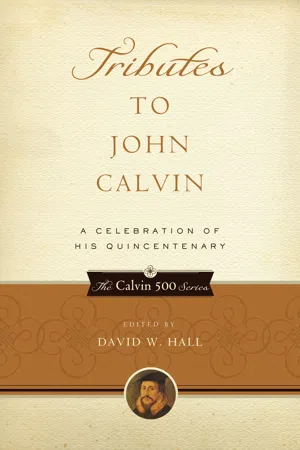
These essays illuminate Calvin's times, thought, and legacy and provide a celebratory tribute to one of the most influential people in history.
- English
- ePUB (mobile friendly)
- Available on iOS & Android
eBook - ePub
About this book
Information
Topic
Theology & ReligionSubtopic
Christian TheologyPART 1

CALVIN’S TIMES
1
CALVIN’S CHILDREN
WILLIAM A. MCCOMISH

This essay concerns the spread of John Calvin’s ideas in the world. It is not based on a narrow study of a particular aspect of Calvin’s life or work but rather provides a wide-ranging survey of Calvinist influence on the development of modern civilization. I am profoundly grateful to Dr. David Hall for his invitation to be a keynote speaker at the Calvin500 celebrations. I am deeply aware of the honor that he has shown me, and I believe that this invitation, and this essay that I now present to you, represents an “action de grace” or thanksgiving. It is also a confession of my faith, and it is a conviction statement. If it were not for Calvin and his successors, I would not be what I am. If it were not for Calvin and his successors—whom I have chosen to call his “children”—the modern world would be a much more primitive and barbarous place than it is. If we look only at the sixteenth century and look only at Geneva or at theology, then we are lost in a time warp and will never know who we are or from where we have come.
We are gathered here today on sacred ground—not that Calvinists have sacred ground, but we are here where it all began and in buildings that are powerful symbols for us all. My time frame is five hundred years and my field the whole world. In this conference we are aware of the great Latin motto of Geneva, Post tenebras lux, “Light comes after darkness,” but I would like to place this article under the magnificent motto of my old and battered home city of Belfast in Northern Ireland, Pro tanto quid retribuamus, “For what we have received let us be truly thankful.”
It is not enough to regard Calvinism as a purely academic theological system. From its beginnings in Geneva it had a strong practical application in human life in the real world. Calvin, I believe, was the greatest Christian theologian since St. Paul, and his work has ensured that for five centuries his followers have benefited from a vision of Jesus Christ that is more true, more accurate, and more clear than any other. But this revolutionary mind-set has not been confined to academic theologians. The kind of responsible middle-class people who accepted Calvinism then went out into the world with a living faith to serve their Master, Jesus Christ, in the world. I am reminded of the great question of Isaiah 53:1: “Who hath believed our report? and to whom is the arm of the LORD revealed?” (KJV).
Calvinists have lived in many countries and worked in many areas. The Calvinist principle of individual responsibility has led to wave after wave of Presbyterians turning their faith into practice in many different fields—and I will cite examples such as those of banking, politics, business, political thought and democracy, human rights, education, and Bible translation, printing, distribution, and reading. This is the topic of my present essay, which is also very personal. It is my own selection of a very few iconic women and men who, I believe, carry the heritage of Calvin’s work in Geneva. In a very modest way I am following Theodore Beza when he wrote his Icones of 1580.1 Some of my choices may surprise you, and fraternally, I suggest that creating your own list to celebrate Calvin500 would be a worthy exercise.
Presbyterians, Calvinists, are not called to celebrate their own vision of the past. Rather, we are called to strive for God’s kingdom in our own place and in our own time. But it is part of the pleasure of this fifth centenary to look back and not only to draw strength from the past but to gather strength to face an uncertain future. It is not my intention to produce a panegyric of Calvinist history, and this is my first caveat: Calvinists have made plenty of mistakes. Do we not, after all, believe that we are fallen, imperfect creatures that can be saved only by the grace of God? Yet one major feature of Calvinism has been the evolution of our practice, and we will see how the application of Calvinist faith to resistance theory or to human rights has changed over the centuries. This is normal and admirable. It must not be thought that Calvinism has always spoken with one voice; it has always been plural. It is an old joke, but a truth, that where you have three Presbyterians, you have five points of view! This is not a weakness but a strength. Calvinism and Presbyterianism are not authoritarian systems in which clone-like sectarians endlessly repeat a truth that they have been taught by their guru. Calvinists have seized a theological truth, and this truth has set them free to use their individual responsibility to apply a multitude of attitudes and solutions to the problems and challenges of the world.
My second caveat is to point out that although I believe Calvinism to be the primary force for progress in human society, I do not do so in any sectarian way. We are not alone in doing good and improving the lives of people. Who can ignore the work of the Quakers, the Methodists, and the Catholics, as well as secular groups and other faith families?
My third caveat is to state clearly that this essay is by no means exhaustive. Millions of women and men have lived lives far from the limelight but have put their faith into practice in modest, limited circumstances known perhaps only to themselves and to God. Calvinism at its best is a mass movement, not an elitist one. To concentrate on a few interesting people is not to decry or to diminish the rest. All, in Calvinism, are equal in the sight of God. I must add that one major difficulty for me in writing this essay is that there is simply too much to say. There are too many people to whom I would like to introduce you! We are in very good company.
Beginnings
The history of Calvinism really begins with the cataclysmic plague of the fourteenth century—the Black Death that wiped out a third, a half, perhaps two-thirds of the population of Europe. All figures are inaccurate, since there were so many dead that they could be neither counted nor buried. What is clear is that the Black Death spelled the end of the feudal system in western Europe. The system that had developed (after the fall of the late Roman empire) of the illiterate lord in his castle and the illiterate serfs laboring in the fields broke down for good. The towns sprang up, and a new, literate middle class came into being: the merchant, the trader, the industrialist, the banker. For the first time in a thousand years, literacy was not confined to the church. A literate, secular middle class now took life and religion seriously, wanted to read the Bible, hear intelligent sermons, and take part in the government of the church, as well as to have responsibilities in business and government. It was this new, urban middle class that became Protestant, in Hamburg, Zurich, Venice, and Amsterdam; in Edinburgh, Lausanne, Philadelphia, and Debrecen; and in Geneva—which is the perfect example because in 1536 the new middle-class citizens overturned an aristocratic civil government and Roman ecclesiastical government to take control of both themselves.
The Bible
Calvinists were not the first or the only translators of the Bible. The fourth-century Biblia Vulgata of Jerome contained many errors, but had been used for centuries. The wave of Greek-speaking scholars who came to western Europe in the mid-fifteenth century following the fall of Constantinople to the Turks stimulated the rediscovery of Greek texts in Renaissance Italy, notably at Florence and Ferrara. Theologians produced Greek New Testaments that were the basis of Protestant biblical scholarship. Erasmus’s Greek New Testament was published in 1516 and was contemporary with the Complutensian Polyglot of the Spanish Cardinal Ximenes of 1522, published after twenty years of labor. Calvinist seminaries, including the Genevan Academy (founded by Calvin in 1559), taught from the Greek text. Theodore Beza published his Greek New Testament in 1565.2
The method of teaching was to develop propositions from the text that were formed into commonplaces and theses that were then developed into doctrines. This propositional form of revelation was controlled by a Melanchthonian hierarchy in the use of the books of the Bible. Calvin and others taught that if the Epistle to the Romans were properly understood, it would enable understanding of the whole Bible. The first and fourth Gospels were next in the order of authority, with the rest of the New Testament following, and the Old Testament following after that.
Comprehension of the biblical text was essential to the Calvinists for two reasons. The first was that Calvin and his associates understood clearly that the education of the clergy was essential to the Reformation’s survival. In an increasingly educated secular world, people would listen only to properly trained ministers. The Genevan Academy attracted hundreds of young men from all over Europe and sent them out to preach the Word. Preaching was popular and an essential part of the life of the Calvinists—as it is today. The second reason was that private Bible study, alone or in the family circle, was encouraged and indeed required. Thus, translations were necessary as furnishings for church and home. The Calvinists became the greatest preachers and biblical translators in history. Bibles in French, English, and Italian were translated in Geneva. Calvin’s own cousin Olivetan published a French translation in 1535. It was in Geneva that Robert Estienne, one of Calvin’s followers, first divided the Bible into chapter and verse in his 1551 New Testament. Many other translations followed: an Irish version by 1602 and a Lithuanian version by 1662,3 as well as Dutch (authorized by the Synod of Dort), Hungarian, Spanish, Polish, German—many in several versions, but all inspired by the Calvinist hunger to know and to practice the will of God. The vast amount of work involved in the making of these translations will never be known, but we can glean some idea of their success by looking briefly at two Bibles.
The Geneva English Bible was published by a group of exiles fleeing the persecution of the Catholic Mary Tudor in 1560. It is popularly known as the “Breeches” Bible because in Genesis 3:7 Adam and Eve made themselves breeches to cover their nakedness. But for fifty years it was the standard Bible in English and was reprinted some 160 times, making it one of the best sellers of all time. Its influence on the Protestant mind-set of the British is incalculable, especially when we realize that it was not simply the text that was reproduced but vast numbers of marginal notes inspired by Calvin, Beza, and Olivetan. James VI and I, who did not much like Presbyterians, wrote that the notes were “very partial, untrue, seditious, and savouring too much of dangerous and traitorous conceits,”4 which is high praise indeed!
Another Bible with a specifically Genevan origin was that of Giovanni Diodati, a professor in the Genevan Academy and a delegate to the Synod of Dort. Diodati rapidly translated the New Testament into Italian in 1607 to support a Protestant conspiracy to take control of the Venetian Republic, where there were many Protestants among the ruling classes. Unfortunately, the conspiracy failed, but the Diodati Bible remained the standard translation used by Italian Protestants until our own day.5
These are...
Table of contents
- Cover Page
- Title Page
- Copyright Page
- Contents
- Foreword: R. Albert Mohler Jr.
- Preface: David W. Hall
- Abbreviations
- PART ONE: CALVIN’S TIMES
- PART TWO: CALVIN’S TOPICS
- PART THREE: CALVIN TODAY AND TOMORROW
- Appendix: Original Schedule of Calvin500 Tribute Conference
- Index of Scripture
- Index of Subjects and Names
- Contributors
Trusted by 375,005 students
Access to over 1.5 million titles for a fair monthly price.
Study more efficiently using our study tools.
Frequently asked questions
Yes, you can cancel anytime from the Subscription tab in your account settings on the Perlego website. Your subscription will stay active until the end of your current billing period. Learn how to cancel your subscription
No, books cannot be downloaded as external files, such as PDFs, for use outside of Perlego. However, you can download books within the Perlego app for offline reading on mobile or tablet. Learn how to download books offline
Perlego offers two plans: Essential and Complete
- Essential is ideal for learners and professionals who enjoy exploring a wide range of subjects. Access the Essential Library with 800,000+ trusted titles and best-sellers across business, personal growth, and the humanities. Includes unlimited reading time and Standard Read Aloud voice.
- Complete: Perfect for advanced learners and researchers needing full, unrestricted access. Unlock 1.5M+ books across hundreds of subjects, including academic and specialized titles. The Complete Plan also includes advanced features like Premium Read Aloud and Research Assistant.
We are an online textbook subscription service, where you can get access to an entire online library for less than the price of a single book per month. With over 1.5 million books across 990+ topics, we’ve got you covered! Learn about our mission
Look out for the read-aloud symbol on your next book to see if you can listen to it. The read-aloud tool reads text aloud for you, highlighting the text as it is being read. You can pause it, speed it up and slow it down. Learn more about Read Aloud
Yes! You can use the Perlego app on both iOS and Android devices to read anytime, anywhere — even offline. Perfect for commutes or when you’re on the go.
Please note we cannot support devices running on iOS 13 and Android 7 or earlier. Learn more about using the app
Please note we cannot support devices running on iOS 13 and Android 7 or earlier. Learn more about using the app
Yes, you can access Tributes to John Calvin by David W. Hall in PDF and/or ePUB format, as well as other popular books in Theology & Religion & Christian Theology. We have over 1.5 million books available in our catalogue for you to explore.