Explores John Calvin's extraordinary influence on what we consider the key elements of a modern, compassionate, and just society—particularly the fields of liberal democracy, rights, and civil liberties.
eBook - ePub
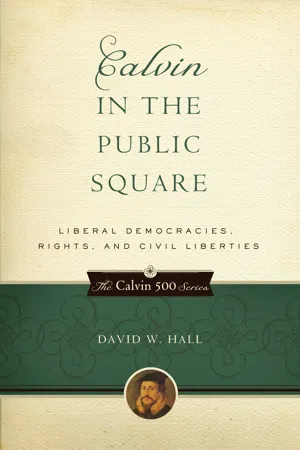
Calvin in the Public Square
Liberal Democracies, Rights, and Civil Liberties
- English
- ePUB (mobile friendly)
- Available on iOS & Android
eBook - ePub
About this book
Information
Topic
Theology & ReligionSubtopic
Christian Theology1
Standing on the Shoulders of Previous Giants

Below is one man’s study of how one man’s thought became a movement that changed the political landscape of modernity. Of course, the political involvement and ideas of John Calvin neither can nor should be expected to answer all or even the most begging current questions in this field. Calvin was, to be sure, not a political scientist or a campaign strategist. However, in addition to stirring the republicanizing wave that crested on the shores of most Western governments before and after the Enlightenment, his varied theological applications yield much political prudence. It is that wisdom, both practical and theoretical, that is valued and explicated in this work.
Numerous scholars have traced Calvin’s political ideas.1 Some have focused on the socioeconomic impact (M. Weber), while others have highlighted his ties to medieval thought (Q. Skinner), his fueling of a burgeoning democratic movement (R. Kingdon), and his impact on the development of Western law and human rights ( J. Witte, Jr., D. Kelly et al.); and, of course, critics too numerous to cite accuse him of inhibiting liberty, humanity, or knowledge.
Compared with the heft of Calvin’s international and multigenerational influence, seldom have the written words of a pastor fostered so much sustained political impact. Douglas Kelly extols the virtue of the “sober Calvinian assessment of fallen man’s propensity to seize, increase, and abuse power for personal ends rather than for the welfare of the many.” He further evaluates: “Governmental principles for consent of the governed, and separation and balance of powers are all logical consequences of a most serious and Calvinian view of the biblical doctrine of the fall of man.”2 While probably overstating (thinking of Calvin as “wholly medieval” and as advocating an “aristocratic theocracy in which he was dictator”), notwithstanding, historian Franklin Palm recognized Calvin’s contribution as “emphasizing the supremacy of God and the right of resistance to all other authority . . . [H]e did much to curb the powers of kings and to increase the authority of the elected representatives of the people.”3 Further, Palm noticed Calvin’s belief in the “right of the individual to remove the magistrate who disobeys the word of God. . . . Consequently, he justified many revolutionary leaders in their belief that God gave them the right to oppose tyranny.”
Recently, John Witte Jr. has noted how “Calvin developed arresting new teachings on authority and liberty, duties and rights, and church and state that have had an enduring influence on Protestant lands.” As a result of its adaptability, this “rendered early modern Calvinism one of the driving engines of Western constitutionalism. A number of our bedrock Western understandings of civil and political rights, social and confessional pluralism, federalism and social contract, and more owe a great deal to Calvinist theological and political reforms.”4
In various parts of the Calvin corpus of literature, he addresses the following questions, which are of vital interest to modernity and political theorists:
- • Is the state or are its governors sovereign?
- • What form should the government take?
- • Is democracy an absolute?
- • Who pays for government and how/how much?
- • Who functions as governmental leaders?
- • How much of human life should government cover?
- • What other valid spheres should the government respect (family, church, school)?
- • May citizens resist their government? Under what limitations or conditions?
His political writings were, to be sure, in part the culmination of a tradition. They followed decades of Renaissance thought and sat perched atop centuries of medieval and Scholastic theological reflection on political principles. We would not wish to be understood as suggesting that Calvin worked in isolation in formulating his principles; it was common for leading theologians of the period—leaders in society in that day—to expound matters of state. However, the subsequent expansion and replication of his thought by his followers virtually created a new trajectory of political discourse. It is no exaggeration to observe that before Calvin, certain political principles were viewed as radical; while after him, they became widely acceptable. Thus, this volume treats not only Calvin’s thought but also the subsequent Calvinism, particularly with its impact on politics and human government.
Before observing his own teachings on political matters, we need to look at historical context. To provide this, the pages below in these opening chapters summarize important theological developments prior to him along with a short biography of Calvin.
Augustine
Calvin neither wrote in a vacuum nor originated all ideas frequently associated with his name. He would be quick to confirm that the best ideas stand on the shoulders of previous giants. One of the fathers on whom Calvin relied most was St. Augustine of Hippo (354–430), certainly the dominant theologian in many religious matters for centuries. Even in Calvin’s day, Augustine’s shadow loomed large over discussions about matters of state. The classic work that addresses these matters, The City of God, attempted to illustrate the rival and antithetical strains characteristic of belief and unbelief (and, in this case, its impact on politics) throughout the history of mankind. For him, one city was organized around the prowess and pride of man, complete with its materialism, violence, unbelief, lust for domination, and oppression; on the other hand, the civitatis Dei was characterized by a profound love for God, valuing of the eternal over the temporal, high ethical standards, and equitable treatment of neighbors. Interestingly, Augustine’s very taxonomy draws upon a political unit: the city. The recognition that people would organize themselves in civilized units, such as cities, occurred early. An ardent believer in human depravity and the limitations of the goodness of man, Augustine saw the necessity of government as a restraining mechanism for the good society. Augustine did not expect non-Christian thought to spawn good civil government, nor to be the seat of liberty: “Sinful man [actually] hates the equality of all men under God and, as though he were God, loves to impose his sovereignty on his fellow men. He hates the peace of God which is just and prefers his own peace which is unjust. However, he is powerless not to love peace of some sort. For, no man’s sin is so unnatural as to wipe out all traces whatsoever of human nature.”5
Augustine’s City of God was an apology for the Christian church and its ethical values. In answer to the secular critics who sought to blame the fall of the Roman Empire on Christian beliefs and practices (Rome fell during the reign of Honorarius, a Christian emperor), Augustine strove to demonstrate instead that the seeds of societal corruption rested in the very morals and concepts of pre-Christian Roman paganism. For Augustine, Rome’s fall was but another chapter in the unfolding providence of God—a theme that would become a Calvinistic calling card. There was no reason to think that the Roman Empire, complete with its stunning collapse, should necessarily be seen as an apocalyptic fulfillment. It was perhaps merely the latest instance of God “bringing princes to naught and reducing the rulers of this world to nothing. No sooner are they planted, no sooner are they sown . . . than he blows on them and they wither and a whirlwind sweeps them away like chaff ” (Isa. 40:23–24 NIV). Changes among the administrations of the City of Man were but epiphenomena—not the real substrata of important history. Nations would rise and fall, and those accessions and declensions were part of the plan of God. Nonetheless, Augustine refused to categorize a government as exclusively pro-God or anti-God, each having mixed strains of justice and injustice.
One Augustine scholar clarifies: “These two cities, divided on moral ground, co-exist within the same political and geographical limits. The civitatis terrena [earthly city], comprising all the cities that have existed, presently exist, and ever will exist in actuality, carries within itself the two mystical cities or societies . . . . Moreover, no external sign reliably identifies them as members of one or the other mystical city. . . . Consequently, the whole of human history, past, present, and future is marked by the co-existence of both moral types in all times and places.”6 George J. Lavere has observed Augustine’s refusal to identify strictly the City of God with a particular nation or institution. In so doing, Augustine does not accept the dilemma maintained prior to his writing.
Prior to Augustine, the two primary options were (1) to follow Origen (185–254) and Eusebius in blessing the Roman Empire as the divine means of God’s providence and (2) to follow Hippolytus and other apocalyptists in viewing the Roman Empire as the satanic incarnation of the beast predicted in Revelation 13. Ambrose, Jerome, and other theologians tended to adopt the first view, while persecuted Christians such as Cyprian, Tertullian, and other martyrs tended to see a fundamental enmity between church and state. As Augustine reflected on these two major options, he split the horns of the dilemma and adopted a transformational view. Rather than condoning the Roman state as the means of God’s decree, and instead of seeing the state as the instrument of the Antichrist, Augustine preferred to minimize the state’s importance in the overall evaluation. Calvin would later broadcast a similar approach.
For Augustine, the task of the state was “remedial and protective,” and “a corrective device for the restraint of self-centered human beings.”7 He saw the state as a necessary but unnatural institution, insofar as it was erected primarily to restrain sin after the fall. Human governments, according to Augustine, had their origin in the consequences of the fall, not in the order of creation.
Seeing the Edenic fall as the origination of human governments inherently delimited both the successes as well as defeats that Christians might experience in political matters. Such a view necessarily de-emphasizes the political, or restores it to its proper perspective as less than all-dominating. Christians in the fifth century needed this reminder, as do Christians of all centuries. Too close identification of any earthly polis with the heavenly polis, as both Augustine and Calvin taught, is a danger to avoid.
In his analysis of the absence of Roman justice, Augustine commented:
It follows that, wherever true justice is lacking, there cannot be a multitude of men bound together by a mutual recognition of rights; consequently, neither can there be a “people” in the sense of Scipio’s definition. Further, if there is no “people,” there is no weal of the “people,” or commonwealth, but only the weal of a nondescript mob undeserving of the designation “the people” . . . . If a commonwealth is the weal of the people, and if there is no people save one bound together by mutual recognition of rights, and if there are no rights where there is no justice, it follows beyond question that where there is no justice, there is no commonwealth. . . . Justice is the virtue which accords to every man what is his due. What, then, shall we say of a man’s “justice” when he takes himself away from the true God and hands himself over to dirty demons? Is this a giving to each what is his due? If a man who takes away a farm from its purchaser and delivers it to another man who has no claim upon it is unjust, how can a man who removes himself from the overlordship of the God who made him and goes into the service of wicked spirits be just?8
“What fragment of justice can there be in a man who is not subject to God?” queried Augustine. “And if there is no justice in a man of this kind, then there is certainly no justice, either, in an assembly made up of such men. As a result, there is lacking that mutual recognition of rights which makes a mere mob into a ‘people,’ a people whose common weal is a commonwealth. . . . Careful scrutiny will show that there is no such good for those who live irreligiously, as all do who serve not God but demons. . . . I consider sufficient to show that, on the basis of the definition itself, a people devoid of justice is not such a people as can consti...
Table of contents
- Cover Page
- Title Page
- Copyright Page
- Contents
- 1. Standing on the Shoulders of Previous Giants
- 2. John Calvin: A Biography for a Political Figure
- 3. Calvin’s View of Politics from the Institutes and Other Writings
- 4. Calvin on Poverty
- 5. Calvin’s Disciples in the Public Square, 1540–1640 and Beyond
- 6. Puritan Heirs to Calvin in England and New England
- 7. A New, Old, Less Pluralistic, and More Particularistically Religious View of Rights
- 8. A Modern Revival of Practical Calvinistic Politics
- Index of Subjects and Names
Trusted by 375,005 students
Access to over 1.5 million titles for a fair monthly price.
Study more efficiently using our study tools.
Frequently asked questions
Yes, you can cancel anytime from the Subscription tab in your account settings on the Perlego website. Your subscription will stay active until the end of your current billing period. Learn how to cancel your subscription
No, books cannot be downloaded as external files, such as PDFs, for use outside of Perlego. However, you can download books within the Perlego app for offline reading on mobile or tablet. Learn how to download books offline
Perlego offers two plans: Essential and Complete
- Essential is ideal for learners and professionals who enjoy exploring a wide range of subjects. Access the Essential Library with 800,000+ trusted titles and best-sellers across business, personal growth, and the humanities. Includes unlimited reading time and Standard Read Aloud voice.
- Complete: Perfect for advanced learners and researchers needing full, unrestricted access. Unlock 1.5M+ books across hundreds of subjects, including academic and specialized titles. The Complete Plan also includes advanced features like Premium Read Aloud and Research Assistant.
We are an online textbook subscription service, where you can get access to an entire online library for less than the price of a single book per month. With over 1.5 million books across 990+ topics, we’ve got you covered! Learn about our mission
Look out for the read-aloud symbol on your next book to see if you can listen to it. The read-aloud tool reads text aloud for you, highlighting the text as it is being read. You can pause it, speed it up and slow it down. Learn more about Read Aloud
Yes! You can use the Perlego app on both iOS and Android devices to read anytime, anywhere — even offline. Perfect for commutes or when you’re on the go.
Please note we cannot support devices running on iOS 13 and Android 7 or earlier. Learn more about using the app
Please note we cannot support devices running on iOS 13 and Android 7 or earlier. Learn more about using the app
Yes, you can access Calvin in the Public Square by David W. Hall in PDF and/or ePUB format, as well as other popular books in Theology & Religion & Christian Theology. We have over 1.5 million books available in our catalogue for you to explore.