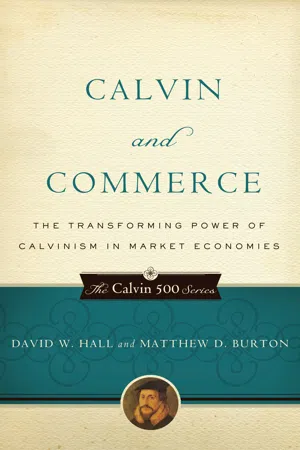
This fifth Calvin 500 volume analyzes the impact of Calvin's ideas on business, economics, finance, and industry—and shows how Calvinism leads to strengths and advantages in market economies.
eBook - ePub
Calvin and Commerce
The Transforming Power of Calvinism in Market Economies
- English
- ePUB (mobile friendly)
- Available on iOS & Android
eBook - ePub
Calvin and Commerce
The Transforming Power of Calvinism in Market Economies
About this book
Information
Topic
Theology & ReligionSubtopic
Biblical Studies1
Creation

To commence, any proper understanding of Calvin on the subjects of money, wealth, and business must accept that these are all created entities. The Swiss Reformer knew that God was more important than material wealth, and Calvin’s advice can serve to steer investors, entrepreneurs, and stewards in any century away from a chilling materialism. Money is—and ever will be—a creation; as such it should not be worshiped, overemphasized, or ignored. Like the creation itself, it has a place and is useful. However, outside of that designed space, Calvin warned that it can become an idol.
Calvin was clear that Mammon was not to be served. In his commentary on Matthew 6:24, he explained the dilemma well: “Where riches hold the dominion of the heart, God has lost his authority. True, it is not impossible that those who are rich shall serve God; but whoever gives himself up as a slave to riches must abandon the service of God; for covetousness makes us slaves of the devil.”1
In earlier comments on the same chapter from Matthew he perceptively described how the devil plagued many with the worship of wealth:
Men are grown mad with an insatiable desire of gain. Christ charges them with folly, in collecting wealth with great care, and then giving up their happiness to moths and to rust. . . . What is more unreasonable than to place their property, where it may perish of itself or be carried off by men? Covetous men, indeed, take no thought of this. They lock up their riches in well-secured chests, but cannot prevent them from being exposed to thieves or to moths. They are blind and destitute of sound judgment, who give themselves so much toil and uneasiness in amassing wealth . . . particularly, when God allows us a place in heaven for laying up a treasure and kindly invites us to enjoy riches which never perish.2
Instead of entangling oneself in this world’s snares, Calvin commended the alternative of making it one’s “business to meditate on the heavenly life,” a theme that would be repeated throughout his work. He warned that if money becomes the chief good, “covetousness will immediately predominate.”3 Calvin knew—in ways that might be shocking to those who only refract Calvin’s thought through the lens of Max Weber4 or other hostile critics—that “if we were honestly and firmly convinced that our happiness is in heaven, it would be easy for us to trample upon the world, to despise earthly blessings, and to rise towards heaven.”5 He was emphatic that, while wealth has a place as a created blessing, it should never be confused with the Creator.
Moreover, his explanation of the law often echoed this teaching. Commenting on the first commandment, Calvin called for exclusivity of allegiance to God. If one is subtly tempted to put the acquisition of wealth above God, he is reminded that God is a jealous God who will not tolerate co-allegiance to God and Mammon. Later, in reference to the eighth commandment, Calvin warned against lusts that could lead to a variety of frauds. Since Calvin so strongly supported the holding of private property (which is implicit in that commandment), he also opposed any wrongful taking or seizing of others’ property, insofar as such misappropriations are normally motivated by greed, which is itself a form of idolatry (Col. 3:5).
In similar comments on the tenth commandment, Calvin advised against setting our hearts on others’ property or seeking “gain at another’s loss and inconvenience.”6 Not only was greed condemned in this commandment, but Calvin perceived that through it God sought to “put a restraint on evil desires before they prevail.”7 He compared coveting and other temptations to “so many fans” that swirled human passions even higher. Perched at an early stage of modern economic development, Calvin certainly knew that wealth has its snares if one’s inward dispositions are not rightly ordered.
Calvin’s comments on the rich young ruler in Luke 18 reflect the same principle. It is not enough merely to divest oneself of riches (“he who deprives others, along with himself, of the use of money, deserves no praise”); one should also use wealth for the glory of God and love of neighbor. Calvin observed on this passage that to “renounce riches is not in itself virtuous, but rather an empty ambition.” Referring to Crates the Theban from secular history, Calvin further noted that the rich young ruler was called to aid others with his income as an act of love: “And so Christ is recommending him not to simply sell but to be liberal in helping the poor.”8
Calvin believed that Christ was teaching his listeners not to worship money or riches. He stated that this teaching warns both rich and poor to trust in God—the rich being warned of their danger, the poor being called to be satisfied with their lot—so that each can serve God. While Calvin realized that riches themselves do not preclude obedience to God, he perceived that, in view of mankind’s incurable depravity, it is rare for those with abundance to avoid becoming intoxicated by riches.9
Calvin realized from his careful reading of Scripture that God does not want humans to worship wealth or any aspect of it. He has given humans the capacity to use wealth, but if the ever-present idol-factory of the human mind confuses Creator with creation, it inevitably leads to disaster. As he reflected upon the opening chapters of the Bible, Calvin noted a categorical distinction between the Creator, who is ever blest, and all other created things. In terms of economic matters or management, the Lord assigned persons a stewardship to care, first, for the garden, and then, by extension, for all of creation. It is noteworthy that this assignment came to man10 in his native, pre-fall state, and thus has no part of the curse in it. It was, in other words, a positive good for man to care for many aspects of creation—animals, the garden, others, and wealth.
But the design of God is not to have money worshiped or served. No one, as Jesus would later say, can serve two masters. One either serves money as a creator or uses money to serve the Creator; these two purposes are mutually exclusive. Calvin understood the difference, and his disciples put that economic faith into practice in many sectors.
While it is too much to claim that Calvin produced the principles of wealth development de novo, it is historically true that such development seemed uncannily to happen wherever Calvinists went for several centuries after the Reformer’s death. Secularists might try to explain that phenomenon away, but we prefer to understand why and how Calvinism fostered the kind of business culture that it did.
Calvin and his business disciples knew that the Old Testament (hereafter, OT) was replete with wisdom on the subject of wealth. The book of Proverbs, for example, has much to say on this subject. To begin with, it teaches that the Lord may give wealth but that to acquire wealth by illegal means is sinful. Moreover, some riches will sour. “Ill-gotten treasures,” wrote Solomon, are “of no value” (Prov. 10:2); however, “diligent hands bring wealth” (Prov. 10:4). The earnings of the righteous aid their life (Prov. 10:16), and “the blessing of the Lord brings wealth, and he adds no trouble to it” (Prov. 10:22). One may even be ruthless and gain wealth; however, ruthlessness is contrasted with virtues like kindheartedness (Prov. 11:16). Hoarding is also condemned (Prov. 11:26), and giving to others can lead to greater gain, refreshment, and blessings (Prov. 11:24–26).
Puritan descendants of Calvin noted the advice on work and business planning contained in Proverbs 12:11, which advocates the working of one’s land instead of chasing fantasies or speculation. Proverbs 13 also warns against pretentiousness (v. 7) and issues a caveat about being owned by one’s own riches or possessions (v. 8). Moreover, some income can come with a hangman’s noose around it (Prov. 15:6). Calvinistic business practices would assimilate these teachings into a distinct corporate culture.
Readers of this OT wisdom also learn that dishonest gain has a way of dwindling away, while a gradual accumulation of wealth normally makes those assets grow more (Prov. 13:11). Prosperity can be a reward to those who serve God well (Prov. 13:21), and even a poor man, if he works the ground that is given him, may “produce abundant food” (Prov. 13:23). It is a sign of a man’s goodness to “leave an inheritance for his grandchildren” (Prov. 13:22), but according to the contrast in the second half of that verse “a sinner’s wealth is stored up for the righteous.” The distribution of providence is one thing and it continues. Houses and wealth are inherited from the Lord (Prov. 19:14). Calvin and his disciples took these biblical truisms and applied them to the evolving business and economic practices of their day.
Again, one can identify the profit assumption of the Calvinistic business ethic in Proverbs 14:23–24, which promises that all useful work brings some kind of profit. In contrast, mere discussion or even elaborate planning devoid of action and work “leads to poverty” (Prov. 14:23). Wealth may even provide a protective buffer or a cause for societal admiration, while the folly of laziness and nonproductive behavior “yields folly” (Prov. 14:23).
Calvin also understood that oppressing the poor to increase one’s own wealth is morally wrong (Prov. 22:16) and that one should not exhaust oneself in the pursuit of riches (Prov. 23:4–5). In fact, the allure of riches should be avoided. In other words, one should take care of wealth but not fall in love with it. For, as we read in Proverbs 27:24, “riches do not endure forever, and a crown is not secure for all generations.” Also, one should avoid wearing oneself out to obtain status or fame that the Lord has not designed to give. Embracing these principles has led many nations and families to lasting wealth. God’s Word, Calvin knew, has much to say to us on this topic. In summary, the application of OT wisdom supplies the following business premises:
- Ill-gotten treasures are of no value.
- Wealth per se is not condemned.
- Wealth has a limited long-range advantage, but it should not be idolized.
- Wealth does not endure.
- Godly obedience or righteousness is more valuable than the acquisition of riches.
When one compares Jesus’ teaching in Matthew 6 (which warns us not to store up corruptible treasures) both with the OT wisdom on wealth and with even a few of Calvin’s comments, a harmonious chorus of voices can be heard.
Furthermore, all these voices affirm that wealth is given by God and can be used very productively to enhance his created order. Again, the distinction between the right and the wrong use of wealth is what makes the difference for Calvin, who surely could recount better than most of the numerous wealthy people recorded in the Bible who never received a rebuke from God for owning and accumulating assets. Among them are:
• Abraham, whose possessions are noted in Genesis 12:5 and who, according to Genesis 14:14, had over three hundred trained men born in his household. He must have had quite a business to have 318 trained soldiers (and most likely their families as well). This was a wealthy man.
• Joseph, who later rose to a position of great importance and wealth in ancient Egypt. He served God through economic acquisition and management.
• Solomon, who, of course, was the wealthiest person in the world of his time.
• Nicodemus and Joseph of Arimathea, both of whom became followers of Christ.
• Mary and Martha, who, according to the book of Acts, used their large home for church meetings.
• Barnabas, an unsung hero of the New Testament, who donated family lands to the cause of the gospel.
Like the OT, the New Testament (hereafter, NT) warns against love for money as a many-pronged root of evil (1 Tim. 6:10). Even so, as one surveys either the Scriptures or the works of Calvin, one can clearly see that wealth is presented as a providential creation from God. It may also become (either immediately or gradually) a means by which God tests the allegiance of a person’s heart. Materialism, in contrast to Calvinism, fails to recognize the proper relationship between wealth, a creation, and God, the Creator.
God may bless a person with wealth or he may choose not to do so. If an individual is so blessed, then along with the blessing comes the call to share generously and to work for the glory of God rather than selfish ambition. Therefore, wealth summons a spirit of servitude to the Lord and stewardship of his gifts in order to glorify God. Furthermore, misuses of wealth can reflect insufficient theological or moral values. If one exclusively strives to save and never to enjoy, then he is not embracing the call to glorify God through spending. Similarly, individuals who are consumed by debt and continually live beyond their means demonstrate a lack of stewardship and responsibility. Both of these patterns represent an imbalance in one’s attitude toward affluence. Calvin’s view of wealth, giving, and affluence determines how persons live in economic settings. This is a matter not of abstract theology but of pastoral theology with macroeconomic content.
While wealth is to be shown proper respect and treated according to God’s calling, it is never to be worshiped or treated as divine. Instead it is designed to be used as a tool for the glory of God and the betterment of man. Thus, money, wealth, or finance is always a tool—always a creation, never the Creator—and it is useful for the ends that God designed. The wise steward will seek to keep wealth in its place—never becoming mesmerized by its allure but always using it to serve God, his creation, our families, and society. Wealth is not eternal; neither is it an automatic identifier of the blessing of God. The Lord gives and he takes away. Wealth can be destroyed just as easily as it is created.
In his commentary on the book of Genesis, Calvin asserted that prior to creation there was only emptiness and formlessness. Accordingly, “...
Table of contents
- Cover Page
- Title Page
- Copyright Page
- Contents
- Preface
- Introduction
- 1 Creation
- 2 Fall
- 3 Redemption
- 4 Philanthropy
- 5 Sanctification and Service
- 6 Eschatology
Trusted by 375,005 students
Access to over 1.5 million titles for a fair monthly price.
Study more efficiently using our study tools.
Frequently asked questions
Yes, you can cancel anytime from the Subscription tab in your account settings on the Perlego website. Your subscription will stay active until the end of your current billing period. Learn how to cancel your subscription
No, books cannot be downloaded as external files, such as PDFs, for use outside of Perlego. However, you can download books within the Perlego app for offline reading on mobile or tablet. Learn how to download books offline
Perlego offers two plans: Essential and Complete
- Essential is ideal for learners and professionals who enjoy exploring a wide range of subjects. Access the Essential Library with 800,000+ trusted titles and best-sellers across business, personal growth, and the humanities. Includes unlimited reading time and Standard Read Aloud voice.
- Complete: Perfect for advanced learners and researchers needing full, unrestricted access. Unlock 1.5M+ books across hundreds of subjects, including academic and specialized titles. The Complete Plan also includes advanced features like Premium Read Aloud and Research Assistant.
We are an online textbook subscription service, where you can get access to an entire online library for less than the price of a single book per month. With over 1.5 million books across 990+ topics, we’ve got you covered! Learn about our mission
Look out for the read-aloud symbol on your next book to see if you can listen to it. The read-aloud tool reads text aloud for you, highlighting the text as it is being read. You can pause it, speed it up and slow it down. Learn more about Read Aloud
Yes! You can use the Perlego app on both iOS and Android devices to read anytime, anywhere — even offline. Perfect for commutes or when you’re on the go.
Please note we cannot support devices running on iOS 13 and Android 7 or earlier. Learn more about using the app
Please note we cannot support devices running on iOS 13 and Android 7 or earlier. Learn more about using the app
Yes, you can access Calvin and Commerce by David W. Hall,Matthew D. Burton in PDF and/or ePUB format, as well as other popular books in Theology & Religion & Biblical Studies. We have over 1.5 million books available in our catalogue for you to explore.