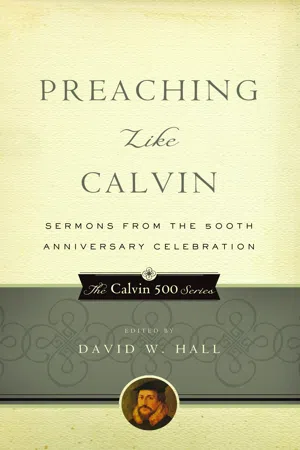
This book presents the sermons of sixteen preeminent Reformed pastors of our day who preached in St. Pierre's to commemorate John Calvin's towering legacy to the church.
- English
- ePUB (mobile friendly)
- Available on iOS & Android
eBook - ePub
About this book
Information
Topic
Theology & ReligionSubtopic
Christian Ministry1
REFORMATION, CALVINISM, AND LESSONS LEARNED—NEHEMIAH 8:I–4A AND 9:1–3, 16–21
DAVID W. HALL
Ann and I have been privileged to watch the unfolding, the maturing, and the cultivation of Calvin500. As we met last Sunday (July 5, 2009) for worship, we were in the church—that dates to the 12th century—in Calvin’s Geneva, and for the week we heard several dozen presentations by Calvin scholars and enjoyed fifteen of the finest expositions of Scripture in St. Pierre Cathedral over a five-day conference. I wish to thank the church for the privilege of allowing me to be involved and for your support. It was a high point for us to hear the echoes of psalms bouncing off the same walls, using some of the same tunes, prayers, concepts, and creeds as our forefathers did. We were blessed by being surrounded by a great cloud of witnesses, who, at times, seemed very close.
Bob Godfrey spoke of Calvin’s “cherished text,” finding that Calvin often referred to John 17:3: “For this is eternal life: to know the only true God,” which later became the motto of Harvard College. A humble Archbishop of Uganda mounted the stairs to the pulpit, only after making a sincere protest because he was awed by following Calvin, and brought us a bold message. Phil Ryken preached on the always-open door for the gospel.
Geoff Thomas, a Reformed Baptist, summed up the simplicity of predestination in a few questions between a pastor and a member:
Pastor: How are you saved? Parishoner: By God’s grace.
Pastor: Did God save you or did you save yourself? Parishoner: God did.
Pastor: Did he do so on purpose or by accident?
Pastor: Did God save you or did you save yourself? Parishoner: God did.
Pastor: Did he do so on purpose or by accident?
Sinclair Ferguson called us to relate all things to Christ alone. And Ted Donnelly, from Northern Ireland, challenged us to live out Romans 8:35–39, even while not in luxury hotels as on a tour, but as with five young martyrs who were killed at Lyon at the hands of Roman Catholic persecutors in the 1550s, while Calvin tried to console them. They, like we, sang psalms to one another and summoned each other to heroic courage.
We heard many great quotes and illustrations at the conference, which is the major preaching conference for this commemorative cycle. Outstanding studies were presented, and much fellowship was renewed. Importantly, these messages provide a current apology for the vitality of Calvinism, and they are exemplars to modern audiences of what living Calvinism looks like and sounds like today.
One of the painful lessons, however, is to observe how Calvin’s church—once bustling, burgeoning, and exporting the faith—is now often marginalized in its own city and in the world. Surrounded by obvious signs of modernity, hedonism, and unbelief, most of us questioned: what happened to the faith that once changed the world? How could it shrink, vanish, or succumb to the spirit of the age? Of course, we also ask—and to some degree, each of these sermons asked—how can we avoid that same fate? Also we ask: is it right to look back?
A Renewal or Reformation from Time to Time Is Necessary
In Nehemiah’s time, there was a return to faith—a vital revival and reformation. The three primary features of it were: return to the Word, repentance from and recognition of sin, and refocus of priorities.
Calvin found and highlighted the same features. As I share my comments with you today, I want to begin and end with the book of Nehemiah—bookending some of my other thoughts.
I would hope that a celebration of a past event would stimulate folks to return faithfully to their faith and live it out. They may have to change some things, as in Nehemiah’s time, and they may have to rebuild. But that is better than spinning farther and farther away from the truth.
That is, after all, the reason to have a commemoration: to call folks back to the strong and living aspects of a tradition. No tradition should be perpetuated if it is not thoroughly biblical and helpful. We should not, in these events, focus on the outward or glorify previous human beings. We should take their faith, their thought, their moral examples and benefit from those. Notwithstanding, we ought not to worship any ancestor, even a hero like Calvin. We should seek to learn from him and his disciples to the degree that they imitate Christ.
In this Old Testament example, we see: a strong decline, a rebuilding that follows that decline, and light that follows darkness.
The Heart of Calvinism Can Bring These: Three Points of Calvinism
If we expect Calvinism to endure and bring other reformations like the one in Nehemiah’s time, we should make sure we know what we are talking about. For simplicity’s sake, and rather than using the customary five points, I shall summarize Calvinism under three points that should be taught in the home, the church, and the school. The other sermons herein form a collage of how Calvinism may be rightly understood.
The Glory and Sovereignty of God
From the Institutes’ beginning preface, John Calvin portrayed the human condition as “naked of all virtue,” enslaved, blind, and weak. The purpose of this depiction was to preclude all occasion for self-glorying and give all glory to God. Human beings, thought Calvin, should be stripped of “vainglory” to “learn to glory in the Lord.”
Five centuries after Calvin’s birth, John Piper suggests that a fitting symbolic banner over Calvin’s work could be: Zeal to Illustrate the Glory of God. Whether in life or on his deathbed, Calvin professed to propound only “what I esteemed to be for the glory of God.” At the 500th anniversary of Calvin’s birth, Calvinism’s essence is tied to “passion for the absolute reality and majesty of God.”
Also, at Calvin’s 400th anniversary Princeton giant Benjamin Warfield summarized: “No man ever had a profounder sense of God than [Calvin].” Whether it is “this relentless orientation on the glory of God” (Piper), or the “all-embracing slogan of the Reformed faith: the work of grace in the sinner as a mirror for the glory of God” (Vos), or Calvin’s own words, the glory of God distills the meaning of Calvin’s message.
Warfield summarized: “The Calvinist is the man who has seen God, and who, having seen God in his glory, is filled on the one hand, with a sense of his own unworthiness to stand in God’s sight as a creature, and much more as a sinner, and on the other hand, with adoring wonder that nevertheless this God is a God who receives sinners.”
Calvin described this world as theatrum Gloriae. For him, every aspect of life from work to worship and from art1 to technology bore the potential to glorify God. Creation is depicted as a platform for God’s glory2 or a “dazzling theater,”3 displaying God’s glorious works. Such comments support Lloyd-Jones’ later claim that for Calvin “the great central and all-important truth was the sovereignty of God and God’s glory.”
British evangelical James I. Packer concurs that Calvin’s Christianity rested on a vision of God enthroned and reigning majestically: “How often Calvin used the words ‘majesty’ and ‘glory’! How often he dilates on the greatness of God! The passion corresponded to the vision. It was the passion expressed in that great phrase which has become the slogan of Calvinism—soli Deo gloria!”
If the glory and sovereignty of God is the first note of Calvinism, the second enduring hallmark of Calvinism is the fall of man.
The Fall of Man
Calvinism, if it is to resemble Nehemiah’s reform, will manifest a stubborn realism and retain limited expectations. We expect neither the world nor ourselves to be perfect; we are not utopian. And the better Calvinists quickly learn that this applies to our own inner lives as well; for every morning, the first visage we see in the mirror is one of depravity. This is not something that we will outgrow nor end with an educational remedy. If we jettison the doctrine of sin, along with its necessary remediation only by Christ, we will not serve to reform or aid those around us.
Calvin’s doctrine was a bracing tonic for the accumulated arrogance of the day, complete with its opulence and outer success. The Renaissance hubris would fall, however, like the subprime mortgage market in 2008. Calvin’s faith in God, not man, filled that gap. The fallenness of human nature continues to exemplify Calvinism in all ages.
The third signature of Calvinism is calling to the world.
Calling to the World
All vocations can give glory to God. All walks of life can be noble, helpful, and God-oriented. The clergy have no corner on the marketplace, and many who are not ministers are and have been used for great things.
Vocation and daily work are good. Calvinism calls us out of the cloister, far from the hiddenness of the monastic life, and into the world with the shining, powerful message of God.
These make Calvinism different from every other religious scheme. And this is the faith that is spreading.
The Spread of Calvinism and Why It Doesn’t Die
This week I wondered: do you think John Calvin might be surprised five centuries after his birth to find three men of African descent in his pulpit or to find more Calvinists in the Southern Baptist Convention than in the Presbyterian Church in America? It was sheer joy to note the participation by the many brothers and sisters below.
• Several of the “guardians” (deaconal assistants) at St. Pierre Cathedral were Turkish-Kurds, having come to the faith.
• Koreans and Chinese populated Geneva and may be the leading visitors to this area.
• The largest seating capacity for a sanctuary of any Reformed church (seating five thousand) is in the heart of downtown Jakarta, Indonesia, pastored by a Chinese Calvinist, Dr. Stephen Tong.
• Chinese Calvinism is growing, and may prove to be one of the most exciting stories of our century.
• Africans blessed us, with the sermon by a most humble Archbishop (of Uganda) Henry Orombi, with his assistant, Onesimus Asiimwe. On another occasion, the Rev. Dr. Setri Nyomi (of Ghana), the president of the World Alliance of Reformed Churches, welcomed us as brothers and sisters.
• Our church supports a strong Calvinist, the Rev. Jean Paul in Haiti with Reformation Hope International. He knows the hope for Haiti is the Reformed faith.
• We met Dr. Peter Vimalasekaran, originally from Northern Ireland, but who is leading a German Gypsy ministry in Fribourg.
• Sebastian Heck, from our presbytery and a former intern at Grace Presbyterian in Douglasville, Georgia, is replanting a Reformed denomination in Heidelberg, Germany.
Conferences on Calvin this year were held in unlikely places such as Rome, Italy; St. Petersburg, Russia; Prague; South Africa; Toronto; and Boston. Others met in Holland, France, New Zealand, Australia, and South Carolina and California.
Dr. Michael Milton of Reformed Theological Seminary (Charlotte, NC) calls this “Global Calvinism” because it is catholic/ biblical Calvinism. And that Calvinism is spreading.
How Living Calvinism Is Expanding Today
Who would have imagined the following news stories in the first half of this year?
• The third most potent idea in a CNN/Time poll in April 2009 was “New Calvinism.”
• More books have been published on Calvin this year than in any other previous year. For example, Calvin500.com has released a CD that contains 97 volumes of Calvin materials.
• University campuses, especially in the East, are cropping up with independent young scholars who dare to question tradition, and in so doing find that Calvinism is one o...
Table of contents
- Cover Page
- Title Page
- Copyright Page
- Contents
- Editor’s Note: David W. Hall
- Foreword: Eric J. Alexander
- Abbreviations
- 1. Reformation, Calvinism, and Lessons Learned—Nehemiah 8:1–4a and 9:1–3, 16–21
- 2. In Christ Alone—Philippians 3:8–12
- 3. Who Is the Wise and Faithful Servant?—Matthew 24:45–51
- 4. In Praise of Predestination—Ephesians 1:3–6
- 5. A Great Door for Spreading the Gospel—1 Corinthians 16:5–9
- 6. All the Glorious Offices of Christ—1 Corinthians 1:29–31
- 7. Calvin’s Cherished Text—John 17:3
- 8. John Calvin and Guarding the Gospel—Galatians 1:6–10
- 9. Three Great Intercessions—Romans 8:26–34
- 10. The Christian Life—Philippians 2:12–13
- 11. God’s Sovereign Election—Ephesians 1:3–14
- 12. Cherishing the Church—Matthew 16:18b
- 13. John Calvin and Psalm 110: The Psalm for Yesterday and Today—Psalm 110
- 14. More Than Conquerors—Romans 8:35–39
- 15. One of a Thousand—Job 36:1–4
- 16. Bowing before the Majesty of God—Romans 11:33–36
- Index of Scripture
- Index of Subjects and Names
- Contributors
Trusted by 375,005 students
Access to over 1.5 million titles for a fair monthly price.
Study more efficiently using our study tools.
Frequently asked questions
Yes, you can cancel anytime from the Subscription tab in your account settings on the Perlego website. Your subscription will stay active until the end of your current billing period. Learn how to cancel your subscription
No, books cannot be downloaded as external files, such as PDFs, for use outside of Perlego. However, you can download books within the Perlego app for offline reading on mobile or tablet. Learn how to download books offline
Perlego offers two plans: Essential and Complete
- Essential is ideal for learners and professionals who enjoy exploring a wide range of subjects. Access the Essential Library with 800,000+ trusted titles and best-sellers across business, personal growth, and the humanities. Includes unlimited reading time and Standard Read Aloud voice.
- Complete: Perfect for advanced learners and researchers needing full, unrestricted access. Unlock 1.5M+ books across hundreds of subjects, including academic and specialized titles. The Complete Plan also includes advanced features like Premium Read Aloud and Research Assistant.
We are an online textbook subscription service, where you can get access to an entire online library for less than the price of a single book per month. With over 1.5 million books across 990+ topics, we’ve got you covered! Learn about our mission
Look out for the read-aloud symbol on your next book to see if you can listen to it. The read-aloud tool reads text aloud for you, highlighting the text as it is being read. You can pause it, speed it up and slow it down. Learn more about Read Aloud
Yes! You can use the Perlego app on both iOS and Android devices to read anytime, anywhere — even offline. Perfect for commutes or when you’re on the go.
Please note we cannot support devices running on iOS 13 and Android 7 or earlier. Learn more about using the app
Please note we cannot support devices running on iOS 13 and Android 7 or earlier. Learn more about using the app
Yes, you can access Preaching Like Calvin by David W. Hall in PDF and/or ePUB format, as well as other popular books in Theology & Religion & Christian Ministry. We have over 1.5 million books available in our catalogue for you to explore.