This book seeks durable solutions for tax crime and is a great resource for the development of knowledge, policy and law on tax crime. The book uniquely blends current practice with new approaches to countering tax crime. With insights from the EU-funded project, PROTAX, which conducts advanced research on tax crimes, the book comparatively analyses the EU's tax crime measures and the Ten Global Principles (TGPs) on fighting tax crime by the Organisation for Economic Cooperation and Development (OECD).
The study critically examines how the TGPs can serve as minimum standards for the EU to counter tax crime such as tax evasion and tax fraud. The study also analyses how the anti-tax avoidance package can be graduated to fight tax crime in the EU. When escalated, the strengths of the EU tax crime measures and TGPs can form a fortress in which criminal law can be empowered to mitigate tax crimes with greater effect.
The book will be particularly useful for end-user stakeholders such as tax policy makers, LEAs, professional enablers as well as academics and students interested in productive interaction between tax, criminal and administrative laws.
eBook - ePub
Countering Tax Crime in the European Union
Benchmarking the OECD’s Ten Global Principles
- 336 pages
- English
- ePUB (mobile friendly)
- Available on iOS & Android
eBook - ePub
Countering Tax Crime in the European Union
Benchmarking the OECD’s Ten Global Principles
About this book
Information
1
Introduction
Tax offenders can evade reality but they cannot evade the consequences of evading reality.1 The legal framework against tax crimes such as tax fraud and tax evasion, that paints this reality, must make tax criminals face the full rigour of the law.
Background
Markets and finances have become more globalised than ever. Countries across the world continue to increase their appetite for gaining a useful foothold against criminal exploitation of the increasing complexities associated with their interconnected systems and interests in the global marketplace. One of the critical areas of mutual concern and interest among jurisdictions is the complex disposition of tax crimes – including tax fraud, tax evasion and related financial crimes such as money laundering and fiscal corruption.
Indeed, tax crimes have notoriously taken an aversive international dimension, yet they continue to have national relevance since they are committed within the jurisdiction of states. With the international dimension, taxpayers leverage international opportunities to commit tax crimes in the national jurisdictions that provide the launching path opportunities. With the local dimension, resident taxpayers (both natural and legal persons) exploit the weaknesses in the law formulation and enforcement architecture to commit tax crimes, hoping that the long arm of the law will not catch them.
Essentially, tax criminals adeptly exploit loopholes and weaknesses (eg, the lack of a common definition of tax crimes) in local and international systems to commit tax crimes. As the loopholes are being closed and weaknesses are being addressed, tax criminals develop more sophisticated methods to override the efficacy of tax law enactment and enforcement strategies. These have serious social and economic consequences such as widening inequality and inadequate revenue for much-needed public services and socioeconomic development projects. Because of the huge adverse socioeconomic implications of tax crimes, it has become obvious that the search for remedies thereof must continue unabated.
The fight against tax crimes must use more sophisticated strategies, which are based on tenets such as effective and resilient principles, standards and enforcement mechanisms. These must stand the test of time and effectively counter the vagaries of sophistication of tax criminals. For instance, by virtue of the global and local disposition of tax crimes, there is the need for stronger inter-agency collaboration and cooperation – both domestically and internationally- in fighting tax crimes.
EU Member States appear to be individually demonstrating the desire, even if with unsettled political will, to take effective measures in countering tax crimes. Collectively too, under the umbrella of the OECD and the EU and as part of bilateral and multilateral cooperation, measures are being designed and implemented to counter tax crimes. For instance, the publication, in 2017, of the OECD’s Ten Global Principles (TGPs) for fighting tax crimes, with a claim to be global in nature, is a good example of such collective initiatives.
The TGPs were designed to be representative of essential international principles that could be effectively used to combat tax crimes. These principles, imbued with the strategic inputs from over 200 countries, do address pertinent concerns ranging from legal, administrative, institutional to operational areas that are germane to establishing a system that is, at least, efficient, in countering tax crimes. The disposition of the principles is designed in a way that gives space or opportunity for different countries to ‘benchmark their legal and operational framework and identify areas where improvements can be made’.2
The TGPs are situated within the framework of ‘a whole of government approach to fighting tax crimes’.3 It is premised on the understanding that tax crimes are dynamic, and criminals easily adapt themselves to generously benefit from any financial opportunities. Leveraging every available benefit any tax crimes can chance on, tax criminals also, all the more, usually outpace the legislative and enforcement modifications that have been put in place by the state machinery to effectively prevent, detect and prosecute these crimes. It is due deliberation to establish this framework that brought out the TGPs on countering tax crimes, which have three-layered purposes:
(i)to allow countries to be able to benchmark their legal and operational framework so as to identify tax practices that are deemed successful for the improvement of relevant systems in the areas that are essential ‘for an effective system to fight tax crimes’;
(ii)to allow progress of countries to be measured ‘through regular updates’; and
(iii)to allow countries to ‘articulate their needs for training’ or capacity-building on fighting tax crimes.4
The TGPs have established 10 global principles, covering the legal, strategic, administrative and operational aspects of addressing tax crimes.5 The TGPs include criminalisation of tax offences, effective strategies against tax crimes, adequate and effective resources and powers for LEAs, inter-agency and international cooperation, organisational structure with defined responsibilities, classification of tax crimes as predicate offences for money laundering as well as protection of fundamental rights of tax offenders.6 With their crosscutting and complementary nature, the TGPs can, at least, serve as a ‘minimum standard’ to finding durable solutions for tax crimes, internationally.
These set of principles, if implemented and practised accordingly, can act as a strong lever for success. This is partly because the OECD has made provision for the continuous improvement of the principles through a framework of broadening jurisdictional and institutional participation in the OECD forum on tax and crime (FTC).7 The FTC also fosters efforts towards developing more tools for countering tax crimes and money laundering.8
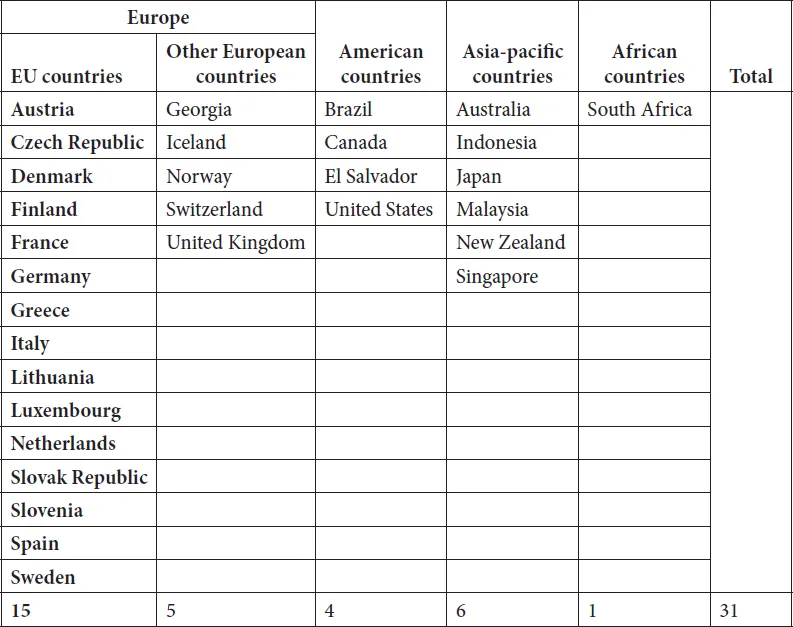
The OECD Task Force on Tax Crimes and other Crimes (TFTC),9 which prepared the TGPs, is expected to take stock of the TGPs in collaboration with the FTC10 and other partners. The TGPs have drawn on the experience of TFTC’s members and additional survey data provided by the 31 jurisdictions in Table 1.
Table 1 Countries surveyed by OECD to draw on for the TGPs11
Although the TGPs could become popular amongst OECD countries and their associates, the extent to which tax crime measures of various countries in the EU are effectively harmonious with the TGPs is unclear. This requires a critical analysis to determine:
i.if and to what extent the OECD countries are integrating the minimum standards of fighting tax crimes into the legal framework of their jurisdictions; and
ii.which robust pathways can effectively and sustainably counter the menace of tax crimes in OECD countries.
Meanwhile, as it were, in the archetypical legal framework of the European Union (EU), several tax crime counter-measures have been developed for its members, many of which are also members of the OECD.12 These measures include legal approaches to countering tax crimes in the EU. The EU Directives designed to harmonise the anti-money laundering regulations and anti-tax avoidance practices are typical of the legal approaches adopted by the EU.
In fact, in the past decade or so, there has been a degree of intensification in designing and developing policy, legislative and administrative initiatives that are geared towards fighting tax crimes in Europe. It is within the competence of the EU to facilitate cooperation and exchange of information among its Member States on diverse taxes, especially savings taxation and VAT.13 In this regard, tax authorities of EU Member States are being given the legal tools to collaborate in the exchange of information on matters relating to tax crimes. This is achieved through legal instruments such as the Directive on Administrative Cooperation (DAC) (2011/16/EU) regarding direct taxation,14 Anti-Tax Avoidance Directive (EU) 2016/1164 to protect the performance of the internal market,15 and Council Directive 2006/112/EC on VAT.16
Apart from utilising the legislative competences, the EU has also establish...
Table of contents
- Cover
- Title Page
- Acknowledgements
- Contents
- List of Abbreviations
- List of Figures
- List of Tables
- Table of Cases
- Table of Legislation
- 1. Introduction
- 2. Defining Tax Crimes in the OECD and the EU
- 3. Substantive Principles
- 4. Structural/Procedural Principles
- 5. Relationship between Criminal and Administrative Mechanisms
- 6. Other Components of the Tax Crime Ecosystem
- 7. Conclusion and Recommendations
- Bibliography
- Index
- Copyright Page
Trusted by 375,005 students
Access to over 1.5 million titles for a fair monthly price.
Study more efficiently using our study tools.
Frequently asked questions
Yes, you can cancel anytime from the Subscription tab in your account settings on the Perlego website. Your subscription will stay active until the end of your current billing period. Learn how to cancel your subscription
No, books cannot be downloaded as external files, such as PDFs, for use outside of Perlego. However, you can download books within the Perlego app for offline reading on mobile or tablet. Learn how to download books offline
Perlego offers two plans: Essential and Complete
- Essential is ideal for learners and professionals who enjoy exploring a wide range of subjects. Access the Essential Library with 800,000+ trusted titles and best-sellers across business, personal growth, and the humanities. Includes unlimited reading time and Standard Read Aloud voice.
- Complete: Perfect for advanced learners and researchers needing full, unrestricted access. Unlock 1.5M+ books across hundreds of subjects, including academic and specialized titles. The Complete Plan also includes advanced features like Premium Read Aloud and Research Assistant.
We are an online textbook subscription service, where you can get access to an entire online library for less than the price of a single book per month. With over 1.5 million books across 990+ topics, we’ve got you covered! Learn about our mission
Look out for the read-aloud symbol on your next book to see if you can listen to it. The read-aloud tool reads text aloud for you, highlighting the text as it is being read. You can pause it, speed it up and slow it down. Learn more about Read Aloud
Yes! You can use the Perlego app on both iOS and Android devices to read anytime, anywhere — even offline. Perfect for commutes or when you’re on the go.
Please note we cannot support devices running on iOS 13 and Android 7 or earlier. Learn more about using the app
Please note we cannot support devices running on iOS 13 and Android 7 or earlier. Learn more about using the app
Yes, you can access Countering Tax Crime in the European Union by Umut Turksen in PDF and/or ePUB format, as well as other popular books in Law & Criminal Law. We have over 1.5 million books available in our catalogue for you to explore.