“Riveting...A great read, full of colorful characters and outrageous confrontations back when the west was still wild.” —George R.R. Martin
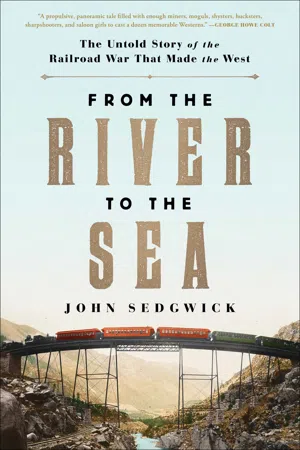
A propulsive and panoramic history of one of the most dramatic stories never told—the greatest railroad war of all time, fought by the daring leaders of the Santa Fe and the Rio Grande to seize, control, and create the American West.
It is difficult to imagine now, but for all its gorgeous scenery, the American West might have been barren tundra as far as most Americans knew well into the 19th century. While the West was advertised as a paradise on earth to citizens in the East and Midwest, many believed the journey too hazardous to be worthwhile—until 1869, when the first transcontinental railroad changed the face of transportation.
Railroad companies soon became the rulers of western expansion, choosing routes, creating brand-new railroad towns, and building up remote settlements like Santa Fe, Albuquerque, San Diego, and El Paso into proper cities. But thinning federal grants left the routes incomplete, an opportunity that two brash new railroad men, armed with private investments and determination to build an empire across the Southwest clear to the Pacific, soon seized, leading to the greatest railroad war in American history.
In From the River to the Sea, bestselling author John Sedgwick recounts, in vivid and thrilling detail, the decade-long fight between General William J. Palmer, the Civil War hero leading the “little family” of his Rio Grande, and William Barstow Strong, the hard-nosed manager of the corporate-minded Santa Fe. What begins as an accidental rivalry when the two lines cross in Colorado soon evolves into an all-out battle as each man tries to outdo the other—claiming exclusive routes through mountains, narrow passes, and the richest silver mines in the world; enlisting private armies to protect their land and lawyers to find loopholes; dispatching spies to gain information; and even using the power of the press and incurring the wrath of the God-like Robber Baron Jay Gould—to emerge victorious. By the end of the century, one man will fade into anonymity and disgrace. The other will achieve unparalleled success—and in the process, transform a sleepy backwater of thirty thousand called “Los Angeles” into a booming metropolis that will forever change the United States.
Filled with colorful characters and high drama, told at the speed of a locomotive, From the River to the Sea is an unforgettable piece of American history “that seems to demand a big-screen treatment” (The New Yorker).
Frequently asked questions
Yes, you can cancel anytime from the Subscription tab in your account settings on the Perlego website. Your subscription will stay active until the end of your current billing period. Learn how to cancel your subscription.
At the moment all of our mobile-responsive ePub books are available to download via the app. Most of our PDFs are also available to download and we're working on making the final remaining ones downloadable now. Learn more here.
Perlego offers two plans: Essential and Complete
Essential is ideal for learners and professionals who enjoy exploring a wide range of subjects. Access the Essential Library with 800,000+ trusted titles and best-sellers across business, personal growth, and the humanities. Includes unlimited reading time and Standard Read Aloud voice.
Complete: Perfect for advanced learners and researchers needing full, unrestricted access. Unlock 1.4M+ books across hundreds of subjects, including academic and specialized titles. The Complete Plan also includes advanced features like Premium Read Aloud and Research Assistant.
Both plans are available with monthly, semester, or annual billing cycles.
We are an online textbook subscription service, where you can get access to an entire online library for less than the price of a single book per month. With over 1 million books across 1000+ topics, weāve got you covered! Learn more here.
Look out for the read-aloud symbol on your next book to see if you can listen to it. The read-aloud tool reads text aloud for you, highlighting the text as it is being read. You can pause it, speed it up and slow it down. Learn more here.
Yes! You can use the Perlego app on both iOS or Android devices to read anytime, anywhere ā even offline. Perfect for commutes or when youāre on the go. Please note we cannot support devices running on iOS 13 and Android 7 or earlier. Learn more about using the app.
Yes, you can access From the River to the Sea by John Sedgwick in PDF and/or ePUB format, as well as other popular books in History & North American History. We have over one million books available in our catalogue for you to explore.
SHORTLY BEFORE SEVEN OāCLOCK ON the bitter, snowy evening of February 26, 1878, two men, both traveling lightly but well bundled against the cold, boarded a Rio Grande train in Pueblo, Colorado, on the edge of the Rockies south of Denver. A modest settlement when the General first put in his line, Pueblo had emerged as a thriving trading center with a proper layout of right-angled streets, a few good-sized buildings, some retail shops, plenty of noisy saloons and some serious retail bustle after the Santa Fe arrived to make it two. The two travelers were ticketed to go south for El Moro, that drab coal mining town of the Generalās at the current southern terminus of his Rio Grande tracks eighty miles down, just shy of the New Mexico border, though they were not traveling together.
One was from William Barstow Strongās Santa Fe Railroad. The other was from General William J. Palmerās āBaby Road,ā the Rio Grande. Although both were fairly prominent in the world of the western railroads, that world was so thinly populated that the men had never met. But each knew enough about the other to be watchful: each was the very last person on earth the other wanted to find aboard that train that night.
The Rio Grande train was most likely pulled by the Las Animas, a mighty locomotive the General had purchased from the Baldwin Locomotive Works. It had been built back East at the companyās vast plant in Philadelphia, which took up an astounding eight blocks of the cityās downtown. Since it weighed fifty tons, Palmer had the locomotive shipped west in parts to be assembled on the Rio Grande tracks. The fully reconstructed Las Animas had an angled cowcatcher in front to shove any obstacles out of the way as the train roared along, with two spanking yellow domes capping the engineās boiler. Charging across the open prairie, the train made for a roaring, clanking slab of iron, forest green with yellow trim, trailed by a thick and smelly plume of coal smoke. In this largely barren outback, its arrival was excitement itself, the sight, sound, and smell of progress.
Running on steam, the Las Animas put out six hundred horsepower and kept up a steady clip of twenty-five miles an hour. If the train relied on actual, paired horses, theyād have stretched a full half mile ahead. Such a speed also made the train the very devil to stop. The job was left to brakemen who had to climb atop the teetering passenger cars and hand-crank metal brakes down onto the track, the second riskiest task in America after the physical coupling of the cars, which could clip off a manās arm or throw him under the wheels.
All railroads depended on a curious fact of nature: that a cloud of steam is a spectacularly potent force, so determined to break free of any containment that it will drive a piston to escape. This fact lay behind the industrialization that was, in 1878, busy transforming nearly every aspect of human life through its revolution of industry and transportation. The first steam-powered engines pushed steamships across water until an Englishman thought of inserting them onto wheeled vehicles that could roll on land atop straight iron rails that wouldnāt freeze, flood, or dry up. An American inventor brought the concept to the United States, developing a darling locomotive called Tom Thumb to do the hauling. To publicize this marvel of engineering, he raced it against a horseāonly to lose when a gasket blew. Still, the concept caught on to form the basis of Americaās first railroad, the Baltimore and Ohio, in 1827. Countless more train lines crisscrossed the East before the first transcontinental finally ventured west four decades later, sounding a steam whistle as it went.
A Denver & Rio Grande locomotive from the period.
The Rio Grande train lumbering south now had just three passenger cars, each one a ālong, narrow wooden box, like a flat-roofed Noahās ark,ā said a young Robert Louis Stevenson, who rode such a train for a magazine story a year later. There were likely fairly few passengers aboard, so the two mutual strangers from Pueblo could sit well apart, each one settling himself onto one of the tight, uncomfortable wooden benches. Most of the trains of the more established East were far cushier, offering mobile parlors for the well-to-do, but this was the rugged West. While the standard gauge was wide enough to offer four seats across, the Rio Grandeās narrow gauge left room only for benches for two on one side of the aisle and just one on the other, an arrangement that was reversed in the middle of the car, for balance. (The narrow cars could still tip alarmingly in the gusts of wind that whipped across the plain. Just the year before, one had toppled over entirely in a gale.) Overhead, hanging oil lamps swung about as the train rocked along on the uneven tracks, jostling the passengers sideways as the train sped forward. A meager coal stove in the middle of each car kicked out a little heat. At either end a āconvenienceā provided, according to Stevenson, āa somewhat dangerous toiletā on a lurching train.
The tracks ran south along the edge of the craggy Rockies, and they made for quite a divide. To the passengersā left lay the known worldāa broad plain, its whitened mesas looming up off the icy desert like tombstones, stretching back to settled Kansas. To their right, the unknown worldāa mostly uncharted, largely uninhabited territory lying behind those menacingly high peaks that glistened in the twilight.
It is doubtful that either man much took in the view. They were the chief engineers of their respective lines, and unbeknownst to each other had both boarded the train for the same urgent purpose: to seize the Raton Pass, the sole passage through the mountains to the great Southwest. Each of their bosses, Strong and the General, had independently decided it was key to his future. The General had long thought so, but not yet acted on it. Strong had long been aware of the Generalās interest but come to see its brilliance only upon taking the Santa Fe job. The task now for each of these men was to claim itāto get a work crew there first and start digging. On the western frontier, possession was not nine-tenths of the law but just about all of it.
The chief engineer of any railroad is a key figure, and Strong and the General had each dispatched his man personally. The two train men had been tracking each otherās movements practically from the moment they parted at Glen Eyrie, and the situation had turned into a matter of spy versus spy. All the most sensitive cables were sent in codeābut then each man intercepted the otherās and bribed the telegrapher to decode them. The messages conveyed a tightening of focus, and an increasing need for haste, but they did not reveal the nature or timing of any clear plan. The whole business induced a rising panic in the two rivals, but neither was free to act.
The General was in the tighter bind. By early 1878, heād become dangerously overextended. His branch lines reaching into the coal fields of the foothills of the Rockies had not produced the revenues heād hoped for, leaving him reluctant to push past El Moro at the bottom of the state to Ratonālet alone into virgin New Mexico on the far side. Heād decided it was safer to wait.
But Strong had his own problems. New to the job, he had difficulty persuading the somewhat stodgy financiers of the Boston Crowd to leap into the Southwest, which they felt would just swallow up their railroad and never cover the costs of construction. Unlike the General, however, Strong lived by that one maxim, Grow or Die, and he saw the Raton Pass as the companyās route to prosperity. To him, it was the Santa Feās destiny to reach the holy city of its name and press on to the sea from there, but to the Boston Crowd, it made much more sense to go straight on through the Rockies from Pueblo, picking up revenue from local mines and then blasting west from there when the time was right.
The General couldnāt imagine that Strong would spring for Raton any time soon. The Santa Fe, after all, had only fairly recently reached Pueblo, and for Strong to hit Raton, heād now have to swerve drastically south and build a lot of track along territory that the General had already claimed for himself. Why would Strong ever want to double the Generalās tracks, only to fling himself over some distant mountains into the unknown? And so early in his tenure?
But the fact was, from the moment he had joined the Santa Fe, Strong was determined to hit the passāand to hide his intentions from the competition. The General might have experience as a military spy, but Strong knew a few things about keeping secrets. Shortly after leaving Glen Eyrie that November, Strong had hired a surveyor to plot a train route over Raton, directing him to disguise himself as a Mexican shepherd so he could map the exact contours of the local topography without drawing suspicion.
Such subterfuge succeeded only into February, though, when the General intercepted enough cables from him to Boston to realize that the upstart might be planning the unthinkable. Through his own surveillance channels, Strong likewise sensed that Palmer had become all too aware of his interest and was now responding to it with plans of his own.
In each man, the anxiety went deep. It was as if the needles on their internal compasses no longer oriented to their own intentions, but to the other manās. What the devil was he up to? And this forced on each man a begrudging reappraisal. Previously, each had defined himself by his difference from the other. Now, suddenly, that difference wasnāt so clear, for each was starting to act exactly like his rival. The General may have convinced himself that Strong was the soulless figurehead of the money-grubbing Santa Fe, Inc., while he himself was the rugged individualist who acted on principle, and Strong may have seen the General as a blithe aristocrat, while he was a businessman with one overarching conviction, Grow or Die. Now as their two engineers rattled through the night to El Moro, the two menās objectives were merging into one. And as they did, the fundamental distinction between these two very different bosses was gradually draining away, leaving each to wonder, once their ambitions collided at the Pass, who he was now.
But, of course, there was more at stake than these menās egos, for they were struggling to determine the direction their lines would take. Initially, of course, the two lines ran perpendicularly to each other, the Rio Grande due south, the Santa Fe due west. But now, as the two lines became entwined, they settled on a new, common direction, running neither south nor west, but into the Southwest on the same route to the sea.
CHAPTER 2
The Wild West
IT IS HARD TO IMAGINE now, but well into the 1870s, most of the American West, for all its cloud-topped peaks and gorgeous coastline, was a barren and uninhabitable tundra as far as most Americans knew. If the United States opened like a book, just about every sign of domestic habitation would be on the right-hand page, and, as if by divine ordinance, the crease down the middle followed almost exactly the 100th meridian that ran just west of the Mississippi. The left-hand page was widely dismissed as the Great American Desert.
Of the 38.5 million Americans counted in the census of 1870, fewer than two million were in the West. (The Plains Indians were left uncounted, but they were never especially numerous.) Of the top ninety cities in America, only two were located west of the Mississippi, and for both their appeal depended on gold. San Francisco, port city for most of the incoming miners seeking gold and a residence for those who found it, edged out Buffalo to claim spot number ten, with a thriving population of 149,473. Sacramento, a mere mining town, came in at number eighty-nine, with a paltry 16,283 even though it was the first western terminus of the Pacific Railroad.
It made sense that the West was still relatively empty. Most Americans arrived in the East, and if they wanted to go farther west, they faced a daunting topography. On maps, the East was colored a lush green, being heavily forested and well watered, while most of the West was a dull brown, barren and parched. The Appalachian Mountains of the East were relatively gentle compared to the towering Rockies of the West, which seemed designed to intimidate. And, for many, the Mississippi served as a moat halting passage beyond. While the many waterways of the East provided easy transportation, there was no equivalent in the bone-dry West. (That function would be filled by trains.) This made America less one country than two.
The United States, of course, was originally made up of the thirteen colonies hugging the Atlantic coast, plus Indian land stretching out to the Mississippi that was secured by treaty from the British after the War of Independence. Another wedge of land, running up from Louisiana through the Midwest to Montana, was added in 1803 as part of Jeffersonās famous Louisiana Purchase. The final piece was acquired in a series of bold strokes by President James K. Polk, a one-termer who has never received his due credit. Polk had been determined to fulfill Americaās supposed Manifest Destiny to reach from sea to shining sea, and he did, acquiring much of the Pacific Northwest in his own treaty with the British. He also formalized the annexation of Texas, formerly a breakaway state from Mexico, and took the rest of the spreading flatlands of the Southwest out to California as the spoils of the American armyās sweeping victory over Mexico in 1848. Altogether, Polk added all or part of what would become thirteen western states, a full third of contiguous America.
The US government had been duly sending out explorers to investigate these mysterious western lands, starting with the most famous of them all, Lewis and Clark, in 1803. But as late as 1869, when the first transcontinental railroad was completed, large portions of the West remained the āGreat Unknown,ā as the grizzled, one-armed geographer John Wesley Powell put it. As he paddled down the Colorado River into the otherworldly chasm he named the Grand Canyon, he summed up the mixture of terror and admiration that all these early western explorers experienced:
We have an unknown distance yet to run; an unknown river yet to explore. What falls there are, we know not; what rocks beset the channel, we know not; what walls rise over the river, we know not. Ah, well! we may conjecture many things. The men talk as cheerfully as ever; jests are bandied about freely this morning; but to me the cheer is somber and the jests are ghastly.
It was left to the railroads to dispel the terror of these alien landscapes.
The first train to venture into the uncharted West was the Union Pacific, a new railroad company that had been created by ...