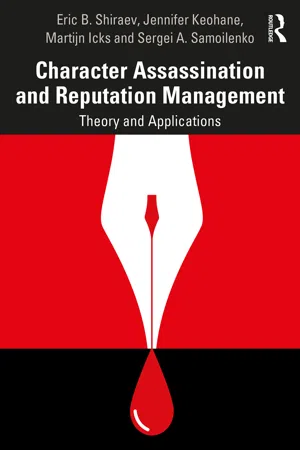
This lively book offers the first comprehensive examination of character assassination. In modern politics as well as in historical times, character attacks abound. Words and images, like psychological weapons, have sullied or destroyed numerous individual reputations. How does character assassination "work" and when or why does it not? Are character attacks getting worse in the age of social media? Why do many people fail when they are under character attack? How should they prevent attacks and defend against them?
Moving beyond discussions about corporate reputation management and public relations canons, Character Assassination and Reputation Management is designed to help understand, critically analyze, and effectively defend against such attacks. Written by an international and interdisciplinary team of experts, the book begins with a discussion of theoretical and applied features of the "five pillars" of character assassination: (1) the attacker, (2) the target, (3) the media, (4) the audience, and (5) the context. The remaining chapters present engaging in-depth discussions and case studies suitable for homework and class discussion. These cases include:
Historic figures
Leaders from modern times
Women in politics
U.S. presidents
World leaders
Political autocrats
Democratic leaders
Scientists
Celebrities
Featuring an extensive glossary of key terms, critical thinking exercises, and summaries to encourage problem-based learning, Character Assassination and Reputation Management will prove invaluable to the undergraduate and postgraduate students in communication, political science, global affairs, history, sociology, and psychology departments.
Describe the key features of character and character assassination.
Explain why character assassination is an important and powerful phenomenon in politics and public life.
Identify the key components (pillars) of character assassination.
Suggest major practical applications of the study of character assassination.
People in the past used the sword, the pitchfork, the bullet, the torch, the cannon, the bottle of poison, and recently a missile or a backpack with explosives—all to damage, destroy, and kill. To guard themselves from such attacks, people build shields, armor, trenches, and fortresses. They invent government institutions in charge of security. They create military doctrines and security procedures and launch counterattacks. In this book, we discuss attacks and defenses against them. In particular, we have turned attention to destructive power of a different and less physical kind, namely, to words and images used to harm, devastate, and destroy other people’s reputations. We begin with an example.
Few students born in the 1990s or later will immediately recognize the name Gary Hart (b. 1936; see Image 1.1). Yet, Hart was once a prominent politician, a United States senator. So prominent was he that he was widely assumed to be a frontrunner and a shoo-in for the 1988 Democratic presidential nomination. Young, rugged, outspoken, and handsome, Hart would—as many believed—shake up the aging Democratic Party. When Hart in 1987 announced that he was running for president, he declared,
Since we are running for the highest and most important office in the land, all of us must try to hold ourselves to the very highest possible standards of integrity and ethics, and soundness of judgment and ideas, of policies, of imagination, and vision for the future.
(qtd. in Bai, 2014, p. 5)
These words would come to seem ominous.
image 1.1 U.S. Senator Gary Hart seemed like a shoo-in for the 1988 Democratic presidential nomination, but things went differently
Source: Photo by Kenneth C. Zirkel, CC BY-SA 4.0
As you should know, Hart did not go on to be president of the United States. Nor did he secure the Democratic Party’s nomination. So, what happened in the process? In short, some journalists got a tip that Hart was having an extramarital affair while running for the highest office in the country. Although Hart was seen with women before, it was common practice for the media in the past to ignore the private lives of politicians. But the times were changing. When rumors of Hart’s affairs persisted and generated a buzz, he brazenly challenged the media to prove it. “Follow me around,” he declared. “I don’t care.” When the Miami Herald, after a stakeout of Hart’s Washington townhouse, captured photographs strongly indicating that he was having an affair with a woman named Donna Rice, Hart abruptly suspended his campaign (see Image 1.2). Next, he dramatically retired from politics to a remote cabin where he penned articles about international affairs and prayed the world would move on and forget about him. And it did. He continued to strenuously maintain that his character, his personal life, and his affair with Rice had nothing to do with his fitness for the office of president.
image 1.2 This picture of Donna Rice sitting in Gary Hart’s lap, published by the National Enquirer, has come to define his political reputation
Source: National Enquirer/Getty Images
Yet why did he give up his brilliant and promising political career so abruptly? One can put the blame on journalists and refer to Hart’s frequent dismissal of the press. His disdain for their work may have contributed to their eagerness to air his dirty laundry. Others mention how the advent of satellite technology and lighter-weight cameras and recorders that allowed for easier snooping and quicker reporting also had a hand in this sea change. However, these are merely the people and the means by which the information about Hart spread. The real takeaway from Hart’s sudden and catastrophic downfall is the recognition of the old axiom that character matters for presidential candidates. The actual story was bigger than just an extramarital affair—it was about Hart’s character, his individual traits and whether a person like him could and should be president (Little, 2018).
Even after Hart’s career ended, the American public continued to debate the implications of what seemed like a remarkable change in the relationship between the press and the public. Many were cautious of what seemed like a new era in politics that was obsessed with the private lives of politicians. And their concerns were valid: the 1988 presidential campaign devolved into a perpetual circus of sensationalism.
The central question that the case raised is this: is a politician’s private life, their individual traits, and their character relevant to their ability to serve the country? Do someone’s private habits have anything to do with their ability to defend the Constitution? Opinions, as you can imagine, vary. Some even say Hart simply was unlucky: had he successfully hidden his affair, he would have been president. But luck is a slender strategy on which to build an effective political career. So, why does character matter?
Introducing Character Assassination
Before we define key terms such as character assassination, character, and character attacks in a detailed manner, it is essential to acknowledge that it was the media that engaged in an intentional campaign to destroy Hart’s reputation and to smear him as an adulterer. Never mind, of course, that the accusations against him were actually true. That is a subject we shall take up in more detail later.
Although Gary Hart did not do himself any favors in terms of handling the press, his withdrawal from the 1988 presidential race was the direct result of character attacks against him by the media. After all, Hart had committed no crime. His political platform had not suffered a radical drop in popularity. Most Democrats and quite a few moderate Republicans actually thought he had pretty good plans for how to run the country! He dropped out purely because the character attacks against him damaged his moral reputation beyond repair.
The Gary Hart case is just one in a long line of political scandals. In current American and world politics, personal attacks are rampant. Whether former president Donald Trump (b. 1946)—by hurtling personal insults at his political opponents—has ushered in a new era of uncivil politics in the United States and even globally will long be debated (Baker & Rogers, 2018; Muszynski, 2017). Yet there is little doubt that Trump, before and during his presidency, was busy attacking people of all walks of life. In fact, the New York Times had a running list of “people, places, and things” that President Trump was attacking on Twitter. Neither foes nor former associates were spared. Trump’s former Republican fellows and competitors for the 2016 presidential nomination like Jeb Bush and Ted Cruz had long lists of insults that Trump hurled at them. Unsurprisingly, his Democrat opponents in the general election, Hillary Clinton and Joe Biden in 2020, had a list several columns long. It includes insults like “crooked!” “corrupt!” “lying,” “sleepy,” and “heartless” among many, many more (Lee & Quealy, 2019).
Character attacks have been rampant in other countries as well. World leaders like former U.K. Prime Minister Margaret Thatcher (1925–2013) have been the frequent targets of attacks. She was smeared as a “man eater” and called “Thatcher, the Milk Snatcher” for her bullying, pushy style of politics (Baxter, 2013). These attacks were certainly related to stereotypes regarding gender and leadership, a topic which we will discuss throughout this book. Moreover, in non-democratic regimes, leaders themselves often use character assassination as a tool to harass and eliminate dissidents who speak out against their policies. This has happened in Russia under President Vladimir Putin (Shiraev & Khudoley, 2019) and in China under its recent and current leadership. In China, for example, the state-controlled media often use words to smear the reputations of military members accused of accepting bribes. This allows President Xi Jinping to perfect his own reputation as the only available and effective fighter against corruption (Yang, 2020).
Of course, character attacks are not limited to the realm of politics, either. They occur in business, education, religious circles, science, sports, entertainment, and other professional and social areas. For starters, one example will be particularly illustrative. It displays character assassination in the area intertwining popular culture and science. Robert Gallo, one of the researchers who helped discover the human immunodeficiency virus (HIV) that causes AIDS was routinely smeared in the media. In And the Band Played On: Politics, People, and the AIDS Epidemic, a 1987 ground-breaking book covering the AIDS crisis by Randy Shilts, Gallo is portrayed as an egotistical, petty person who got in the way of advancing AIDS research. When actor Alan Alda played him in an HBO movie based on the book, he represented Gallo as Shilts had written him: seeking only self-promotion instead of helping to cure the disease. In the movie, he was portrayed as an evil scientist who wanted people to suffer until he got recognition. Gallo reported receiving hate emails each time HBO aired the movie, even 25 years after it debuted (Harden, 2012).
Do not think that the act of attacking someone’s reputation is a new phenomenon. While character assassination certainly has been helped by the advent of social media and other communication technologies that allow people to send messages immediately and anonymously, character attacks are a timeless phenomenon. They actually date back to the advent of human civilization. As long as humans have been living in groups, they have been finding ways to smear each other to gain power and advantage. While we will take up the history of character assassination in the next chapter, there is strong evidence of character assassination dating back to the ancient Egyptians, Greeks, and Romans over 2000 years ago.
On the Importance of the Subject
Studying character assassination is important for several reasons:
Given that character assassination has been a consistent feature of political and social discourse since ancient times and across cultures and territories, it is worthy of examination and assessment. We simply should better understand this phenomenon that has had a huge impact on the world around us.
Character assassination goes well beyond our personal use of social media to smear other people for personal reasons. It is also a powerful tool in the struggle for political influence. It is used in business in attempts to compromise competitors and thus increase revenues. In international politics character attacks against national leaders are on the rise as well. Character attacks against political leaders have become part of modern cyberwarfare to target people’s knowledge, attitudes, manipulate them, sway them in a particular direction, and influence public opinion on important social and political issues as well as impact voting behavior. The rise of Russian troll factories to meddle in elections through posting fake and scandalous stories under fake social media accounts is a new arena of character assassination online (Shiraev & Mölder, 2020). In these factories, workers are paid nice salaries to post things online given assigned key words (MacFarquhar, 2018). Then, computer algorithms spread the fake posts to create viewership and drive traffic to the posts. Other factory employees are assigned just to add comments to the fake posts.
There are new horizons for character assassination, too. While this phenomenon appears timeless, as we shall see in this book, it is also true that the rise of mediated communication means that more people have more tools to attack others’ characters. Social media provides all of us the opportunity to launch character attacks in the form of tweets or anonymous posts, or spread the attacks launched by others far and wide. Cyberbullying has been on the rise even among children and young adults. The Cyberbullying Research Center notes that cyberbullying affects from 10 to 40 percent of children in the United States (Hinduja & Patchin, 2020).
There is a practical reason for studying character assassination, too. Today we are all exposed to hundreds of messages a day on our phones and computers. Studying character assassination can help build our own media savviness and social responsibility. It will allow us to recogn...
Table of contents
Cover
Half Title
Title
Copyright
Contents
List of Images
List of Figures
List of Tables
Preface
1 Introduction
2 Character Assassination in History
3 Approaches to and Methodology for Studying Character Assassination
4 The Actors in Character Attacks
5 Content and Types of Character Attacks
6 Means and Venues of Character Attacks
7 The Impact of Character Attacks
8 Defending Against and Managing Character Attacks
9 The Culture Factor
10 Character Assassination in Democracies
11 Character Assassination in Authoritarian Regimes
12 Character Assassination in International Relations
13 The Gender and Sexuality Factor
14 Character Attacks in Sports, Science, and Entertainment
Conclusion
Index
Trusted by 375,005 students
Access to over 1.5 million titles for a fair monthly price.
Study more efficiently using our study tools.
Frequently asked questions
Yes, you can cancel anytime from the Subscription tab in your account settings on the Perlego website. Your subscription will stay active until the end of your current billing period. Learn how to cancel your subscription
No, books cannot be downloaded as external files, such as PDFs, for use outside of Perlego. However, you can download books within the Perlego app for offline reading on mobile or tablet. Learn how to download books offline
Perlego offers two plans: Essential and Complete
Essential is ideal for learners and professionals who enjoy exploring a wide range of subjects. Access the Essential Library with 800,000+ trusted titles and best-sellers across business, personal growth, and the humanities. Includes unlimited reading time and Standard Read Aloud voice.
Complete: Perfect for advanced learners and researchers needing full, unrestricted access. Unlock 1.5M+ books across hundreds of subjects, including academic and specialized titles. The Complete Plan also includes advanced features like Premium Read Aloud and Research Assistant.
Both plans are available with monthly, semester, or annual billing cycles.
We are an online textbook subscription service, where you can get access to an entire online library for less than the price of a single book per month. With over 1.5 million books across 990+ topics, we’ve got you covered! Learn about our mission
Look out for the read-aloud symbol on your next book to see if you can listen to it. The read-aloud tool reads text aloud for you, highlighting the text as it is being read. You can pause it, speed it up and slow it down. Learn more about Read Aloud
Yes! You can use the Perlego app on both iOS and Android devices to read anytime, anywhere — even offline. Perfect for commutes or when you’re on the go. Please note we cannot support devices running on iOS 13 and Android 7 or earlier. Learn more about using the app
Yes, you can access Character Assassination and Reputation Management by Eric B. Shiraev,Jennifer Keohane,Martijn Icks,Sergei A. Samoilenko in PDF and/or ePUB format, as well as other popular books in Politics & International Relations & Political History & Theory. We have over 1.5 million books available in our catalogue for you to explore.