eBook - ePub
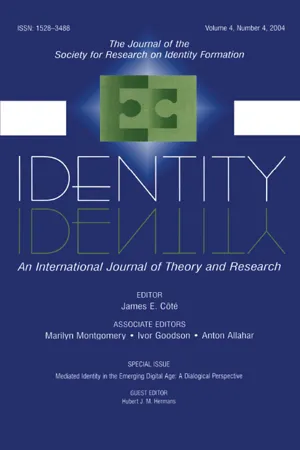
Mediated Identity in the Emerging Digital Age
A Dialogical Perspective:a Special Issue of identity
- 112 pages
- English
- ePUB (mobile friendly)
- Available on iOS & Android
eBook - ePub
Mediated Identity in the Emerging Digital Age
A Dialogical Perspective:a Special Issue of identity
About this book
This book illustrates the process of mediated dialogue in a digital age. It shows that culture and self-like society and identity-are conceived as mutually inclusive and shows how technology is able to create a new form of dialogue that is very personal and very public at the same time. The first article shows that culture and self-like society and identity-are conceived as mutually inclusive. Then looks at how technology is able to create a new form of dialogue that is very personal and very public at the same time. The third paper looks at education. Next, SMS-a medium of communication is covered. The last two papers focus on television which is seen as a "social space" that offers a variety of possible self-images through audience discussion programs, its participants, and the disclosure of private stories and historical changes in the notion of space.
Information
Mediated Identity in the Parasocial Interaction of TV
University of Bari, Italy
Electronic media contributes toward modifying the self as they shape it as a multivoiced construction. Television talk shows function as a space of parasocial interaction where ordinary people represented on the screen offer involving images of subjectivity for the home viewers. Through interpretative procedures, viewers integrate screen suggestions in the positions’ repertoire of their self. This study hypothesized that viewers co-construct identities through involvement in what they are watching and employed focus group discussions and content analysis to investigate this hypothesis. The results demonstrate recurrent comparisons contrasting the screen “other” and the real self. This categorization marks a strong involvement of participants and an interpretative reconstruction of television images. As such, identity is constructed in the dialogical relation between others and selves in a mediated relation whose only result is a self traveling through different repositionings.
Social psychology and mass communication research have always been interested in the study of identity. The most innovative contributions propose a negotiated notion of identity that overcomes an essentialist approach. Identity is the product of social practices in which the individual is involved. This relational and linguistic perspective reflects social constructionism that assumes that
selves, persons, psychological traits, and so forth, including the very idea of individual psychological traits, are social and historical constructions, not naturally occurring objects (Sampson, 1989, p. 2).
These theoretical afterthoughts respond to a change of cultural perspective that conceives reality as interwoven in social relationships and proposes the self as an integral part of these relationships. Nowadays, social relationships develop toward virtual forms, and mediated interactions contribute to the structuration of identity. Electronic relationships contribute toward modifying the self as they shape it—not as a univocal structure, but a plural construction originating in the technologies of social “saturation” (Gergen, 1991).
The most important dimensions of interaction—self, other, and reality—are constructed in the continuous flow of communicative and relational practices:
What we might call our orderly person–world dimensions of interaction … emerge out of, and are constructed within, a whole melee of disorderly, self-other dimensions of interaction (Shotter, 1995, p. 165).
The social dimension of the interaction originates in the “joint action” (Shotter, 1984) between the self and the other, between the individual and the world.
ELECTRONIC RELATIONSHIPS AND DIALOGICAL SELVES
Identity is a “process of self definition directed by the connection self/other” (Galimberti & Riva, 1998, p. 437); it is a dynamic construction coming from a multiplicity of people and voices in self-presentation (Hevern, 2000); it is composed of many voices, each voice represents a position inside which the image of the other is reflected (Hermans, Kempen, & van Loon, 1992). Its nature is dialogic because the self is in constant dialogue with other selves of the sociocultural world (Hermans, 2001). Its nature is transactional because its manifold meanings are distributed in its interactions with others. Bruner (1990/1992) wondered:
Isn’t the Self a transactional relationship between a speaker and his receiver… ? Isn’t it a way of structuring its own conscience, position, [and] identity, … towards another? In this condition the Self becomes dialogue-dependent, (p. 100)
The awareness of the other relates to a practical moral knowledge that precedes each other kind of knowledge. John Shotter and Kenneth Gergen (1994) defined it as a “third type” of knowledge, neither theoretical nor practical or technical:
It is a form of knowledge from within a relationship, in which, in its articulation, others around us continually exert a morally coercive force upon us to be persons of a particular kind, to assume a particular identity, and to exhibit a particular kind of sensibility: that is, to be persons who act and make sense of the events and activities studied through the “proper” use of the “proper” terms. (p. 6)
Relational knowledge produces a dialogic reality, a co-construction of meanings made through language. Discourse modulates identity; the social strength of discourse, the existence of the other in discourse, shapes aspects of the self. According to Harré (1995, p. 158), “the self, as the author of public and private discourse, is not itself an entity that can be observed by the person whose self it is (p. 158). To propose the self as a discursive construction means to conceive it as a modality and not an entity, “the characteristics of articulation, dynamism, [and] versatility emerge” (Mininni, 1995, p. 52). The notion of a fluid identity (Annese 2001), built in interaction with the other, finds its apotheosis in the technological society where social relationships are multiplied by spatial and temporal dispersion; and with them, even the possibilities of the self are multiplied.
Through mediated processes, remote people and situations enter everyday social worlds by unhinging the nature of social interactions and altering the type of experience, the intensity of involvement, and the depth of familiarity in them. It is clear that alteration in social relationships drives the individual to interact with substitutes for the real other, visible but “notional” people, “absent others” (Giddens, 1990, p. 19). The concept of identity—what individuals are for themselves and for others—becomes problematic because relationships are denaturalized and give life to a plurality of social worlds. The continuous change of social situations produces a multiplicity of positions that generates the characteristic of mutability in the self (Hermans, 2001).
The communicative function of television is a particular form of mediated relationship, which can be defined as “parasocial interaction” (Horton & Wohl, 1956) or mediated “quasi-interaction” (Thompson, 1995/1998, p. 126). In it, the roles of production and reception are separated; their relationship is an exchange of symbolic forms that takes place in disparate contexts and in different times. If physical co-presence is not an essential condition, then the “mediation/representation of subjectivity through TV simulacra” (Galimberti, 1994, p. 144) is required.
Television production plans for the representation of the ordinary person who produces conversational interactions suitable for public circulation. This representation offers meanings that are only potential because it can provoke discussions in varied contexts that build effective meanings very different from the potential ones. Audiences use TV meanings in a relational way: “They participate without passive identification, they blur boundaries between viewing and living by endless ‘what happened then’ discussions and by bringing their everyday experience to judge the drama” (Livingstone, 1990, p. 2).
Viewers can carefully process information, contextualize their elaborations in the shared symbolic order, and so they can contribute to the process of TV production. Through reception they can construct meanings rather than simply exchange information. As Jensen (1991) remembered, “a discursive or interpretive conception of reception is a necessary constituent of a comprehensive theory of the audience” (p.138). Viewers employ interpretative procedures to reconstruct meanings of television programs; they order information received by television through schemes or representations that allow them to appraise, select, complete, and reorganize the perceptive material. They elaborate television texts through interpretative mechanisms that recall their mental schemes.
According to research in audience studies (Anderson & Meyer, 1988; Ang, 1991; Jensen, 1991; Lindlof, 1988), viewership is a process of negotiation “between a set of structured potentialities ‘out there’ and the person’s repertoire of knowledge representations and processing strategies (Livingstone, 1990, p. 32).
By means of interpretation, viewers negotiate the information in television texts with other factors such as their previous experiences of reception, gender, and social disposition toward the received information. In other words, reception is an active process creating a parasocial interaction with production.
The TV genre of the talk show offers such a space of parasocial interaction to the active audience. Ordinary people represented on the screen serve as a kind of simulacrum for the audience on the other side of the screen and offer images of subjectivity for their viewers. Through interpretative procedures, viewers integrate screen suggestions in their self schemes; they mix symbolic “possible selves” (Markus & Nurius, 1986) with individual ones, so that TV representation of subjectivity drives them to continuous processes of identity construction.
RESEARCH WORK: FLUID IDENTITY IN THE MEDIATED INTERACTION OF A TALK SHOW
This research adopts a socioconstructionist perspective, the emerging field of audience studies, and a qualitative methodology to explore the television construction of identity. It seeks to point out ways by which viewers construct identities as a comparison between real selves and screen others. Television programs drive viewers to co-construct, in cooperative or conflicting ways, TV meanings through their involvement in what they are watching.
This research work employs focus group discussions and content analyses as methodological tools. The data are collected by in-depth interviews conducted as group discussions. These are subsequently transcribed for content analysis by software such as NUD*IST (Nonnumerical Unstructured Data FOR Indexing Searching Theorizing). Focus group discussions respond to the need (a) to consult viewers directly as suggested by audience studies; (b) for interaction between participants and researchers according to qualitative research tenets; and, (c) for the purpose of negotiating possible worlds, according to the socioconstructionist approach. Content analysis responds to the need to create semantic nets connected to both discursive context and the wider sociocultural context through an operation of interpretation. By emphasizing interpretative steps and qualitative results, content analys...
Table of contents
- Cover
- Copyright Page
- Table of Contents
- Society for Research on Identity Formation
- Introduction: The Dialogical Self in a Global and Digital Age
- Threaded Identity in Cyberspace: Weblogs and Positioning in the Dialogical Self
- Self-Positioning in a Text-Based Virtual Environment
- The Diatextual Construction of the Self in Short Message Systems
- Mediated Identity in the Parasocial Interaction of TV
- The Usage of Space in Dialogical Self-Construction: From Dante to Cyberspace
- Contributor Information
Trusted by 375,005 students
Access to over 1.5 million titles for a fair monthly price.
Study more efficiently using our study tools.
Frequently asked questions
Yes, you can cancel anytime from the Subscription tab in your account settings on the Perlego website. Your subscription will stay active until the end of your current billing period. Learn how to cancel your subscription
No, books cannot be downloaded as external files, such as PDFs, for use outside of Perlego. However, you can download books within the Perlego app for offline reading on mobile or tablet. Learn how to download books offline
Perlego offers two plans: Essential and Complete
- Essential is ideal for learners and professionals who enjoy exploring a wide range of subjects. Access the Essential Library with 800,000+ trusted titles and best-sellers across business, personal growth, and the humanities. Includes unlimited reading time and Standard Read Aloud voice.
- Complete: Perfect for advanced learners and researchers needing full, unrestricted access. Unlock 1.5M+ books across hundreds of subjects, including academic and specialized titles. The Complete Plan also includes advanced features like Premium Read Aloud and Research Assistant.
We are an online textbook subscription service, where you can get access to an entire online library for less than the price of a single book per month. With over 1.5 million books across 990+ topics, we’ve got you covered! Learn about our mission
Look out for the read-aloud symbol on your next book to see if you can listen to it. The read-aloud tool reads text aloud for you, highlighting the text as it is being read. You can pause it, speed it up and slow it down. Learn more about Read Aloud
Yes! You can use the Perlego app on both iOS and Android devices to read anytime, anywhere — even offline. Perfect for commutes or when you’re on the go.
Please note we cannot support devices running on iOS 13 and Android 7 or earlier. Learn more about using the app
Please note we cannot support devices running on iOS 13 and Android 7 or earlier. Learn more about using the app
Yes, you can access Mediated Identity in the Emerging Digital Age by Hubert J.M. Hermans in PDF and/or ePUB format, as well as other popular books in Psychology & Developmental Psychology. We have over 1.5 million books available in our catalogue for you to explore.