- 584 pages
- English
- ePUB (mobile friendly)
- Available on iOS & Android
Soft Ground Tunnel Design
About this book
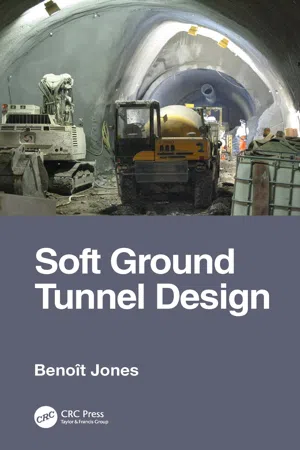
Soft Ground Tunnel Design is a textbook that teaches the principles of tunnel and underground space design in soft ground. 'Soft ground' refers to soil, in contrast to rock. The book focuses on stability, prediction of ground movements, and structural design of the lining. It shows that the choice of excavation and support methods depends on ground stability, limitation of damage to the existing built environment, and health, safety and environmental considerations.
Benoît Jones builds on the basic principles of soil-structure interaction, the three-dimensional effects of construction sequence, and the effects of construction on other surface or subsurface structures in steps of gradually increasing complexity. The use of worked examples throughout, and example problems at the end of each chapter, give the reader confidence to apply their knowledge.
Engineers and graduate students will be able to:
• understand the basis for choosing an underground construction method and/or ground improvement method
• calculate heading stability
• predict ground movements
• understand the complex soil-structure interaction around an advancing tunnel
• design tunnel linings in soft ground using a variety of methods
• predict the effects of construction on the built environment and assess potential damage
Benoît Jones has worked in tunnelling as a designer, contractor and academic for more than 20 years. He set up and ran the MSc Tunnelling and Underground Space course at the University of Warwick. He is now managing director of his own company, Inbye Engineering.
Tools to learn more effectively

Saving Books

Keyword Search

Annotating Text

Listen to it instead
Information
Table of contents
- Cover Page
- Half-Title Page
- Title Page
- Copyright Page
- Contents
- Preface
- Books on tunnel construction methods
- Acknowledgements
- Author
- 1 Real tunnel behaviour
- 2 Undrained stability
- 3 Drained stability
- 4 Stability of shafts
- 5 Stability and Eurocode 7
- 6 Global design using analytical solutions
- 7 Global design using numerical modelling
- 8 Lining materials
- 9 Segmental lining design
- 10 Segment design for transient loads
- 11 Sprayed concrete lining design
- 12 Estimating ground movements
- 13 Estimating building damage
- Appendix A: Derivation of wedge-prism method
- Appendix B: Details from derivation of Curtis–Muir Wood equations
- Appendix C: Derivation of the deflection of a rectangular simply-supported beam under a point load
- Index
Frequently asked questions
- Essential is ideal for learners and professionals who enjoy exploring a wide range of subjects. Access the Essential Library with 800,000+ trusted titles and best-sellers across business, personal growth, and the humanities. Includes unlimited reading time and Standard Read Aloud voice.
- Complete: Perfect for advanced learners and researchers needing full, unrestricted access. Unlock 1.4M+ books across hundreds of subjects, including academic and specialized titles. The Complete Plan also includes advanced features like Premium Read Aloud and Research Assistant.
Please note we cannot support devices running on iOS 13 and Android 7 or earlier. Learn more about using the app