Ground improvement has been one of the most dynamic and rapidly evolving areas of geotechnical engineering and construction over the past 40 years. The need to develop sites with marginal soils has made ground improvement an increasingly important core component of geotechnical engineering curricula. Fundamentals of Ground Improvement Engineering addresses the most effective and latest cutting-edge techniques for ground improvement.
Key ground improvement methods are introduced that provide readers with a thorough understanding of the theory, design principles, and construction approaches that underpin each method. Major topics are compaction, permeation grouting, vibratory methods, soil mixing, stabilization and solidification, cutoff walls, dewatering, consolidation, geosynthetics, jet grouting, ground freezing, compaction grouting, and earth retention.
The book is ideal for undergraduate and graduate-level university students, as well as practitioners seeking fundamental background in these techniques. The numerous problems, with worked examples, photographs, schematics, charts and graphs make it an excellent reference and teaching tool.
Ground modification in the constructed environment is not a new idea. For instance, the method of wattle and daub has been used for thousands of years to provide tensile reinforcement to clayey materials in buildings. The process of adding straw to clay and baking it in the sun improved the strength properties of the clay creating a building material that has been used for thousands of years. In another ancient application, the Romans used timber as a base layer for roads. In modern times, inclusions (such as geogrids and geotextiles) are commonly employed for ground improvement. Similarly, the addition of lime to clay (a chemical admixture in modern terminology) has long been used to create a weak binder in stone foundations. The Roman road, Via Appia, now in modern-day Italy, is the earliest known example of the use of lime in ground improvement engineering (Berechman 2003).
The terms ground improvement, ground modification, and similar terms are lexicon of the late 20th century. The first conference on the subject was “Placement and Improvement of Soil to Support Structures” and was held in Cambridge, Massachusetts, in 1968, sponsored by the Division of Soil Mechanics and Foundation Engineering of the American Society of Civil Engineers (ASCE 1968). The first comprehensive textbook on the subject was by Hausmann (1990). University courses on the subject began at about the same time. In many ways, ground improvement engineering is a relatively new field within geotechnical engineering. New developments are occurring at a rapid pace and no doubt will have occurred throughout the life of this book. Thus, this book focuses on fundamentals, enabling the user to understand and adapt to the latest ground improvement developments.
How might ground modification/improvement be defined? In the proceedings on the Conference on Soil Improvement (ASCE 1978), the introduction succinctly states that one of the alternatives available when poor soil conditions are encountered is to “treat the soil to improve its properties.” Moseley and Kirsch (2004) in the second edition of their book, Ground Improvement, note that
All ground improvement techniques see to improve those soil characteristics that match the desired results of a project, such as an increase in density and shear strength to aid problems of stability, the reduction of soil compressibility, influencing permeability to reduce and control groundwater flow or to increase the rate of consolidation, or to improve soil homogeneity.
Schaefer et al. (2017) define ground modification as “the alteration of site foundation conditions or project earth structures to provide better performance under design and/or operational loading conditions.” For the purposes of this book, ground improvement is defined as the application of construction means and methods to improve the properties of soil.
Note that some improvements are of the first order. For example, compaction will increase the density of soil. However, density increases can lead to second order effects such as increased strength and reduced compressibility. Finally, these second order improvements can result in third order effects such as increased bearing capacity and reduced settlement and/or improved liquefaction resistance. By beginning with the fundamentals of ground improvement engineering, the text is designed to provide an understanding of both the fundamental first-order effects as well as those second- and third-order effects that are often the actual desired outcome of the application of ground improvement. As there are many definitions of ground improvement and further much gray area within each definition, the authors used this definition as a guide to define the scope of this book.
Finally, for the purposes of the selection of the content in this book, the authors use the term ground improvement rather than ground modification. Ground modification is a neutral term meaning the modification could either improve or worsen the ground whereas ground improvement is unambiguous.
Prior to in-depth study of ground improvement, what are the alternatives to ground improvement? Imagine a site where the subsurface conditions are not suitable for the anticipated project. While ground improvement is the option to be considered in detail in this book, what are the alternatives? Some common alternatives to the application of ground improvement include:
Avoid the site or area: There are many circumstances where the owner/developer has options regarding the location of the proposed facility and finding an alternative site or a different area of the same site is a viable option.
Remove and replace: If the unsuitable materials are limited in aerial and/or vertical extent, the best (and most economical) option may be to simply excavate the unsuitable soils and replace them with more suitable materials having more predictable properties, such as crushed stone. This is a commonly chosen alternative when a localized fill is encountered.
Transfer load to deeper strata: The use of deep foundations, such as piles or drilled shafts, has long been the option of choice in locations where unsuitable bearing materials are present near the ground surface. Deep foundations affect load transfer through the use of stiff structural members placed between the structure and competent bearing materials found at deeper depths. Although significantly more sophisticated today, this technique has existed for centuries with ample evidence including ancient Roman bridges supported on timber piles.
Design structure accordingly: Some sites and structures, in combination, may lend themselves to structural redesign to accommodate the site conditions. For instance, it may be possible to stiffen the structure to redistribute stresses within the structure and minimize differential movement. In a specific application, sinkhole prone areas such as solution-prone geologic settings, grade beams can be used to connect spread footings in order to redistribute loads in case of loss of support beneath any single footing. Likewise, structures can incorporate construction joints, allowing some differential settlement without causing distress.
1.2 Improvements in soil behavior
Ground improvement may be viewed from the perspective of system performance. For example, it may be necessary to improve the ground to increase the allowable bearing value of a footing supported on the soils beneath a structure. From the system perspective, ground improvement alternatives would be evaluated for their ability to increase bearing capacity and decrease settlement, i.e. increase the allowable bearing value. More precisely, the allowable bearing value can be increased by:
increasing the stiffness of the soil (decreases settlement),
increasing the shear strength of the soil (increases bearing capacity), and/or
Densifying granular materials or consolidating cohesive materials can increase soil strength and stiffness.
Using these definitions, there are many ways ground improvement can be viewed. For the purposes of understanding ground improvement, this text will focus on a fundamental understanding of the interactions between ground improvement techniques and the resulting changes in soil and/or soil system behavior. This text also provides insight into the means and methods used by contractors to implement ground improvement techniques with most of the chapters and information segmented by construction techniques.
In this chapter, it is useful to articulate the improvements in soil behavior that may result from the ground improvement methods employed. These fundamental soil behavior characteristics include shear strength, compressibility, hydraulic conductivity, liquefaction potential, shrink and swell behavior, and reduction in variability in any of the aforementioned behavioral characteristics. Details of soil behavior principles related to ground improvement are provided in Chapter 2.
1.2.1 Shear strength
Shear strength is a fundamental engineering property of soils that can be increased through the application of numerous ground improvement techniques. Shear strength is a measure of the soil’s ability to resist failure under the application of a load that induces shear stresses in the soil. Shear strength can be increased through ground improvement techniques that decrease the void ratio (Chapters 4, 5, and 11), and/or adding a cohesive (cementing) component (Chapter 6 and 7). There are many applications that benefit from improved shear strength including increased bearing capacity, improved slope stability, and reduced liquefaction potential.
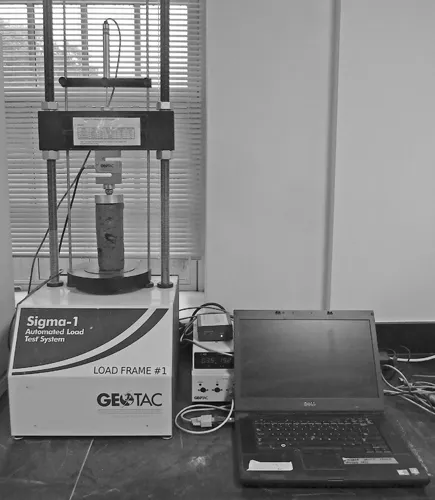
The shear strength of soils is a sophisticated concept. There are entire texts devoted solely to this topic. Unconfined compression tests (see Figure 1.1) are a common means to quantitatively judge the benefit of ground improvement efforts. For some projects, more sophisticated testing may be needed. Principles of shear strength, both drained and undrained, are reviewed in Chapter 2.
Soil stiffness is a measure of the deformation of soils associated with the application of a load. Compressibility is not a unique value, since it depends on the nature of the load application and the initial stress state of the soil. The soil stiffness can be increased, i.e. decreased compressibility, through ground improvement techniques that reduce void ratio or add a cohesive or cementing component. Cohesive soil stiffness can be increased by compaction (Chapter 4) and consolidation (Chapter 5). Granular soil stiffness is generally increased by densification (Chapter 4). Cohesive and granular material compressibility can also be reduced via increasing cohesiveness through soil mixin...
Table of contents
Cover
Half-Title
Title
Copyright
Contents
Preface and Acknowledgments: Fundamentals of Ground Improvement Engineering
1 Introduction to ground improvement engineering
2 Geotechnical fundamentals
3 Fundamentals of geosynthetics in ground improvement
4 Compaction
5 Consolidation
6 Soil mixing
7 Grouting
8 Slurry trench cutoff walls
9 Ground improvement using geosynthetics
10 Reinforcement in walls, embankments on stiff ground, and soil nailing
11 Additional techniques in ground improvement
12 The future of ground improvement engineering
Index
Trusted by 375,005 students
Access to over 1.5 million titles for a fair monthly price.
Study more efficiently using our study tools.
Frequently asked questions
Yes, you can cancel anytime from the Subscription tab in your account settings on the Perlego website. Your subscription will stay active until the end of your current billing period. Learn how to cancel your subscription
No, books cannot be downloaded as external files, such as PDFs, for use outside of Perlego. However, you can download books within the Perlego app for offline reading on mobile or tablet. Learn how to download books offline
We are an online textbook subscription service, where you can get access to an entire online library for less than the price of a single book per month. With over 1.5 million books across 990+ topics, we’ve got you covered! Learn about our mission
Look out for the read-aloud symbol on your next book to see if you can listen to it. The read-aloud tool reads text aloud for you, highlighting the text as it is being read. You can pause it, speed it up and slow it down. Learn more about Read Aloud
Yes! You can use the Perlego app on both iOS and Android devices to read anytime, anywhere — even offline. Perfect for commutes or when you’re on the go. Please note we cannot support devices running on iOS 13 and Android 7 or earlier. Learn more about using the app
Yes, you can access Fundamentals of Ground Improvement Engineering by Jeffrey Evans,Daniel Ruffing,David Elton in PDF and/or ePUB format, as well as other popular books in Technology & Engineering & Agriculture. We have over 1.5 million books available in our catalogue for you to explore.