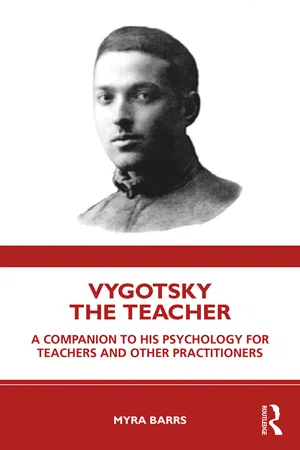
A cult of the book literally reigned in the house. Regardless of how modestly the family lived, they nevertheless bought books. Works of the Russian classics and foreign literature were in the house … An interest in literature predominated perhaps above all else in the family, and a love of literature united them. Joint readings aloud of the classics and of new literature were a family practice. After new works were read, or after a visit to the theater, the family discussed together what they had read or seen, and each could state his own opinion and impressions about the book or the play.
Vygotsky’s father was the president of the local branch of OPE, the Association for the Enlightenment of the Jews of Russia. He founded a public library, which was open to all, in the same building as the family apartment (Kotik-Friedgut and Friedgut, 2008, p. 18).
These were very problematic times for the Jews of Russia. Following the assassination of Tsar Alexander in 1881, blamed by some on the Jews, there was a series of violent anti-Semitic attacks and pogroms, which led to further restrictions on Jewish rights. Jews were expelled from Moscow in 1891. Pogroms increased across various cities in the early 1900s. In Gomel there were two pogroms during Vygotsky’s childhood, one in 1903 when he was seven. The Jewish community anticipated an attack, and trained and armed themselves beforehand; Lev’s father was on the organising committee. This self-defence group repelled the invaders, but then had to resist an attack by the police, who tried to disarm them. Thirty-six Jewish defenders and 44 non-Jews were subsequently tried. Lev’s father was a witness for the Jewish self-defence group; in his testimony he spoke about the suffering that Jews were experiencing for having sought equal rights (Kozulin, 1990).
After Vygotsky’s early education with his mother, when he learnt German, English, Hebrew and other languages, Vygotsky had an outstanding home tutor, Solomon Markovich Aspiz, whose Socratic style of teaching was intellectually demanding. Vygotsky was taught always to look for the flaws in his own arguments. In due course he went on to study in the sixth form of a Jewish private secondary school. Semyon Dobkin, a school friend, remembers that Vygotsky’s sister and his own sister formed a Jewish history study group and invited him to join it; Vygotsky was asked to chair the group. Under his leadership it soon became a study group on the philosophy of history, and its meetings went on for two years. Vygotsky had read both Hegel and Spinoza – his father had given him a copy of the Ethics, and he continued to refer to Spinoza throughout his life.
David Vygodsky, Vygotsky’s cousin, was a great influence on Vygotsky as a student. He was a linguist, translator and poet with a strong interest in modern Jewish poetry, and was eventually a friend of Roman Jakobson and Victor Shklovsky. Dobkin reports that he was an enthusiast for Esperanto; under his influence Vygotsky learnt Esperanto and corresponded with an Icelandic penfriend in that language.
It is obviously intriguing that David Vygodsky and the rest of the family spelt their name with a ‘d’, whereas Vygotsky spelt it with a ‘t’. This name change was a deliberate decision by Vygotsky. Gita Vygodskaya explains it this way:
Thus, in his youth he thought about the origin of his family, his name, and his kin. He studied this question and got to the truth. He showed his father that their family name was written incorrectly, that it did not come from the word vygodu, but from the name of a small village in Belarus from whence his kin came, and hence should be written with a “t”, Vygotsky. From that time on, he began to write his last name accordingly, and that is how the whole world knows it today.
The desire to ‘get to the core’ of things, to dig to the depths of everything he undertook, was typical of his character.
(Vygodskaya and Lifanova, 1999, p. 21)
In 2013, Vygotsky passed the final school exams with honours, and was awarded a gold medal. He planned to go to university but there was a quota of three per cent of the intake for Jews seeking admission to higher education. His gold medal meant that in normal times he would have automatically qualified for admission to Moscow University. But that summer the rules were changed; Jewish applicants were now to be chosen by lot, not merit. Despite this extra hurdle Vygotsky was given a place in the University by the lottery draw. He was going to read for a medical degree; this would mean that he had a profession (Jews were not allowed to be government employees at that time) and enable him to work outside the pale of settlement.
When he went up to Moscow University he almost immediately transferred to the law department – law was also a permitted profession. And he enrolled as well for Shanyavsky University, a private mixed university with some celebrated scholars in its faculty and a more liberal atmosphere; here he studied philosophy, literature and psychology.
In 1915 his sister Zinaida joined him in Moscow and they shared a lodging. She was reading philosophy and languages and the topic of her dissertation was Spinoza. The topic of Vygotsky’s final thesis for Shanyavsky University was Shakespeare’s Hamlet, a play which had already been the topic of a long essay that he wrote in high school. While in Moscow both Vygotsky and his sister often went to the theatre; they knew the whole repertoire of the Moscow Arts Theatre and did not miss a single performance (Vygodskaya and Lifanova, 1999, p. 28).
During his last year in Moscow Vygotsky began to work for Novyi put’, a liberal Jewish periodical, for which he wrote articles on the Jewish people’s situation in Russia, and on literary works by Lermontov and others. He also wrote theatrical reviews for the journal Letopis.
In 1917, after decades of unrest and uprisings, the February revolution began in Petrograd with mass demonstrations, extensive mutinies in the army, and the abdication of the Tsar. A provisional revolutionary government came into power in March with a manifesto proposing a plan of civic and political rights. Later in March the government, with Alexander Kerensky as Attorney General, passed a decree repealing anti-Semitic Tsarist laws, making all citizens equal before the law, and banning discrimination based on religion or ethnic origin. To mark this decree Vygotsky wrote an article for Novyi put’ entitled ‘We were slaves’.
Vygotsky graduated in the turbulent year of 1917, although he did not take his degree in law from Moscow University, presumably because of the chaos of the times. He may not have returned to Gomel immediately. Luciano Mecacci (2017) states that he accompanied his mother and younger brother Dodik, who was very ill with tuberculosis, to Samara and Kiev, possibly for medical care. It was still wartime and Gomel was under German occupation. Later in 1917 Dodik died, and a second brother died of typhoid fever (Vygodskaya, 1995).
There was now no law against Jews working in public service, so Vygotsky was finally able to work as a teacher in Gomel from about 1918. He taught Russian language and literature, philosophy and logic at several institutions, including vocational schools for printers and metalworkers, and summer training courses for teachers. He taught logic and psychology to kindergarten teachers. At the same time he was writing regular theatre reviews for the local paper. In 1919 he became head of the theatre section of the Gomel Department of Public Education. In this role he worked with Israel Daniushevsky, who was to be his friend and supporter for the rest of his life.
Vygotsky’s lifelong interest in literature had been developed partly through his close friendship with his cousin David Vygodsky (Kelner, 2006). During the Gomel period Vygotsky, his cousin and his friend Semyon Dobkin founded a small literary press to publish new poetry. All three shared a passion for literature and poetry; Vygotsky had a special admiration for the poetry of Heine, Blok and Tyutchev. The new press was able to publish only one book, Ilya Ehrenburg’s Fire, before the government requisitioned all paper for official uses and the business was closed in 1919. Through David, Vygotsky came to know the works of Roman Jakobson, Viktor Shklovsky, Lev Jakubinsky and Osip Mandelstam (Dobkin, 1982).
Gita Vygodskaya provides a glimpse of his passion for poetry. She quotes Vygotsky’s sister Maria telling the following story, which happened in 1919:
Once I was washing the floors in the house when Lev Semenovich came in. He was happy and excited. ‘Quick, finish scrubbing the floors and come with me. I have brought some very interesting poems by Mayakovsky and will read them.’ I finished tidying up and hurried to him. Everyone was gathered around, and he began to read. I think it was [‘The flutist’]. At the time, it was difficult for me to understand Mayakovsky when I read him alone, but Lev Semenovich read so well that I immediately understood, and listened attentively. He read very simply, but drew out the main idea in such a way that it was very interesting and understandable to all.
(Vygodskaya and Lifanova, 1999, p. 31)
Vygotsky gave popular literary lectures in Gomel on writers such as Shakespeare, Chekhov, Pushkin and Mayakovsky – but also general lectures on topics such as Einstein’s theory of relativity (Blanck, 1990).
However, in 1920 Vygotsky suffered a severe attack of tuberculosis which he feared might be fatal. It was the first of a series of episodes of the disease that eventually killed him. When he did recover he began to teach again. He was reading omnivorously in poetry and literature and in linguistics, linguists like Potebnya and Humboldt as well as Jakobson and Jakubinsky. At this time he must have been writing his dissertation for Shanyavsky University, which became The psychology of art (Vygotsky, 1971). In addition, as always, he was reading philosophy, which now included, as well as Spinoza and Hegel, Feuerbach, Engels and Marx.
Before moving to Moscow in 1924, Vygotsky taught for several years at the teachers’ college in Gomel, his home town. He taught Russian literature but also psychology. Alexander Luria, his friend and colleague in psychology, says that this experience was formative for Vygotsky:
Vygotsky’s work at the teachers’ college brought him in contact with the problems of children who suffered from congenital defects – blindness, deafness, mental retardation – and with the need to discover ways to help such children fulfil their individual potentials. It was while searching for answers to these pr...