Responding to the linguistic and cultural diversity of the U.S. K–12 student population and an increasing emphasis on STEM, this book offers a model for professional development that engages teachers in transformative action research projects and explicitly links literacy to mathematics and science curriculum through sociocultural principles. Providing detailed and meaningful demonstrations of participatory action research in the classroom, Razfar and Troiano present an effective, systemic approach that helps preservice teachers support students' funds of knowledge. By featuring teacher and researcher narratives, this book centers teacher expertise and offers a more holistic and humanistic understanding of authentic and empathetic teaching. Focusing on integrating instructional knowledge from ESL, bilingual, and STEM education, the range of cases and examples will allow readers to implement action research projects in their own classrooms. Chapters include discussion questions and additional resources for students, researchers, and educators.
eBook - ePub
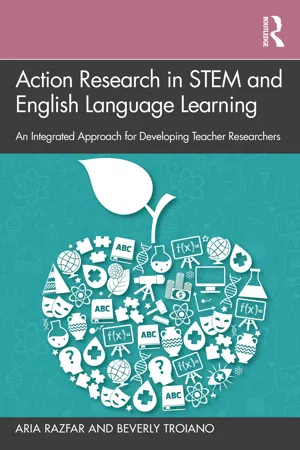
Action Research in STEM and English Language Learning
An Integrated Approach for Developing Teacher Researchers
- 160 pages
- English
- ePUB (mobile friendly)
- Available on iOS & Android
eBook - ePub
Action Research in STEM and English Language Learning
An Integrated Approach for Developing Teacher Researchers
About this book
Information
1 Integrating Language Learning and STEM through Action Research
DOI: 10.4324/9781351001168-1
We begin with final testimonial accounts of the teachers we worked with to reimagine and redesign STEM education that was linguistically and culturally sustaining, adaptive to restrictive mandates, and pedagogically transformative:
We found that teacher collaboration strengthens our abilities as educators. While we initially found ourselves struggling to connect students’ playground funds to the FOSS [mandated] curriculum, Ms. Abby’s science expertise, Ms. Karen’s knowledge of standards and curriculum planning, and Ms. Lorena’s prominence in the community and Spanish language expertise helped us design transformative science curriculum through linguistic and science funds.Karen, First-Grade Teacher, Genesis Elementary [Chapter 2]
I’m more confident in this way of teaching because it’s better for my students. This year I feel like especially with all the changes in middle school [science curriculum] that I am doing what is best for my students and I have proof that inclusion is the best for my students and I think a lot of stuff that we did last year has empowered me to say I am doing what is best for my students. I don’t care what your book says I am doing what is best for them.Dana, Fifth-Grade Special Education [Chapter 3]
Despite the fact that I valued other cultures and languages and had traveled and lived extensively overseas, I did not know how to value students’ home language in my classroom. When I first began encouraging them to use Spanish in the classroom, they were pleasantly surprised. By the end of the year, many comfortably wrote and spoke in Spanish.Susan, Seventh- and Eighth-Grade Language Arts Teacher [Chapter 4]
Language development is so important for English learners … that’s what this action research project pointed out to me. Also, that science is there for them to develop their language and vocabulary.Allison, Eighth-Grade Science Teacher [Chapter 5]
I came to change during the action research project, realizing how important it was to allow students to use their native language to clarify or communicate with classmates. During the beginning of the year, this change began, but ultimately once the project began. I would consistently use Spanish when I could to clarify and to encourage the EL students to speak. I also tried to encourage my African-American students to use African American Vernacular English.Cara, Second-Grade Teacher [Chapter 6]
Introduction
Teachers enter the classroom every day to make an impact on their students’ learning and increasingly more, looking for valuable resources to help engage and enhance their students’ learning outcome(s). In particular, it is becoming more common for teachers to implement an alternative approach to their teaching practice and in turn seeking to do away with teaching paradigms that minimize teacher expertise and their central role in curriculum design. With an increase in students’ lack of interest in the fields of science and mathematics, teachers are looking for more opportunities to implement purposeful and meaningful curriculum that help to create the most gains in the subject areas as well as center their pedagogical and content knowledge (Green, 1983; Kelly & Green, 2019; Shulman, 1986; Silberman, 1973).
Responsiveness to community needs and community engagement have become more prominent metrics in the evaluation of higher-education institutions (Driscoll, 2008). In 2005, after a thorough self-examination, the Carnegie Foundation for the Advancement of Teaching created the Community Engagement Classification as a way to address concerns about the lack of community engagement and insensitivity to the evolution of higher education (Campus Compact, 2016; Driscoll, 2008). This elective classification has given visibility and recognition for co-curricular growth, collaboration, and partnerships; increased student involvement in the community, and leveraged faculty expertise for cutting-edge initiatives that benefit the communities in which universities are located (e.g., Trent, 2020). Over the last 15 years, the Carnegie Foundation’s community engagement classification has altered how we view the purpose of higher education (Driscoll, 2014). It has brought promise and prestige to community engagement, and now there are 361 universities with this classification (Vann & Firth, n.d.).
With the increase of diversity among students in urban contexts, for more than a decade, projects Learning Science through Math and Action Research (LSciMAct, 2007–2012)1 and English Learning through Mathematics, Science, and Action Research (ELMSA, 2012–2017),2 sponsored by the U.S Department of Education, Office of English Language Acquisition, set out to facilitate resources to educators wanting to make an impact in the classroom for their English learners (ELs). In addition, these projects answer a broader national call to integrate literacy and STEM education (National Research Council, 2014).
Over 100 teachers across 26 schools have participated in these action research projects designed to provide long-term professional development for K–8 teachers working with ELs in predominantly low-income areas (Razfar, 2007, 2011). Between 2009 and 2020, eight dissertations and more than 100 master’s theses based on these action research projects were written (Razfar & Li, 2017; Razfar & Li, 2014). In contrast to off-the-shelf, cookie-cutter curriculum, our aim was to empower teachers to become researchers and designers of authentic curricular activities that fostered learning for all participants: teachers, students, and university-based researchers. Our goal was to cultivate a systematic approach, which implements curricular activities based on students’ funds of knowledge and national mathematics, science, and literacy standards. This model for professional development focuses on integrating instructional knowledge from the fields of bilingual and English as a Second Language (ESL) education, mathematics education, and science education, with teachers doing action research and developing collegial communities. Our professional development program sought to engage teachers in a transformative action research model that explicitly linked literacy, mathematics, and science through sociocultural principles of teaching and learning.
Furthermore, these cases have broader applicability and implications beyond the schools and communities in which they were situated. They are part of a teacher professional development movement that goes beyond methods fetish (Bartolomé, 1994; Wells, 2000). Our professional development sought to go beyond simply “PD” by actively co-creating processes that lead to continuous opportunities for teachers and university researchers to develop professionally together (Green, Camilli, & Elmore, 2012). This book is the product of continuous dialogues over the last 15 years with teachers and teacher educators. It is a metanarrative of cultural practices, identity shifts, and processes that aim to fundamentally humanize K–12 education. By humanizing, we mean centering teacher expertise, student learning, and community epistemologies (Bartolomé, 1994). More specifically, the challenge is to provide a well-suited curriculum for English learner (EL) students. The preparation of teachers for linguistically and culturally diverse populations has been the subject of a growing body of research and discussion over the last six decades (Brisk, 2008; Cochran-Smith, Fieman-Nemser, McIntyre, & Demers, 2008, Green, 1983; Gupta, 2020; Silberman, 1973). As the increase in diversity becomes apparent in our classrooms across the country, the need for alternative approaches to teaching are of great need. For decades, teacher educators have been calling for an educational approach that is less focused on information transfer and more centered on relational cultural practices and humanizing values (Blume, 1971; Freire, 1993).
Humanizing teacher education and professional development is an intentional and strategic move away from deficit views of teachers and K–12 education. One way this is accomplished is when university-based researchers are embedded in authentic, empathetic, and committed partnerships with schools and communities (Andrews, Brown, Castillo, Jackson, & Vellanki, 2019; Mirra, 2018). We demonstrate throughout how participatory action research humanizes research and university-based researchers in contexts that are often dehumanizing (Irizarry & Brown, 2013). It emphasizes the unique role of university-based research partners to create opportunities for learning, growth, and development in spaces that have been historically constrained at best and dehumanizing at worst (Paris & Winn, 2013). Universi...
Table of contents
- Cover Page
- Half Title page
- Title Page
- Copyright Page
- Contents
- Acknowledgments
- Authors
- Contributors
- Foreword
- 1 Integrating Language Learning and STEM through Action Research
- 2 Teaching Math and Science Through Playground Activism
- 3 Community Renewable Energy Designing Solar Panels Through Science-Funds of Knowledge
- 4 Preparing the Next Generation of City Planners and Tech-Savvy Teachers
- 5 From IRE to Conversational Shifting Classroom Discourse Through Community-Based Forensics Expertise
- 6 From Weslandia to Urban Gardening Shifting Teacher Language Ideologies Through Ecological Science and Third Space
- 7 Sustaining Teaching Excellence and Professional Identity Across Time and Space From Reporting to Sharing
- 8 Breaking the Fourth Wall Rebuilding University and School Partnerships Through Action Research
- Epilogue
- Appendix A Activity Triangle Template
- Appendix B Fund of Knowledge Inventory Table
- Appendix C Social Organization of Learning Protocol (Adapted from Razfar)
- Appendix D Field-Note Observation Template
- Appendix E Coding Sheet Template
- Appendix F Discourse Analysis Transcription Conventions
- Appendix G Unit Planning
- Appendix H Final Reporting Tools
- Index
Trusted by 375,005 students
Access to over 1.5 million titles for a fair monthly price.
Study more efficiently using our study tools.
Frequently asked questions
Yes, you can cancel anytime from the Subscription tab in your account settings on the Perlego website. Your subscription will stay active until the end of your current billing period. Learn how to cancel your subscription
No, books cannot be downloaded as external files, such as PDFs, for use outside of Perlego. However, you can download books within the Perlego app for offline reading on mobile or tablet. Learn how to download books offline
Perlego offers two plans: Essential and Complete
- Essential is ideal for learners and professionals who enjoy exploring a wide range of subjects. Access the Essential Library with 800,000+ trusted titles and best-sellers across business, personal growth, and the humanities. Includes unlimited reading time and Standard Read Aloud voice.
- Complete: Perfect for advanced learners and researchers needing full, unrestricted access. Unlock 1.5M+ books across hundreds of subjects, including academic and specialized titles. The Complete Plan also includes advanced features like Premium Read Aloud and Research Assistant.
We are an online textbook subscription service, where you can get access to an entire online library for less than the price of a single book per month. With over 1.5 million books across 990+ topics, we’ve got you covered! Learn about our mission
Look out for the read-aloud symbol on your next book to see if you can listen to it. The read-aloud tool reads text aloud for you, highlighting the text as it is being read. You can pause it, speed it up and slow it down. Learn more about Read Aloud
Yes! You can use the Perlego app on both iOS and Android devices to read anytime, anywhere — even offline. Perfect for commutes or when you’re on the go.
Please note we cannot support devices running on iOS 13 and Android 7 or earlier. Learn more about using the app
Please note we cannot support devices running on iOS 13 and Android 7 or earlier. Learn more about using the app
Yes, you can access Action Research in STEM and English Language Learning by Aria Razfar,Beverly Troiano in PDF and/or ePUB format, as well as other popular books in Education & Education General. We have over 1.5 million books available in our catalogue for you to explore.