Providing vital reading for audio students and trainee engineers, Sound and Recording is the essential guide for anyone who wants a solid grounding in both theory and industry practices in audio, sound, and recording. This updated and comprehensively restructured edition includes new content on DAW configuration, effects processing, 3D/immersive audio systems, object-based audio, and VR audio technology.
This bestselling book introduces you to the principles of sound, perception, audio technology, and systems. Sound and Recording is the ideal audio engineering text for students, an accessible reference for professionals, and a comprehensive introduction for hobbyists.
This chapter offers an introduction to some of the basic principles of audio and acoustics, such as the nature of sound in the air and in electrical form, and some units, measurements, and laws that are useful for understanding explanations in the rest of the book.
A Vibrating Source
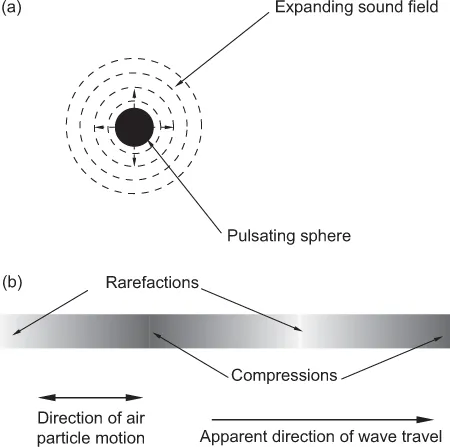
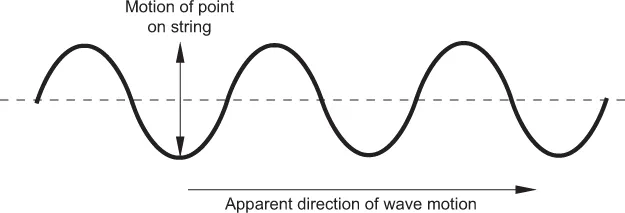
Sound is produced when an object (the source) vibrates and causes the air around it to move. Consider the sphere shown in Figure 1.1. It is a pulsating sphere which could be imagined as something like a squash ball, and it is pulsating regularly so that its size oscillates between being slightly larger than normal and then slightly smaller than normal. As it pulsates, it will alternately compress and then rarefy the surrounding air, resulting in a series of compressions and rarefactions traveling away from the sphere, rather like a three-dimensional version of the ripples which travel away from a stone dropped into a pond. These are known as longitudinal waves since the air particles move in the same dimension as the direction of wave travel. The alternative to longitudinal wave motion is transverse wave motion (see Figure 1.2), as found in vibrating strings, where the motion of the string is at right angles to the direction of apparent wave travel.
FIGURE 1.1 a) A simple sound source can be imagined to be like a pulsating sphere radiating spherical waves. (b) The longitudinal wave thus created is a succession of compressions and rarefactions of the air.
FIGURE 1.2 In a transverse wave, the motion of any point on the wave is at right angles to the apparent direction of motion of the wave
Characteristics of a Sound Wave
The rate at which the source oscillates is the frequency of the sound wave it produces, and is quoted in hertz (Hz) or cycles per second (cps). 1000 Hz is termed 1 kilohertz (1 kHz). The amount of compression and rarefaction of the air which results from the sphere’s motion is the amplitude of the sound wave, and is related to the loudness of the sound when it is finally perceived by the ear (see Chapter 2). The distance between two adjacent peaks of compression or rarefaction as the wave travels through the air is the wavelength of the sound wave, and is often represented by the Greek letter lambda (λ). The wavelength depends on how fast the sound wave travels, since a fast-traveling wave would result in a greater distance between peaks than a slow-traveling wave, given a fixed time between compression peaks (i.e. a fixed frequency of oscillation of the source).
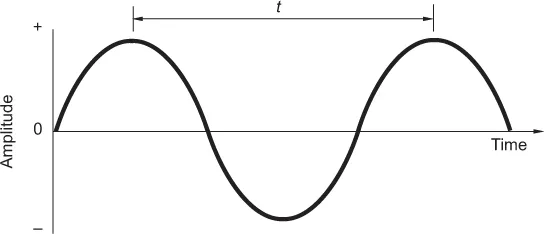
As shown in Figure 1.3, the sound wave’s characteristics can be represented on a graph, with amplitude plotted on the vertical axis and time plotted on the horizontal axis. It will be seen that both positive and negative ranges are shown on the vertical axis: these represent compressions (+) and rarefactions (−) of the air. This graph represents the waveform of the sound. For a moment, a source vibrating in a very simple and regular manner is assumed, in so-called simple harmonic motion, the result of which is a simple sound wave known as a sine wave. The simplest vibrating systems oscillate in this way, such as a mass suspended from a spring, or a swinging pendulum. It will be seen that the frequency (f) is the inverse of the time between peaks or troughs of the wave (f = 1/t). So, the shorter the time between oscillations of the source, the higher the frequency. The human ear is capable of perceiving sounds with frequencies between approximately 20 Hz and 20 kHz (see ‘Frequency Perception’, Chapter 2); this is known as the audio frequency range or audio spectrum.
FIGURE 1.3 A graphical representation of a sinusoidal sound waveform. The period of the wave is represented by t, and its frequency by 1/t.
How Sound Travels in Air
Air is made up of gas molecules and has an elastic property (imagine putting a thumb over the end of a bicycle pump and compressing the air inside — the air is springy). Longitudinal sound waves travel in air in somewhat the same fashion as a wave travels down a row of up-ended dominoes after the first one is pushed over. The half-cycle of compression created by the vibrating source causes successive air particles to be moved in a knock-on effect, and this is normally followed by a balancing rarefaction which causes a similar motion of particles in the opposite direction.
It may be appreciated that the net effect of this is that individual air particles do not actually travel — they oscillate about a fixed point — but the result is that a wave is formed which appears to move away from the source. The speed at which it moves away from the source depends on the density and elasticity of the substance through which it passes, and in air, the speed is relatively slow compared with the speed at which sound travels through most solids. In air, the speed of sound is approximately 340 meters per second (m s−1), although this depends on the temperature of the air. At freezing point, the speed is reduced to just above 330 m s−1. In steel, to give an example of a solid, the speed of sound is approximately 5100 m s−1.
The frequency and wavelength of a sound wave are related very simply if the speed of the wave (usually denoted by the letter c) is known:
To show some examples, the wavelength of sound in air at 20 Hz (the low-frequency or LF end of the audio spectrum), assuming normal room temperature, would be
whereas the wavelength of 20 kHz (at the high-frequency or HF end of the audio spectrum) would be 1.7 cm. Thus, it is apparent that the wavelength of sound ranges from being very long in relation to most natural objects at low frequencies, to quite short at high frequencies. This is important when considering how sound behaves when it encounters objects — whether the object acts as a barrier or whether the sound bends around it (see Fact File 1.5).
Simple and Complex Sounds
In the foregoing example, the sound had a simple waveform — it was a sine wave or sinusoidal waveform — the type which might result from a very simple vibrating system such as a weight suspended on a spring. Sine waves have a very pure sound because they consist of energy at only o...
Table of contents
Cover
Half Title
Series Page
Title Page
Copyright Page
Table of Contents
Fact File Directory
Preface to the Second Edition
Preface to the Third Edition
Preface to the Fourth Edition
Preface to the Fifth Edition
Preface to the Sixth Edition
Preface to the Seventh Edition
Preface to the Eighth Edition
Chapter 1 Audio and Acoustics
Chapter 2 Auditory Perception and Sound Quality
Chapter 3 Microphones
Chapter 4 Loudspeakers
Chapter 5 Digital Audio Principles
Chapter 6 Digital Recording and Editing Systems
Chapter 7 Mixing, Metering, and Signal Levels
Chapter 8 Signal Processing and Effects
Chapter 9 Audio Data Reduction
Chapter 10 Digital Audio Interfaces and Networking
Chapter 11 Analog Lines and Interconnection
Chapter 12 Power Amplifiers
Chapter 13 MIDI and Musical Instrument Control
Chapter 14 Synchronization
Chapter 15 Two-Channel Stereo
Chapter 16 Surround Sound and Immersive Audio
Appendix Analog Recording and Reproduction Systems
Glossary
Index
Trusted by 375,005 students
Access to over 1.5 million titles for a fair monthly price.
Study more efficiently using our study tools.
Frequently asked questions
Yes, you can cancel anytime from the Subscription tab in your account settings on the Perlego website. Your subscription will stay active until the end of your current billing period. Learn how to cancel your subscription
No, books cannot be downloaded as external files, such as PDFs, for use outside of Perlego. However, you can download books within the Perlego app for offline reading on mobile or tablet. Learn how to download books offline
Perlego offers two plans: Essential and Complete
Essential is ideal for learners and professionals who enjoy exploring a wide range of subjects. Access the Essential Library with 800,000+ trusted titles and best-sellers across business, personal growth, and the humanities. Includes unlimited reading time and Standard Read Aloud voice.
Complete: Perfect for advanced learners and researchers needing full, unrestricted access. Unlock 1.5M+ books across hundreds of subjects, including academic and specialized titles. The Complete Plan also includes advanced features like Premium Read Aloud and Research Assistant.
Both plans are available with monthly, semester, or annual billing cycles.
We are an online textbook subscription service, where you can get access to an entire online library for less than the price of a single book per month. With over 1.5 million books across 990+ topics, we’ve got you covered! Learn about our mission
Look out for the read-aloud symbol on your next book to see if you can listen to it. The read-aloud tool reads text aloud for you, highlighting the text as it is being read. You can pause it, speed it up and slow it down. Learn more about Read Aloud
Yes! You can use the Perlego app on both iOS and Android devices to read anytime, anywhere — even offline. Perfect for commutes or when you’re on the go. Please note we cannot support devices running on iOS 13 and Android 7 or earlier. Learn more about using the app
Yes, you can access Sound and Recording by Francis Rumsey in PDF and/or ePUB format, as well as other popular books in Physical Sciences & Digital Media. We have over 1.5 million books available in our catalogue for you to explore.