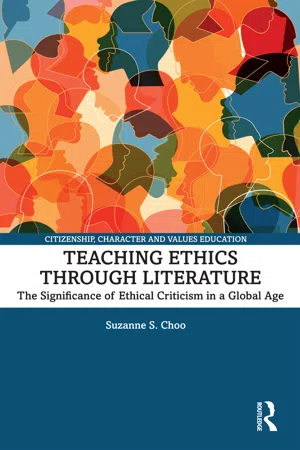
Teaching Ethics through Literature provides in-depth understanding of a new and exciting shift in the fields of English education, Literature, Language Arts, and Literacy through exploring their connections with ethics. The book pioneers an approach to integrating ethics in the teaching of literature. This has become increasingly relevant and necessary in our globally connected age. A key feature of the book is its integration of theory and practice. It begins with a historical survey of the emergence of the ethical turn in Literature education and grounds this on the ideas of influential Ethical Philosophers and Literature scholars. Most importantly, it provides insights into how teachers can engage students in ethical concerns and apply practices of Ethical Criticism using rich on-the-ground case studies of high school Literature teachers in Australia, Singapore and the United States.
eBook - ePub
Teaching Ethics through Literature
The Significance of Ethical Criticism in a Global Age
- 200 pages
- English
- ePUB (mobile friendly)
- Available on iOS & Android
eBook - ePub
Teaching Ethics through Literature
The Significance of Ethical Criticism in a Global Age
About this book
Information
1
Introduction
The significance of ethics in the teaching of literature
At the start of the third decade of the twenty-first century, the world was gripped by news of a bushfire that rapidly evolved to an uncontrolled wildfire. At first, this appeared to be a national affair affecting Australia, where fires destroyed 3,000 homes and killed over a billion animals. Later, this devastation that started in such inconsequential ways became a preview to another kind of global inferno that would spread a few months later. The rapid combustion of the world began in small ways in the form of a novel respiratory disease that was first reported in Wuhan, a province in Hubei, China, in January 2020. Three months later, the Coronavirus had infected over half a million people in almost every continent in the world with the World Health Organization declaring it a pandemic (Sam et al., 2020).
In the race to treat the infections, governments and major transnational organizations have focused on providing funding to support scientific research and development. In the United States, Congress passed an $8.3 billion emergency response bill to support the development of medical countermeasures, vaccines, and purchase of diagnostic tests among others. The European Union opened an emergency call for research to treat Covid-19 with funding up to €47.5 million. Major companies and academic institutions have also rallied to support such scientific endeavours. The Gates Foundation, for example, partnered with credit card company MasterCard in a $125 million push to speed up the development of drugs for treating infections (European Union, 2020; Geulette, 2020).
In major global crisis, the prevailing view is that science needs to be invested in and counted on for providing informed evidence in tackling the unknown. While science is the harbinger of hope, the arts is dispensable and can be temporarily suspended. Thus, theatre companies, dance troupes, music ensembles, film and other arts groups have cancelled performances in the face of nation-wide lockdowns. Arts organizations have called on governments to provide emergency funding in response to closures, cancelled tours, international festivals, and the probability of bankruptcy. Yet, the perception remains that the arts is associated with an “entertainment” industry which, in disaster situations, is deemed “non-essential” and should take a backseat. In Maslow’s Hierarchy of Needs (1943), the arts address higher levels of need for love and belonging and are less crucial to meeting basic physiological and safety needs.
This age-old view of the arts as connected to pleasure and of literature as associated with an elitist appreciation of belles letters or beautiful writing should today be problematized. If not, the arts risk becoming obsolete and marginalized in an age when global risks are increasingly becoming part and parcel of everyday realities. As Ulrich Beck (2014) argues, “Being at risk is the way of being and ruling in the world of modernity; being at global risk is the human condition at the beginning of the twenty-first century” (p. 80). As the world has become hyper-connected, globalization can no longer be conceived as an external phenomenon, the glocalization of the everyday pushes individuals to encounter, live with, and accommodate foreign others. Beck (2007) describes this as “enforced cosmopolitanization” in which “global risks activate and connect actors across borders, who otherwise don’t want to have anything to do with one another” (p. 287).
While the arts perform multiple roles in society – to engage the senses, to expand the imagination, to entertain, to escape, to critique, and so on – in the context of an interconnected age, I argue that the arts must respond more prominently and intentionally to global risks. In this light, the most significant value of the arts is in developing the kinds of critical, social, and ethical dispositions that mitigate intolerance, discrimination, and forms of institutional, symbolic, social, and historical violence arising from global crisis. This book focuses specifically on the teaching of English Literature although its principles may be applied to other areas in arts education such as Drama, Dance, Film, Fine Arts, and Music. For the sake of clarity, I capitalize the term “Literature” to refer to the subject English Literature while the non-capitalized form “literature” refers to literary texts. The primary focus in this book is how ethics can be taught and ethical dispositions cultivated through Literature.
For much of the twentieth century, engagements with ethical concerns and moral values have largely been excluded from the Literature curriculum. This may be attributed to two dominant approaches to teaching literature particularly in schools – New Criticism and Reader Response Criticism. New Criticism became popular around the 1930s and 1940s as influenced by I. A. Richards, T. S. Eliot, John Crowe Ransom, among others. The New Critics advanced a disconnected practice of close reading and positioned the text as an autonomous, self-contained entity. A Literature student is to avoid the intentional fallacy, which involves considerations of the author’s context and his or her intentions in literary analysis; similarly, the student is to avoid the affective fallacy by leaving impressionistic feelings at bay and remaining a disinterested reader of texts (Wimsatt & Beardsley, 1947/2001).
In the 1970s, Reader Response Criticism countered New Criticism’s passive approach to interpretation. Louise Rosenblatt (1988), a leading scholar of the movement, highlights the point that texts are not isolated entities and that readers bring to the text past linguistic and life experiences. Readers and texts coexist in a transactional relationship. In contrast to “efferent reading” in which the reader approaches the text in a utilitarian manner such as the way one treats a recipe or car manual, literary reading can promote “aesthetic reading” in which the reader’s emotions, experiences, and imagination are evoked leading to immersive rather than detached responses to texts (Rosenblatt, 1978).
Broadly, both approaches popularized text and reader-centric ways of teaching literature that emphasized aesthetic appreciation of the stylistic properties of texts and aesthetic engagement, tapping on readers’ responses to texts. Both approaches continue to influence Literature curriculum and assessment. Take, for example, a typical question in the New York State’s Regents High School Examination (2020) in English Language Arts:
write a well-developed, text-based response of two to three paragraphs. In your response, identify a central idea in the text and analyze how the author’s use of one writing strategy (literary element or literary technique or rhetorical device) develops this central idea.
(p. 21)
To answer such a question, the student must apply New Criticism’s close analysis of the stylistic properties of texts. Similarly, in the Cambridge International General Certificate of Secondary Education (IGCSE) Literature in English examination, some questions are entirely centred on the formal properties of text such as the following based on Jane Austen’s Northanger Abbey:
Mr and Mrs Allen are supposed to be looking after Catherine in Bath. To what extent does Austen’s writing persuade you that they do this successfully?
(Cambridge Assessment International Education, 2020, p. 11)
Other questions involve a blend of New Criticism and Reader Response Criticism such as the following based on an anthology of short stories:
What does the writer make you feel about either Mr Twycott in The Son’s Veto (by Thomas Hardy) or the husband in Sandpiper (by Ahdaf Soueif)?
(Cambridge Assessment International Education, 2020, p. 25).
Here, students must explore their own responses to texts and support this through close textual exegesis. Such questions reflect two of the key aims of the syllabus that are for students to “communicate an informed personal response appropriately and effectively” and “appreciate different ways in which writers achieve their effects” (Cambridge Assessment International Education, 2019, p. 5).
Absent from text and reader-centric-type questions are what I term “other-centric” questions (Choo, 2013) that push students to bridge the gap between fictional texts and real-world in order to empathize and engage with diverse others and their ethical concerns. Today, there is even greater pressure to challenge Literature’s absorption in the fictional lifeworld of texts and validation of readers’ responses. Recovering the close interconnection between Literature and ethics has become especially crucial today because of what I proceed to describe as the three pressure points that have countered traditional approaches to teaching literature.
The three pressure points catalyzing reform in Literature
The pressure to reclaim relevance
The first concerns the increasing pressure to reclaim Literature’s relevance in the context of an intensely globalized twenty-first century. In recent years particularly, debates concerning the value of Literature have garnered increasing attention. Once described as the “supremely civilizing pursuit” and the most central subject in American and British schools (Applebee, 1974; Eagleton, 1996, p. 27), Literature appears to have now lost its place of prominence. Already in 1987, a report commissioned by the United States Congress found that History, Literature, and Languages were inadequately taught in public schools (Cheney, 1987). Years later, another influential report, Reading at Risk, by the National Endowment for the Arts (2004) provided a comprehensive survey of literary reading and reported “solid evidence of the declining importance of Literature to the [country’s] populace” (p. ix). This decline had occurred among all education levels from grade school to college over the past 20 years. Three years later, another study found that nearly half of all Americans aged 18–24 read no books for pleasure and the percentage who read a book not required for work or school had declined at a rate of 12% from 1992 to 2002 (National Endowment for the Arts, 2007). Although the latest report (National Endowment for the Arts, 2009) revealed a reversal of this declining trend, figures still showed that students were turning away from majoring in Literature and the Humanities in favour of Sciences at colleges (Chace, 2009; Lewin, 2013; Simpson & Kelly, 2013).
Even in the United Kingdom, the number of students enrolled in GCSE English Literature Advanced Level examination, a high-stakes nationwide examination taken at the end of secondary education, dropped from 77% in 2004 to 72% in 2009, which is equivalent to one in four students opting out of taking the subject (Curtis, 2009). Further, a review of examination papers by the Office of Qualifications and Examinations Regulation, an independent watchdog, reported the lack of rigour in assessment since questions appeared too formulaic and predictable. Scholars also charged that the curriculum had not progressed since the 1950s and still continued to assess students on the traditional analysis of themes, plot, character, and style at the secondary level which was out of sync with the integration of literary theory at college level (Ballinger, 2003; Eaglestone & McEvoy, 1999). The most scathing attack was made by the National Association of Teachers of English (NATE) that recommended GCSE English Literature be discontinued at the Advanced Level since the subject relied on a narrow list of texts, failed to give students the requisite skills for college, and had little relevance to contemporary society (Bluett, Cockcroft, Harris, Hodgson, & Snapper, 2006; Garner, 2005).
In Australia, it is compulsory for high school students to take either English or English Literature. In 2018, only 1,400 Year 12 students opted to study Literature compared to 11,000 who opted to study English. The English Teachers Association of Western Australia reported that the percentage of Year 12 students plummeted from 26% in 1998 to 11% in 2017 and the number of schools offering Literature dropped from 135 in 2001 to 97 in 2017 (Hiatt, 2018).
Similarly, in Singapore where English Language is a compulsory first language subject and the main medium of instruction in primary and secondary schools, the number of students enrolled in the national Literature in English examination dropped from 48% in 2002 to 9% in 2012 (Heng, 2013).1 A national survey on Singapore teenagers’ reading habits found that more than once a week, only 25% read fiction books compared to 51% who read online articles posted on social media or websites (National Library Board, 2017, p. 15).
This bleak picture of Literature has spurred numerous books and opinion articles that range from grim prophesies about the death of Literature (Kernan, 1990; Scholes, 1998) and cynical questions concerning “Will the Humanities save us?” (Fish, 2008) to passionate defences about why democracy needs the Humanities (Nussbaum, 2010). As Alvin Kernan (1990) already anticipated, the decline would open the way for a renewed vision of Literature that would “claim for the traditional literary works a place of some importance and usefulness in individual life and society as whole” (p. 213). For Martha Nussbaum (1997), this usefulness must address the question of “what sorts of literary works, and what sort of teaching of those works, our academic institutions should promote in order to foster an informed and compassionate vision of the different” (p. 89).
Along these lines, organizations such as the American Academy of Arts & Sciences were commissioned by the United States government to counterbalance state investments in the STEM (Science, Technology, Engineering, and Mathematics) disciplines. Part of its goal was to propose ways in which the Humanities can empower students to contribute to twenty-first century democracy by expanding their understanding of diverse cultures. Essentially, these calls for Literature’s relevance to social realities have meant that Literature can no longer remain purely insulated with its focus on aesthetic texts and language. Scholars have argued that the scope of Literature should expand to include newer textual modes such as video games, graphic novels, hypermedia, etc. (Swenson, Young, McGrail, Rozema, & Whitin, 2006). Other scholars have argued the need to emphasize textual and discourse analysis so that students would be equipped to read, interpret, and criticize texts in all forms of modes and media (Holden, 1999; Scholes, 1998). Broadly, the decline of Literature has revived new global positioning strategies in response to a fast-changing, increasingly complex and connected age.
The pressure to globalize
As an extension of the need to uncover new relevance for Literature, the second reason why ethics has become an important focus in teaching literature lies in the pressure to promote Global Citizenship Education. Growing consciousness of cross-cultural volatility has arisen as a result of the intensification of twenty-first century globalization. As the world headed into the third millennium, key globalization studies scholars concurred that there was now a greater perception of the world as a whole (Robertson, 1992), a growing movement “by which the peoples of the world are incorporated into a single world society” (Albrow & King, 1990, p. 9), and an “intensification of social relations throughout the world linking distant localities” (Giddens, 1991, p. 64). The “flattening” of the world (Friedman, 2007) also exacerbated rising instances of extremism, fundamentalism, and xenophobia worldwide.
Concerns about the effects of globalization led to increasing calls by governments, policymakers, and educators of the need to invest in Global Citizenship Education. This umbrella term encompasses Global Education, Human Rights Education, Peace Education, Environmental Education, among others (Fricke, Gathercole, & Skinner, 2015; Hicks, 2003). Global Citizenship Education essentially advocates that issues should be explored from a globally oriented perspective and that this should not just occur via subjects such as Social Studies or Civics Education but should be integrated into all subjects in the curriculum (Choo, 2017b). Frameworks by the Organisation for Economic Co-operation and Development (OECD) and Partnership for Twenty-first Century Learning (P21), founded by the United States Department of Education in collaboration with multinational corporations such as Apple Computer, Microsoft Corporation, Time Warner Foundation, etc., have been influential in spreading awareness about the need to infuse core twenty-first century skills and competencies in all aspects of teaching and learning. These twenty-first century competencies include intercultural competencies such as learning to “interact in heterogeneous groups” (OECD, 2005, p. 5) and “global awareness” (Partnership for 21st Century Skills (P21), 2013, p. 5).
Global Citizenship Education’s influence ...
Table of contents
- Cover
- Half Title
- Series
- Title
- Copyright
- Contents
- Illustrations
- Acknowledgements
- Series editor’s foreword
- Foreword
- 1 Introduction: the significance of ethics in the teaching of literature
- 2 Objectives: ethics as the philosophical end of Literature education
- 3 Curriculum: developing cosmopolitan-mindedness through ethical inquiry
- 4 Texts: applying Ethical Criticism to interpreting literature
- 5 Pedagogy: building a critical-ethical community of readers
- 6 Values: developing ethical character through dispositional routines
- 7 Conclusion: Literature education and the hospitable imagination
- Appendix A: Profile of Teachers
- Bibliography
- Index
Trusted by 375,005 students
Access to over 1.5 million titles for a fair monthly price.
Study more efficiently using our study tools.
Frequently asked questions
Yes, you can cancel anytime from the Subscription tab in your account settings on the Perlego website. Your subscription will stay active until the end of your current billing period. Learn how to cancel your subscription
No, books cannot be downloaded as external files, such as PDFs, for use outside of Perlego. However, you can download books within the Perlego app for offline reading on mobile or tablet. Learn how to download books offline
Perlego offers two plans: Essential and Complete
- Essential is ideal for learners and professionals who enjoy exploring a wide range of subjects. Access the Essential Library with 800,000+ trusted titles and best-sellers across business, personal growth, and the humanities. Includes unlimited reading time and Standard Read Aloud voice.
- Complete: Perfect for advanced learners and researchers needing full, unrestricted access. Unlock 1.5M+ books across hundreds of subjects, including academic and specialized titles. The Complete Plan also includes advanced features like Premium Read Aloud and Research Assistant.
We are an online textbook subscription service, where you can get access to an entire online library for less than the price of a single book per month. With over 1.5 million books across 990+ topics, we’ve got you covered! Learn about our mission
Look out for the read-aloud symbol on your next book to see if you can listen to it. The read-aloud tool reads text aloud for you, highlighting the text as it is being read. You can pause it, speed it up and slow it down. Learn more about Read Aloud
Yes! You can use the Perlego app on both iOS and Android devices to read anytime, anywhere — even offline. Perfect for commutes or when you’re on the go.
Please note we cannot support devices running on iOS 13 and Android 7 or earlier. Learn more about using the app
Please note we cannot support devices running on iOS 13 and Android 7 or earlier. Learn more about using the app
Yes, you can access Teaching Ethics through Literature by Suzanne S. Choo in PDF and/or ePUB format, as well as other popular books in Education & Education General. We have over 1.5 million books available in our catalogue for you to explore.