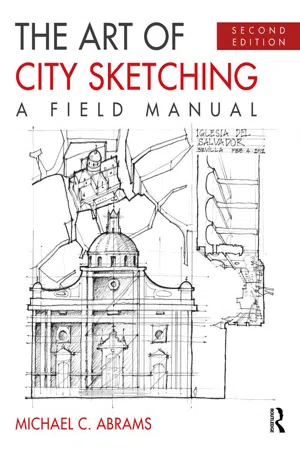
The Art of City Sketching: A Field Manual guides readers through the process of freehand architectural sketching and explains orthographic, diagrammatic, three-dimensional, and perceptual-type drawings. The book presents hundreds of drawings of historic buildings and urban spaces, examples, and exercises, which help readers develop their drawing skills and employ sketching as an analytical tool. The book is divided into three parts, based on the reader's skill level: beginner, intermediate, and advanced. As an architect and field sketching instructor, the author shows that through drawing the reader can discover, analyze, and comprehend the built environment.
The new edition of The Art of City Sketching expands on the drawing techniques of the previous version by adding new drawing examples, exercises, and two new chapters—Chiaroscuro and Storyboard. New drawing tips, demonstrations, and composition "do's and don'ts" will support readers when they illustrate their viewpoint of the city by using simple drawing tools. The lessons in this book will allow readers to mix method with imagination and sensibility.
Trusted by 375,005 students
Access to over 1 million titles for a fair monthly price.
Learning a new skill, whether it is playing an instrument, dancing, or drawing requires determination, skill, patience, and practice … lots of practice!
Part I of The Art of City Sketching is geared towards all beginners interested in sketching but uncertain of their drawing skills and visualization techniques. Part I helps these readers interpret the built environment through orthographic projections. Orthographic projections describe multiple views of an object, space, or building on a flat drawing surface using only two dimensions. These drawings project exterior and interior views of a subject. Unlike perspectives, orthographic drawings are not actual depictions of a subject at eye level. Instead, they are abstract illustrations of a subject from beyond the viewer’s optical capacity, projecting a unique depiction of that subject on paper. Hence, two-dimensional drawings allow an objective study of a building’s shape, attributes, components, and context.
The goals of Part I are twofold (1) to familiarize the reader with two-dimensional drawings (i.e., elevations, sections, and plans), and (2) to graphically document and analyze the built environment. Each chapter of Part I explores a specific orthographic drawing type and illustrates the potential of each drawing type to study and examine a building or place.
Each chapter presents a list of line types used to generate two-dimensional drawings, as well as the proper line weight value. In addition, all chapters provide numerous drawing examples, step-by-step demonstrations, and technical tips, while attendant exercises continually challenge the reader’s drawing and composition skills.
1.0 Analytical diagrams of the Church of San Giorgio Maggiore in Venice, Italy
Lesson 1: Elevations
Objectives
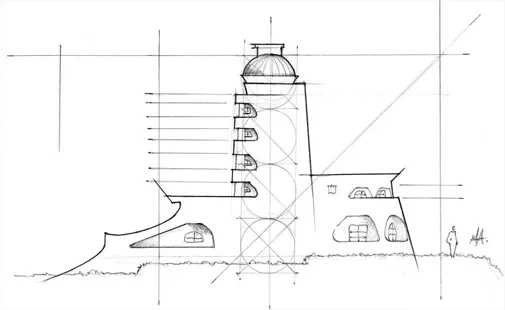
This introductory chapter teaches readers how to analyze and sketch building façades or elevations. Elevations investigate and dissect a building’s façade and its components. This process takes imagination, creativity, practice, and a comprehensive look into its architectural, structural, and ornamental elements. Lesson 1 examines the process of creating elevations using three basic design principles: proportion, geometry, and regulating lines.
1.1 Elevation sketch of the Einstein Tower in Potsdam, Germany
The application section in this chapter explains the proper line work used to create elevations. With the aid of several illustrations, this chapter provides the necessary tools to study and analyze existing building façades. All exercises should be completed in the sketchbook.
At the end of Lesson 1, readers will be able to analyze and draw well-proportioned building elevations, and apply proper line weight value.
Introduction: What is an elevation?
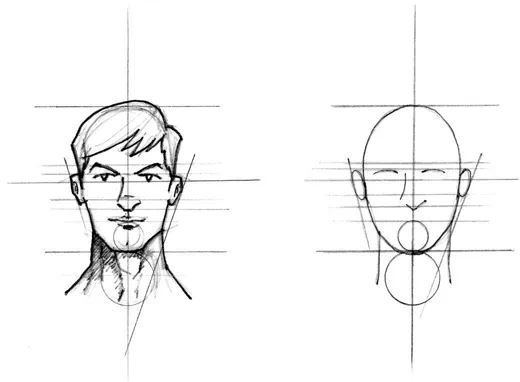
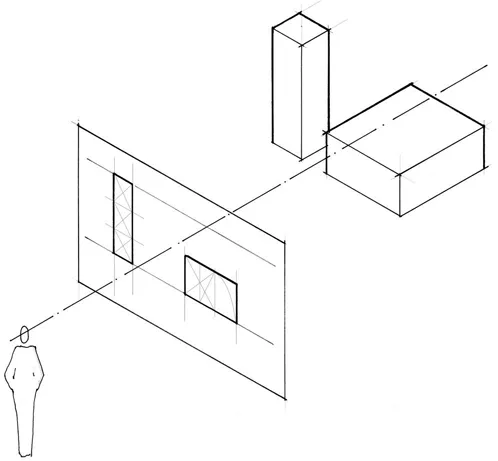
An elevation depicts a two-dimensional projection of a three-dimensional object, building, or site. Elevations illustrate the height and width or the height and length of a subject. To put it simply, an elevation is a flat, orthographic projection, or the expression of a sketch on one geometrical plane, that illustrates the façade, or face, of a subject (Figures 1.2, 1.3).
1.2 Use geometry and regulating lines to draw a face in elevation
1.3 Depiction of façades on paper
A façade marks a clear division between public and private realms. It stands between the exterior public space and the interior private spaces of the building. Over time a building’s façade can develop into a city symbol or landmark. For example, the façade of a building projects the philosophy of the building (e.g., Christianity for a church) and the affluence of the community. Collectively, building façades define a public space (e.g., street, boulevard, or city square) and provide an aesthetic character to that public space and city. A sleek...
Table of contents
Cover
Half Title
Title Page
Copyright Page
Dedication
Contents
About the Author
Foreword by Andrea Ponsi
Preface
Acknowledgments
Contributors
Introduction
Sketching Supplies
General Drawing Tips
Part I Beginner: Orthographic Projection
Part II Intermediate: 3D Projection
Part III Advanced: Perceptual Projection
Conclusion
Bibliography
Index
Frequently asked questions
Yes, you can cancel anytime from the Subscription tab in your account settings on the Perlego website. Your subscription will stay active until the end of your current billing period. Learn how to cancel your subscription
No, books cannot be downloaded as external files, such as PDFs, for use outside of Perlego. However, you can download books within the Perlego app for offline reading on mobile or tablet. Learn how to download books offline
Perlego offers two plans: Essential and Complete
Essential is ideal for learners and professionals who enjoy exploring a wide range of subjects. Access the Essential Library with 800,000+ trusted titles and best-sellers across business, personal growth, and the humanities. Includes unlimited reading time and Standard Read Aloud voice.
Complete: Perfect for advanced learners and researchers needing full, unrestricted access. Unlock 1.4M+ books across hundreds of subjects, including academic and specialized titles. The Complete Plan also includes advanced features like Premium Read Aloud and Research Assistant.
Both plans are available with monthly, semester, or annual billing cycles.
We are an online textbook subscription service, where you can get access to an entire online library for less than the price of a single book per month. With over 1 million books across 990+ topics, we’ve got you covered! Learn about our mission
Look out for the read-aloud symbol on your next book to see if you can listen to it. The read-aloud tool reads text aloud for you, highlighting the text as it is being read. You can pause it, speed it up and slow it down. Learn more about Read Aloud
Yes! You can use the Perlego app on both iOS and Android devices to read anytime, anywhere — even offline. Perfect for commutes or when you’re on the go. Please note we cannot support devices running on iOS 13 and Android 7 or earlier. Learn more about using the app
Yes, you can access The Art of City Sketching by Michael C. Abrams,Michael Abrams in PDF and/or ePUB format, as well as other popular books in Architecture & Architecture General. We have over one million books available in our catalogue for you to explore.